- Prototype
- Intelligent Data Dictionary – Autonomous Understanding and Documentation for Any Data Source
Intelligent Data Dictionary – Autonomous Understanding and Documentation for Any Data Source
Overview of Intelligent Data Dictionary
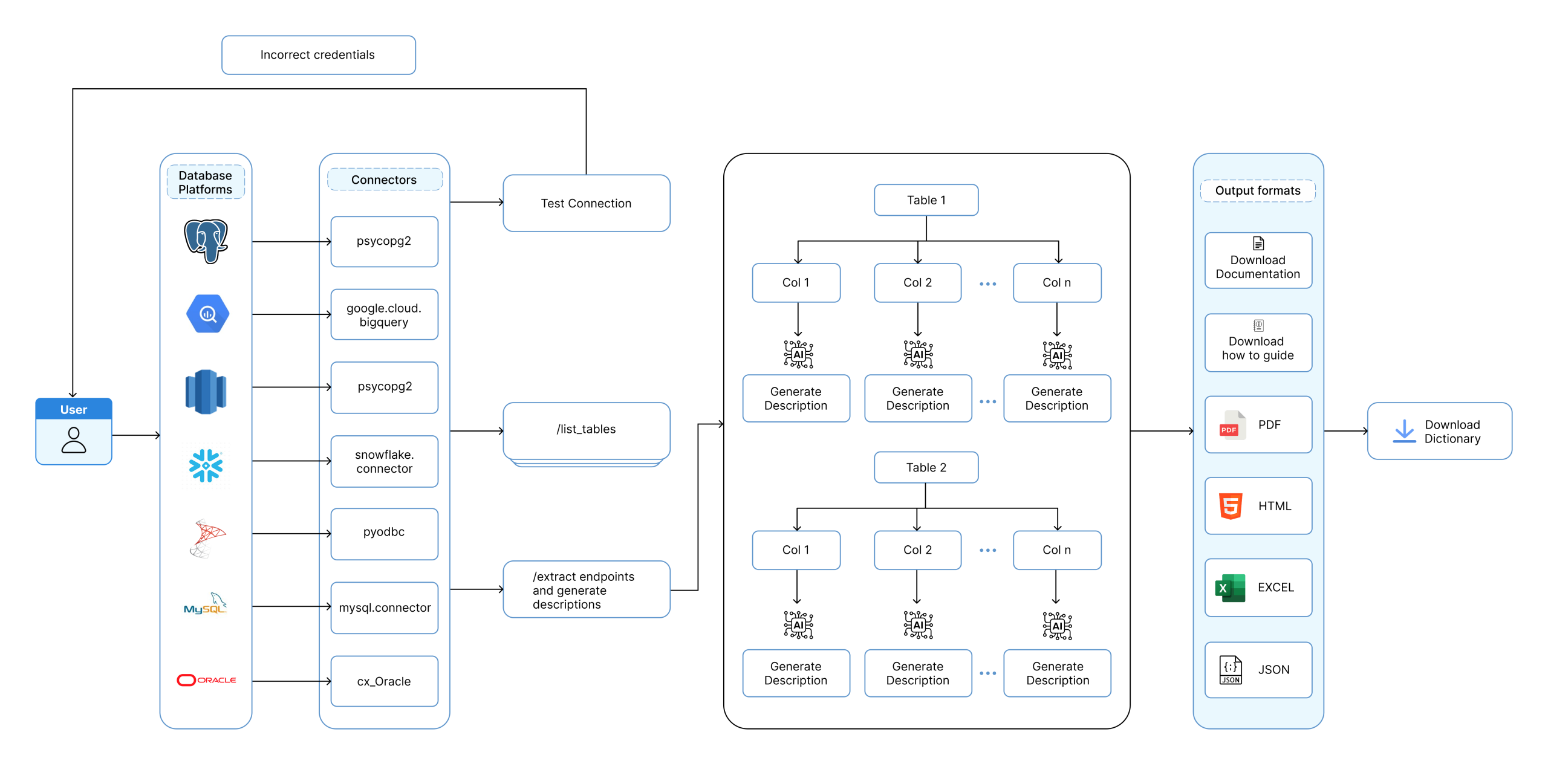
Modern enterprises generate vast amounts of structured and unstructured data across diverse systems. However, most organizations struggle to understand what data exists, how it’s structured, and how it can be used to drive value. Traditional metadata documentation is manual, inconsistent, and reactive slowing analytics, creating compliance risks, and hiding critical insights.
This Proof of Concept introduces an AI-powered Data Dictionary that does much more than extract metadata. It connects directly to any database system, intelligently analyzes the data structure and samples, builds a complete data dictionary, tags PII, and even creates functional business documentation that explains how data can be leveraged for value creation.
The Challenge
- Metadata documentation remains a tedious, error-prone process.
- Teams lack unified visibility across data silos.
- Compliance and data governance rely on subjective interpretation.
- Business teams struggle to understand the purpose and value of data.
The Solution
The AI Data Dictionary is an intelligent platform that autonomously understands your enterprise data landscape. It directly connects to databases, analyzes schema and sample data, and automatically:
- Builds a comprehensive data dictionary.
- Tags PII fields for compliance.
- Profiles data quality and patterns.
- Generates human-readable functional documentation explaining each dataset’s business relevance.
Functional Workflow
- Direct Connection – Securely connect to any supported database using built-in connectors.
- Automated Understanding – AI models analyze schema, datatypes, and sample records to infer context.
- Intelligent Documentation – The system generates contextual descriptions, business definitions, and relationships.
- PII Detection & Data Profiling – Automatically identifies sensitive fields and provides statistical summaries.
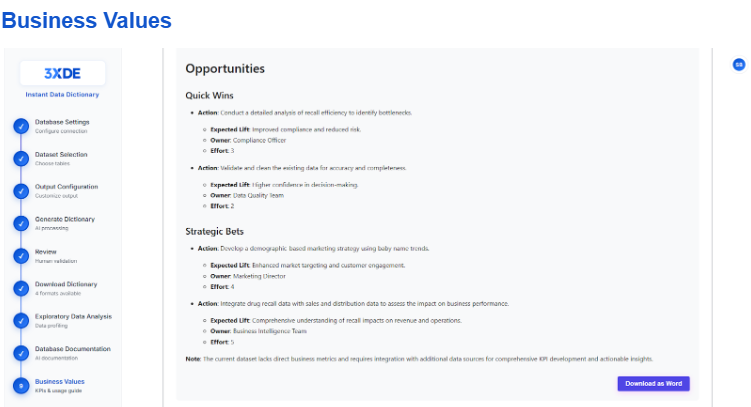
- Business Insights Generation – Suggests potential use cases and data-driven opportunities.
- Review & Export – View, refine, and export the entire documentation set in your preferred format.
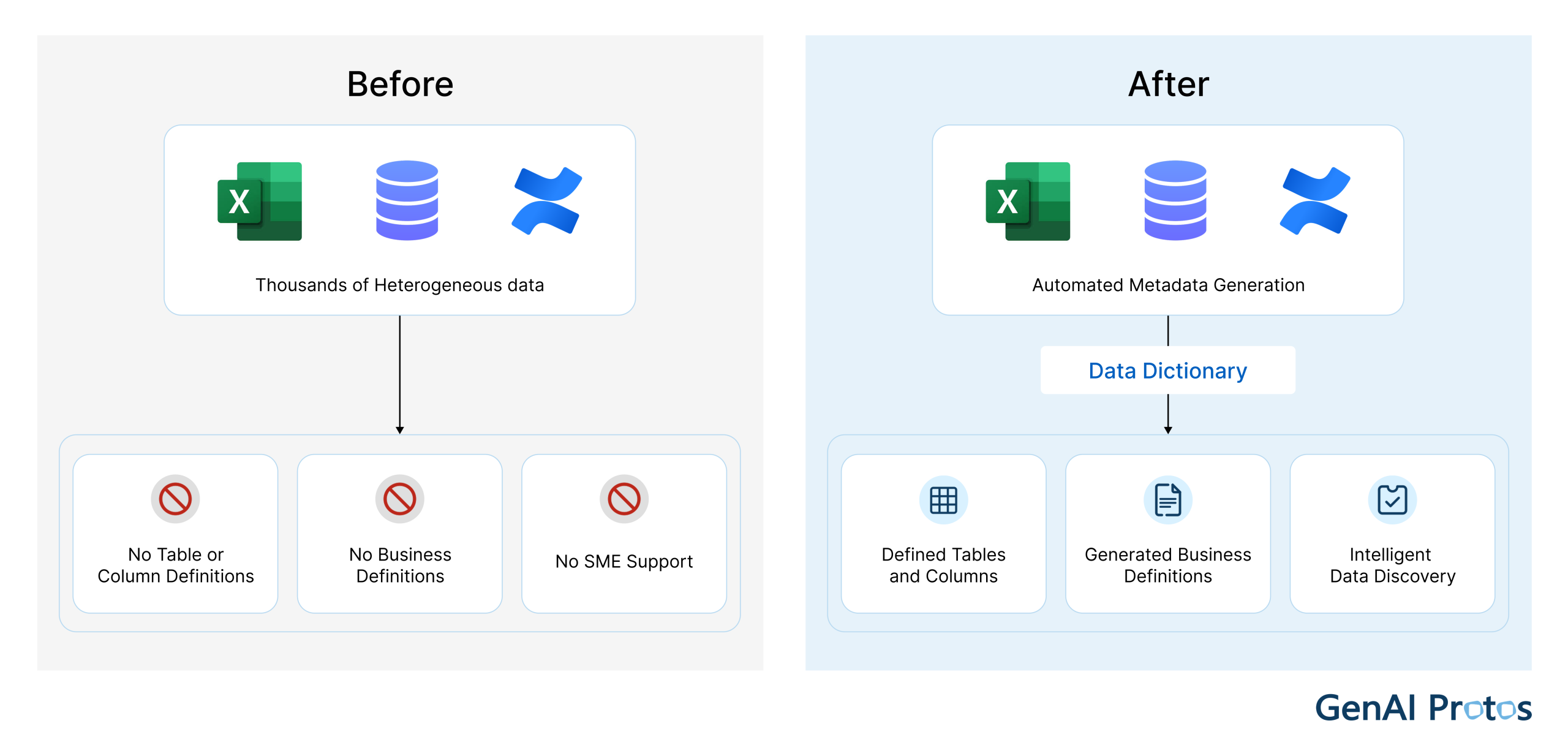
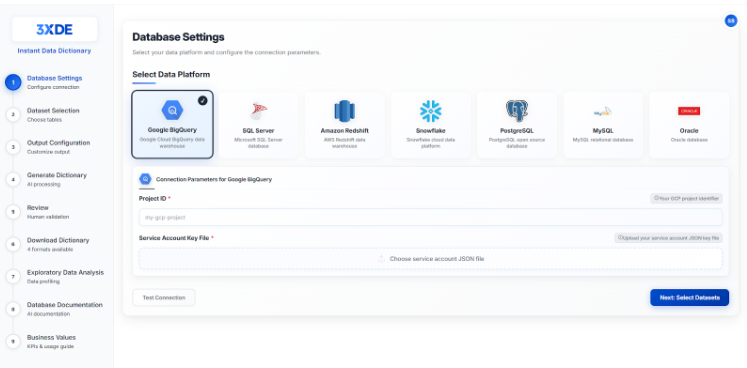
Intelligent Data Dictionary supports wide range of databases, including:
- MySQL
- PostgreSQL
- SQL Server
- Oracle
- Amazon Redshift
- Google BigQuery
- Snowflake
Database Connection Configuration – Selecting Database
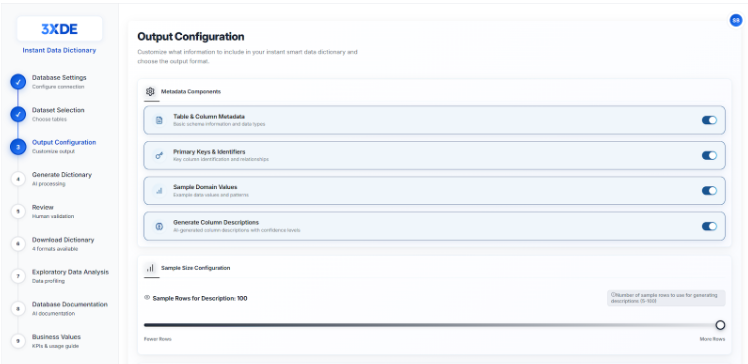
Output Configuration – Metadata and Sample Size Settings for Data Dictionary Generation
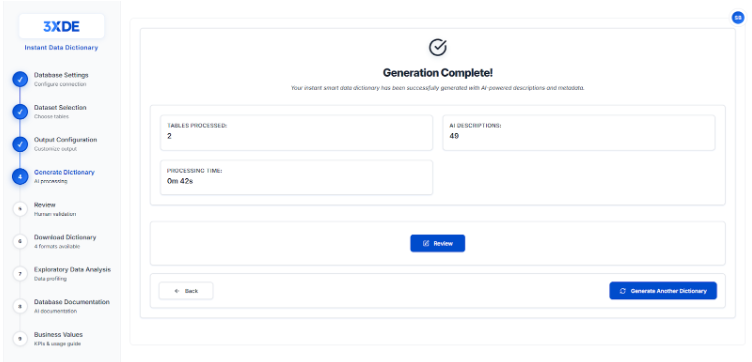
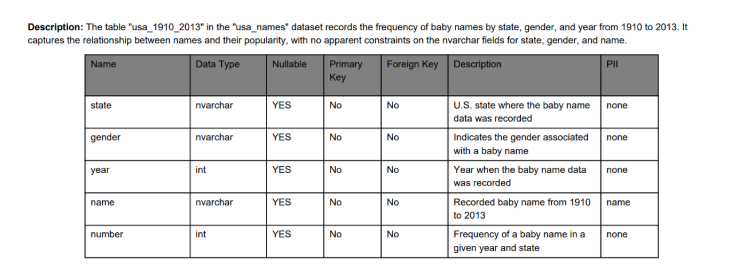
Data Dictionary – Generated
Core Capabilities
- Autonomous Data Understanding: Goes beyond metadata extraction to interpret data meaning and relationships.
- PII Identification: Flags sensitive attributes such as names, addresses, and contact details for compliance readiness.
- AI-Generated Functional Documentation: Converts raw technical structures into human-readable, business-friendly summaries.
- Exploratory Profiling: Provides data distribution, missing value analysis, and quality indicators.
- Business Insight Layer: Highlights how specific datasets can be leveraged for analytics, reporting, or decision-making.
- Unified Dashboard: Centralized view of all dictionaries with search, filtering, and collaboration capabilities.
- Multi-Database Connectivity: Compatible with MySQL, PostgreSQL, SQL Server, Oracle, Redshift, Snowflake, and BigQuery.
- Flexible Exports: Generate structured outputs in CSV, JSON, PDF, or HTML.
Business Impact
- Accelerates Data Discovery: Weeks of manual documentation reduced to minutes.
- Strengthens Compliance: Automated PII tagging and consistent metadata standards.
- Boosts Collaboration: Empowers analysts, engineers, and business users with shared, contextual understanding.
- Drives Data Monetization: Reveals data assets with potential business value and actionable insights.
- Improves Governance: Centralizes control and traceability for all data assets.
Technical Architecture
- Backend: Python, FastAPI, LangChain, Pandas, ydata-profiling.
- Frontend: React, Vite, Axios, Google OAuth for secure access.
- AI/LLM Stack: OpenAI, Anthropic, Groq, and HuggingFace for language-driven data interpretation.
- Integration Layer: Native database connectors for major relational and cloud platforms.
- Artifact Generation: ReportLab and python-docx for producing downloadable documentation artifacts.
Final Thoughts
This POC redefines what a Data Dictionary can be. Instead of a static catalog, it’s an intelligent system that understands, documents, and explains enterprise data autonomously. It bridges the gap between technical data assets and business understanding making data governance proactive, compliant, and value-driven.
Explore how our AI-powered accelerators can revolutionize your enterprise data landscape:
👉 www.3XDataEngineering.com
👉 www.GenAIProtos.com