Your associates are spending 4.2 hours reviewing a standard commercial agreement. The clauses are the same ones they reviewed last week. The risk flags are the same ones they will flag next week. The work is mechanical, repeatable, and expensive.
Legal AI does not replace the attorney judgment that makes a law firm valuable. It eliminates the mechanical layer that sits underneath that judgment and consumes most of the billing hours. That distinction matters, because it determines where you deploy, what you measure, and what ROI actually looks like.
This article covers what legal AI delivers in production contract review: specific outcomes from a live deployment, the architecture that produced them, where AI for lawyers earns its keep today, and what the evaluation framework looks like when you are choosing tools.
What Legal AI Does in Contract Review
Legal AI is a document intelligence layer that extracts, classifies, and risk-scores contract clauses at machine speed, so attorneys can focus time on the clauses that require judgment.
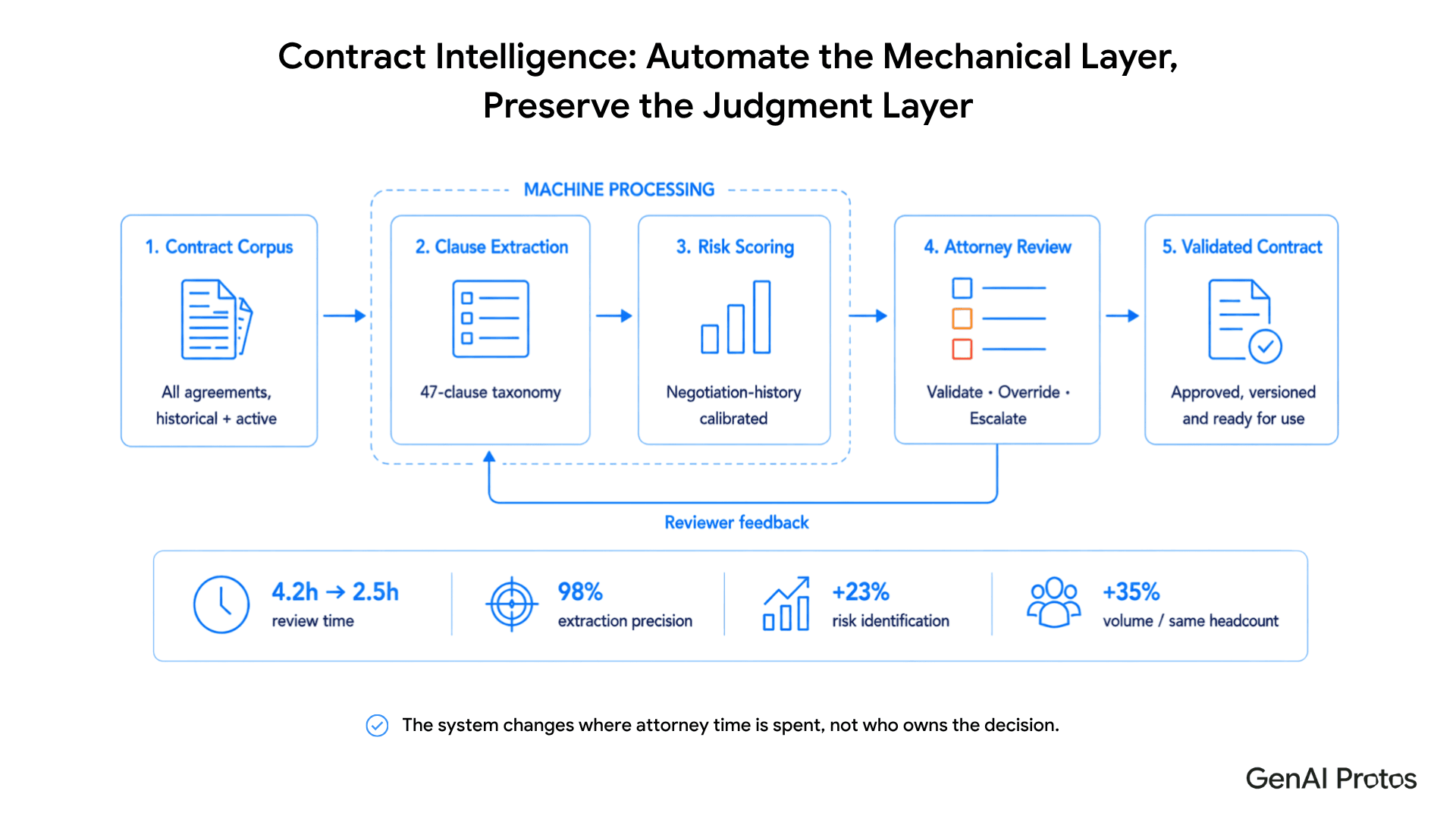
In a contract intelligence platform GenAI Protos deployed for a legal team processing thousands of agreements annually, the results were specific: review time dropped from 4.2 hours to 2.5 hours per document, clause extraction precision reached 98% across a 47-clause taxonomy, and the system identified 23% more risk flags than manual review alone. The same team handled 35% more contract volume without additional headcount.
Read the full case study: AI-Powered Contract Intelligence Platform → genaiprotos.com/case-studies/ai-powered-contract-intelligence-transforming-legal-document-review-with-genai/
Those numbers came from a system built on three layers: a clause extraction model trained on the client's specific contract corpus, a risk scoring engine calibrated against the firm's negotiation history, and a review interface embedded directly into the attorneys' existing document workflow. The AI did not replace the review. It restructured where attorney time went.
AI for Legal Research: From Hours to Minutes
AI for legal research uses retrieval-augmented generation (RAG) to surface relevant case law, statutory references, and precedent documents in response to natural language queries.
The practical impact: a research task that required two to three hours of case law review now returns an initial brief in four to seven minutes. The brief is not final. It is a structured starting point that the attorney validates, supplements, and frames for the client. The AI handles the retrieval and initial synthesis. The attorney handles the analysis and judgment.
Where this earns its keep: routine research on well-documented legal areas. Where it does not yet earn its keep: emerging regulatory areas with limited precedent, jurisdiction-specific nuances in underdeveloped case law, and any research task where the quality of the AI output cannot be verified against a known body of reliable sources.
AI for Lawyers: The Production Use Cases
AI for lawyers in production covers five areas where the economics are clear and the accuracy benchmarks are established.
Contract review and clause extraction. Legal research and case law synthesis. Due diligence document review for M&A and transactions. e-Discovery document classification and privilege review. Compliance monitoring against regulatory change feeds.
Outside these five, production deployments are rarer and the ROI evidence is thinner. Legal chatbots for client intake show promise but have higher error rates on complex matters. Predictive litigation analytics are useful for directional guidance but not reliable enough to drive case strategy. Document drafting AI produces useful first drafts but requires significant attorney review for anything beyond standard forms.
The boundary is not permanent. But building a deployment strategy on today's production capabilities, not tomorrow's roadmap, is the safer approach.
AI for Law Firms: The Evaluation Framework
The question law firms consistently ask wrong: "Which AI tool is best?" The right question: "What is the specific task, volume, and accuracy threshold we need to meet?"
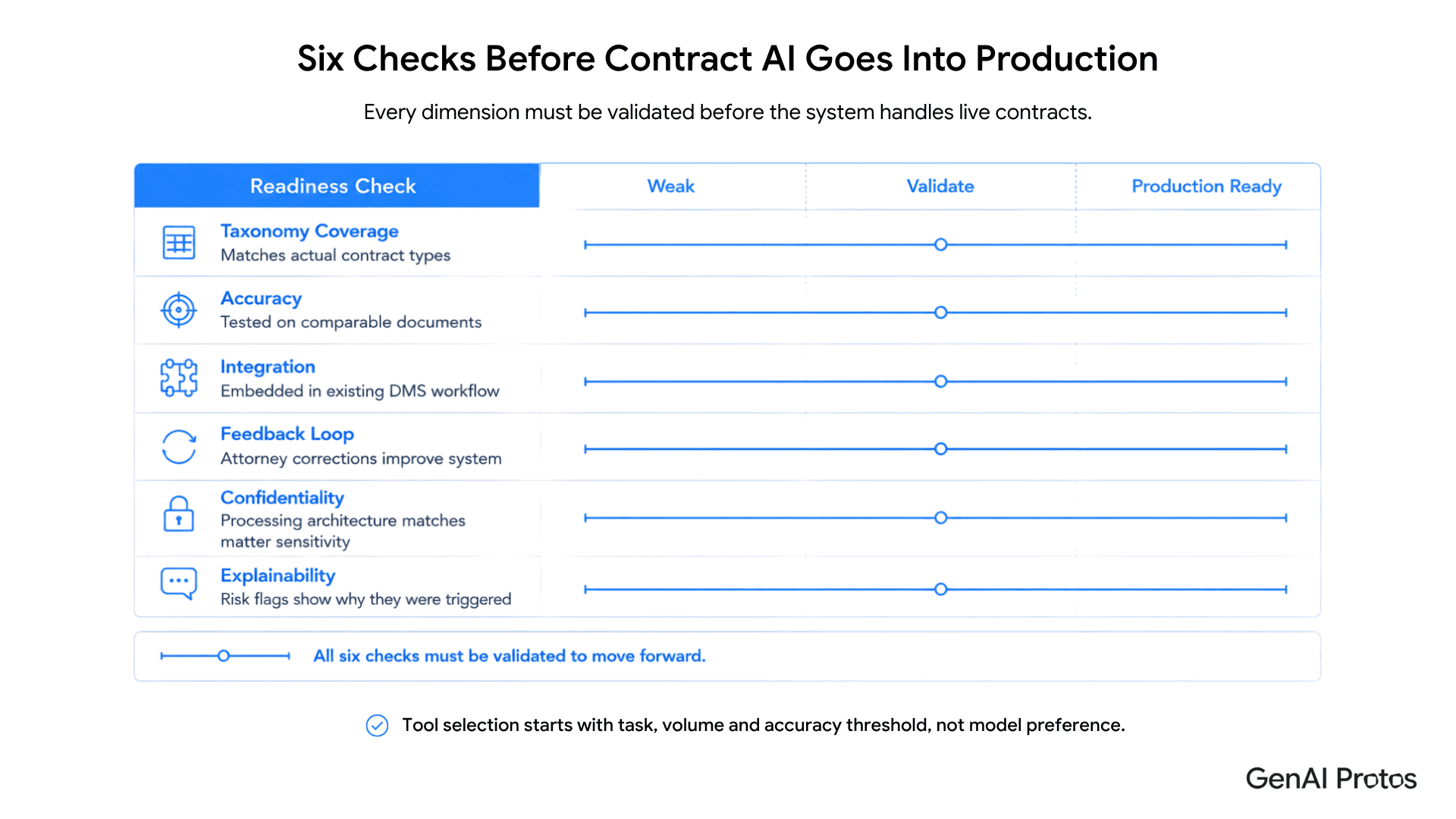
Six criteria matter when evaluating AI for law firms:
Clause taxonomy coverage.
Does the system's extraction model cover your contract types? A generic model trained on public contracts performs significantly worse on specialized agreements, construction contracts, or cross-border deals than a model fine-tuned on your corpus.
Accuracy at your document complexity level.
Vendors report accuracy on benchmark datasets. Ask for accuracy data on documents similar to yours. The gap is often 15 to 25 percentage points.
Integration depth.
Does the tool connect to your document management system, or does it require a separate workflow? Tools that require attorneys to leave their primary environment see adoption rates below 30%.
Attorney feedback loop.
Can attorneys flag incorrect extractions and have that feedback improve the model? Systems without a feedback mechanism drift over time as your contract mix evolves.
Data privacy and confidentiality architecture.
Where do documents go when processed? Client confidentiality requirements may prohibit third-party cloud processing for certain matter types.
Explainability of risk flags.
Attorneys need to understand why a clause was flagged, not just that it was. Systems that produce risk scores without explanations are not useful in attorney workflow.
Legal AI Tools: What Teams Get Wrong
The most common mistake:
Deploying a general-purpose LLM for contract review without domain-specific fine-tuning or clause taxonomy calibration.
General LLMs produce plausible-sounding clause summaries. They are not reliable at consistent 47-clause extraction across thousands of documents. The difference between a general LLM and a fine-tuned contract intelligence model is not marginal at scale. It is the difference between 72% clause recall and 98% clause recall. In contract review, that gap has material risk consequences.
The second mistake:
Measuring adoption rather than accuracy. A system that attorneys use but trust incorrectly is worse than a system they do not use. Baseline clause extraction accuracy before go-live and track it monthly. If it degrades, the training data is drifting from your actual contract mix.
The third mistake:
Not running in shadow mode for six to eight weeks before going live. Shadow mode allows the system to produce outputs that attorneys review and validate, without those outputs entering the official review record. This calibration period is where you catch taxonomy gaps, jurisdiction edge cases, and confidence threshold issues before they affect client work.
CONCLUSION
Retail AI built on real-time unified intent delivers measurable revenue results. The 35% uplift is not a benchmark number. It is a production outcome from a specific architecture. The difference between that outcome and a failed personalization project is not the AI model. It is the data layer, the signal richness, and the fulfilment coordination. If your retail personalization is running on purchase history alone, you are leaving a significant revenue gap on the table. The AI to close it exists. The data infrastructure to feed it is the work. Explore how we build real-time retail AI platforms at GenAI Protos


