Loading...
What Are On-Demand AI Labs & R&D Services?
On-Demand AI Labs & R&D Services provide enterprises with a dedicated AI experimentation and validation capability without the cost of building an internal research team. Through structured AI experiments, LLM evaluations, architecture benchmarking, feasibility assessments, and proof-of-value testing, organizations can validate AI use cases, compare technologies, and reduce implementation risk before committing to full-scale AI development.
Start Your AI Lab Engagement
Ready to Validate Your AI Initiative Before You Build It?
Reduce uncertainty before investing in AI development. Our AI Labs help you evaluate models, test architectures, validate use cases, and generate evidence-backed recommendations so you can move forward with confidence.
AI consulting produces recommendations based on analysis and expertise. An AI lab service produces evidence based on controlled experimentation. The difference matters for enterprise decision-making because evidence is testable, reproducible, and defensible to investment committees in a way that advisory recommendations are not. Our lab engagements deliver benchmark data, comparative evaluation results, and documented failure modes, not slide decks with strategic guidance.
Q1. How is an AI lab service different from AI consulting?
A proof of concept demonstrates that an AI technology can function in a given context. AI experimentation tests whether a specific approach performs at the level required for production value, across multiple candidate models or architectures, against your actual data and operational constraints. A proof of concept answers "does it work?" An AI experimentation engagement answers "which approach works best, at what performance level, and does that performance level justify building it?"
Q2. What is the difference between AI experimentation and a proof of concept?
Yes. Private AI experimentation is a core capability of our lab service. We run AI experiments entirely within your controlled on-premise infrastructure, with no data transmitted to external services at any stage of the engagement. This is specifically designed for healthcare, financial services, legal, and government use cases where sensitive data cannot be processed through public cloud infrastructure even for testing purposes.
Q3. Can you run AI experiments in a private or air-gapped environment?
Every engagement delivers a structured findings report covering: the experimental design and success criteria, the methodology used, results for each candidate model or architecture evaluated, a comparative analysis, documented failure modes for every tested approach, and an explicit recommendation with the evidence supporting it. For proof-of-value engagements, the report also includes validated performance metrics against your operational baseline.
Q4. What does a typical AI lab engagement produce?
A focused feasibility assessment or model evaluation covering one use case typically takes two to four weeks from scoping to findings report. A structured proof-of-value engagement covering prototype build, controlled testing, and performance validation typically takes four to eight weeks. Architecture benchmarking engagements covering multiple candidate designs are scoped based on the number of variants under evaluation and the complexity of the testing environment.
Q5. How long does an on-demand AI lab engagement take?
FAQ
Start Your Roadmap
primary
Validate AI with confidence before you invest. We design and run enterprise AI experiments, model evaluations, architecture benchmarks, and feasibility assessments that replace assumptions with evidence. Helping you make faster, lower-risk AI decision.
https://cdn.sanity.io/images/qdztmwl3/production/e810be3d3f479bada00df31b6927d2ef64f35184-9925x7135.png
On-Demand AI Labs & R&D Services for Enterprise
89bac0a20163
Healthcare organisations validating AI for clinical documentation, medical record intelligence, diagnostic assistance, and operational workflow automation require experimentation in private environments where patient data never leaves controlled infrastructure. We run HIPAA-aware AI validation engagements on private on-premise hardware, covering model evaluation, accuracy benchmarking, and feasibility assessment for clinical AI use cases where public cloud testing is not an option.
https://www.genaiprotos.com/industry/healthcare/
Healthcare
bac5514b57ea
Financial institutions evaluating AI for document processing, regulatory compliance, fraud detection, and customer service automation require AI experimentation environments where transaction and customer data remains within their governed infrastructure. We run AI validation engagements for financial services organisations under GDPR, FCA, and EU AI Act frameworks, covering model evaluation, architecture benchmarking, and proof-of-value testing for regulated financial AI applications.
https://www.genaiprotos.com/industry/finance/
Financial Services
f3f66cf282ad
Law firms and legal departments evaluating AI for contract review, legal research, e-discovery, and document intelligence require air-gapped experimentation environments where client-privileged data cannot leave controlled infrastructure under any circumstances. We run AI feasibility assessments and LLM evaluations for legal AI use cases in fully isolated lab environments, without any data transmitted to external services at any stage of the engagement.
https://www.genaiprotos.com/industry/legal/
Legal
851075bbe49c
Manufacturing organisations evaluating AI for predictive maintenance, quality control, production monitoring, and process optimisation require experimentation on edge hardware designed for industrial deployment environments. We run AI validation and feasibility assessments for manufacturing use cases on ruggedised edge platforms, testing model performance under real operating conditions including intermittent connectivity and constrained compute budgets.
https://www.genaiprotos.com/industry/retail/
Manufacturing and Industrial
6d5e39059cfe
Software engineering organisations evaluating AI for code generation, automated testing, documentation, and developer tooling require AI experimentation environments where proprietary codebase data cannot leave internal infrastructure. We run private AI lab engagements for software engineering use cases, covering LLM evaluation on internal codebases and architecture benchmarking for AI-assisted development tooling.
https://www.genaiprotos.com/industry/software-engineering/
Software Engineering
Industries We Serve
Our AI experimentation and validation engagements span regulated industries and operationally demanding environments where evidence-based AI decision-making is a requirement, not a preference.
On-Demand AI Labs & Experimentation
Most enterprise AI projects fail not because the technology is wrong, but because the decision to build was made before anyone tested whether it would work. The architecture was assumed. The model was assumed. The feasibility was assumed. On-demand AI labs and R&D services exist to eliminate that assumption from your AI programme before capital is committed.
GenAI Protos operates as an on-demand AI experimentation and validation partner for enterprises that need evidence before investment. We design and run structured AI experiments covering model evaluation, architecture benchmarking, use case feasibility testing, LLM evaluation, and proof-of-value validation, across private AI environments, edge deployments, and cloud infrastructure, depending on your requirements.
The output of every engagement is not a strategy document. It is tested, benchmarked evidence that tells you whether a specific AI capability works in your environment, on your data, within your operational constraints, before a single line of production code is written.
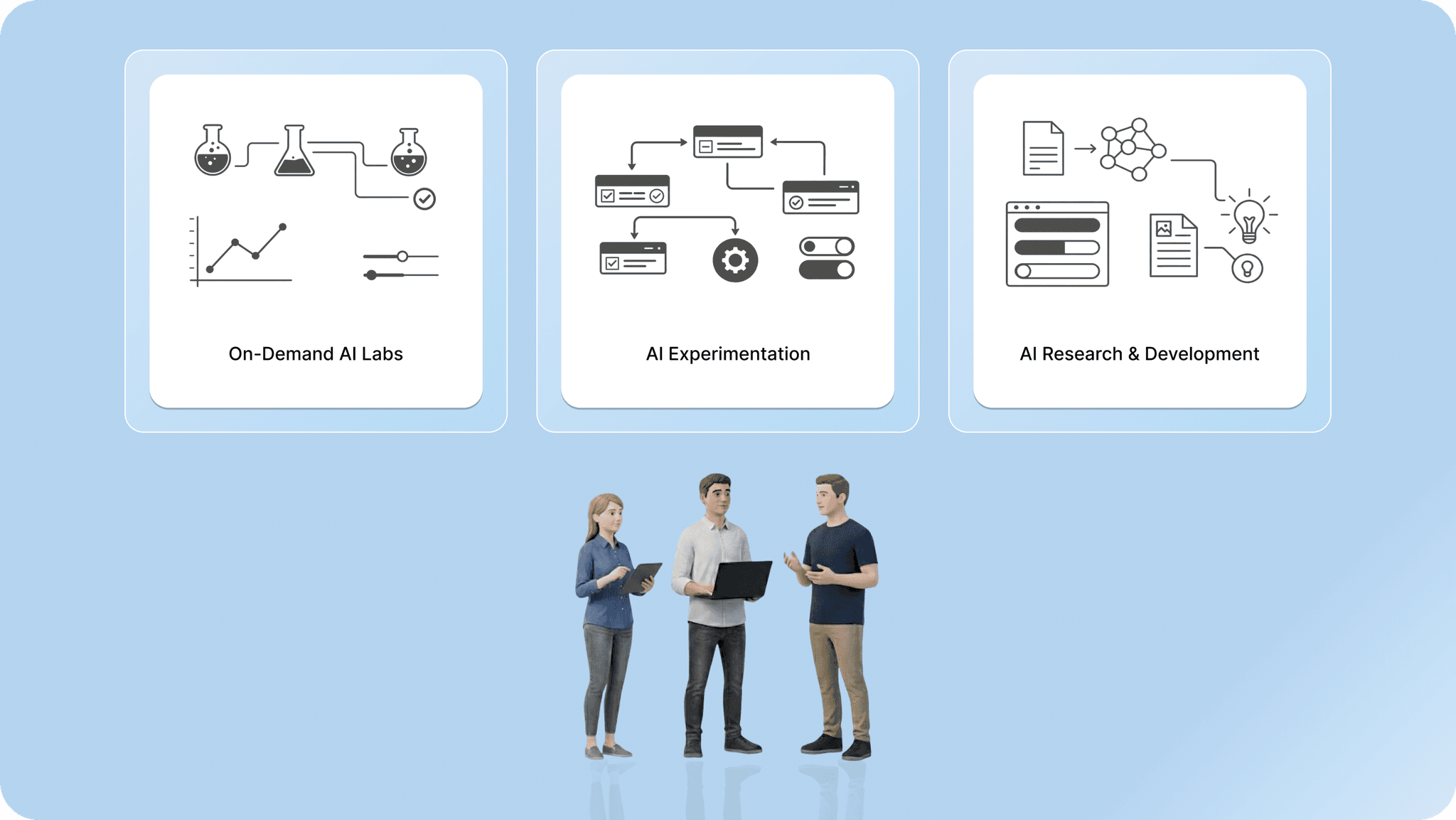
GenAI Protos delivers on-demand AI labs and R&D services for enterprises, covering AI experimentation, model validation, use case feasibility, and architecture evaluation
On-Demand AI Labs & R&D Services | GenAI Protos
De-risk enterprise AI with On-Demand AI Labs & R&D Services. Test feasibility, compare AI models, and validate solutions before investing.
https://cdn.sanity.io/images/qdztmwl3/production/2fddd0442a11ef45c755936bd6c6348165246fed-1731x909.png
Validate AI ideas, benchmark LLMs, test architectures, and prove business value before full-scale development.
LucideRoute
Difficulty turning AI ideas into a clear plan.
Unclear AI Roadmap
UserLock
No dedicated team for AI research or experimentation.
Limited Internal R&D Capacity
Workflow
Unclear choice between LLMs, SLMs, open, or proprietary models.
Model Selection Uncertainty
Layers3
Uncertainty around on-prem, private, or cloud setups.
Architecture Confusion
ShieldCheckIcon
Compliance requirements limit safe experiments.
Privacy & Regulatory Constraints
LucideLock
Wrong early choices lead to costly rework.
Early Technology Lock-In Risk
ChartLine
Hard to prove accuracy, performance, and value u
Unproven Feasibility & ROI
Why Enterprise AI Initiatives Fail Before They Start
The problem is not the technology. It is the decision to build before anyone validated whether the technology would actually perform.
1594098f9701
We begin by translating your AI initiative question into a precise experimental specification. This covers the hypothesis being tested, the evaluation metrics that will determine success or failure, the data environment the experiment will run in, the baseline it will be measured against, and the decision it is intended to support. An experiment without a defined success criterion produces noise, not evidence. No test runs before the design is agreed.
Experiment Design and Success Criteria Definition
1ed232988c9d
We configure the lab environment appropriate for your experiment, whether that is a private on-premise environment for sensitive data, a controlled cloud environment for general evaluation, or an edge hardware environment for on-device testing. Data is prepared, sanitised where necessary, and validated for representative coverage before experimentation begins.
Environment Configuration and Data Preparation
617c3a2dea7e
Experiments are run in controlled conditions with systematic variation of the parameters under evaluation. For model evaluation, this means consistent prompting strategies, identical data inputs, and standardised evaluation criteria across every candidate. For architecture evaluation, this means consistent load profiles, identical integration environments, and documented configuration across every tested variant. Results are logged, version-controlled, and reproducible.
Controlled Experimentation and Benchmarking
abee5651b377
Raw experiment results are analysed against your defined success criteria. Failure modes are documented as rigorously as successes, because understanding where and why a candidate approach fails is as commercially valuable as identifying the one that works. For enterprise decision-making purposes, a well-documented failure is preferable to an undocumented partial success.
Analysis, Interpretation, and Failure Documentation
31bd36f3458c
Every engagement closes with a structured findings report covering experiment design, methodology, results by candidate, comparative analysis, documented failure modes, and an explicit recommendation. The recommendation is binary where possible: this approach is viable for production development, or it is not, with the evidence that supports that position documented in full.
Findings Report and Recommendation
The following engagements represent the range of experimentation and validation work delivered by the GenAI Protos AI lab team.
Our AI Experimentation Methodology
What We Deliver
Strategic Planning
Business Alignment
Define a practical, experiment-driven AI roadmap aligned to business goals and technical constraints.
AI Roadmap & Prioritization
Infrastructure Testing
Cloud & Hybrid AI
Evaluate and compare on-prem, private, hybrid, and cloud AI architectures through real tests.
Architecture Experimentation & Validation
Model Evaluation
Performance Optimization
Benchmark and validate models (LLMs, SLMs, fine-tuned variants) to choose the best fit.
Model Benchmarking & Selection
Technical Validation
Integration Testing
Run experiments to prove technical feasibility, performance, and integration viability.
Feasibility Testing & Technical Proofs
Data Strategy
Privacy & Synthetic Data
Test data strategies including real, synthetic, and privacy-preserving approaches for training/testing.
Data Strategy & Synthetic Data Experiments
Knowledge Transfer
Team Enablement
Run sessions with your team to explain experiments, findings, and recommended paths for production
Technical Workshops & Handover Sessions
Structured experimentation and validation across every major AI decision point, from initial feasibility through to production readiness.
AI Experiments and Validations We Have Delivered

https://cdn.sanity.io/images/qdztmwl3/production/9b6ae4337c4df57954c56706d10af46486f43743-12x12.svg
https://cdn.sanity.io/images/qdztmwl3/production/5cc8e86e2eb78c36ad19674e51dd7075926a1634-12x12.svg
https://cdn.sanity.io/images/qdztmwl3/production/5c51d89c7dd5d04589eac811bc5b5c6eb86e0c87-24x24.svg
Clinical AI
SLM
Healthcare Automation
NVIDIA DGX Spark
Protocol Compliance
Privacy-First
Fine-Tuned Model
A fine-tuned Small Language Model that converts unstructured clinical visit notes into protocol-compliant summaries in under one minute, deployed securely on NVIDIA DGX Spark for complete data privacy.

Clinical Trial Assistant
https://cdn.sanity.io/images/qdztmwl3/production/056b2908dc880dda0cebc052f9db10ccce0d310e-512x512.svg
https://cdn.sanity.io/images/qdztmwl3/production/f02d3d00f554a053989381fdd658a22d1cad0b33-512x512.svg
Enterprise Search
Medical AI
Vector Database
On-Premises
Document Search
Spark Vault is a secure, on-premises enterprise search solution for medical documents on NVIDIA DGX Spark, combining containerized AI models and vector databases for rapid, private searches without cloud dependency.
Spark Vault
https://cdn.sanity.io/images/qdztmwl3/production/158aea33dbc784254d83e64f099b03457e61265e-12x12.svg
https://cdn.sanity.io/images/qdztmwl3/production/5552a61568665ac47d821bee683e920cb396396f-512x512.svg
Synthetic Data
Healthcare Data
Privacy-Preserving
HIPAA Compliance
Model Training
Data Augmentation
Regulatory Safe
AI-powered platform generating realistic patient records with medical reports, demographics, images, and professional PDFs at scale for ML training, testing, and demos without privacy or compliance concerns.
Synthetic Data Generation Strategy
Book a Free Technical Consultation
Ready to Validate Your AI Initiative?
Don't commit to AI based on assumptions. Validate your models, architecture, and business use case with structured experimentation before investing in production development.
Validate AI with confidence before you invest. We design and run enterprise AI experiments, model evaluations, architecture benchmarks, and feasibility assessments that replace assumptions with evidence. Helping you make faster, lower-risk AI decision.

Most enterprise AI projects fail not because the technology is wrong, but because the decision to build was made before anyone tested whether it would work. The architecture was assumed. The model was assumed. The feasibility was assumed. On-demand AI labs and R&D services exist to eliminate that assumption from your AI programme before capital is committed.
GenAI Protos operates as an on-demand AI experimentation and validation partner for enterprises that need evidence before investment. We design and run structured AI experiments covering model evaluation, architecture benchmarking, use case feasibility testing, LLM evaluation, and proof-of-value validation, across private AI environments, edge deployments, and cloud infrastructure, depending on your requirements.
The output of every engagement is not a strategy document. It is tested, benchmarked evidence that tells you whether a specific AI capability works in your environment, on your data, within your operational constraints, before a single line of production code is written.
On-Demand AI Labs & R&D Services provide enterprises with a dedicated AI experimentation and validation capability without the cost of building an internal research team. Through structured AI experiments, LLM evaluations, architecture benchmarking, feasibility assessments, and proof-of-value testing, organizations can validate AI use cases, compare technologies, and reduce implementation risk before committing to full-scale AI development.
The problem is not the technology. It is the decision to build before anyone validated whether the technology would actually perform.
Structured experimentation and validation across every major AI decision point, from initial feasibility through to production readiness.
Leveraging cutting-edge AI frameworks and platforms for robust experimentation.
The following engagements represent the range of experimentation and validation work delivered by the GenAI Protos AI lab team.
Our AI experimentation and validation engagements span regulated industries and operationally demanding environments where evidence-based AI decision-making is a requirement, not a preference.
Healthcare organisations validating AI for clinical documentation, medical record intelligence, diagnostic assistance, and operational workflow automation require experimentation in private environments where patient data never leaves controlled infrastructure. We run HIPAA-aware AI validation engagements on private on-premise hardware, covering model evaluation, accuracy benchmarking, and feasibility assessment for clinical AI use cases where public cloud testing is not an option.
Financial institutions evaluating AI for document processing, regulatory compliance, fraud detection, and customer service automation require AI experimentation environments where transaction and customer data remains within their governed infrastructure. We run AI validation engagements for financial services organisations under GDPR, FCA, and EU AI Act frameworks, covering model evaluation, architecture benchmarking, and proof-of-value testing for regulated financial AI applications.
Law firms and legal departments evaluating AI for contract review, legal research, e-discovery, and document intelligence require air-gapped experimentation environments where client-privileged data cannot leave controlled infrastructure under any circumstances. We run AI feasibility assessments and LLM evaluations for legal AI use cases in fully isolated lab environments, without any data transmitted to external services at any stage of the engagement.
Manufacturing organisations evaluating AI for predictive maintenance, quality control, production monitoring, and process optimisation require experimentation on edge hardware designed for industrial deployment environments. We run AI validation and feasibility assessments for manufacturing use cases on ruggedised edge platforms, testing model performance under real operating conditions including intermittent connectivity and constrained compute budgets.
Software engineering organisations evaluating AI for code generation, automated testing, documentation, and developer tooling require AI experimentation environments where proprietary codebase data cannot leave internal infrastructure. We run private AI lab engagements for software engineering use cases, covering LLM evaluation on internal codebases and architecture benchmarking for AI-assisted development tooling.
The following engagements represent the range of experimentation and validation work delivered by the GenAI Protos AI lab team.
We begin by translating your AI initiative question into a precise experimental specification. This covers the hypothesis being tested, the evaluation metrics that will determine success or failure, the data environment the experiment will run in, the baseline it will be measured against, and the decision it is intended to support. An experiment without a defined success criterion produces noise, not evidence. No test runs before the design is agreed.
We configure the lab environment appropriate for your experiment, whether that is a private on-premise environment for sensitive data, a controlled cloud environment for general evaluation, or an edge hardware environment for on-device testing. Data is prepared, sanitised where necessary, and validated for representative coverage before experimentation begins.
Experiments are run in controlled conditions with systematic variation of the parameters under evaluation. For model evaluation, this means consistent prompting strategies, identical data inputs, and standardised evaluation criteria across every candidate. For architecture evaluation, this means consistent load profiles, identical integration environments, and documented configuration across every tested variant. Results are logged, version-controlled, and reproducible.
Raw experiment results are analysed against your defined success criteria. Failure modes are documented as rigorously as successes, because understanding where and why a candidate approach fails is as commercially valuable as identifying the one that works. For enterprise decision-making purposes, a well-documented failure is preferable to an undocumented partial success.
Every engagement closes with a structured findings report covering experiment design, methodology, results by candidate, comparative analysis, documented failure modes, and an explicit recommendation. The recommendation is binary where possible: this approach is viable for production development, or it is not, with the evidence that supports that position documented in full.

Don't commit to AI based on assumptions. Validate your models, architecture, and business use case with structured experimentation before investing in production development.
Everything you need to know about the services & billing

Reduce uncertainty before investing in AI development. Our AI Labs help you evaluate models, test architectures, validate use cases, and generate evidence-backed recommendations so you can move forward with confidence.