
At Microsoft Ignite 2025, Microsoft expanded and rebranded Azure AI Studio into a unified platform called Microsoft AI Foundry. Since then, CIOs and technology leaders have been fielding a consistent question: do we actually need this, and what does it do?
The documentation is dense. The marketing is ambitious. Most of the coverage written so far has been for developers, not the people making the platform investment decision. GenAI Protos builds on Microsoft AI Foundry for enterprise clients this is what decision-makers actually need to know.
What is Microsoft AI Foundry?
Microsoft AI Foundry is a unified, enterprise-grade platform on Azure for building, deploying, governing, and monitoring AI applications and agents at scale. Rather than requiring teams to stitch together separate Azure services for each AI project, Foundry brings model access, agent development, knowledge integration, security, compliance, and observability into a single managed environment.
For organisations with existing Microsoft Azure investment, it is the most integrated path to deploying enterprise AI. For those without that footprint, it warrants careful evaluation against alternatives.
Azure AI Foundry explained: how the platform is structured
The platform operates across three functional layers. Understanding what each layer does and what it replaces is the clearest way to see whether Foundry adds genuine value for your organization.
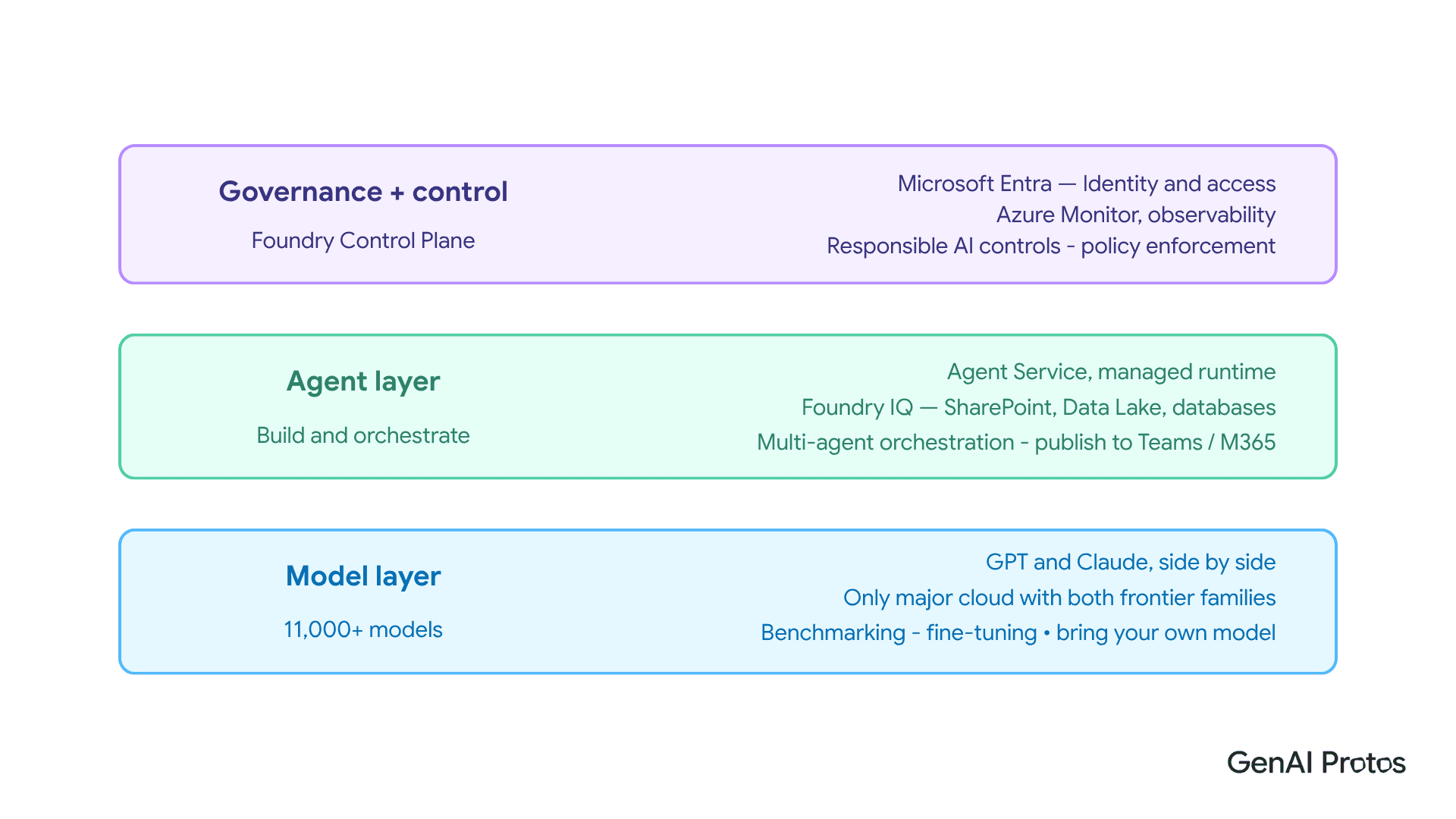
The Governance and Control layer provides organization-wide visibility across all AI assets through the Foundry Control Plane. It handles identity management through Microsoft Entra, real-time threat protection, Azure Monitor observability, and responsible AI controls. For regulated industries, this is the layer that makes enterprise AI deployment viable within compliance requirements.
The Agent layer is where AI systems get built and deployed. It includes the Agent Service (managed runtime for agent execution), Foundry IQ (which connects agents to enterprise data sources including SharePoint, Azure Data Lake, and databases), and multi-agent orchestration for complex workflows. Agents built here can be published to Microsoft Teams or Microsoft 365 with a single step.
The Model layer provides access to more than 11,000 models including both GPT and Claude side-by-side, with benchmarking, comparison, and fine-tuning within the same environment. Azure is currently the only major cloud platform where both frontier model families are available together.
Microsoft AI Foundry architecture: what actually gets built
The most significant architectural shift Foundry represents is the elimination of the custom integration layer. Previously, connecting an AI model to enterprise search, authentication systems, monitoring infrastructure, and deployment pipelines required bespoke development work at each connection point. Foundry handles these connections natively which is where much of the time saving comes from in practice.
For multi-agent workflows, Foundry provides both visual design tools and programmatic orchestration through SDKs. It also supports bring-your-own-model, so organizations with proprietary fine-tuned models can integrate them while still benefiting from Foundry's governance and observability infrastructure.
Building on Azure AI Foundry? GenAI Protos has delivered production systems on this platform.
Talk to our team about how we architect and deploy Foundry-based AI systems for enterprise clients.
Explore our Agentic AI expertise → genaiprotos.com/our-expertise/multi-agent
Microsoft AI Foundry pricing: what it actually costs
The platform is free to access and explore. Costs accrue at the deployment level across three categories: model inference (pay-per-token, varying significantly by model), fine-tuning (compute time and training tokens), and agent service compute including knowledge retrieval through Foundry IQ.
The honest guidance is that costs scale faster than most organisations anticipate when AI agents move from low-volume testing into production workloads. A system handling thousands of interactions per day each requiring multiple model calls accumulates costs that need careful modelling before go-live. Scoping those costs should be part of the architecture design process, not something addressed after deployment.
Azure AI Foundry use cases: what real businesses are building
Five real deployment patterns across different industries each one using Foundry's agent orchestration, data integration, and governance capabilities in ways that would require significant bespoke work on any other architecture:
Healthcare:
clinical documentation agents that process consultation notes, structure them against regulatory templates, and flag missing information before submission
Finance:
employee knowledge agents connected to policy documents, HR systems, and compliance libraries enabling accurate answers to complex operational questions without specialist escalation
Legal:
multi-agent contract review clause extraction, risk flagging, comparison against precedent libraries producing structured output for human review
Software engineering:
agents connected to Jira, GitHub, and documentation systems for conversational project management and automated PR summarisation
Retail:
operations agents synthesising inventory data, supplier information, and demand signals for AI-assisted analysis without multi-system querying
AI Foundry vs Copilot Studio: understanding the difference
This is the question most organisations hit early, and it matters because the answer shapes the build approach and the team that does the work.
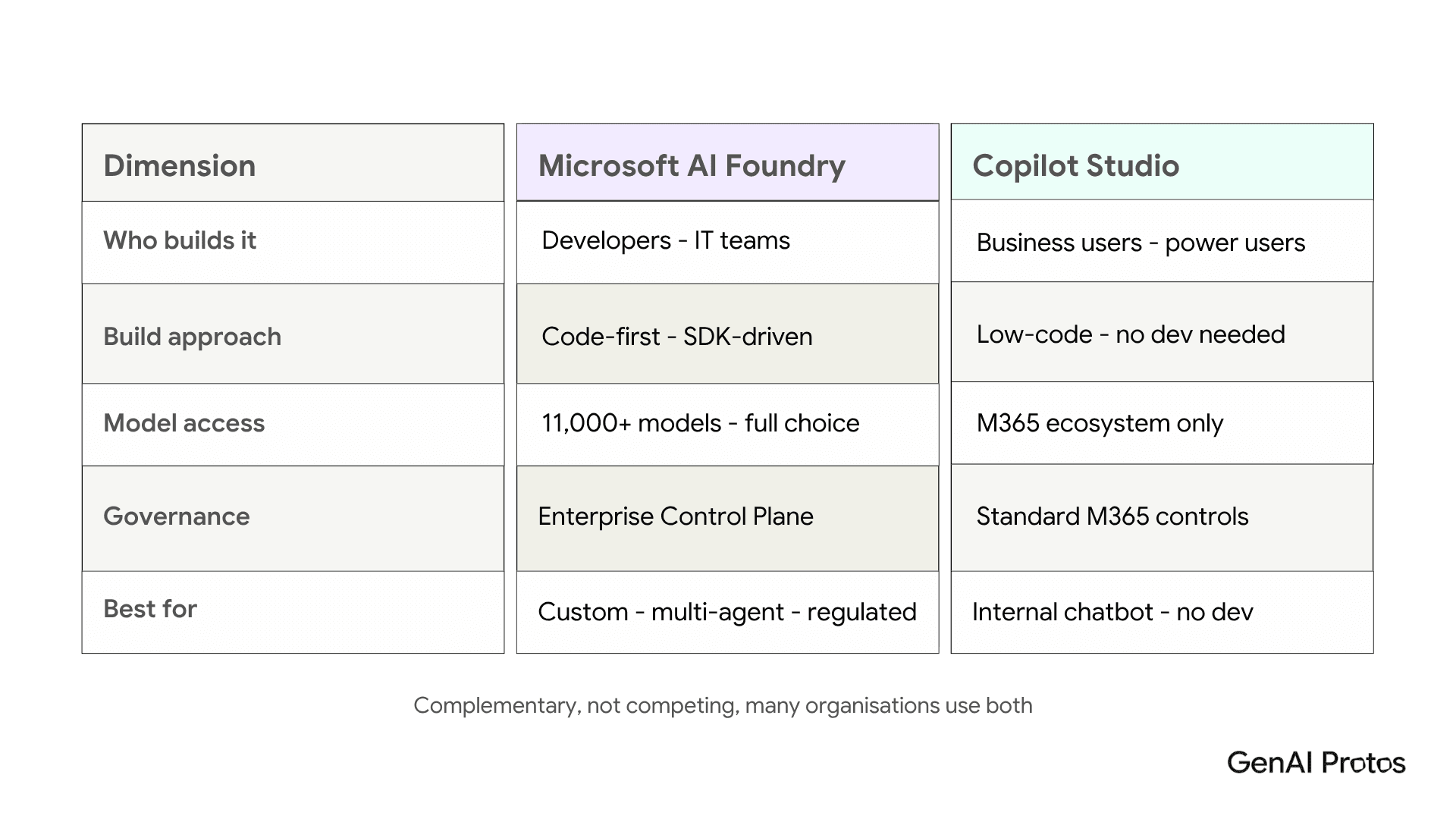
These platforms are complementary, not competing. Foundry is for developers and IT teams building production-grade custom AI systems with full model choice, architecture control, and enterprise governance. Copilot Studio is for business users who need to build low-code conversational assistants within the Microsoft 365 ecosystem without writing code.
Many organisations end up using both, for different purposes and different audiences. The question is which one fits the specific use case in front of you.
Does your business actually need Microsoft AI Foundry?
This is the question the blog is most honest about because the answer genuinely depends on your situation.
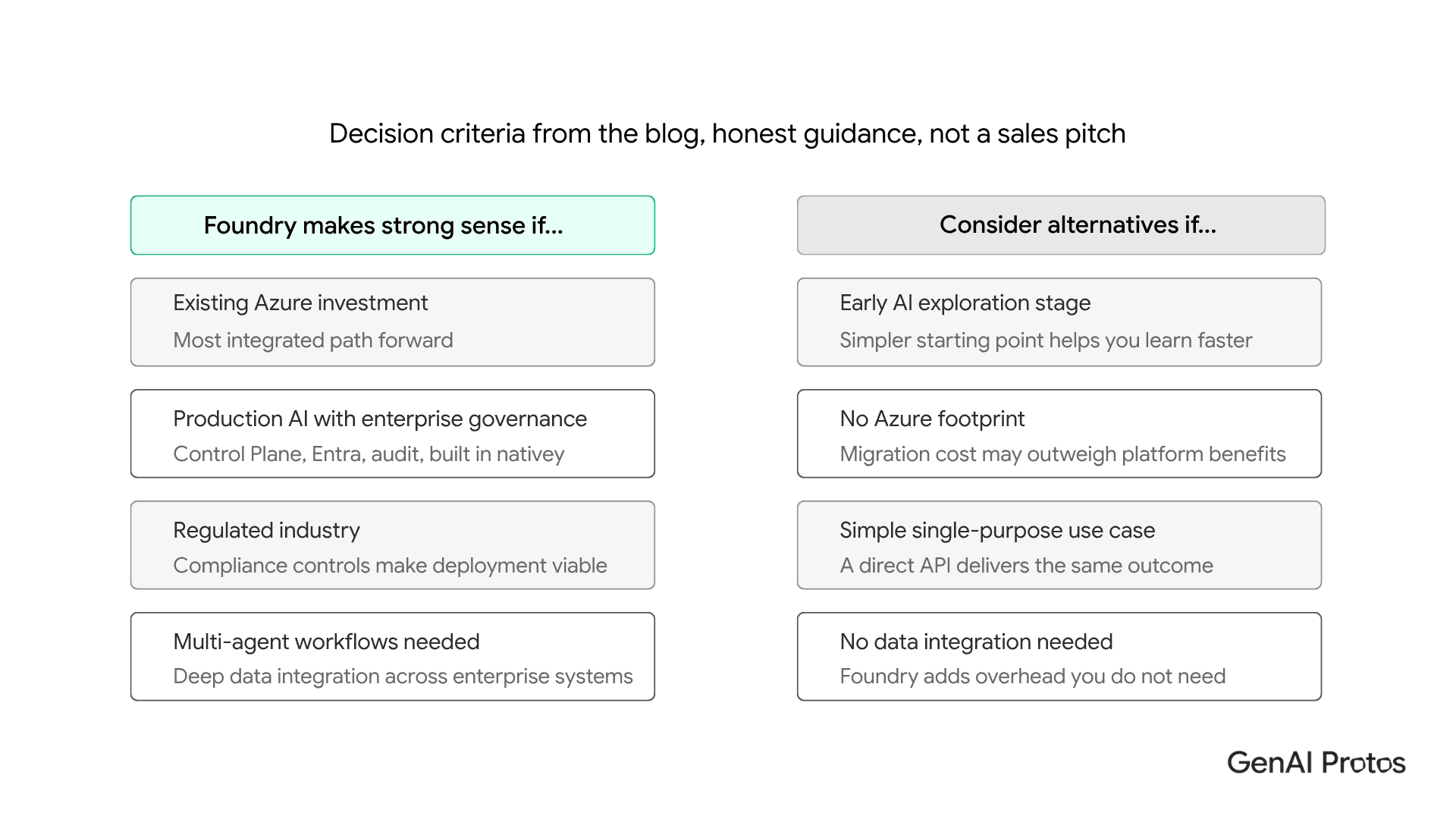
GenAI Protos is not commercially aligned with any single vendor. We have recommended Foundry to clients where it genuinely fits, and recommended simpler alternatives where it would add unnecessary complexity. The platform decision should follow the architecture decision define the problem, design the solution, then select the platform that best supports it in your specific environment.
Ready to build on Microsoft AI Foundry or find out if you should?
Talk to the GenAI Protos team. We assess your use case, your Microsoft environment, and the right architecture for your situation.
Book a meeting → genaiprotos.com/book-a-meeting


