
You evaluated three multi-agent frameworks in a weekend tutorial. All three worked. All three built the same demo pipeline. Now you need to pick one for a production workflow that runs code, calls APIs, persists state across hours, and recovers from infrastructure failures without restarting from scratch.
Framework selection based on tutorial ease does not survive production. The decisions that matter are: how does state persist across failures, what happens when a subordinate agent does not respond, how does token cost scale at 500 concurrent workflows, and who maintains the codebase in two years.
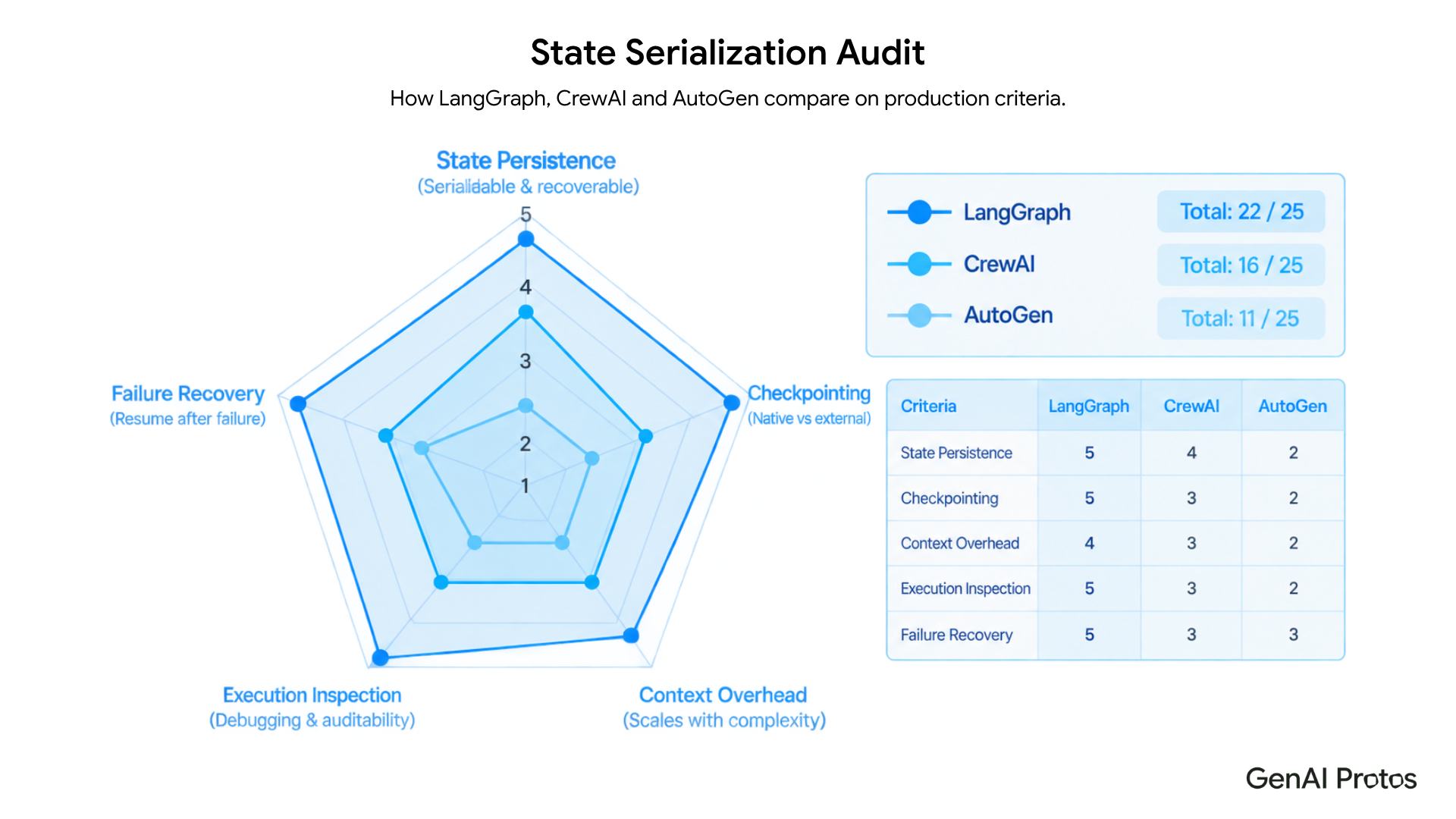
This guide applies the State Serialization Audit to LangGraph, CrewAI, and AutoGen the three multi-agent frameworks most deployed in enterprise production comparing them on the dimensions that determine whether a framework survives infrastructure failures, sustained load, and operational scrutiny. This is not a feature comparison. It is a production readiness evaluation.
The State Serialization Audit: What It Measures
The State Serialization Audit evaluates a framework on four production criteria: whether agent state is serializable and recoverable after a failure, whether the framework has native checkpointing or requires an external persistence layer, how conversation overhead scales with task complexity, and whether the execution graph is inspectable for debugging and compliance purposes.
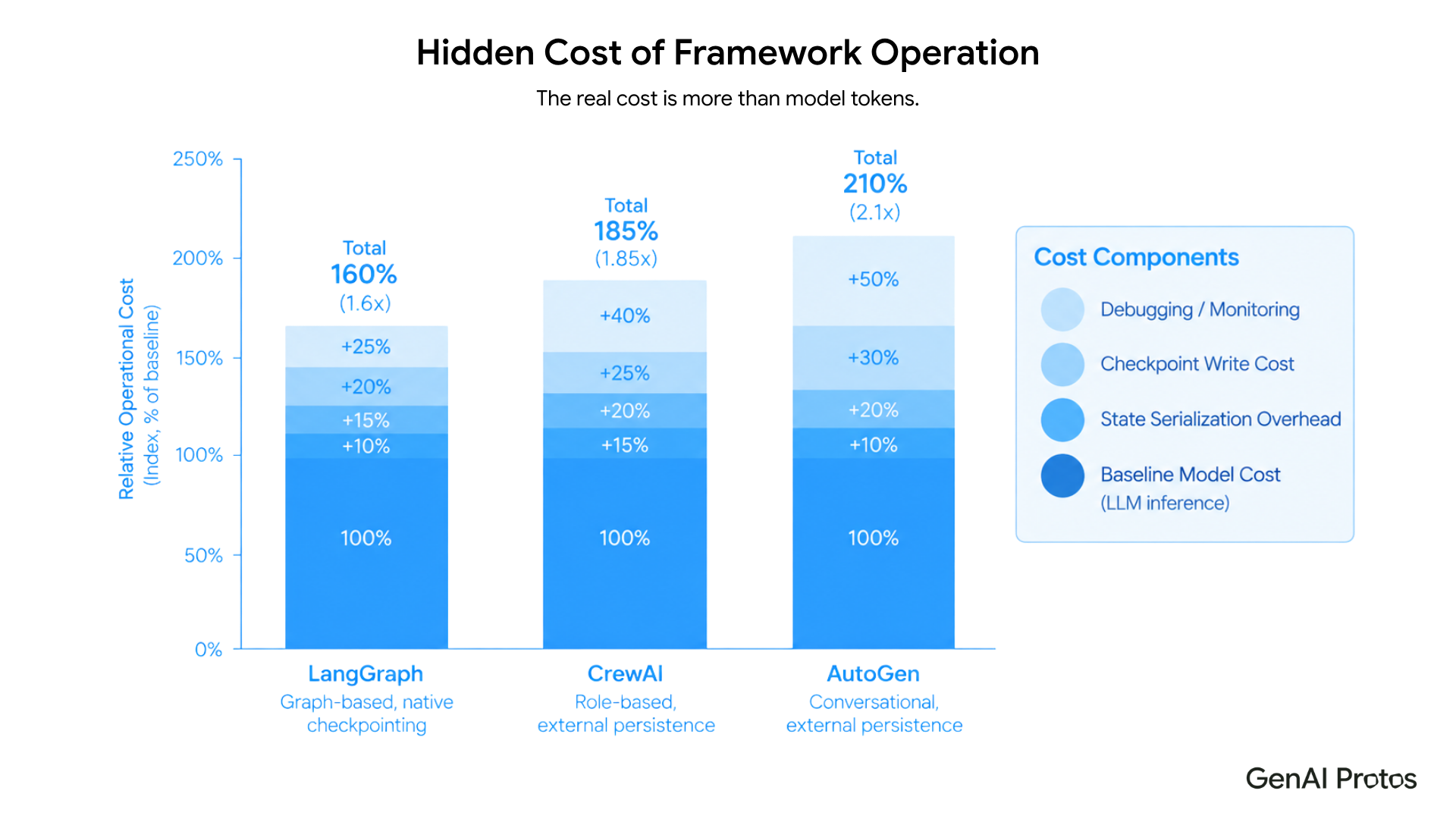
These four criteria determine the hidden cost of framework operation. A framework that requires you to build your own persistence layer shifts engineering cost into infrastructure. A framework with non-deterministic execution paths makes debugging at scale expensive.
Framework Comparison: LangGraph, CrewAI, and AutoGen
| Framework | State Management | Best Suited For | Critical Bottleneck |
|---|---|---|---|
| LangGraph | Typed graph with native checkpointing | Deterministic, auditable workflows with defined state transitions | Graph complexity grows with workflow complexity |
| CrewAI | Task-completion signals; external store required for durability | Role-based agent hierarchies with clear task delegation | Synchronizing role definitions with evolving business requirements |
| AutoGen | In-conversation memory; external persistence required for recovery | Exploratory, conversational multi-agent tasks | Non-deterministic loops without explicit stop conditions |
LangGraph: Deterministic Workflows with Explicit State Graphs
LangGraph models agent workflows as directed graphs with typed state nodes and conditional edges. LangChain Engineering Portal and LangGraph Specifications covers the full graph API. The explicit graph structure makes LangGraph the strongest choice for workflows that require auditability, reproducible execution paths, and compliance documentation.
Native checkpointing means every state transition is serializable to a durable store. After a Kubernetes pod restart, the workflow resumes from the last checkpoint rather than restarting from the beginning. This is a production infrastructure requirement, not a nice-to-have.
The cost of LangGraph is graph complexity. A well-designed state graph for a simple workflow is maintainable. An undisciplined graph built incrementally without a clear state schema becomes difficult to modify without breaking existing state transitions.
CrewAI: Role-Based Delegation for Structured Hierarchies
CrewAI structures agent workflows around roles and task delegation. A Crew defines agent roles, their capabilities, and the task sequence. The framework handles delegation routing between agents based on role definitions.
CrewAI suits workflows with stable role definitions and clear task boundaries: a content pipeline with defined roles for research, writing, and review; a document processing workflow with extraction, classification, and routing roles. When role definitions match the workflow structure, CrewAI produces readable, maintainable agent code.
The limitation is state persistence. CrewAI relies on task-completion signals from individual agents. For recovery after a mid-task failure, you need an external persistence layer that captures intermediate state before the failure. Plan this infrastructure before deployment, not after the first incident.
AutoGen: Conversational Multi-Agent for Exploratory Tasks
AutoGen models multi-agent interaction as a conversation. Microsoft Research AutoGen ecosystem and architecture overview describes the conversation protocol. Agents exchange messages, maintain conversation history as their shared state, and reach task completion through dialogue.
AutoGen is the right choice when the task outcome is defined by conversation quality rather than process structure, when agents need to negotiate or challenge each other, and when the workflow does not require step-by-step audit logging.
The critical limitation for enterprise production is loop control. AutoGen conversations without explicit stop conditions can iterate indefinitely, generating unconstrained token consumption. Every AutoGen deployment must define conversation termination conditions before connecting the framework to production systems.
Get an Unbiased Multi-Agent Framework Recommendation
GenAI Protos has production experience with LangGraph, CrewAI, and AutoGen across enterprise deployments. Get a framework recommendation based on your specific workflow requirements
Contact UsBest Fit by Workflow Type
The State Serialization Audit narrows the field. This section maps the three common enterprise workflow types to the framework that fits them by design, not by preference.
Deterministic, stateful workflows - LangGraph
The workflow has a defined sequence of states. Every transition is conditional. State must survive infrastructure failures. Compliance requires an auditable record of every step. The typed state graph and native checkpointing in LangGraph address all four requirements without custom infrastructure.
Role-based sequential workflows -CrewAI
The workflow maps cleanly onto a set of human-like roles: researcher, writer, reviewer, approver. Tasks have clear handoff points. The role definitions are stable and do not change frequently. The delegation model in CrewAI produces readable, maintainable agent code when the workflow structure matches a role hierarchy.
Exploratory, conversational workflows - AutoGen
The workflow outcome cannot be fully specified in advance. Agents need to negotiate, challenge assumptions, and refine answers through dialogue. The conversational model in AutoGen is the right fit, with explicit stop conditions defined before deployment. This pattern is common in research synthesis, brainstorming, and adversarial review workflows.
If your workflow does not fit cleanly into one of these three types, the most common reason is that it combines deterministic steps with exploratory sub-tasks. In that case, a hybrid architecture using LangGraph for the outer workflow and AutoGen for the exploratory sub-agent is a more robust approach than trying to force the full workflow into a single framework.
How to Run Your Own Framework Evaluation
A framework comparison document is a starting point, not a final answer. Your workflow structure, state requirements, and operational constraints determine which framework fits. Run your own evaluation before committing to a production build.
Define the workflow before selecting the framework:
Write out the complete workflow as a state diagram. Which states need to be recoverable? Which transitions are conditional? A workflow that requires explicit state recovery narrows the choice to LangGraph before you write any code.
Test a failed subordinate-agent scenario:
Simulate a subordinate agent that does not respond. What does the framework do? Does it retry, escalate, or hang? This test reveals whether you need to build failure handling on top of the framework or whether it is provided natively.
Test state recovery after restart:
Kill the orchestrator process mid-workflow and restart it. Does the workflow resume from the last checkpoint or restart from the beginning? If it restarts, measure the business cost of restarted workflows at your expected failure rate.
Measure token cost at target concurrency:
Run your target workflow at the concurrency level you expect in production. Measure total tokens per workflow completion. AutoGen typically generates higher conversation overhead than LangGraph for equivalent deterministic workflows.
Test loop termination:
Define a task with deliberately ambiguous completion criteria and run it without a stop condition. Verify that the framework respects your defined iteration limit and fails closed rather than continuing indefinitely.
Test access boundaries before connecting production tools:
Verify that the framework cannot access tools or data outside the scope you defined for the agent session. This is a security control, not a framework feature test.
Where Framework Evaluations Fail
The most common mistake is selecting a framework based on which one worked first in a tutorial environment. Tutorial workflows are designed to demonstrate features. Production workflows are designed to handle failures, recover state, and operate within cost budgets. Evaluate on production criteria from the start.
The second mistake is not testing loop termination before connecting a framework to external tools or APIs. An unconstrained AutoGen conversation with access to your email API is a support ticket waiting to happen.
Key Takeaways
- Select a framework based on the State Serialization Audit: state persistence, failure recovery, token cost, and execution inspectability.
- LangGraph suits deterministic, auditable workflows. CrewAI suits stable role hierarchies. AutoGen suits exploratory, conversational tasks.
- Run your own evaluation: test failure recovery, loop termination, and token cost at production concurrency before committing.
- Define conversation termination conditions before deploying AutoGen in any production environment.
Conclusion
The framework decision is not about which library has the most GitHub stars or the cleanest tutorial. It is about which framework handles your specific failure modes without requiring you to build the reliability layer yourself. Run the evaluation, test the failure scenarios, and measure token cost at scale. The right framework choice is the one that survives your production incident, not the one that ran the demo fastest.


