Executive Summary
A leading online learning enterprise engaged GenAI Protos to design and deliver an AI-powered Adaptive Learning Platform - a production-grade system that fundamentally transforms how digital education content is created, personalised, and delivered to learners at scale. The platform moves far beyond static course structures and one-size-fits-all curricula, deploying deep learning models and adaptive algorithms that continuously analyse each learner's performance, engagement patterns, and behavioural signals to dynamically tailor the educational experience in real time.
The delivered solution integrates multimodal AI content generation, an adaptive difficulty engine, a real-time learner intelligence layer, and a content cost optimisation pipeline - all built on a cloud-native stack centred on Python and TensorFlow, with a modular architecture designed for scale. The production impact is measurable and compounding: a 25% increase in course enrolment driven by demonstrably better learning outcomes, a 15% reduction in content development costs through AI-assisted generation, improved student progression rates, and significantly higher platform engagement metrics across learner cohorts.
At a Glance
- Use case
- AI-powered adaptive learning platform for personalised education at scale.
- Industry
- EdTech & Online Learning
- Engagement type
- Enterprise AI Build
- Status
- Production
- The mandate
- Design and deliver a production AI system that learns from every learner interaction, adapts content difficulty and modality in real time, reduces content production costs through AI-assisted generation, and provides the intelligence infrastructure to continuously improve educational outcomes - without requiring manual intervention from content or curriculum teams.
- Core AI capabilities
- Learner profile modelling, adaptive difficulty, dropout-risk prediction, multimodal content delivery, AI-assisted content generation, outcome attribution, and curriculum intelligence.
- Primary technologies
- Python, TensorFlow, Keras, TFX, TensorFlow Serving, FastAPI, Neo4j, PostgreSQL, Redis, Next.js, MLflow, AWS EKS.
- Measured outcomes
- +25% course enrolment growth, -15% content development cost, 94% learner engagement vs 71% baseline, and 2.8x completion improvement for adaptive cohorts.
The Challenge
The client operated one of the fastest-growing online learning platforms in its market, with a catalogue spanning hundreds of courses across technology, business, creative skills, and professional development. Despite strong catalogue depth, they faced a persistent and worsening problem: the gap between what learners needed and what the platform delivered.
- One-size-fits-all content delivery: All learners, regardless of prior knowledge, learning velocity, or preferred content modality, were served identical course structures and sequences. Completion rates suffered most acutely in mixed-skill cohorts.
- Static difficulty curves: Course difficulty was fixed at design time by content authors. There was no mechanism to adjust complexity based on demonstrated learner performance.
- Reactive content development: Content teams identified knowledge gaps through lagging indicators such as completion rate drops, support ticket spikes, and low ratings. New content modules took 6-10 weeks from identification to publication.
- Engagement drop-off at critical junctures: Analytics revealed three consistent drop-off points across the catalogue: within the first 15 minutes of a new course, at the first high-difficulty assessment, and after the midpoint of longer courses.
- Content modality mismatch: Learner feedback consistently identified a preference for video-first, interactive, and visual content, while the catalogue was heavily text-and-quiz based due to content production cost constraints.
What GenAI Protos Built
GenAI Protos built a production-grade adaptive learning platform that converts learner interactions into real-time intelligence and uses that intelligence to improve the next content decision. The platform joins learner signal ingestion, adaptive modelling, multimodal content delivery, AI-assisted content generation, and outcome feedback into a single operating loop.
A learner signal ingestion layer that captures clickstream, assessment results, video engagement, session data, content ratings, search queries, and time-on-task metrics.
A TensorFlow-based adaptive intelligence engine combining a learner profile model, IRT-based difficulty adaptation, and LSTM-based engagement prediction.
A multimodal content delivery system that selects content modality, level, sequence, and context for each learner.
An AI-assisted content generation pipeline for draft generation, modality translation, and curriculum gap identification.
A feedback and outcome attribution layer that continuously improves the learner intelligence graph and content library.
A responsible AI operating model covering bias monitoring, learner data privacy, human review, explainability, and learner transparency.
Solution Architecture
GenAI Protos architected the platform across four interconnected AI capability layers, each independently scalable and instrumented for observability. The design principle was explicit: every learner interaction generates a signal, every signal updates the learner model, and every updated learner model improves the next content delivery decision.
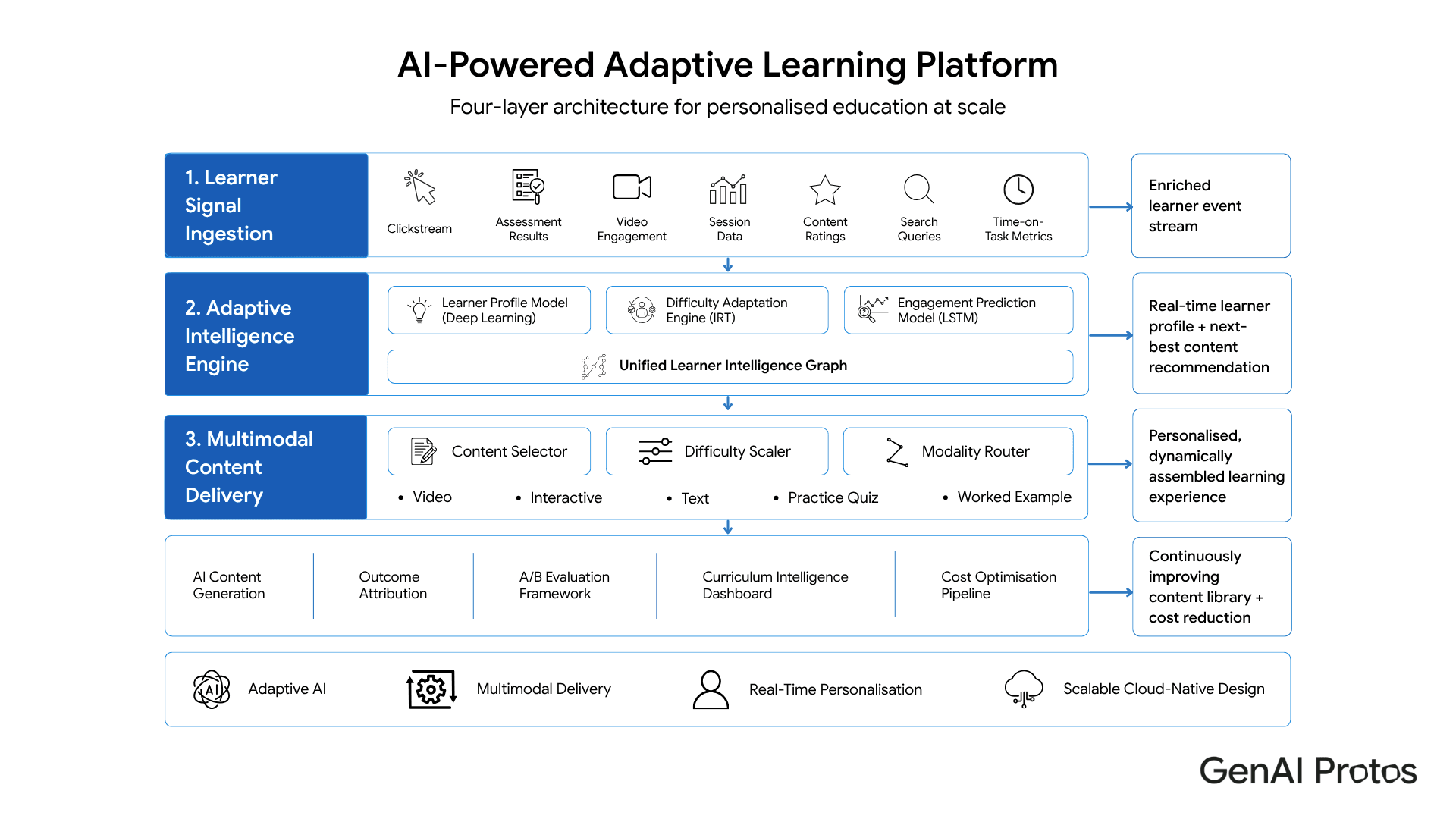
- Learner Signal Ingestion
- Captures clickstream, assessment results, video engagement, session data, content ratings, search queries, and time-on-task metrics; produces an enriched learner event stream.
- Adaptive Intelligence Engine
- Uses TensorFlow deep learning, IRT models, and LSTM prediction to produce a real-time learner profile and next-best-content recommendation.
- Multimodal Content Delivery
- Uses content selector, difficulty scaler, and modality router to assemble personalised content across video, interactive, text, quiz, and worked-example formats.
- Feedback & Content Optimisation
- Uses AI content generation, outcome attribution, A/B evaluation, curriculum intelligence, and cost optimisation to continuously improve content quality and efficiency.
Prompt-to-Output Workflow
The adaptive learning pipeline runs continuously for every active learner session. The sequence below captures the full path from learner action to personalised content delivery and model feedback.
A learner interaction is captured as a structured event by the platform frontend, enriched with session context, and written to the learner event store and real-time cache.
The TensorFlow learner profile model updates the learner's state vector after assessment and interaction events.
The recommendation engine queries the content graph and ranks candidate content by engagement probability and learning efficacy.
The delivery layer assembles the personalised learning unit by selecting modality, applying difficulty scaling, and adding learner-specific context.
Outcome attribution processes session events and assessment results, writing learning outcome signals back into the training dataset for the next model improvement cycle.
Implementation Highlights
- Learner modelling
- A TensorFlow learner profile model represents each learner through a continuously updated embedding across 47 skill dimensions, engagement velocity, modality preferences, and performance history.
- Difficulty adaptation
- A hybrid IRT + TensorFlow calibration approach estimates learner ability and selects content within the learner's zone of proximal development.
- Engagement intervention
- An LSTM dropout-risk model scores learner sessions at 15-minute intervals and triggers modality switches, difficulty adjustments, or motivational prompts.
- Content delivery
- A modality router selects video, interactive exercise, text + diagram, worked example, or adaptive quiz formats based on learner profile and learning objective.
- Content generation
- The AI-assisted pipeline supports draft generation, modality translation, and gap identification for curriculum teams.
- ML operations
- TFX, TensorFlow Serving, MLflow, Prometheus, Grafana, and Kubernetes were used to support model training, serving, tracking, observability, and deployment.
- Governance
- Bias monitoring, pseudonymised learner data, human review of AI-generated content, educator-facing explainability, and learner transparency were designed into the system.
Measured Technical Details
Why This Matters
The value of this build is not limited to personalisation. The larger engineering pattern is that learner experience, content operations, curriculum intelligence, and model improvement were connected into one production system. This closes the gap between static digital courses and adaptive education at scale.
Results
GenAI Protos delivered a production adaptive learning platform with measurable commercial, learning, and operational impact. The following outcomes are taken from the source case study content.
| Outcome | What changed |
|---|---|
| Course enrolment growth | Course enrolment increased by 25% year-over-year, attributed to personalised onboarding and outcome-driven word of mouth. |
| Diagnostic-to-paid conversion | New learners completing a personalised onboarding diagnostic converted to paid enrolment at a 34% higher rate than the standard course catalogue path. |
| Paid subscription renewal | Paid subscription renewal rate improved by 18%, linked to higher completion rates and demonstrable skill progress. |
| Content development cost | Content development cost reduced by 15%, supported by AI-assisted authoring and adaptive difficulty scaling. |
| Authoring productivity | Average authoring time per content unit decreased from 8.4 hours to 3.2 hours, a 62% reduction. |
| Learner engagement | Learner engagement reached 94% versus a 71% pre-deployment baseline. |
| Completion improvement | Adaptive cohorts achieved a 2.8x completion improvement versus static cohorts. |
| Learner satisfaction | Learner satisfaction improved from 3.8 / 5.0 to 4.6 / 5.0. |
| Support efficiency | Learner support tickets reduced by 22% due to proactive engagement intervention. |
Reusable Pattern
This use case can be reused as a pattern for adaptive AI systems where the goal is to continuously improve user experience from behavioural signals, not just automate a single task. The same operating model can support education platforms, enterprise learning systems, customer onboarding journeys, skills platforms, and role-based training environments.
- Signal layer: capture high-quality user interaction events with context and time-series history.
- Profile layer: convert behavioural events into a continuously updated user or learner state.
- Decision layer: choose the next best content, workflow, intervention, or support action based on current state.
- Delivery layer: assemble a personalised experience while maintaining content quality and governance.
- Feedback layer: measure outcomes and feed them back into model improvement, content optimisation, and operational intelligence.
- Governance layer: embed privacy, bias monitoring, explainability, and human review into the production workflow.
Build Adaptive AI Systems That Improve with Every Interaction
GenAI Protos helps teams design and deliver production-grade AI systems for personalised learning, adaptive content delivery, curriculum intelligence, and measurable learner outcomes.
Get custom solutions