Executive Summary
Legal teams have long wrestled with the same problem: too many contracts, too little time, and too much riding on every clause. A missed indemnity provision, an overlooked renewal date, or an undetected liability cap can translate into significant financial and reputational exposure.
GenAI Protos designed and deployed an end-to-end AI-powered contract intelligence platform for a legal services organisation handling thousands of contracts annually. By combining Large Language Models (LLMs), Retrieval-Augmented Generation (RAG), and multimodal document parsing, the platform transformed how legal teams read, classify, and act on contractual documents reducing review time by 40% while materially improving accuracy and risk detection.
The platform reduced review time by 40%, improved clause flagging and risk detection, reduced billable overhead on routine work, and gave reviewers a structured, auditable way to validate AI outputs before legal judgement or sign-off.
At a Glance
- Use case
- AI-powered contract intelligence platform for legal document review and risk analysis.
- Industry
- Legal Services
- Solution
- AI Contract Analysis Platform
- Core capabilities
- Document ingestion, contract classification, clause extraction, semantic risk scoring, anomaly detection, reviewer validation, and structured review output.
- Primary technologies
- GPT-4o, Claude 3.5 Sonnet, Azure OpenAI, LangChain, LlamaIndex, Azure Document Intelligence, LlamaParse, Pinecone, pgvector, LangGraph, CrewAI, Next.js, REST APIs, and webhooks.
- Measured outcomes
- 40% faster contract review, 60% improved risk detection, 30% lower review cost, and 98% extraction precision on standard contract types.
The Challenge
Before this engagement, the legal team relied on a largely manual review process. Junior associates spent a disproportionate share of their billable hours on routine document tasks extracting party details, checking clause presence, flagging non-standard terms work that is critical but inherently repetitive and error-prone at scale.
- Volume bottleneck: Hundreds of contracts per month were reviewed linearly, with no parallel processing capability.
- Inconsistency risk: Different reviewers applied different interpretations to the same clause types, introducing variance in risk assessment.
- Slow turnaround: Average contract review cycle times were measured in days, constraining deal velocity for clients.
- Buried risks: Critical provisions buried in lengthy schedules and annexures were routinely under-scrutinised due to time pressure.
- No cross-contract intelligence: There was no mechanism to compare clause language across a portfolio of agreements a significant gap for clients managing master agreements and downstream variations.
What GenAI Protos Built
Legal AI is a specialised domain. Off-the-shelf tools deliver generic outputs; the value is in the configuration, the playbook design, the integration, and the ongoing model governance. GenAI Protos brought three things that mattered most to this engagement:
If your legal team is processing high volumes of contracts and relying on manual review as your primary quality control mechanism, you are leaving significant efficiency and risk-management value on the table. GenAI Protos can help you change that.
- Domain expertise: Deep understanding of legal workflows, privilege considerations, and the regulatory context in which legal AI must operate.
- Technical depth: The capability to customise and extend enterprise-grade platforms rather than simply resell them.
- Outcome accountability: We measure success by client results, not by platform hours. Our delivery model is built around agreed KPIs and transparent reporting.
Solution Architecture
The architecture combines document parsing, retrieval, large language models, vector search, agentic orchestration, private deployment controls, and a reviewer-facing dashboard. The design goal was accuracy, auditability, and security, while keeping qualified legal reviewers in control of final decisions.
- GPT-4o + Claude 3.5 Sonnet via Azure OpenAI / Anthropic API
- Clause extraction, semantic reasoning, risk narrative generation
- LangChain + LlamaIndex
- Document ingestion, chunking, retrieval-augmented generation orchestration
- Azure Document Intelligence + LlamaParse
- OCR, multimodal parsing of PDFs, scans, and mixed-format contracts
- Pinecone with pgvector option for on-prem
- Semantic clause similarity search and cross-contract retrieval
- LangGraph + CrewAI
- Agentic review workflows, anomaly detection, and multi-step reasoning loops
- Azure OpenAI on Your Data with private no-egress design
- Client confidentiality, privilege protection, and full audit logging
- Custom Next.js dashboard
- Confidence scores, clause annotations, and escalation workflows
- REST API + webhook layer
- Connections to iManage, NetDocuments, SharePoint, and Relativity DMS
Prompt-to-Output Workflow
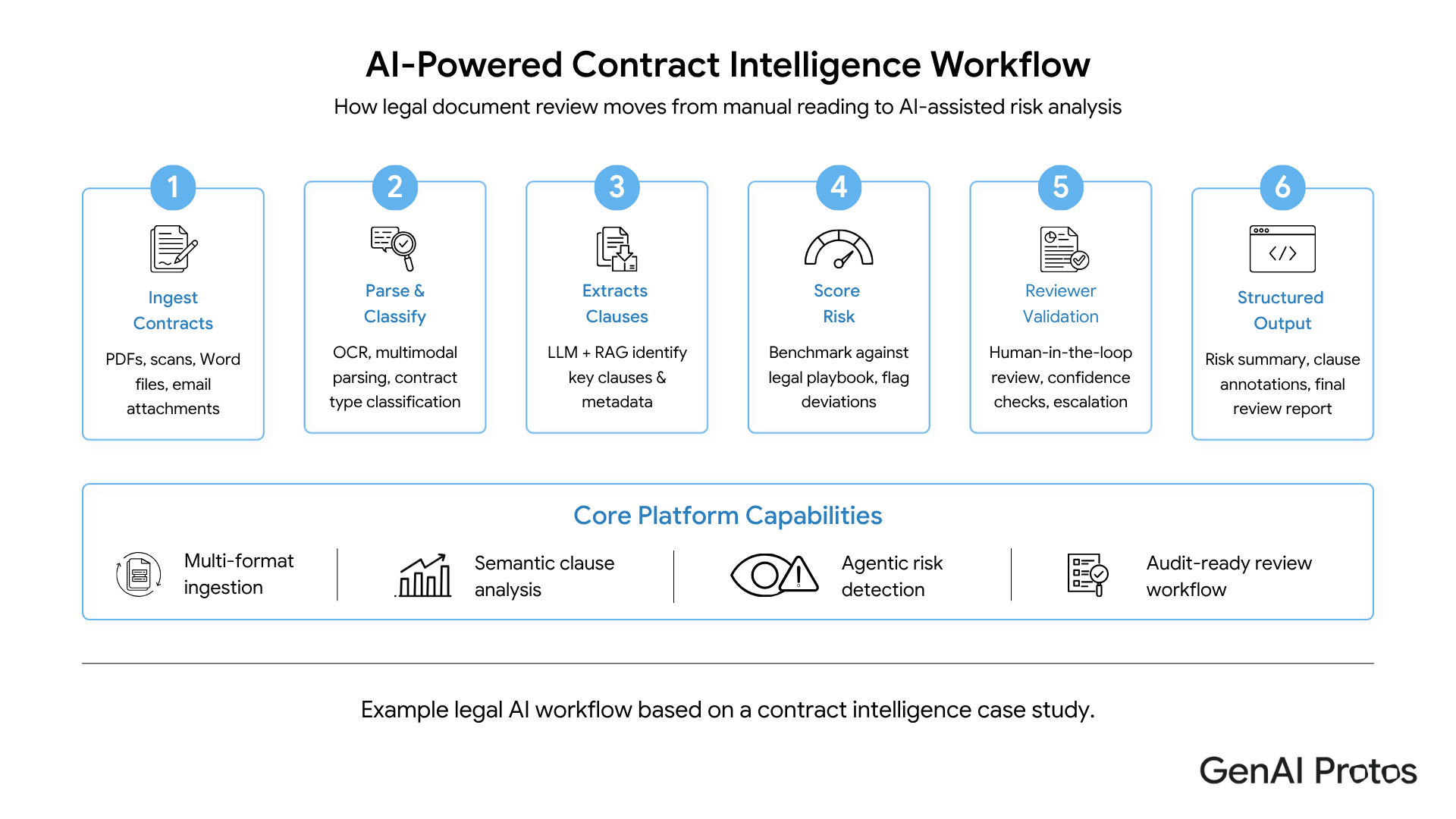
The platform moves contract review from manual reading to AI-assisted risk analysis through a structured workflow that keeps legal reviewers in control.
Contracts enter through upload, DMS integration, email attachment, or webhook workflow so the review starts from a single controlled intake point.
OCR and multimodal parsing convert PDFs, scans, Word files, and mixed-format contracts into structured data, then identify the contract type.
LLMs and RAG identify key clauses, metadata, obligations, and cross-references so reviewers can inspect important provisions without manual page-by-page review.
Clauses are benchmarked against the legal playbook, and missing terms, non-standard language, or deviations are flagged by severity.
Legal reviewers see confidence scores, clause annotations, and escalation prompts before applying legal judgement or moving issues to senior counsel.
The system generates risk summaries, clause annotations, and review reports that can be shared with stakeholders and retained for audit.
Implementation Highlights
- Technical Discovery & Data Architecture
- Analysed 400 historical contracts, defined a 47-clause taxonomy, and designed a hybrid retrieval architecture combining BM25 sparse retrieval with dense vector retrieval.
- RAG Pipeline Build & Prompt Engineering
- Built a LlamaIndex ingestion workflow with Azure Document Intelligence, clause-boundary detection, Pinecone indexing, structured extraction prompts, Pydantic validation, and a LangGraph review graph.
- Controlled Pilot, Evaluation & Calibration
- Ran 380 live contracts in shadow mode, evaluated precision, recall, risk-score agreement, and critical-tier false negatives, then calibrated chunking and cross-reference resolution.
- Production Deployment & Handover
- Deployed the platform through a blue-green release into the client Azure tenancy, completed hardening, configured observability, and delivered handover documentation and runbooks.
Measured Technical Details
GenAI Protos selected and integrated a purpose-built stack for this engagement, prioritising accuracy, auditability, and enterprise security.
Why This Matters
Contract review is one of the highest-leverage AI applications in professional services because it combines high document volume, repetitive extraction, high-risk clause interpretation, and significant commercial impact. The value is not only faster reading. The value is better legal risk visibility, more consistent review criteria, a structured audit trail, and better use of senior legal judgement.
Results
Outcomes were measured at 3 months and 6 months post-deployment. The results exceeded the projections set out in the business case.
| Outcome | What changed |
|---|---|
| 40% reduction in review time | Average contract review cycle time fell from approximately 4.2 hours to 2.5 hours per document. |
| Over 200 hours recovered in high-volume months | Recovered capacity was created during high-volume review periods. |
| 1.8 business days faster turnaround | Commercial contract review turnaround improved by an average of 1.8 business days. |
| 98% extraction precision | Clause extraction precision reached 98% on standard contract types, up from an estimated 84% under manual review. |
| 23% additional risk identification | The ML anomaly detection layer identified risks in 23% of reviewed contracts that were not flagged during the manual pilot. |
| 35% more volume without added headcount | The platform absorbed a 35% increase in contract volume over the engagement period with no additional headcount. |
| 91% action rate on AI risk flags | Risk flags generated by the AI were actioned in 91% of cases within six months of full deployment. |
Reusable Pattern
This use case can be reused as a pattern for AI-assisted document intelligence systems where teams need structured extraction, contextual reasoning, risk scoring, and human validation. The same operating model can support compliance reviews, procurement contracts, regulatory documents, real estate leases, employment agreements, and intellectual property licensing workflows.
- Ingestion pattern: Accept mixed-format documents and normalise them into structured review-ready data.
- Retrieval pattern: Combine sparse retrieval for exact clause matching with dense vector retrieval for semantic similarity.
- Reasoning pattern: Use RAG and agentic orchestration to extract clauses, score deviations, and detect cross-reference inconsistencies.
- Governance pattern: Keep legal reviewers in the loop with confidence scores, escalation paths, audit trails, and playbook governance.
- Integration pattern: Connect the platform into existing DMS and legal operations systems through APIs and webhooks.
Ready to Transform Your Contract Review Process?
GenAI Protos delivers AI solutions that legal teams actually use. Book a discovery call and see how your organisation can achieve similar results in under 90 days.
Get custom solutions