Executive Summary
Modern enterprises operate complex, distributed IT infrastructure spanning on-premise data centers, multi-cloud environments, containerized workloads, and hybrid networks. The challenge is no longer just maintaining uptime. It is doing so proactively, at scale, and without exponentially growing IT support headcount.
GenAI Protos designed and deployed an end-to-end AI Operations solution that transforms IT operations from reactive incident handling into proactive, intelligent operations command. The platform combines real-time multi-modal data ingestion, anomaly detection, predictive maintenance, intelligent ticket automation, and an AI chatbot for L1 support deflection.
The result is a production-ready AIOps pattern that reduced IT support operating cost by 20%, improved system uptime by 15%, accelerated ticket resolution by 40%, achieved greater than 90% predictive accuracy, and resolved more than 60% of L1 tickets autonomously.
At a Glance
- Use case
- AI-powered IT operations intelligence for proactive monitoring, predictive maintenance, intelligent ticketing, and support automation.
- Domain
- IT Operations
- Primary stack
- Azure AI, multi-modal infrastructure data, Azure ML, Azure Event Hubs, Azure Logic Apps, ITSM integrations, Azure Bot Service, and GPT-4o.
- Core inputs
- Telemetry, logs, metrics, and event streams across cloud, applications, networks, and endpoints.
- Core capabilities
- Anomaly detection, failure forecasting, capacity forecasting, smart ticket creation, runbook automation, duplicate suppression, escalation routing, and L1 AI support.
- Measured outcomes
- 20% IT support cost reduction, 15% system uptime improvement, 40% faster ticket resolution, greater than 90% predictive accuracy, and 60%+ autonomous L1 ticket resolution.
The Challenge
The organization faced three compounding operational pain points that made traditional monitoring and support processes insufficient for modern infrastructure scale.
- Reactive incident management: IT teams were perpetually responding to failures after they occurred, resulting in cascading outages and SLA breaches.
- Ticket volume overload: L1 support queues were overwhelmed with repetitive, low-complexity incidents that consumed engineering capacity better directed at higher-order problems.
- Fragmented observability: Infrastructure signals from servers, applications, networks, and cloud services existed in siloed monitoring tools with no unified intelligence layer.
What GenAI Protos Built
GenAI Protos designed and deployed an end-to-end AIOps solution that connects infrastructure monitoring, AI-driven detection, predictive intelligence, ITSM workflows, and employee support automation into one operating model.
- Real-time multi-modal ingestion for telemetry, logs, metrics, and event streams.
- A layered anomaly detection engine using statistical baselines, LSTM models, unsupervised clustering, and correlation analysis.
- Predictive maintenance and failure forecasting for hardware assets, software instability windows, capacity events, and dependency impact.
- Intelligent ticket automation through ServiceNow or Jira Service Management integrations.
- Automated runbook execution for approved known failure patterns.
- Azure Bot Service-powered L1 support deflection backed by GPT-4o for natural language issue handling
- Feedback loops that use human resolutions and outcomes to improve future detection and reduce false positives.
Solution Architecture
The platform is structured around operational signals, an AI operations intelligence core, automated actions, and measurable business outcomes. This turns fragmented infrastructure data into decisions and actions that support proactive operations.
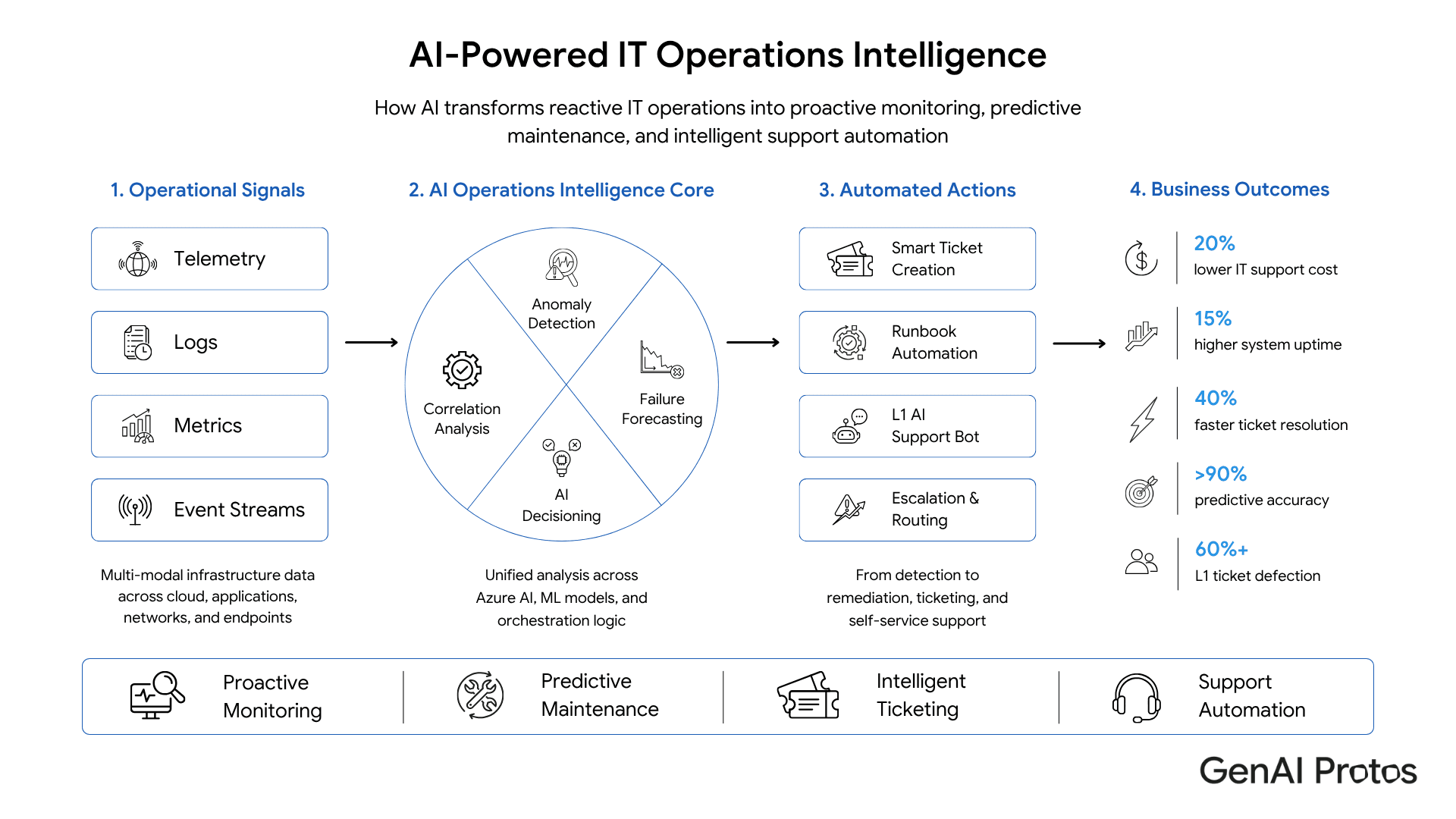
- Operational signals
- Telemetry, logs, metrics, and event streams are collected across cloud, applications, networks, and endpoints.
- AI operations intelligence core
- Anomaly detection, correlation analysis, failure forecasting, and AI decisioning unify infrastructure signals into actionable intelligence.
- Automated actions
- Smart ticket creation, runbook automation, L1 AI support, and escalation routing move the workflow from detection to action.
- Business outcomes
- Lower IT support cost, higher uptime, faster ticket resolution, predictive accuracy, and L1 ticket deflection.
Prompt-to-Output Workflow
AIOps Data Flow and Automation Loop The end-to-end data and control flow operates across five sequential layers: collect, detect, decide, act, and learn. Integration points use event-driven architecture over Azure Service Bus, enabling decoupled and resilient communication between platform components.
Infrastructure agents and Azure IoT Hub collect multi-modal signals from monitored endpoints in real time.
Azure ML pipelines run anomaly detection models continuously and generate scored anomaly events with confidence levels.
Orchestration logic evaluates scored events against business rules to determine whether to auto-remediate, create a ticket, alert on-call, or suppress duplicates.
Logic Apps execute remediation runbooks or push structured tickets into ITSM platforms with AI-generated context.
Human resolutions and outcomes feed back into model retraining pipelines to improve detection precision and reduce false-positive rates.
Implementation Highlights
- Real-time data ingestion
- Azure Event Hubs and IoT Hub ingest structured telemetry, unstructured logs, time-series metrics, and event streams from distributed infrastructure endpoints.
- Anomaly detection
- Azure Anomaly Detector API, LSTM networks, Isolation Forest, Autoencoder models, and correlation analysis identify known and unknown failure patterns.
- Predictive maintenance
- Remaining Useful Life estimation, software failure prediction, capacity forecasting, and blast radius analysis provide forward-looking operational intelligence.
- ITSM automation
- Azure Logic Apps trigger ServiceNow or Jira Service Management APIs to create structured tickets with affected system, anomaly type, severity, and root cause hypothes
- Runbook automation
- Pre-approved remediation runbooks execute automatically for known patterns such as disk cleanup, service restart, and certificate renewal.
- L1 support deflection
- Azure Bot Service and GPT-4o resolve common employee IT issues through secure API-driven actions and escalate with full conversation context when needed.
Measured Technical Details
Why This Matters
The value of this platform is not only automation. The larger shift is that IT operations moves from fragmented, reactive monitoring to an intelligent operating model that predicts, prioritizes, and acts before issues become business disruptions.
Results
The AIOps platform delivered measurable improvements across cost, uptime, ticket resolution, predictive accuracy, and support automation.
| Outcome | What changed |
|---|---|
| IT support cost reduction | 20% reduction in IT support OpEx through automated L1 ticket resolution. |
| System uptime improvement | 15% improvement in infrastructure uptime through predictive failure prevention. |
| Mean time to resolution | 40% faster average resolution time through automated runbook execution. |
| Engineering capacity reclaimed | 60%+ of L1 tickets resolved autonomously through AI chatbot deflection. |
| Predictive accuracy | Greater than 90% failure prediction accuracy rate. |
Reusable Pattern
This use case can be reused as a pattern for enterprise operations environments where monitoring data exists but intelligence and action remain fragmented. The same structure can support cloud operations, network operations, endpoint operations, DevOps support, and service desk automation.
- Signal ingestion: collect telemetry, logs, metrics, and events across infrastructure domains.
- Detection layer: combine baselines, ML models, and correlation analysis to reduce noise and find true risk.
- Decisioning layer: apply business rules to decide whether to remediate, ticket, escalate, or suppress.
- Action layer: connect AI outcomes to ITSM workflows, runbooks, and employee support channels.
- Learning loop: feed human outcomes back into models to improve precision over time.
Build AI Operations Systems That Teams Can Trust
GenAI Protos helps teams turn fragmented IT operations signals into proactive monitoring, predictive maintenance, intelligent ticketing, and support automation systems that operate inside existing enterprise workflows.
Get custom solutions