Executive Summary
Marketing teams at scale often have the data they need, but not the execution speed to turn that data into campaign action. The source engagement focused on replacing repetitive manual workflows with a governed, production-ready AI marketing intelligence platform.
GenAI Protos engineered a system of collaborating AI agents for content generation, consumer trend analysis and personalised advertising. A central orchestrator agent receives campaign objectives, decomposes work into specialist tasks, routes those tasks to the right agent and assembles the final marketing deliverables.
The platform helped the marketing team move from manual campaign execution to AI-assisted, insight-driven marketing operations. Documented outcomes include 50% less content creation time, 20% ROI uplift, 3x faster audience segmentation and 40% higher engagement.
At a Glance
- Use case
- AI-powered marketing intelligence platform for campaign execution, trend intelligence and personalised advertising.
- Industry
- Marketing and enterprise go-to-market operations.
- Core platform pattern
- Supervisor-worker multi-agent architecture with one orchestrator and specialist content, trend and personalisation agents.
- Primary inputs
- Campaign brief, objective, audience, channel, brand rules, CRM data, approved brand content and analytics data.
- Primary outputs
- Marketing deliverables, faster content, smart insights and personalised campaigns.
- Key technologies
- Agno, Anthropic Claude Sonnet, OpenAI GPT-4o, LanceDB, REST APIs, Vertex AI or cloud-hosted inference, LLM tracing and evaluation.
- Measured outcomes
- 50% content time saved, 20% campaign ROI uplift, 3x faster segmentation and 40% higher engagement.
The Challenge
The organisation had already invested in marketing technology, including CRM, DMP and ad platform integrations. Campaign performance had still plateaued because the stack was data-rich but execution-poor. Insights existed, but the manual process of turning them into campaign action had become the bottleneck.
- Content production ceiling: creative teams were spending 60 to 70% of their time producing repetitive assets such as social copy, ad headline variants, email subject line tests and content drafts.
- Delayed trend response: consumer behaviour analysis was manually compiled from disconnected sources and translated into campaign action after a 5 to 7 day lag.
- Generic personalisation: ad targeting relied on demographic segments rather than real-time behavioural intent, creating a gap between active buyer interest and campaign message relevance.
- Manual segmentation: campaign teams were limited to 3 to 4 demographic audience segments instead of intent-based micro-segments.
- Execution pressure: the content team averaged 47 campaign assets per week across four team members before deployment.
What GenAI Protos Built
GenAI Protos built a production-ready multi-agent marketing intelligence platform. The platform converts a campaign brief into coordinated AI work across three specialist agents, while preserving governance through RAG grounding, structured output validation, confidence scoring and audit logs.
- An orchestrator agent that plans, coordinates and routes marketing tasks to specialist agents.
- A content generation agent that creates ad copy, email drafts and social posts using LLMs and RAG-grounded brand content.
- A trend analysis agent that monitors market signals, audience insights and competitor trends to convert live signals into structured recommendations.
- A personalisation agent that uses CRM and intent signals to create targeted messaging, variant suggestions and campaign recommendations.
- A shared intelligence layer that combines RAG-grounded brand content, CRM data, analytics data, LLM tracing, agent memory and audit logs.
Solution Architecture
The architecture follows a supervisor-worker pattern. A central orchestrator receives the campaign brief, decomposes the objective into tasks, routes work to specialised agents and assembles approved outputs. This avoids a single monolithic LLM and improves quality, observability and maintainability.
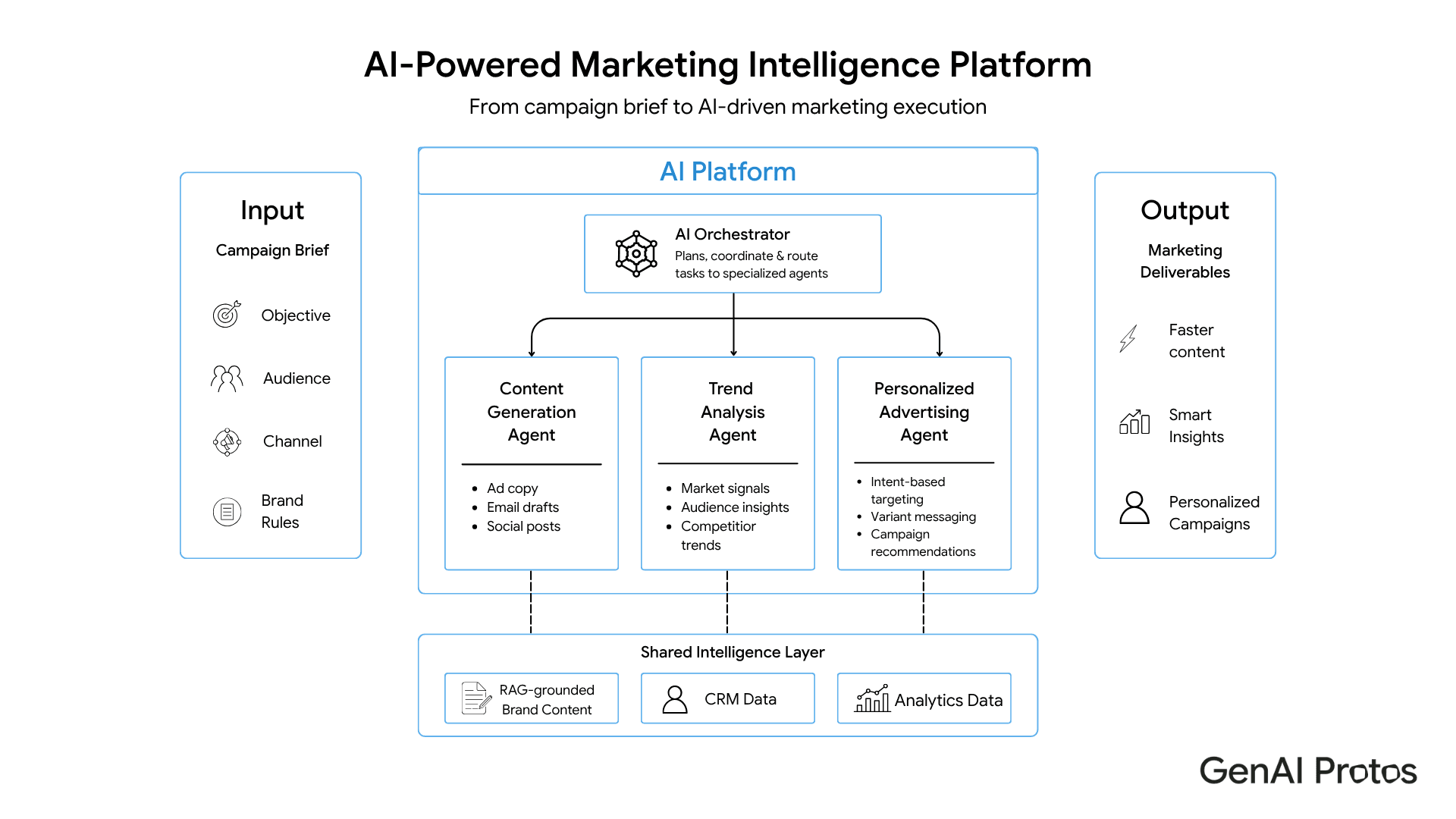
- Campaign brief input
- Captures campaign objective, audience, channel, compliance requirements and brand rules.
- Orchestrator agent
- Plans the workflow, decomposes tasks, routes work to agents and assembles the final output.
- Content generation agent
- Generates ad copy, email drafts and social posts from approved brand content and campaign goals.
- Trend analysis agent
- Reads market signals, audience insights and competitor trends to produce structured recommendations.
- Personalisation agent
- Combines CRM data and intent signals to create audience-specific messaging and campaign recommendations.
- Shared intelligence layer
- Provides RAG database, LLM layer, agent memory, CRM API, ad platform API, analytics API, tracing and audit logs.
Prompt-to-Output Workflow
The platform is designed around a governed worker model: the orchestrator coordinates specialist agents rather than asking one general-purpose model to complete the entire marketing workflow. This improves traceability because each agent has its own tool access, output schema and quality controls.
The campaign brief enters the orchestrator with objective, audience, channel and compliance constraints.
The orchestrator decomposes the brief into content, trend and personalisation tasks.
The content agent retrieves relevant approved content from the RAG database and generates channel-ready variants.
The trend analysis agent interprets market signals, audience insights and competitor trends.
The personalisation agent maps CRM and intent signals to targeted campaign recommendations.
The orchestrator assembles outputs into marketing deliverables with tracing and auditability.
Implementation Highlights
- Content generation
- LLM-driven generation for ad copy, email drafts and social posts, with RAG grounding against approved brand content.
- Brand governance
- Output schema enforcement and review queues for content that fails brand voice, format or compliance criteria.
- Trend intelligence
- Scheduled and on-demand trend analysis that produces audience-specific insight summaries and recommendations.
- Personalised advertising
- Intent-based ad copy variants generated from CRM segments, research intent and current audience behaviour.
- Performance feedback
- Live campaign metrics such as CTR, conversion rate and cost per acquisition feed back into future recommendations.
- Observability
- LLM tracing, output evaluation and audit logs provide a record of agent decisions and generated assets.
Measured Technical Details
Why This Matters
The value of this build is not just faster copy generation. The larger operating change is that campaign execution becomes a coordinated, governed workflow where content, trend intelligence and personalisation reinforce each other. That is the gap between a marketing chatbot and a production marketing intelligence platform.
Results
GenAI Protos delivered a working AI marketing intelligence platform that improved campaign execution speed, increased output volume and created a measurable uplift in campaign performance. The system provides a reusable foundation for content generation, trend intelligence and personalised advertising workflows.
| Outcome | What changed |
|---|---|
| Faster content production | Content creation time was reduced by 50% and weekly output doubled from 47 assets to 94+ assets. |
| Higher campaign ROI | Campaign ROI improved by 20% across active ad programmes. |
| Faster segmentation | Audience segmentation became 3x faster using intent signals instead of only demographic grouping. |
| Higher engagement | Personalised variants produced a 40% engagement lift over generic campaign variants. |
| Governed AI workflow | Every agent output could be traced, evaluated and routed for human review when confidence was low. |
Reusable Pattern
This use case can be reused as a pattern for enterprise marketing teams that need more than single-prompt content generation. The same structure can support brand content operations, product marketing, customer lifecycle campaigns, paid media, ABM programmes and cross-channel campaign operations.
- Orchestrator: coordinate campaign tasks and assemble final outputs.
- Specialist agents: separate content generation, market signal analysis and personalisation work.
- RAG layer: ground outputs in approved brand content and campaign history.
- Integration layer: connect CRM, analytics, ad platforms and campaign systems through APIs.
- Governance layer: track outputs, confidence, reviews and audit logs before publishing.
Build AI Marketing Workflows That Teams Can Operate
GenAI Protos helps teams turn campaign briefs, customer data and market signals into governed AI workflows for content generation, trend analysis and personalised campaign execution.
Get custom solutions