Executive Summary
GenAI Protos partnered with a leading healthcare organization to reimagine radiology workflows through the power of multimodal AI. The challenge was clear: radiologists were overwhelmed by growing imaging volumes, manual documentation demands, and fragmented patient data - slowing diagnoses and increasing the risk of human error.
Our solution integrated AI directly into the radiology value chain - from image ingestion and analysis to report generation and clinical decision support. The result: faster diagnoses, fewer unnecessary procedures, and measurably better patient outcomes.
This use case demonstrates GenAI Protos's capability to deliver production-ready AI solutions that are grounded in clinical reality, compliant with healthcare data standards, and built to scale across enterprise radiology environments.
At a Glance
- Use case
- AI-powered radiology intelligence platform for diagnostic workflow support.
- Industry
- Healthcare and radiology operations.
- Core data inputs
- Imaging data, patient history, clinical notes, demographics, medications, and lab results.
- AI capabilities
- Multimodal fusion, anomaly detection, ranked differential diagnosis, evidence and rationale, image highlights, and structured report generation.
- Workflow capabilities
- Worklist prioritization, image quality checks, clinical communication drafts, audit trail generation, and follow-up scheduling flags.
- Measured impact
- 30% faster diagnosis, 15% fewer unnecessary procedures, 40% less documentation time, and 20% more capacity.
The Challenge
Radiology departments face a compound problem that manual tools and legacy systems cannot solve:
- Data Silos: Imaging data (CT, MRI, X-Ray) lived separately from patient history, lab results, and clinical notes - forcing radiologists to piece together context manually.
- Volume Pressure: Diagnostic imaging volumes have grown significantly year-over-year while radiologist headcount has not scaled proportionally - increasing turnaround times and burnout risk.
- Documentation Overhead: Radiologists spent significant time on report generation and administrative documentation that could be automated - time better spent on complex case review.
- Diagnostic Variability: Without AI-assisted pattern recognition across large datasets, inter-reader variability in diagnosis remained a persistent clinical quality issue.
- Missed Early Indicators: Early-stage findings requiring cross-referencing of imaging with labs and history were often missed due to cognitive overload and workflow fragmentation.
What GenAI Protos Built
At GenAI Protos, we specialize in designing and deploying AI systems that solve high-stakes, data-intensive problems like the ones that make radiology uniquely challenging. This use case reflects our core engineering philosophy:
- Multimodal First: We architect AI systems that fuse structured, unstructured, and image data from day one - not as an afterthought.
- Domain-Grounded AI: We work closely with domain experts (in this case, radiologists and clinical informatics teams) to ensure AI outputs are clinically meaningful and safe.
- Production-Ready Engineering: Our solutions are built on enterprise-grade stacks with security, scalability, and system integration designed in from the start.
- Measurable Outcomes: We instrument every deployment for impact measurement - efficiency, accuracy, and cost metrics are tracked from go-live.
- Rapid Prototyping to Scale: GenAI Protos moves from POC to production-ready system faster than traditional development approaches, using our proprietary AI prototyping methodology.
Solution Architecture
The architecture places AI as the central intelligence layer across the radiology value chain. Multimodal inputs flow into an AI reasoning layer, radiologists remain in the loop for validation and final interpretation, and outputs are delivered through structured reporting and workflow automation.
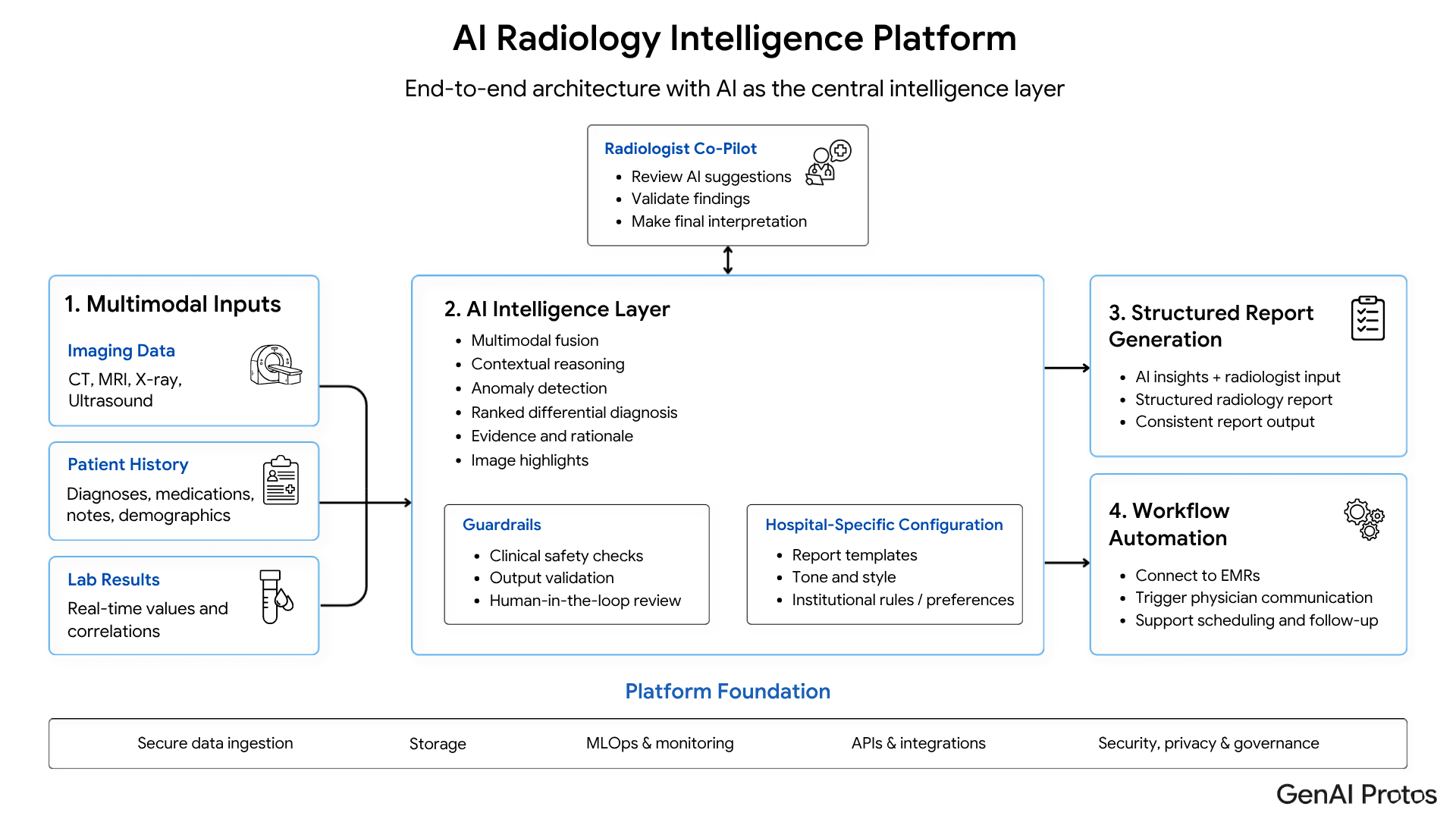
- Multimodal inputs
- Ingests imaging data, patient history, and lab results as connected diagnostic context.
- AI intelligence layer
- Performs multimodal fusion, contextual reasoning, anomaly detection, ranked differential diagnosis, evidence generation, and image highlighting.
- Radiologist co-pilot
- Supports review of AI suggestions, validation of findings, and final clinical interpretation.
- Structured report generation
- Combines AI insights and radiologist input into consistent radiology reports.
- Workflow automation
- Connects to EMRs, triggers physician communication, and supports scheduling and follow-up workflows.
- Platform foundation
- Uses secure data ingestion, storage, MLOps and monitoring, APIs and integrations, and security, privacy, and governance controls.
Prompt-to-Output Workflow
Brings imaging data, patient history, and lab results together so the radiologist reviews the case with connected clinical context rather than isolated data sources.
Analyses CT scans, MRI sequences, X-rays, ultrasound images, clinical history, and lab correlations together to detect patterns that may be missed in isolated review.
Surfaces ranked differential diagnoses with supporting evidence and image highlights so radiologists can quickly focus on areas requiring closer review.
Keeps radiologists in control by allowing them to review AI suggestions, validate findings, and make the final clinical interpretation.
Uses a purpose-built NLP layer to convert AI-generated insights and radiologist input into structured radiology reports in real time.
Automates adjacent workflow steps including worklist prioritization, image quality checks, clinical communication drafts, audit trails, and follow-up scheduling flags.
Implementation Highlights
- Multimodal AI fusion
- The solution processes imaging data, longitudinal patient records, clinical notes, demographics, medications, and lab results together.
- Imaging intelligence
- Fine-tuned Convolutional Neural Networks support imaging pattern recognition, anomaly detection, and lesion segmentation.
- Contextual reasoning
- Patient history and lab data are used to surface composite diagnostic signals that isolated imaging analysis may miss.
- Diagnostic assistance
- The AI acts as a radiologist co-pilot by presenting ranked differential diagnoses, supporting evidence, image highlights, and high-risk pattern flags.
- Structured reporting
- A purpose-built NLP layer converts AI-generated insights and radiologist input into structured radiology reports.
- Workflow automation
- The platform automates worklist prioritization, image quality checks, clinical communication drafts, audit trail generation, and follow-up imaging flags.
Measured Technical Details
GenAI Protos selected and integrated a healthcare-grade technology stack optimized for clinical accuracy, HIPAA compliance, and high-throughput image processing:
Why This Matters
The value of this build is not only automation. The larger operating pattern is an AI-driven radiology workflow where clinical data, imaging evidence, radiologist oversight, report generation, and enterprise integrations work together as one system.
Results
The platform delivered measurable clinical, operational, and business impact by embedding AI across the radiology value chain while keeping radiologists responsible for final interpretation.
| Outcome | What changed |
|---|---|
| Faster diagnosis | Image analysis and automated report generation reduced turnaround time by 30%. |
| Fewer unnecessary procedures | More accurate initial diagnoses reduced redundant follow-up imaging and procedures by 15%. |
| Lower documentation burden | Automated report generation reduced documentation time by 40%. |
| More radiology capacity | The same radiologist team could review 20% more imaging volume per shift. |
| Better patient outcomes | Faster and more accurate diagnoses supported earlier treatment initiation and reduced time-to-care for critical findings. |
| Workflow standardization | AI-driven prioritization and structured reports reduced variability across departments and shifts. |
Reusable Pattern
The underlying architecture is directly applicable to healthcare organizations with radiology operations and can also be adapted to adjacent healthcare workflows such as pathology, cardiology imaging, and emergency triage systems.
- Multimodal-first design: fuse structured, unstructured, and image data from day one.
- Domain-grounded AI: work with clinical experts so AI outputs are meaningful and safe.
- Production-ready engineering: design for security, scalability, interoperability, and system integration from the start.
- Measurable outcomes: instrument deployments for efficiency, accuracy, cost, and operational metrics from go-live.
- Rapid prototyping to scale: move from POC to production-ready systems using an AI prototyping methodology.
Ready to bring AI into your radiology or healthcare workflow?
GenAI Protos offers rapid prototyping, POC development, and full-scale AI deployment for healthcare organizations.
Get custom solutions