Executive Summary
A global-scale retail enterprise deployed an end-to-end Multimodal AI Personalisation and Fulfilment Platform designed and delivered by GenAI Protos to transform how customers discover, evaluate and purchase products. The platform fuses deep learning, regression models and multimodal AI to analyse browsing behaviour, purchase history and visual preferences in real time, generating hyper-personalised recommendations that adapt to each individual's intent and context.
Beyond personalisation, GenAI Protos extended the solution to orchestrate the full order fulfilment value chain using agentic AI. It automates multi-step workflows across inventory allocation, routing logic and one-click checkout optimisation. The combined impact: a 35% uplift in incremental sales revenue and a 20% improvement in customer loyalty rates, alongside measurable gains in satisfaction and platform engagement.
At a Glance
- Use case
- AI-powered retail personalisation and fulfilment orchestration for enterprise e-commerce.
- Industry
- Retail and E-Commerce
- Core capability
- Real-time customer intent intelligence, multimodal recommendations and agentic fulfilment workflow automation.
- Customer signals used
- Clickstream, search queries, purchase history, product hover events, cart additions, visual signals and purchase completions.
- AI methods
- Deep learning encoders, regression propensity models, multimodal transformer models, A/B testing and causal inference.
- Primary outcomes
- 35% incremental revenue uplift and 20% customer loyalty improvement.
- Business value
- Better product discovery, higher conversion, stronger retention, faster fulfilment and reduced marketing waste.
The Challenge
Retail at enterprise scale confronts a paradox of abundance: millions of SKUs, billions of user signals and no human-feasible way to match them in real time. The enterprise operated one of the largest e-commerce catalogues in its market, yet recommendation conversion was plateauing, fulfilment workflows required significant manual oversight and customer churn was rising despite heavy discounting.
- Disconnected data silos: clickstream, purchase history and visual/search data were processed in separate pipelines with no unified representation of customer intent.
- Static, rule-based recommendation engines: recommendations were driven by collaborative filtering alone, missing signals from visual browsing patterns and real-time session context
- Fulfilment bottlenecks: order routing, inventory prioritisation and checkout optimisation were manual-intensive, causing drop-offs at the final stage of the funnel.
- No cross-channel continuity: a customer exploring a product visually on mobile would receive no continuation of that intent on desktop or at checkout.
What GenAI Protos Built
GenAI Protos designed a layered, production-grade AI platform structured across three interconnected capability pillars: Unified Intent Intelligence, Multimodal Recommendation Engine and Agentic Fulfilment Orchestration.
Unified Intent Intelligence The foundation of the platform is a real-time event streaming layer that ingests and unifies signals across all touchpoints: page views, search queries, product hover events, cart additions and purchase completions. Deep learning encoders convert raw behavioural sequences into dense customer intent vectors, while regression models layer in purchase propensity scores and churn risk signals. This creates a continuously updated, 360-degree customer representation that feeds all downstream AI layers.
Multimodal Recommendation Engine Moving beyond traditional collaborative filtering, the recommendation engine fuses three modalities of customer signal: behavioural signals from click and purchase sequences, textual signals from search queries and product descriptions, and visual signals from image embeddings derived from product photos the user engaged with. Multimodal transformer models align these representations in a shared embedding space, enabling recommendations that reflect not just what customers have bought, but what they are visually drawn to.
The engine operates in real time, re-ranking the recommendation slate as each new user event is ingested. A/B testing infrastructure and causal inference models ensure that every recommendation change is evaluated against revenue and engagement lift before full deployment.
Agentic Fulfilment Orchestration Once a customer reaches purchase intent, an agentic AI layer orchestrates a sequence of downstream tasks with no manual intervention. The agent coordinates inventory checks across fulfilment centres, selects the optimal shipping route based on delivery SLA and cost, triggers one-click checkout pre-population using stored preferences and initiates post-purchase workflows including confirmation, tracking and cross-sell nudges. This end-to-end orchestration reduced funnel drop-off at the checkout stage and shortened mean time from cart to confirmed order.
Solution Architecture
The architecture combines customer signal ingestion, unified intent intelligence, multimodal recommendations, agentic fulfilment orchestration and customer experience delivery on top of a shared data and AI foundation.
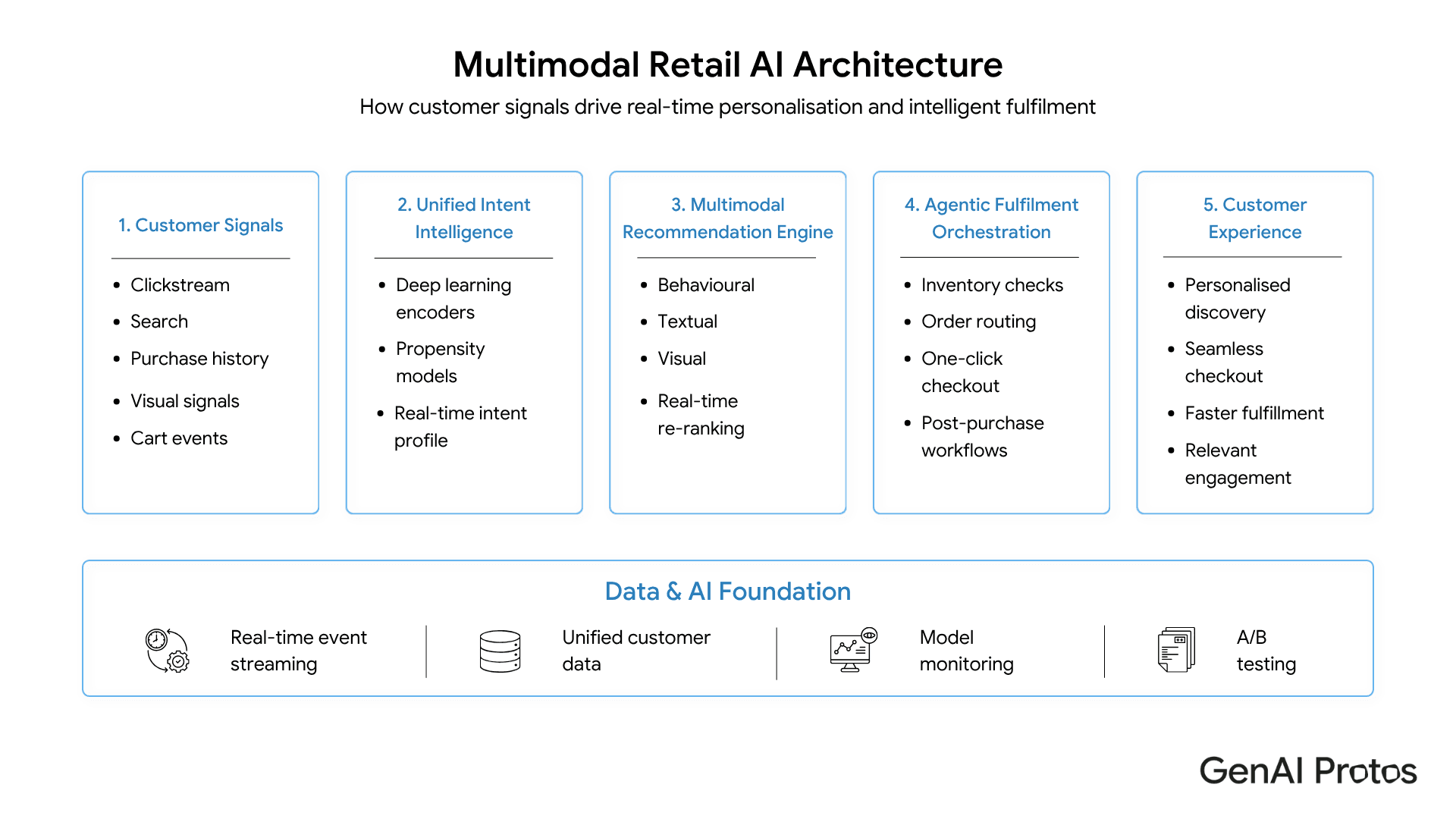
- Customer Signals
- Collects clickstream, search, purchase history, visual signals and cart events.
- Unified Intent Intelligence
- Uses deep learning encoders, propensity models and real-time intent profiles.
- Multimodal Recommendation Engine
- Combines behavioural, textual and visual signals to re-rank recommendations in real time.
- Agentic Fulfilment Orchestration
- Coordinates inventory checks, order routing, one-click checkout and post-purchase workflows.
- Customer Experience
- Improves personalised discovery, checkout, fulfilment and relevant engagement.
- Data and AI Foundation
- Supports real-time event streaming, unified customer data, model monitoring and A/B testing.
Prompt-to-Output Workflow
The customer journey uses AI signals from discovery through post-purchase engagement. Each step improves the next action, from understanding browsing intent to re-ranking products, predicting propensity, accelerating checkout and triggering relevant follow-up workflows.
Understands browsing intent from page views, product hover behaviour, visual engagement, and live session context.
Interprets search queries with customer history, product metadata, and live session behaviour to identify what the shopper is trying to find.
Re-ranks products in real time using behavioural, textual, and visual signals aligned to the customer's current intent.
Predicts purchase propensity and recommends relevant complementary products when a customer adds items to the cart.
Pre-fills preferences and accelerates payment using stored customer context, reducing friction at the final conversion step.
Triggers tracking updates, cross-sell prompts, loyalty nudges, and follow-up workflows based on purchase behaviour.
Implementation Highlights
- Real-time event streaming
- Ingests clickstream, cart and purchase events with sub-second latency.
- Unified customer representation
- Consolidates behavioural, textual and visual signals into a continuously updated customer intent profile.
- Deep learning and regression models
- Supports personalised product recommendations, demand forecasting, churn prediction and purchase propensity scoring.
- Multimodal recommendation logic
- Uses visual preference analysis, image-based product matching and cross-channel intent detection.
- Agentic orchestration
- Automates multi-step tasks across inventory, fulfilment and personalisation workflows.
- A/B testing and causal inference
- Measures recommendation and fulfilment changes against revenue and engagement lift before broader rollout.
- Model governance
- Uses drift monitoring, fairness audits and retraining pipelines embedded from day one.
Measured Technical Details
Why This Matters
The value of the build is not only better recommendations. The larger business pattern is a connected AI operating layer that links intent intelligence, product discovery, checkout and fulfilment into one customer journey. This gives retail teams a stronger foundation for conversion, retention and operational efficiency.
Results
GenAI Protos delivered a production-grade retail AI platform that unifies customer signals, improves recommendations, accelerates checkout and automates fulfilment workflows. The implementation improved revenue, loyalty, discovery, customer satisfaction and operational efficiency while creating a reusable real-time data foundation for future retail AI use cases.
| Outcome | What changed |
|---|---|
| Incremental revenue uplift | 35% sales uplift through personalised recommendations and one-click fulfilment. |
| Customer loyalty improvement | 20% improvement across repeat purchase, retention and reactivation metrics. |
| Better product discovery | Multimodal recommendations improved cross-sell and upsell conversion. |
| Faster fulfilment | AI-triggered routing reduced manual intervention in fulfilment workflows. |
| Stronger retail data foundation | Unified customer intent data can now support demand forecasting, merchandising and supplier planning. |
Reusable Pattern
This use case can be reused as a pattern for retail and e-commerce systems where personalisation, fulfilment and customer engagement need to operate as one connected AI workflow instead of disconnected point tools.
- Signal unification: combine clickstream, search, purchase, visual and cart events into one intent layer.
- Recommendation design: fuse behavioural, textual and visual embeddings for real-time ranking.
- Decision orchestration: connect recommendations to checkout, inventory and fulfilment actions.
- Measurement layer: use A/B testing and causal inference to prove revenue and engagement impact.
- Governance layer: monitor drift, fairness, latency and performance after deployment.
Build AI Into Your Retail Stack
GenAI Protos designs and delivers production-grade AI systems for retail and e-commerce enterprises. From personalisation to fulfilment orchestration, we build AI systems that are grounded in measurable customer and business outcomes.
Get custom solutions