Executive Summary
GenAI Protos deployed Moonshine STT as a lightweight speech-to-text service for English voice workflows that do not need to occupy GPU capacity. The service is designed for always-on operation with a small CPU memory footprint.
The implementation exposes OpenAI-compatible audio transcription endpoints through the private gateway and includes additional operational routes for health, model metadata, and raw transcription output.
The result is a practical edge-friendly STT pattern for voice commands, live transcription, accessibility tools, call logging, and rapid voice AI prototyping.
At a Glance
- Use case
- Always-on CPU speech-to-text service for English voice workflows.
- Deployment style
- FastAPI service wrapping Moonshine ONNX, running without GPU dependency.
- Primary interface
- OpenAI-compatible audio transcription endpoint through the GenAI Protos gateway.
- Resource profile
- Approximately 300 MB RAM for tiny and 600 MB RAM for base; 0 GPU.
- Operational profile
- Always-on service designed for continuous low-impact operation.
- Technical outcome
- Deployed as part of the GenAI Protos DGX Spark model catalog and private gateway pattern.
The Challenge
Not every voice AI workflow should consume GPU capacity. Voice commands, accessibility overlays, edge devices, local dictation, and always-on capture often need simple, fast transcription with predictable resource use.
The challenge was to package a CPU-only speech model as a private API service that could stay available continuously while remaining easy for applications to call.
- Deliver speech-to-text without depending on GPU availability.
- Keep the service small enough for always-on operation.
- Expose transcription through a familiar API shape.
- Support raw text and JSON-style responses for different application needs.
- Document performance, resource footprint, and model options for developers.
What GenAI Protos Built
GenAI Protos packaged Moonshine STT into a private CPU transcription service with gateway access and lightweight operations.
- FastAPI service wrapping Moonshine ONNX models.
- OpenAI-compatible transcription route for application compatibility.
- Tiny and base model options for different footprint and quality needs.
- Always-on CPU deployment with no GPU requirement.
- Operational endpoints for health, model listing, feature metadata, and raw text output.
Solution Architecture
The architecture is intentionally small: CPU model serving, gateway access, and simple transcript output.
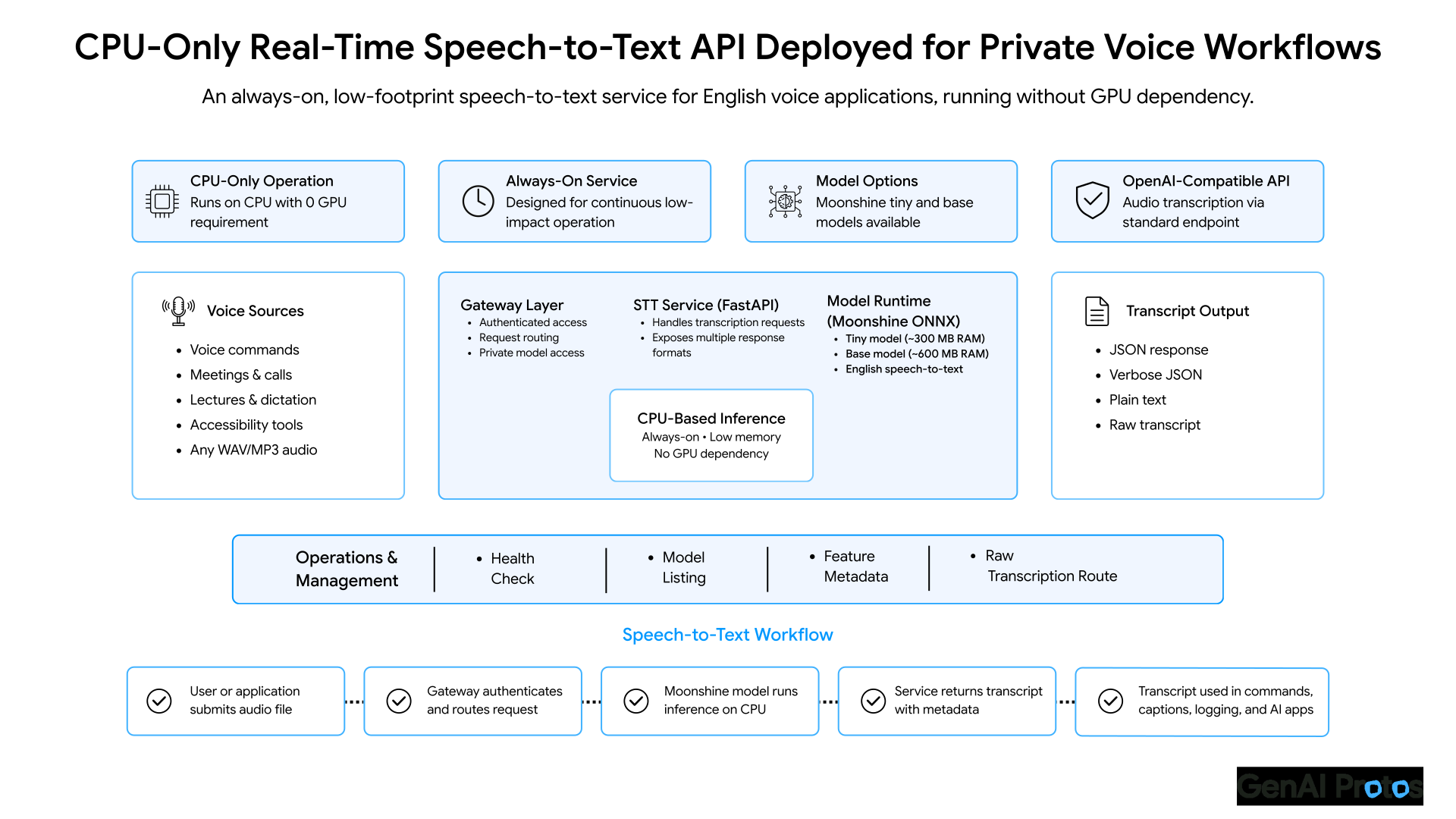
- Voice input
- Audio from commands, meetings, lectures, accessibility tools, or local voice apps.
- Gateway layer
- Provides governed access and routes audio transcription requests.
- STT service
- FastAPI service runs Moonshine ONNX inference on CPU.
- Model options
- FastAPI service runs Moonshine ONNX inference on CPU.
- Model options
- Tiny and base models support tradeoffs between memory footprint and transcription performance.
- Output layer
- Returns JSON, verbose JSON, text, or raw transcription depending on the route.
Prompt-to-Output Workflow
The voice-to-text workflow shows how lightweight English audio transcription runs through a private gateway and CPU-only Moonshine service for low-footprint voice applications.
A user or application sends an audio file to the private transcription endpoint.
The gateway authenticates the request and forwards it to the CPU STT service.
Moonshine runs inference through the selected tiny or base model.
The service returns transcript text with optional performance metadata.
The transcript can power commands, captions, logging, accessibility, or downstream AI workflows.
Implementation Highlights
This section captures the CPU inference design, always-on operating model, API compatibility, model options, and operational visibility provided by the Moonshine STT service.
- CPU inference
- Moonshine was deployed through ONNX runtime without GPU dependency.
- Always-on operation
- The service was designed for continuous availability with low idle memory usage.
- API compatibility
- Standard audio transcription endpoints support easy integration.
- Model choice
- Tiny and base models provide deployment flexibility for footprint and speed.
- Operational visibility
- Health and model metadata routes make the service easier to inspect and operate.
Measured Technical Details
The technical details below record the available models, language scope, RAM footprint, GPU usage, performance profile, configured limits, cost fields, and catalog context.
Why This Matters
The value of this service is not only speech-to-text. The stronger pattern is an always-on, CPU-only transcription layer that can support voice capture without competing with GPU-heavy AI workloads.
Results
The implementation provides a private always-on STT service that is practical for voice applications where GPU use would be unnecessary or expensive.
| Outcome | What changed |
|---|---|
| CPU-only transcription | Speech-to-text runs without occupying GPU capacity. |
| Always-on readiness | The service can remain available for voice input with a low system footprint. |
| Developer compatibility | OpenAI-compatible transcription access simplifies integration. |
| Edge-friendly pattern | The service is suitable for local, low-bandwidth, or offline-first voice workflows. |
| Operational clarity | Model options, response formats, performance headers, and health routes are documented. |
Reusable Pattern
This pattern is useful when a private voice system needs constant availability without tying up accelerator resources.
- Use CPU STT for always-on or low-throughput voice capture.
- Reserve GPU models for heavier multilingual or long-form transcription workloads.
- Expose the service through a standard transcription API.
- Document response formats and performance metadata for downstream systems.
- Pair with local TTS for compact voice I/O systems.
Build Lightweight Voice AI That Runs Where You Need It
GenAI Protos helps teams build private voice AI systems across edge, CPU, GPU, and hybrid deployments with model serving and product integration around the model.
Get custom solutions