Executive Summary
GenAI Protos deployed TRELLIS as a private 3D generation API for image-to-3D and text-to-3D workflows. The service returns textured 3D assets, supports synchronous or asynchronous job handling, and uses on-demand model loading with idle unload to manage resource use.
The focus is practical deployment: model packaging, gateway integration, operational controls, and reusable API access for product and engineering teams.
The content stays close to the documented technical build and avoids unsupported adoption or ROI claims.
At a Glance
- Use case
- Private 3D generation API for image-to-3D and text-to-3D workflows.
- Output formats
- Textured GLB plus additional supported 3D asset formats.
- Serving pattern
- FastAPI service exposed through custom gateway routes.
- Job design
- Synchronous return or async job submission with polling.
- Lifecycle
- Lazy loading and idle unload after inactivity.
- Typical latency
- Approximately 40-70 seconds per standard image-to-3D generation in source notes.
The Challenge
3D generation is useful for product visualization and prototyping, but raw model workflows are often too slow or manual for application teams.
Long-running generation needs async job handling so web interfaces do not block while assets are being created.
The system also needed to support private processing of images and prompts while returning usable 3D assets in standard formats.
What GenAI Protos Built
- Packaged TRELLIS behind a FastAPI 3D generation service.
- Supported image-to-3D and text-to-3D generation modes.
- Returned textured GLB assets and additional model formats where configured.
- Added async job submission, status polling, and asset download routes.
- Used lazy-load and idle-unload behavior to avoid keeping the 3D pipeline loaded when inactive.
Solution Architecture
The architecture separates the application interface, gateway layer, model service, runtime, and operations lane so the model can be consumed as a reusable private AI capability rather than a one-off local experiment.
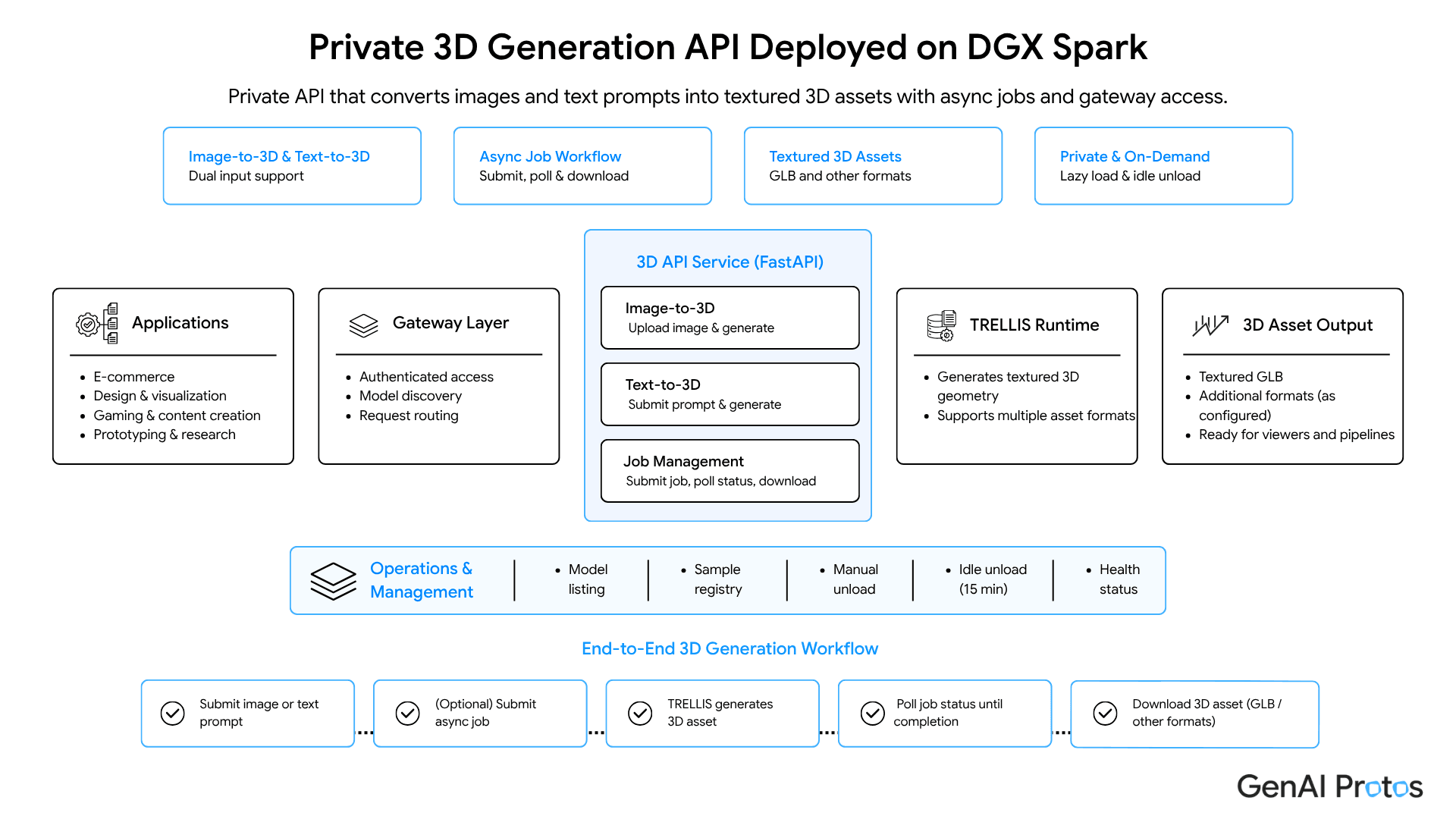
- Application layer
- E-commerce, design, gaming, or prototyping workflow submits image or text prompt.
- Gateway layer
- Provides authenticated routing and model discovery.
- 3D API service
- Handles image-to-3D, text-to-3D, job submission, polling, and asset delivery.
- TRELLIS runtime
- Generates textured 3D geometry and asset outputs.
- Asset layer
- Returns GLB or related outputs for viewers, pipelines, and downstream tools.
- Operations lane
- Model listing, health, manual unload, and idle unload support controlled operation.
Prompt-to-Output Workflow
The 3D generation workflow shows how image or text prompts move through gateway routing, async job handling, TRELLIS generation, asset delivery, and model lifecycle controls.
A user submits an image or text prompt with output configuration.
For longer runs, the application submits an async job and receives a job ID.
The pipeline generates a 3D asset and records job status.
The application polls until completion and downloads the resulting asset.
The model can unload after idle time to free memory for other services.
Implementation Highlights
This section summarises dual input support, async job handling, asset delivery, on-demand serving, and gateway registration for the private 3D generation service.
- Dual input support
- Image and text routes allow different product entry points into the same 3D service.
- Async job model
- Job submission and polling prevent user interfaces from waiting on long requests.
- Asset delivery
- Completed assets are returned in web- and pipeline-friendly formats.
- On-demand serving
- Lazy loading and idle unload are used because 3D generation is bursty and resource-intensive.
- Gateway registration
- The service is cataloged and accessed through the same private model gateway as the broader fleet.
Measured Technical Details
The technical details below record image and text pipeline memory, generation time, idle lifecycle, rate limit, and output asset format.
Why This Matters
The value of this build is not only generating 3D assets. The stronger pattern is turning a heavy generative asset model into a private API that supports product-style job handling and usable file outputs.
Results
GenAI Protos delivered an API-ready private AI service that can be discovered, called, monitored, and operated through the same model-serving pattern used across the wider private AI catalog.
| Outcome | What changed |
|---|---|
| 3D generation as a service | Image and text prompts became usable through a private API instead of manual model execution. |
| Application-ready workflow | Async jobs, polling, and asset download support real product UI patterns. |
| Resource-aware operation | Idle unload and manual unload reduce standing memory use. |
| Reusable generative asset pattern | The same approach can support other heavy media-generation models that return files instead of text. |
Reusable Pattern
This pattern can be reused for heavy generative asset services that return files, need async jobs, and require explicit model lifecycle management.
- Use async job APIs for generation workloads measured in tens of seconds.
- Return standard asset formats to reduce downstream integration effort.
- Use gateway pass-through routes when outputs are files rather than chat messages.
- Manage heavy model lifecycle explicitly to preserve shared infrastructure capacity.
Build Private 3D Generation Workflows That Fit Product Systems
GenAI Protos helps teams turn 3D generation models into private APIs with async jobs, asset delivery, and controlled model lifecycle.
Get custom solutions