Executive Summary
A private image generation and editing service was deployed to show how a visual AI model can move from a local model stack into a repeatable, gateway-accessible system that product and engineering teams can test safely.
The build uses Z-Image-Turbo with a FastAPI service layer and LiteLLM gateway routing. It supports standard image generation through an OpenAI-compatible API surface and adds custom routes for extended text-to-image generation, image-to-image editing, inpainting, upscaling, refinement, LoRA listing, upscaler listing, model preloading, and health visibility.
The result is a reusable private AI media pattern: one governed access layer, one stable service wrapper, clear endpoint behavior, queue controls, and documented performance/resource characteristics on NVIDIA DGX Spark.
At a Glance
- Use case
- Private image generation and editing API for visual AI experimentation, product mock-ups, and controlled media workflows.
- Deployment style
- Self-hosted image service on NVIDIA DGX Spark with gateway-managed access.
- Core capability
- Text-to-image, image-to-image, inpainting, upscaling, refinement, and LoRA-assisted visual generation.
- Primary interface
- FastAPI service exposed through OpenAI-compatible image routes and selected custom pass-through routes.
- Model registrations
- Five model entries: text-to-image, image edit, inpaint, refine, and upscale.
- Operational controls
- Health endpoint, model/asset preload route, queue depth control, rate limits, and memory/queue status visibility.
- Technical outcome
- A reusable private AI service pattern for image models that need both standard API compatibility and custom visual workflow routes.
The Challenge
Image generation models are often demonstrated as scripts, notebooks, or isolated web UIs. That is useful for experimentation, but it is not enough when teams need controlled access, repeatable API behavior, model discovery, queue handling, and a clean path for product integration.
The challenge was to package an image generation and editing model so it could be used as a private service without exposing internal deployment details or forcing every workflow into a single generic endpoint.
- Create a practical API layer for text-to-image and image editing workflows.
- Support both OpenAI-compatible image generation and custom routes for advanced operations.
- Expose the service through the same gateway pattern used across the broader GenAI Protos model catalog.
- Keep resource behavior visible, including memory footprint, loading behavior, queue depth, and health status.
- Document the system clearly enough for developers and operators to discover, test, and reuse it.
What GenAI Protos Built
GenAI Protos built a private image generation and editing suite around Z-Image-Turbo. The model was served through a FastAPI application and registered inside the DGX Spark model catalog so it could be discovered alongside other GenAI Protos model services.
- A FastAPI service using diffusers pipelines for Z-Image text-to-image, image-to-image, and inpainting workflows.
- Five gateway-registered image model entries covering generation, edit, inpaint, refine, and upscale capabilities.
- OpenAI-compatible image generation support for easier integration with existing SDKs and orchestration tools.
- Custom pass-through routes for LoRA stacking, seeded generation, image-to-image edits, mask-based inpainting, 4K upscaling, and refinement.
- Health and preload routes for operational visibility and controlled model/asset readiness.
- Queue and rate-limit behavior suitable for controlled evaluation and early application integration.
Solution Architecture
The architecture separates the developer interface, gateway layer, image service, model pipelines, and output/operations layer. This keeps the public API story clear while allowing advanced image workflows to remain available through controlled routes.
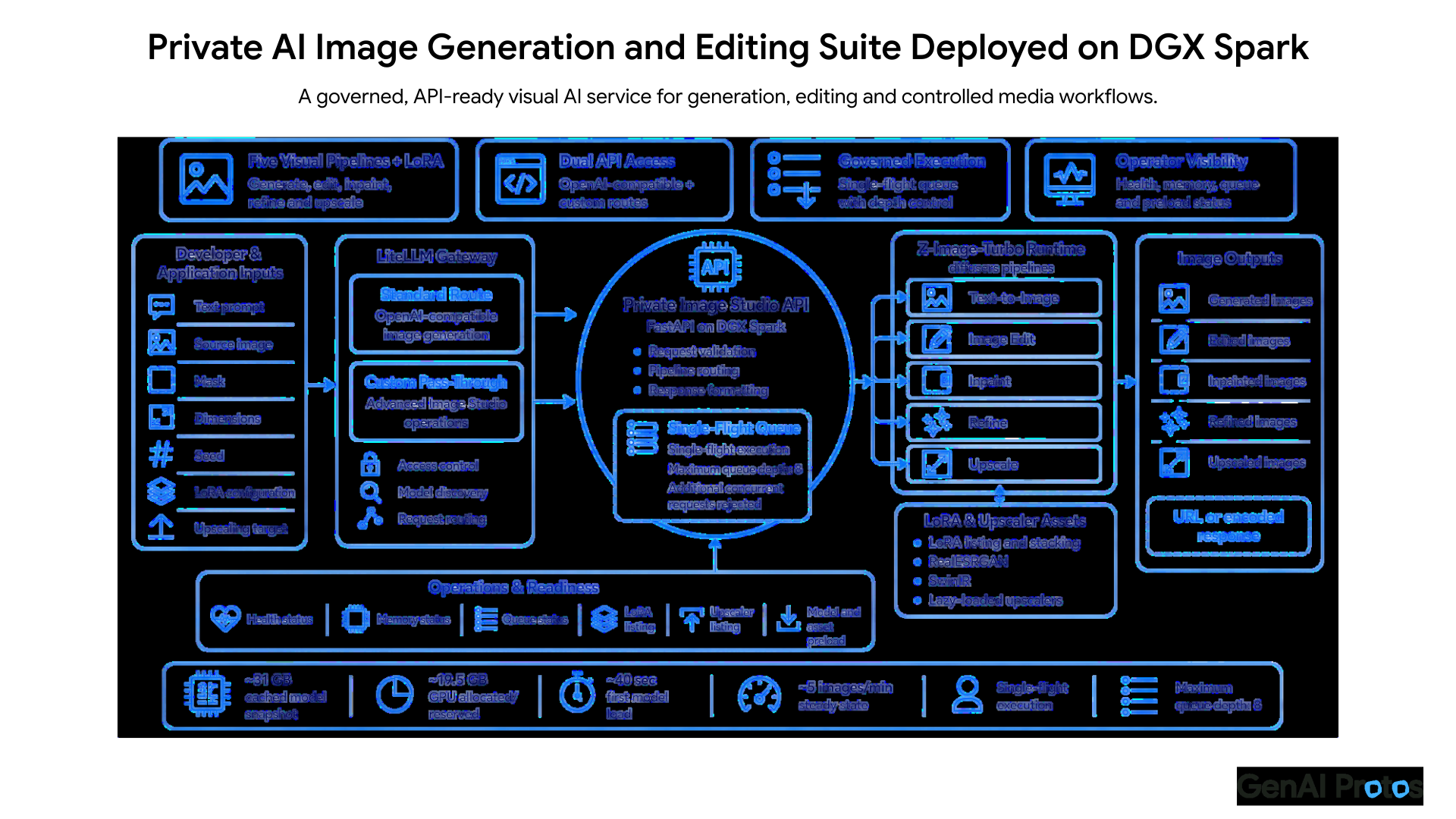
- Application or developer
- Submits prompts, image files, masks, dimensions, seed values, LoRA configuration, or upscaling parameters.
- LiteLLM gateway
- Provides shared access control, model discovery, standard image route support, and pass-through routing for advanced operations.
- Image API service
- FastAPI service receives requests, manages queue behavior, routes to the right image pipeline, and returns image output.
- Model runtime
- Z-Image pipelines handle text-to-image, image-to-image, and inpainting. Upscalers are lazy-loaded when needed.
- Output layer
- Returns generated or edited images through URL or encoded response formats, depending on request type.
- Operations lane
- Health status, memory/queue status, LoRA listing, upscaler listing, and preload behavior support day-to-day operation.
Prompt-to-Output Workflow
The prompt-to-image workflow shows how prompts, images, masks, LoRA settings, and upscaling requests move through the gateway, queue, image pipelines, and output layer.
A user or application submits a text prompt, source image, mask, output size, seed, LoRA configuration, or upscaling target.
The gateway authenticates the call and routes it either through the standard image generation interface or a custom Image Studio pass-through route.
The FastAPI service places work into a single-flight queue so GPU execution remains controlled under concurrent demand.
The service returns the image output in the requested response format and exposes operational state through health and status endpoints.
For advanced workflows, LoRAs and upscalers can be listed or preloaded so the service is ready before a product demo or batch task.
Implementation Highlights
This section summarises how GenAI Protos packaged the image model into a governed visual AI service with standard routes, custom routes, queue control, resource visibility, and operator readiness.
- Model serving
- The model was wrapped behind a FastAPI service so it could behave like a private application endpoint rather than a local-only model setup.
- Gateway integration
- The image suite was registered under the GenAI Protos gateway pattern with both standard and custom routes.
- Image workflows
- The service supports text-to-image, image-to-image editing, inpainting, upscaling, refinement, and LoRA-driven visual style workflows.
- Compatibility
- Standard image generation can be called through an OpenAI-compatible route, while advanced workflows use custom pass-through routes.
- Resource control
- The always-on service has documented first-load behavior, GPU memory footprint, queue depth, and steady-state throughput.
- Operator visibility
- Health, memory status, queue status, LoRA listing, upscaler listing, and preload routes were documented for service operation.
Measured Technical Details
The technical details below record the image model suite, serving stack, cached weights, GPU allocation, upscaler behaviour, first-load timing, throughput, queue policy, catalog registration, and route limits.
Why This Matters
The value of the build is not only that it generates images. The stronger pattern is that a complex visual model was converted into a private, governed service with clear integration and operating behavior.
Results
GenAI Protos delivered a working private AI image generation and editing service that can be discovered, called, monitored, and reused within the same gateway-oriented operating model used for the wider DGX Spark AI catalog.
| Outcome | What changed |
|---|---|
| Private API access | The image model became an API-callable service for controlled text-to-image and image editing workflows. |
| Developer-ready workflow | Standard image generation and advanced custom routes support practical application integration. |
| Operational readiness | Health, queue, memory, model loading, LoRA, and upscaler behavior were documented for operators. |
| Gateway consistency | The service fits the shared model gateway pattern used across the GenAI Protos private model fleet. |
| Resource-aware serving | The deployment records memory footprint, first-load timing, throughput, and queue policy instead of leaving resource behavior implicit. |
Reusable Pattern
This case study can be reused as a pattern for private visual AI systems where the raw model is useful but the repository alone is not enough for product teams.
- Model wrapper: package the image model behind a stable service layer.
- Gateway route: expose standard operations through compatible APIs and advanced operations through governed pass-through routes.
- Workflow design: support generate, edit, inpaint, upscale, refine, and style-control paths instead of treating image generation as one endpoint.
- Resource design: document memory footprint, load behavior, throughput, and queue limits.
- Operational design: expose health, status, and preload behavior before the service is presented as product-ready.
Build a Private Visual AI System You Can Actually Operate
GenAI Protos helps teams turn image, video, speech, and multimodal models into private, API-ready systems with model serving, gateway integration, workflow design, health checks, and product integration around the model.
Get custom solutions