Executive Summary
BFSI teams handle large volumes of voice data across contact centers, customer support, branch operations, advisory conversations, and internal service workflows. Turning that audio into reliable text is often the first step toward search, review, summarization, quality monitoring, and compliance analysis.
GenAI Protos deployed a private speech-to-text service that packages a specialist Whisper-Medium transcription model behind an API-ready service layer. The service uses faster-whisper with CTranslate2 for efficient inference on DGX Spark and exposes a familiar OpenAI-compatible transcription interface for application teams.
The result is a reusable private AI speech pattern for BFSI: audio stays within controlled infrastructure, applications call a standard transcription API, and operators get a deployment model that can be monitored, limited, and expanded across other speech services.
At a Glance
- Use case
- Private BFSI speech-to-text service for recorded and streaming voice workflows.
- Relevant BFSI workflows
- Contact-center transcription, customer-call records, claims conversations, branch support audio, accessibility captions, and internal review workflows.
- Model foundation
- Specialist Whisper-Medium speech-to-text model
- Serving pattern
- Faster-whisper with CTranslate2 backend on DGX Spark.
- Interfaces
- OpenAI-compatible batch transcription and streaming support
- Gateway role
- Cataloged and routed through the GenAI Protos private AI gateway.
- Operational focus
- Private deployment, health visibility, request limits, and resource-aware execution.
The Challenge
In BFSI environments, voice data is not just operational content. It can contain customer context, financial details, service history, claims information, escalation notes, or compliance-relevant statements. That makes public or loosely governed transcription workflows difficult to adopt for sensitive use cases.
The technical requirement was to move beyond a standalone model and create a private transcription capability that product teams could call without managing model runtime details directly.
- Provide a private transcription endpoint for BFSI voice workflows.
- Support both batch audio uploads and streaming use cases for voice-agent or live-caption patterns.
- Expose the service through a familiar OpenAI-compatible transcription route.
- Keep the deployment resource-aware so it can coexist with other models in the DGX Spark catalog.
- Document health, limits, and operating behavior for repeatable engineering use.
What GenAI Protos Built
- A private speech-to-text API packaged around a specialist Whisper-Medium transcription model.
- An efficient inference runtime using faster-whisper and CTranslate2.
- OpenAI-compatible transcription access for batch audio workflows.
- Streaming support suitable for live voice experiences and speech-to-intent pipelines.
- Gateway integration inside the GenAI Protos private model catalog.
- Health and operational routes to support controlled day-to-day use.
Solution Architecture
The architecture separates the BFSI application layer, gateway, speech service, inference runtime, and output layer. This lets the model operate as a reusable private AI capability instead of a one-off local experiment.
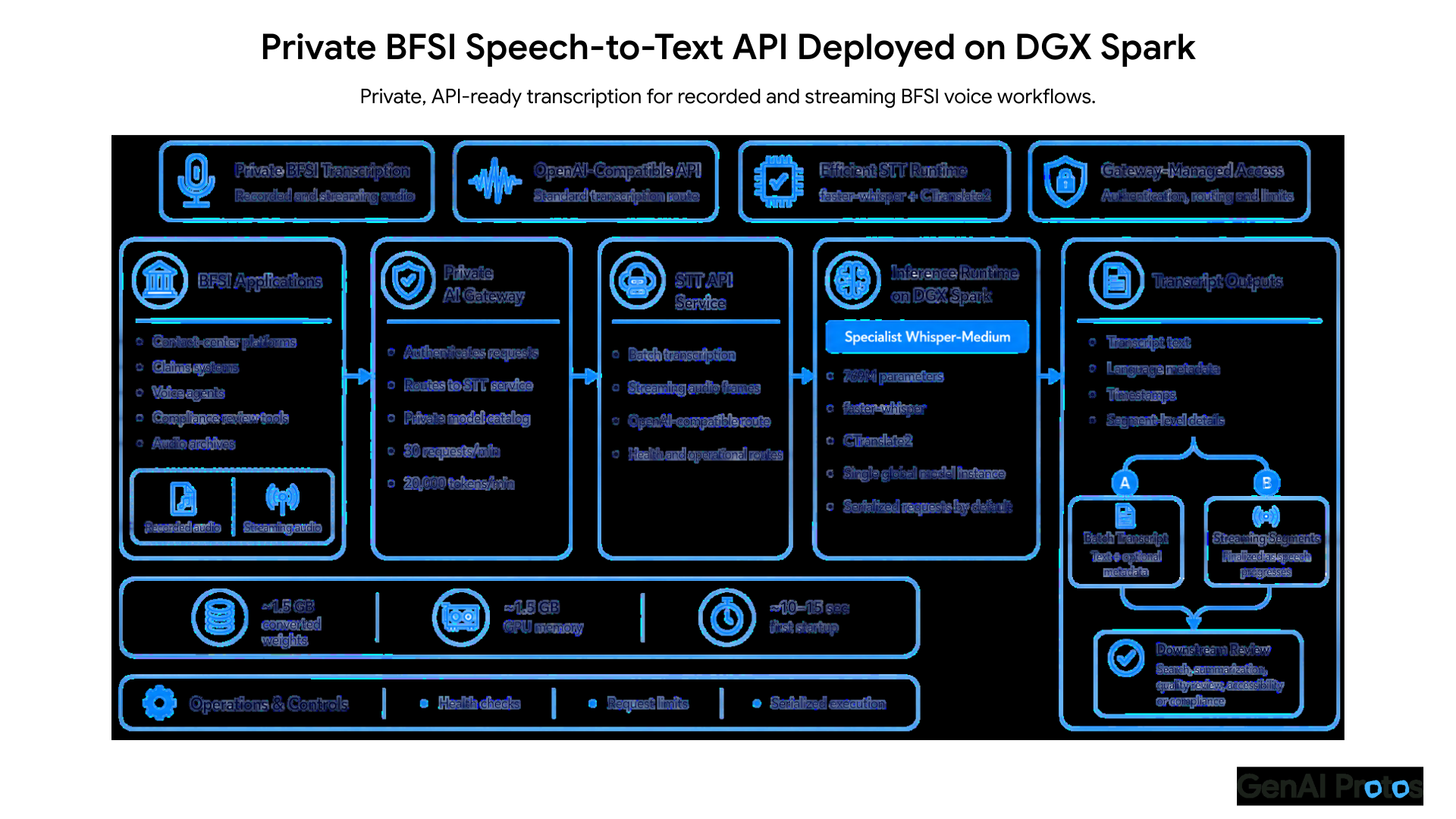
- BFSI application layer
- Contact-center platform, claims system, voice agent, compliance review tool, or archive system submits audio.
- Private gateway layer
- Authenticates and routes requests through the shared GenAI Protos model gateway pattern.
- STT API service
- Accepts recorded audio for batch transcription or streaming audio frames for live workflows.
- Inference runtime
- Runs the specialist STT model through faster-whisper and CTranslate2.
- Output layer
- Returns transcript text, language metadata, timestamps, and segment-level details where requested.
- Operations lane
- Health checks, limits, and serialized execution help keep the service predictable under controlled use.
Prompt-to-Output Workflow
The BFSI speech-to-text workflow shows how recorded or streaming audio moves through private gateway routing, specialist STT processing, transcript output, and downstream review workflows.
A BFSI application sends recorded customer audio or streams live speech into the private AI environment.
The gateway authenticates the request and routes it to the speech-to-text service.
The STT runtime processes the audio with the configured specialist model.
For batch requests, the API returns transcript text and optional verbose metadata.
For streaming use cases, speech segments are finalized and returned as the conversation progresses.
The transcript can then feed search, summarization, quality review, accessibility captions, or downstream compliance workflows.
Implementation Highlights
This section captures the specialist STT service, efficient runtime, OpenAI-style integration, streaming readiness, gateway cataloging, and concurrency controls documented for the BFSI speech deployment.
- Specialist STT service
- A fine-tuned Whisper-Medium transcription model was packaged as an API service instead of remaining a model artifact.
- Efficient runtime
- Faster-whisper and CTranslate2 provide a practical inference profile on DGX Spark.
- OpenAI-style integration
- Applications can use the standard transcription route instead of adopting a custom SDK for the model.
- Streaming readiness
- The service supports streaming patterns for voice-agent, live-caption, and speech-to-intent use cases.
- Gateway cataloging
- The model is discoverable alongside other STT, TTS, LLM, image, video, and 3D services.
- Controlled concurrency
- Requests are serialized by default to avoid GPU thrashing when sharing resources with other workloads.
Measured Technical Details
The technical details below record the model family, parameter count, converted weights, runtime memory, startup behaviour, concurrency model, configured limits, and catalog context.
Why This Matters
The value of this service is not only transcription. The stronger pattern is giving BFSI teams a private speech-to-text capability that can support sensitive voice workflows without exposing audio to unmanaged systems.
Results
GenAI Protos delivered an API-ready private speech-to-text capability that can be discovered, called, monitored, and operated through the same model-serving pattern used across the wider private AI catalog.
| Outcome | What changed |
|---|---|
| Private BFSI transcription access | Speech-to-text became available as a private API capability for BFSI-style voice workflows. |
| Batch and live paths | The service supports recorded audio workflows and streaming patterns. |
| Application-ready interface | Teams can integrate through an OpenAI-compatible transcription route. |
| Resource-aware deployment | A compact runtime footprint allows the service to coexist with other DGX Spark workloads. |
| Reusable speech pattern | The approach can be adapted for other industry-specific or language-specialist transcription models. |
Reusable Pattern
This pattern can be reused for industry-specific speech-to-text systems where teams need private audio processing, standard API access, streaming behaviour, and downstream compliance or review workflows.
- Use specialist STT models where generic transcription does not meet domain, accent, or workflow requirements.
- Expose a standard transcription API so product teams can integrate without custom model-specific clients.
- Pair private STT with downstream summarization, quality review, compliance search, and voice-agent workflows.
- Keep concurrency and runtime behavior explicit when multiple models share private GPU infrastructure.
- Document health, limits, response formats, and streaming behavior before moving from prototype to product integration.
Build Private Speech AI for BFSI Workflows
GenAI Protos helps BFSI teams package speech-to-text, text-to-speech, and voice AI models into private APIs for contact centers, compliance review, accessibility, and customer-facing workflow automation.
Get custom solutions