Executive Summary
GenAI Protos deployed a private coding and reasoning LLM service on NVIDIA DGX Spark using vLLM and FP8 quantization. The build exposes OpenAI-compatible chat completions through a governed gateway, supports streaming, tool-use patterns, and code-review workflows, and uses warm-up steps to reduce first-request latency after model start.
The focus is practical deployment: model packaging, gateway integration, operational controls, and reusable API access for product and engineering teams.
The content stays close to the documented technical build and avoids unsupported adoption or ROI claims.
At a Glance
- Use case
- Private coding and reasoning LLM API for engineering workflows.
- Model capability
- Dense 27B model for code generation, code review, debugging, documentation, and multi-step reasoning.
- Serving pattern
- vLLM with OpenAI-compatible chat completions.
- Deployment mode
- FP8 quantization with warm-up after start to reduce first-request latency.
- Gateway role
- Unified access, model discovery, rate limits, and API consistency.
The Challenge
Engineering teams need private LLM access for source-code-heavy workflows without sending internal code, logs, or architectural details to unmanaged external systems.
A model repository alone is not enough. Teams need an API surface, predictable startup behavior, streaming support, and a resource plan that can coexist with other private AI services on the same hardware.
The deployment also needed to support longer context use cases while remaining practical in a shared DGX Spark environment.
What GenAI Protos Built
- Packaged Qwen3.6-27B as a private OpenAI-compatible chat service.
- Served the model through vLLM using FP8 quantization on DGX Spark unified memory.
- Exposed the service through the GenAI Protos gateway for catalog discovery and authenticated application access.
- Added warm-up behavior after model start so the first real user request does not carry the full cold-start penalty.
- Kept the service on-demand so GPU memory can be reclaimed when other models need the same hardware.
Solution Architecture
The architecture separates the application interface, gateway layer, model service, runtime, and operations lane so the model can be consumed as a reusable private AI capability rather than a one-off local experiment.
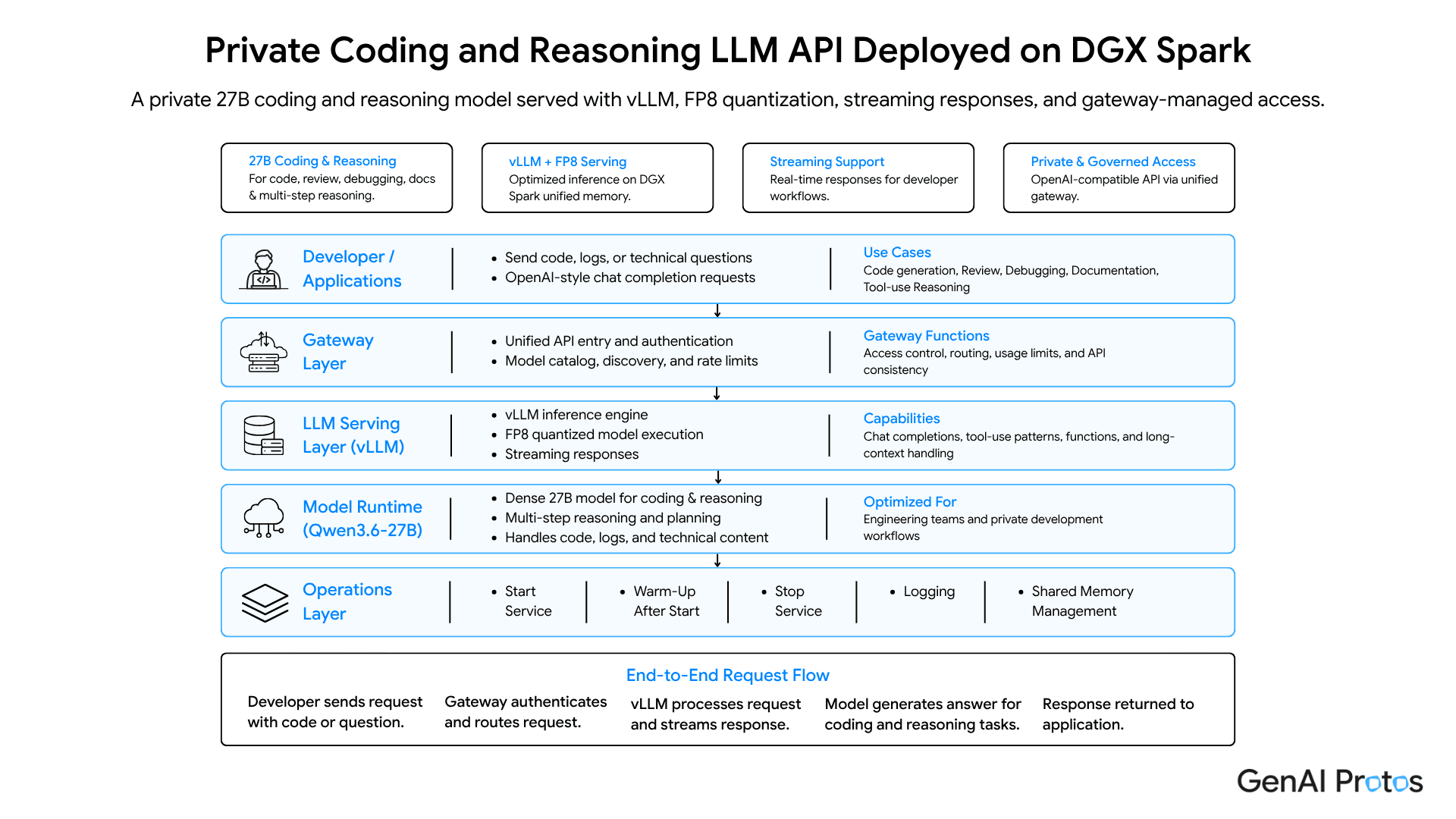
- Developer or application
- Sends chat, code, log, or documentation prompts through an OpenAI-style request.
- Gateway layer
- Provides the common API entry point, catalog registration, and access controls.
- LLM serving layer
- Runs vLLM with FP8 model execution and streaming support.
- Model runtime
- Serves Qwen3.6-27B for coding, reasoning, tool-use, and technical writing tasks.
- Operations lane
- Start, stop, warm-up, logging, and shared-memory controls support day-to-day operation.
Prompt-to-Output Workflow
An engineering application sends code, logs, or technical prompts to the private gateway.
The gateway resolves the model registration and forwards the request to the LLM runtime.
vLLM streams the response when the client requests streaming output.
Developers use the response for code review, debugging, documentation, or implementation planning.
Operators can stop the service when GPU memory needs to be returned to the wider model fleet.
Implementation Highlights
- Model serving
- The 27B model was served through vLLM with OpenAI-compatible chat completions.
- Quantization
- FP8 serving reduced memory pressure while preserving a practical private deployment profile.
- Warm-up
- A warm-up request was added after start to prepare the runtime before user traffic.
- Shared deployment
- The model was tuned for a shared DGX Spark environment rather than assuming exclusive hardware.
- API consistency
- Applications can call the model through the same gateway pattern used by other GenAI Protos services.
Measured Technical Details
Why This Matters
The value of this deployment is not only a private coding model. The stronger pattern is turning a large reasoning model into an API-ready engineering service that can support code, logs, documentation, and tool-enabled workflows inside controlled infrastructure
Results
GenAI Protos delivered an API-ready private AI service that can be discovered, called, monitored, and operated through the same model-serving pattern used across the wider private AI catalog.
| Outcome | What changed |
|---|---|
| Private LLM access | Engineering users gained an API-callable private LLM service for code and reasoning tasks. |
| Operational predictability | Warm-up and on-demand controls reduced friction around model startup and resource sharing. |
| Gateway consistency | The model became discoverable through the same private AI gateway used by the wider model fleet. |
| Reusable pattern | The deployment pattern can support other private LLM services that need OpenAI-compatible access and controlled memory use. |
Reusable Pattern
- Use a model gateway to keep application integration stable.
- Use FP8 quantization and model warm-up for shared infrastructure efficiency.
- Treat model lifecycle controls as part of the product, not an afterthought.
- Register the model with clear limits, purpose, and operating notes.
Build a Private LLM Service Your Engineering Teams Can Use
GenAI Protos helps teams package, serve, and integrate private LLMs with gateway access, model lifecycle controls, and application-ready API
Get custom solutions