Executive Summary
GenAI Protos deployed PersonaPlex-7B as a private speech-to-speech runtime for real-time, bidirectional voice interactions. The implementation focuses on low-latency voice exchange, persona control, voice variants, and runtime access through a direct WebSocket protocol.
Unlike standard HTTP model endpoints, PersonaPlex uses a custom WebSocket interface. GenAI Protos treated that as an explicit architecture constraint rather than forcing the model into the wrong API shape.
The result is a private voice-agent runtime pattern for interactive assistants, companions, game characters, onboarding flows, and other real-time voice experiences.
At a Glance
- Use case
- Private full-duplex speech-to-speech runtime for real-time voice agents.
- Deployment style
- On-demand GPU runtime on NVIDIA DGX Spark.
- Core model capability
- PersonaPlex-7B speech-to-speech model with persona prompts and 18 voice variants.
- Primary interface
- Direct WebSocket protocol for real-time audio interaction.
- Resource profile
- Approximately 14 GB VRAM and on-demand startup with warm-up requirements.
- Technical outcome
- Deployed as part of the GenAI Protos DGX Spark model catalog and private gateway pattern.
The Challenge
Real-time voice agents require a different deployment model than text chat or batch transcription. They need continuous audio exchange, persona consistency, low-latency response behavior, and protocol handling that supports streaming voice frames. The challenge was to package a non-HTTP, WebSocket-based speech-to-speech model into a private operating pattern that engineering teams can evaluate and integrate cleanly.
- Respect the native WebSocket protocol instead of forcing the model into a standard chat API.
- Support real-time bidirectional audio exchange for interactive voice experiences.
- Expose persona and voice control in a repeatable runtime pattern.
- Document audio format, warm-up behavior, runtime footprint, and integration requirements.
- Keep the model discoverable inside the wider private model catalog.
What GenAI Protos Built
GenAI Protos packaged PersonaPlex-7B as a private full-duplex speech-to-speech runtime with a clear separation between discovery and real-time interaction.
- On-demand PersonaPlex-7B runtime on DGX Spark.
- Direct WebSocket integration pattern for real-time voice exchange.
- Persona control through system prompts.
- Support for 18 distinct voice variants according to the model reference.
- Catalog registration for discoverability while documenting that the model does not expose a native OpenAI HTTP route.
Solution Architecture
The architecture separates application voice capture, WebSocket runtime, persona control, and voice output.
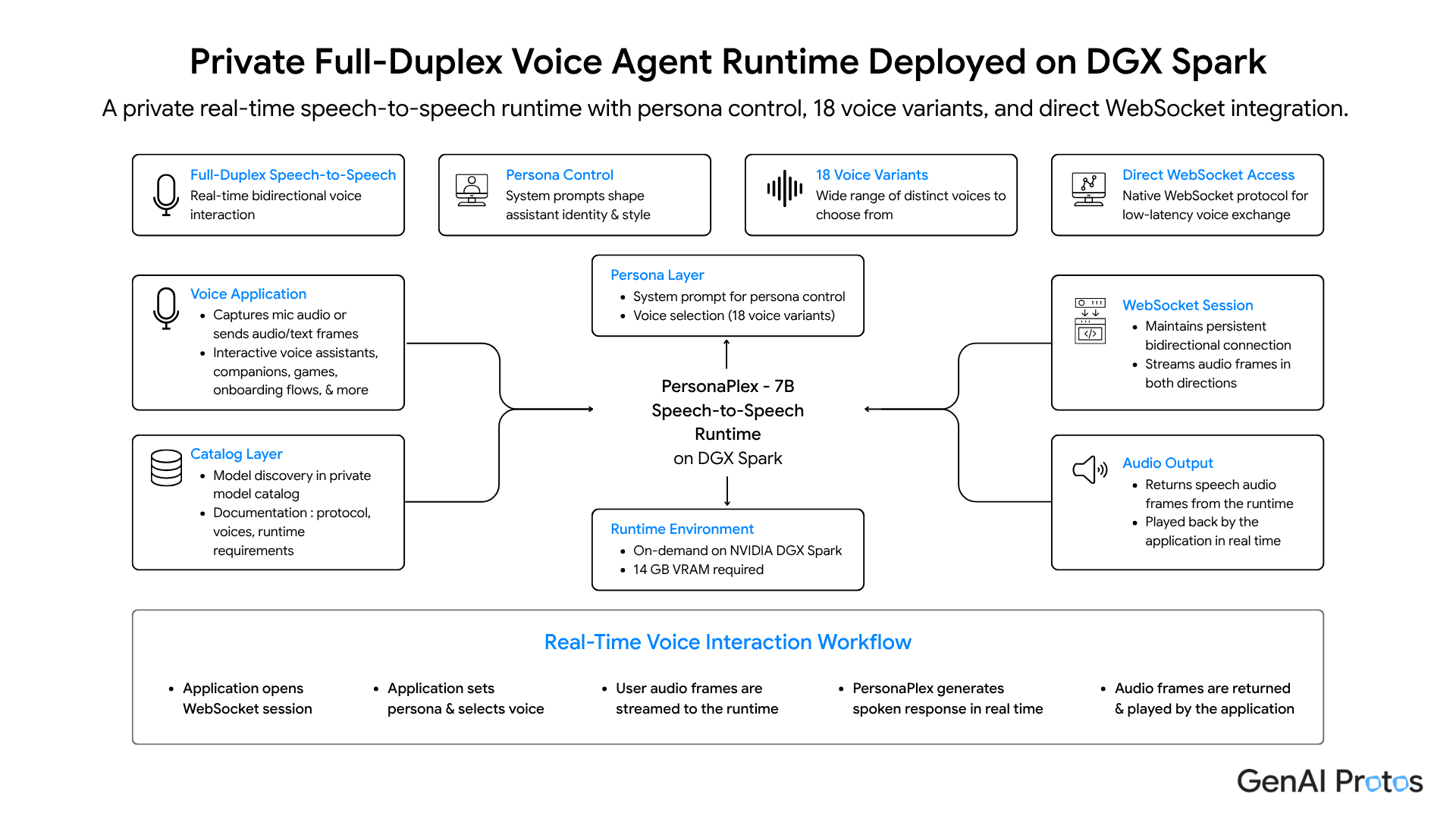
- Voice application
- Captures microphone audio or sends text/audio frames for interactive voice experiences.
- WebSocket session
- Maintains the real-time bidirectional connection needed for full-duplex interaction.
- Persona layer
- Applies system prompt and voice selection to control assistant identity and speaking style.
- Speech-to-speech runtime
- Runs PersonaPlex-7B inference on DGX Spark.
- Audio output
- Returns speech audio frames back to the application for playback.
- Catalog layer
- Lists the model in the private catalog for discoverability and documentation.
Prompt-to-Output Workflow
A voice application opens a direct WebSocket session with the private runtime.
The application sets persona and voice configuration for the session.
User audio frames are streamed into the speech-to-speech runtime.
PersonaPlex generates spoken response frames in near real time.
The application plays the returned audio while maintaining the ongoing conversation context.
Implementation Highlights
- Runtime packaging
- PersonaPlex was deployed as a private GPU-backed speech-to-speech runtime.
- Protocol handling
- The model was documented as WebSocket-based rather than incorrectly positioned as an HTTP OpenAI endpoint.
- Persona control
- System prompt and voice variant controls were captured as part of the integration pattern.
- Operational readiness
- Warm-up timing, model footprint, audio format, and direct connection behavior were documented.
- Catalog integration
- The model was added for discovery while preserving the native protocol requirements.
Measured Technical Details
Why This Matters
The value of this build is not only real-time voice output. The stronger pattern is respecting a full-duplex model's native runtime so interactive voice experiences can be evaluated without forcing the system into the wrong API shape.
Results
The implementation created a reusable private runtime for real-time voice agents where the native interaction model is full-duplex audio rather than request-response text.
| Outcome | What changed |
|---|---|
| Private voice runtime | PersonaPlex can be evaluated and integrated as a private speech-to-speech system. |
| Protocol clarity | The documentation makes clear that direct WebSocket integration is required for real-time use. |
| Persona-ready interaction | Voice and persona controls support distinct assistant identities. |
| Real-time pattern | The runtime supports ongoing audio exchange rather than batch transcription or simple TTS. |
| Reusable integration path | The same approach can guide other non-OpenAI, protocol-specific AI services. |
Reusable Pattern
Document the native protocol before designing the application interface. Separate catalog discovery from runtime interaction when needed. Expose persona and voice configuration as first-class integration controls. Capture audio format and chunk requirements for application developers. Use direct real-time protocols when conversational latency matters more than gateway uniformity.
Build Real-Time Voice AI Around the Right Runtime Pattern
GenAI Protos helps teams package private voice models into usable products with runtime integration, protocol design, edge/private deployment, and application workflows around the model.
Get custom solutions