Executive Summary
GenAI Protos deployed a private multi-mode text-to-speech system that supports preset voices, instruction-based voice design, and reference-audio voice cloning. The system uses a FastAPI orchestrator in front of multiple vLLM-Omni backends and exposes OpenAI-compatible speech access through the GenAI Protos gateway.
The focus is practical deployment: model packaging, gateway integration, operational controls, and reusable API access for product and engineering teams.
The content stays close to the documented technical build and avoids unsupported adoption or ROI claims.
At a Glance
- Use case
- Private multi-mode text-to-speech service.
- Task modes
- Preset voice, voice design, and reference-audio voice cloning.
- Languages
- 11 supported language options plus auto-detect metadata.
- Serving pattern
- FastAPI orchestrator with three vLLM-Omni backend roles.
- Streaming
- PCM streaming supported for real-time audio workflows.
- Operational profile
- On-demand model loading with management and health routes.
The Challenge
Voice systems often need more than one synthesis mode. Product teams may need a fixed preset voice for reliability, a designed voice for brand feel, and a reference-based voice for personalization.
Running all modes privately requires careful orchestration because different model backends serve different tasks and each has its own memory footprint.
The implementation needed a consistent API surface while preserving operational visibility into voices, languages, tasks, and backend health.
What GenAI Protos Built
- Built a private TTS service with preset voice, voice design, and voice cloning modes.
- Placed a FastAPI orchestrator in front of three specialized vLLM-Omni backends.
- Exposed OpenAI-compatible speech generation through the common GenAI Protos gateway.
- Added pass-through management routes for voices, languages, tasks, backend status, and health.
- Supported streaming PCM output for low-latency application experiences.
Solution Architecture
The architecture separates the application interface, gateway layer, model service, runtime, and operations lane so the model can be consumed as a reusable private AI capability rather than a one-off local experiment.
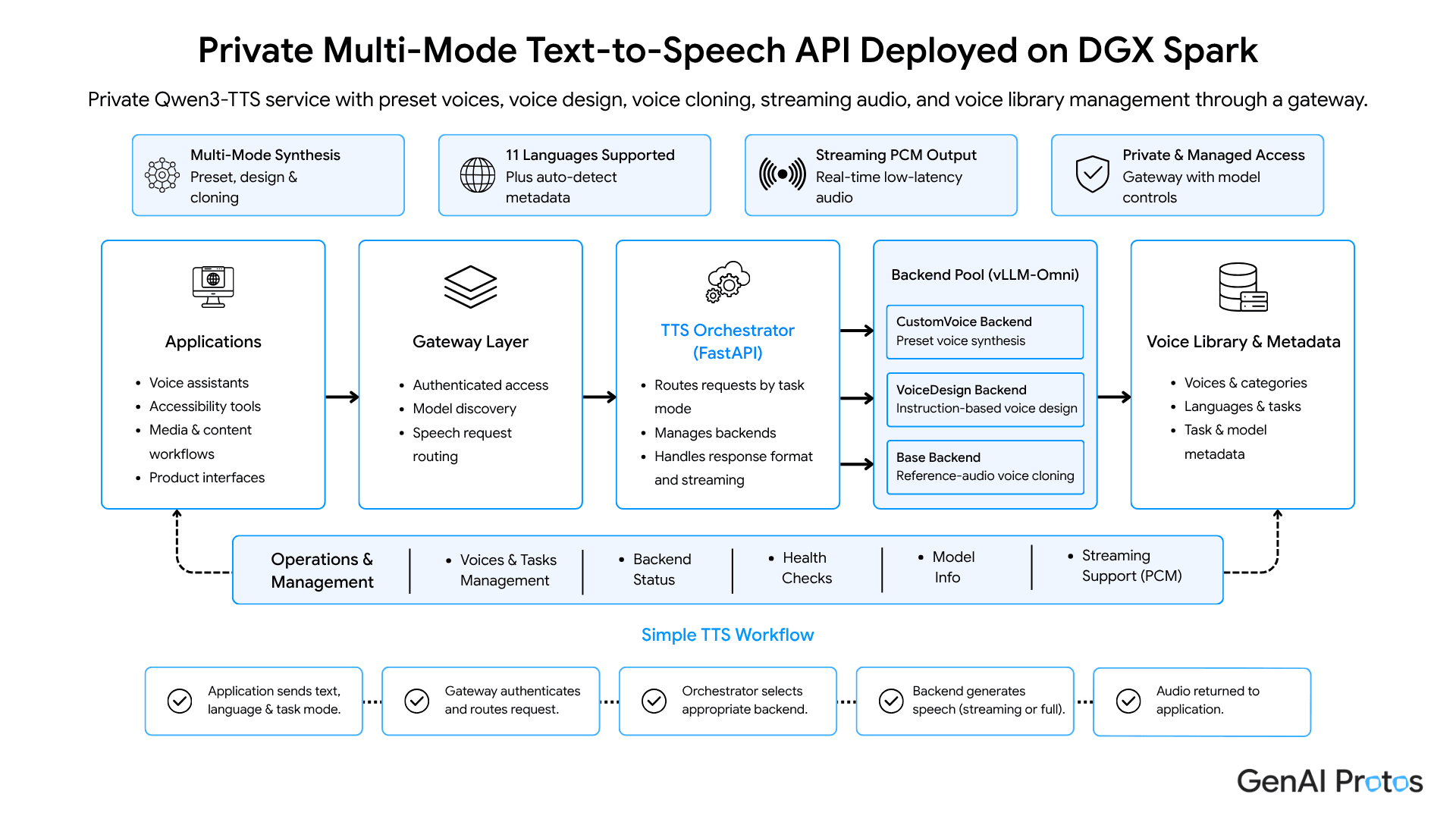
- Application layer
- Voice assistant, accessibility tool, media workflow, or product UI submits text and voice settings.
- Gateway layer
- Provides authenticated speech access and model discovery.
- Orchestrator
- Routes requests to the correct task backend based on preset voice, voice design, or cloning mode.
- Backend pool
- Runs separate model backends for CustomVoice, VoiceDesign, and Base cloning workflows.
- Voice library
- Stores and exposes voice metadata, supported voices, and task information.
- Output layer
- Returns audio in supported response formats, including streaming PCM for real-time paths.
Prompt-to-Output Workflow
The application submits text, language, response format, and the selected task mode.
The gateway authenticates and forwards the request to the speech service.
The orchestrator selects the correct backend for preset, designed, or reference-based voice generation.
The backend generates audio and streams or returns the output based on the request format.
Management endpoints expose available voices, task metadata, backend status, and health.
Implementation Highlights
- Multi-backend design
- Three backends were used so preset voice, voice design, and cloning tasks could operate in parallel.
- Streaming support
- PCM streaming enables real-time voice interfaces and audiovisual sync workflows.
- Voice inventory
- Voice metadata and task metadata were exposed so applications can choose the right synthesis path.
- Gateway integration
- The service was registered as a private speech model behind the shared model gateway.
- Operational controls
- Health and model-management routes support service readiness checks and backend control.
Measured Technical Details
Why This Matters
The value of this build is not only text-to-speech generation. The stronger pattern is packaging multiple voice modes behind one private service so product teams can choose preset, designed, or cloned speech without rebuilding the backend.
Results
GenAI Protos delivered an API-ready private AI service that can be discovered, called, monitored, and operated through the same model-serving pattern used across the wider private AI catalog.
| Outcome | What changed |
|---|---|
| API-ready voice service | Text-to-speech became available through a governed private API. |
| Flexible voice workflows | Teams can select preset voices, design voices from instructions, or use reference-audio cloning. |
| Real-time path | Streaming output supports interactive voice applications. |
| Reusable orchestration pattern | The orchestrator-plus-backend design can be reused for other multi-task voice AI systems. |
Reusable Pattern
- Separate task-specific backends when a single model service would create operational coupling.
- Expose voice and language metadata for product teams, not just raw synthesis endpoints.
- Use streaming output where perceived latency matters.
- Keep voice library management and health checks part of the API surface.
Build a Private Voice AI System Around Your Product Needs
GenAI Protos helps teams turn speech models into private APIs with orchestration, streaming, voice metadata, and application integration.
Get custom solutions