Executive Summary
GenAI Protos built a private multilingual transcription service around Whisper-large-v3 to convert recorded audio into searchable text through a governed API interface. The build focused on model serving, gateway integration, on-demand operation, and reusable documentation rather than a standalone demo.
The service is deployed on NVIDIA DGX Spark using vLLM and exposed through the shared model gateway with the standard audio transcription shape. This gives application teams a familiar API surface while keeping audio processing inside private infrastructure.
The result is a reusable private speech-to-text capability for meetings, podcasts, interviews, localization workflows, accessibility captions, and searchable audio archives.
At a Glance
- Use case
- Private multilingual speech-to-text API for recorded audio, transcripts, captions, and searchable audio workflows.
- Deployment style
- On-demand vLLM transcription service on NVIDIA DGX Spark.
- Core model capability
- Whisper-large-v3 speech-to-text with 99-language coverage.
- Primary interface
- OpenAI-compatible audio transcription endpoint through the GenAI Protos gateway.
- Resource profile
- Approximately 3-4 GB GPU footprint on DGX Spark with FP8 serving notes.
- Operational profile
- Started when needed through the STT inference stack and stopped when not required.
- Technical outcome
- Deployed as part of the GenAI Protos DGX Spark model catalog and private gateway pattern.
The Challenge
Teams that work with multilingual audio often need transcription for meetings, interviews, content archives, compliance review, and accessibility. Public transcription APIs are simple to start with, but they can create concerns around data movement, governance, repeatability, and integration into private AI platforms.
The technical challenge was to expose a reliable transcription model as a private, API-ready service while preserving a familiar developer experience.
- Provide a private transcription endpoint instead of relying on a one-off model script.
- Support multilingual audio workflows with a broad language coverage model.
- Use a standard API shape so existing speech-to-text integrations can connect with minimal changes.
- Keep the service aligned with the same gateway and catalog pattern used across the GenAI Protos model fleet.
- Document rate limits, cost fields, and operating behavior clearly for engineering teams.
What GenAI Protos Built
GenAI Protos packaged Whisper-large-v3 as a private transcription service and registered it inside the DGX Spark model catalog.
- OpenAI-compatible audio transcription route through the shared LiteLLM gateway.
- On-demand containerized deployment using the STT inference stack.
- Model catalog registration for discovery across the private model fleet.
- Documented rate limits, cost fields, response format behavior, and transcription use cases.
Solution Architecture
The architecture keeps the transcription API familiar while running the model inside private infrastructure.
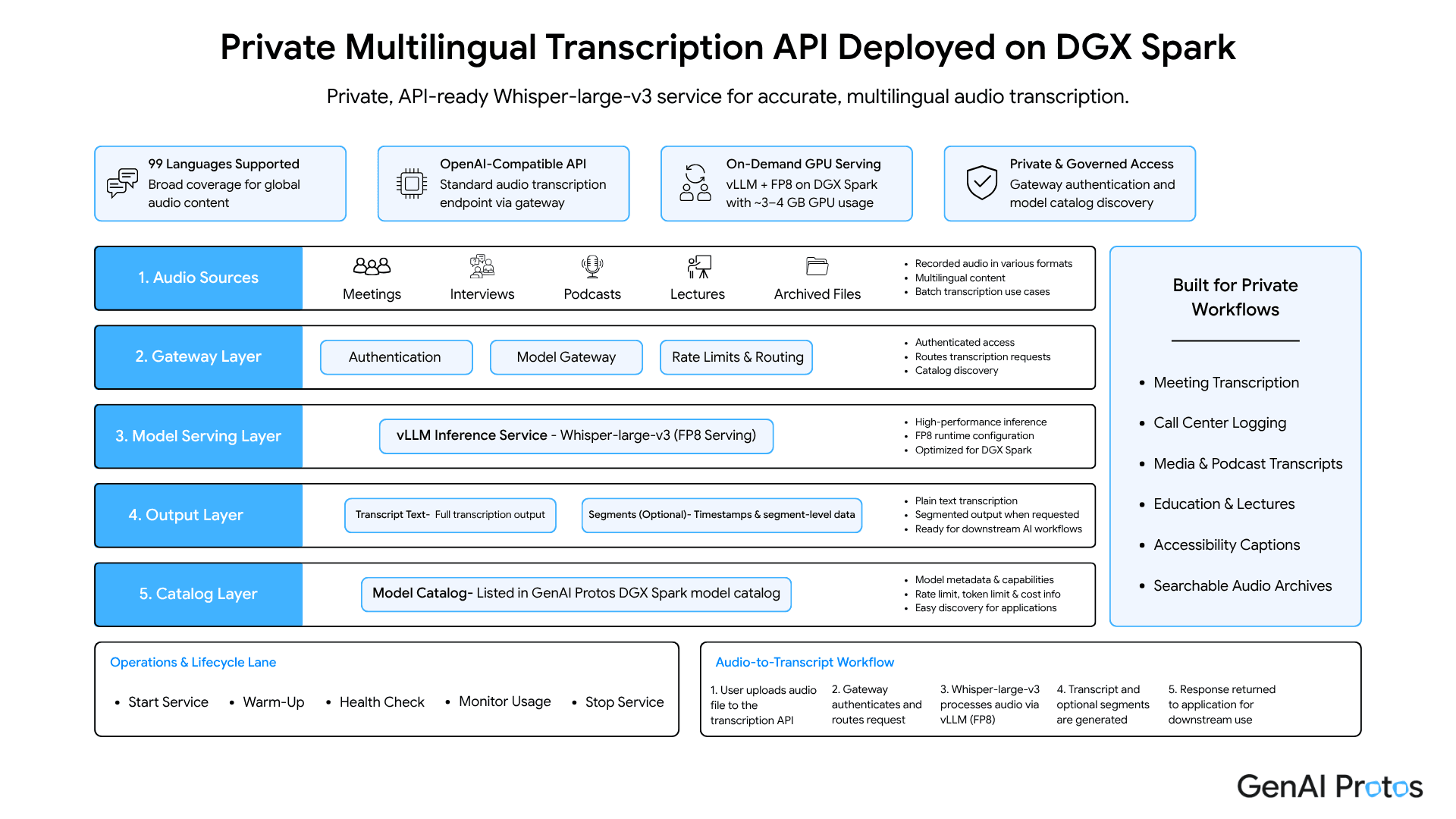
- Audio source
- Recorded meetings, interviews, podcasts, lectures, customer support audio, or archived files.
- Gateway layer
- Provides governed access and routes standard transcription requests to the private model backend.
- Model serving layer
- Runs Whisper-large-v3 through vLLM as an audio transcription service.
- Output layer
- Returns transcript text and, when requested, segment-level transcription metadata.
- Operations layer
- Supports on-demand startup, documented rate limits, and gateway-level catalog discovery.
Prompt-to-Output Workflow
The audio-to-transcript workflow shows how recorded audio is uploaded, routed through the private gateway, transcribed by Whisper-large-v3, and made available for downstream workflows.
A user or application uploads an audio file to the private transcription endpoint.
The gateway authenticates the request and routes it to the Whisper-large-v3 backend.
vLLM runs speech-to-text inference on the uploaded audio.
The service returns transcript text, with optional verbose metadata for downstream processing.
The transcript can feed search, summarization, translation, captioning, or record management workflows.
Implementation Highlights
This section captures how GenAI Protos packaged Whisper-large-v3 into a private transcription service with standard API compatibility, gateway integration, resource awareness, and repeatable documentation.
- Model serving
- Whisper-large-v3 was deployed behind a vLLM service for private speech-to-text inference.
- API compatibility
- The service uses the standard audio transcription route, avoiding a custom integration surface.
- Gateway integration
- The model was added to the shared gateway and catalog so teams can discover and call it consistently.
- Resource awareness
- The service runs on demand, helping avoid unnecessary GPU occupancy when transcription is not active.
- Documentation
- Model behavior, request format, response examples, rate limits, and use cases were captured for repeatable operation.
Measured Technical Details
The technical details below document the model, language coverage, serving engine, GPU footprint, on-demand availability, configured rate limit, cost field, and catalog context.
Why This Matters
The value of this service is not only transcription. The stronger pattern is that multilingual audio becomes a private, reusable data source that applications can search, summarize, translate, caption, and archive through a governed API.
Results
The implementation turned a speech-to-text model into a reusable private transcription service that application teams can call through a governed API.
| Outcome | What changed |
|---|---|
| Private transcription access | Audio transcription can run through the GenAI Protos private gateway instead of a public STT endpoint. |
| Developer-ready API | The standard transcription shape supports straightforward application integration. |
| Multilingual readiness | The model supports broad language coverage for global audio workflows. |
| Operational clarity | Deployment behavior, rate limits, and response formats are documented. |
| Reusable STT pattern | The same structure can support fallback, benchmarking, and specialized transcription models. |
Reusable Pattern
This pattern can be reused for private transcription services where audio must stay under tighter operational control.
- Use a standard transcription API for developer adoption.
- Keep model serving inside a private inference environment.
- Document rate limits, cost fields, response formats, and model behavior.
- Add multiple STT models for fallback or benchmark comparison where needed.
- Connect transcripts into downstream search, analytics, summarization, or accessibility workflows.
Build Private Speech AI That Fits Your Operating Model
GenAI Protos helps teams package speech models into private, API-ready systems with gateway access, model serving, monitoring, and product integration around the model.
Get custom solutions