Executive Summary
GenAI Protos deployed Piper Uzbek TTS as a private speech synthesis service for regional voice AI workflows that need native Uzbek output without GPU dependency.
The model is served through a custom FastAPI layer and exposed through gateway pass-through routes because its API shape is different from standard chat or speech endpoints.
The result is a practical low-footprint Uzbek TTS capability for voice assistants, IVR systems, localized content, accessibility audio, education, and regional product experiences.
At a Glance
- Use case
- Private Uzbek text-to-speech API for regional voice applications.
- Deployment style
- CPU-based FastAPI service with custom gateway pass-through routes.
- Core model capability
- Piper VITS Uzbek speech synthesis at 22.05 kHz.
- Voice coverage
- 16 speaker profiles including 2 hero Tashkent voices and 14 community speakers.
- Resource profile
- Approximately 150-200 MB RAM and negligible GPU usage.
- Operational profile
- On-demand service that loads quickly and runs per request on CPU.
- Technical outcome
- Deployed as part of the GenAI Protos DGX Spark model catalog and private gateway pattern.
The Challenge
Many multilingual AI systems still perform poorly for lower-resource or region-specific languages. For Uzbek voice experiences, teams need speech output that can run privately, stay lightweight, and integrate into broader AI assistant workflows.
The challenge was to expose a CPU-based Uzbek speech model through a governed API pattern without pretending it followed a standard OpenAI speech shape.
- Create a private Uzbek TTS endpoint for regional language applications.
- Use CPU inference to avoid GPU dependency for speech synthesis.
- Expose a custom API shape through gateway pass-through routes.
- Support multiple speaker profiles and adjustable speech speed.
- Document voice options, performance behavior, and operational endpoints.
What GenAI Protos Built
GenAI Protos packaged Piper Uzbek into a custom private TTS service with a simple API surface for Uzbek audio generation.
- FastAPI service around Piper VITS ONNX inference.
- Custom text-to-speech, streaming, voices, models, and health routes.
- Gateway pass-through integration for governed access.
- CPU-only deployment with no GPU resource dependency.
- Documented voice IDs, speed controls, response headers, rate limits, and use cases.
Solution Architecture
The architecture keeps the Uzbek synthesis service lightweight while still integrating with the GenAI Protos model gateway.
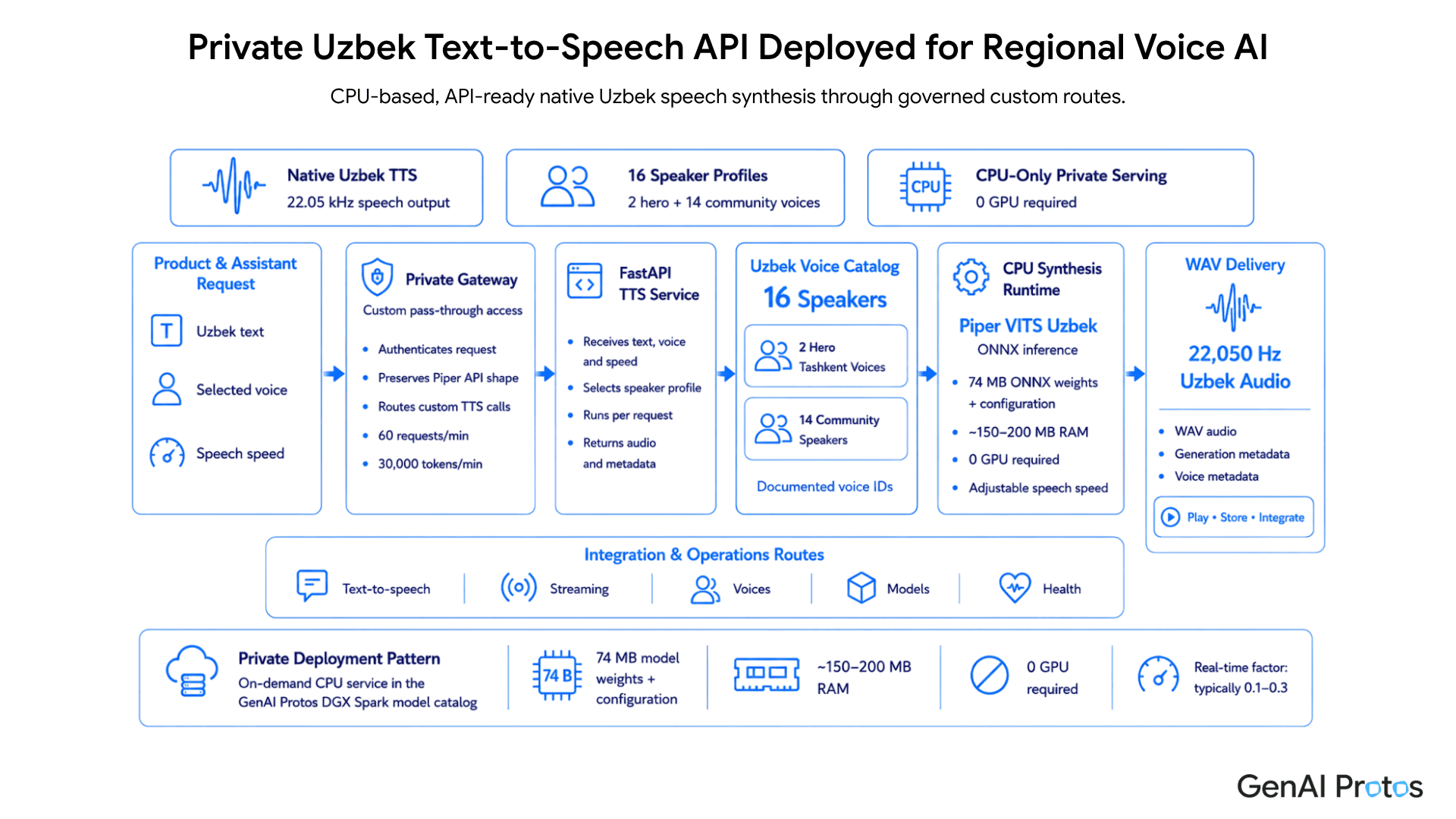
- Application or assistant
- Sends Uzbek text, selected voice, and speech speed settings.
- Gateway layer
- Authenticates requests and forwards custom TTS calls to the service.
- TTS service
- FastAPI service receives custom text-to-speech requests.
- Model runtime
- Piper VITS ONNX model runs Uzbek synthesis on CPU.
- Output layer
- Returns WAV audio with generation and voice metadata in response headers.
- Operations layer
- Health, voice listing, model metadata, and streaming routes support application integration.
Prompt-to-Output Workflow
The text-to-Uzbek-speech workflow shows how Uzbek text, voice settings, gateway routing, CPU synthesis, metadata, and product playback connect inside the private TTS service.
A product or assistant sends Uzbek text with a selected voice and speed setting.
The gateway authenticates the request and routes it to the Piper Uzbek service.
The FastAPI service runs CPU-based Piper VITS synthesis.
The service returns WAV audio and useful response metadata.
The generated audio can be used in assistants, IVR, accessibility, education, or localized content workflows.
Implementation Highlights
This section captures the custom API service, CPU execution profile, speaker support, gateway integration, and operational documentation required for regional Uzbek speech synthesis.
- Custom API service
- Piper Uzbek was wrapped in FastAPI because the service uses a custom TTS shape.
- CPU execution
- ONNX inference runs without GPU dependency.
- Speaker support
- Sixteen speaker profiles were documented for application selection.
- Gateway integration
- Pass-through routes expose TTS, streaming, voices, model metadata, and health checks.
- Operational documentation
- Performance notes, rate limits, response headers, voice IDs, and use cases were recorded for repeatable deployment.
Measured Technical Details
The technical details below record the Piper model, audio format, speaker profiles, model size, memory footprint, GPU usage, performance profile, and rate limit.
Why This Matters
The value of this service is not only Uzbek speech synthesis. The stronger pattern is making a regional language voice capability available as a lightweight private API that can be integrated into real product workflows.
Results
The implementation provides a private Uzbek speech synthesis service that can be integrated into regional language products without relying on GPU-heavy infrastructure.
| Outcome | What changed |
|---|---|
| Native Uzbek speech output | Applications can generate Uzbek audio from text through a private API. |
| Low resource footprint | CPU-only inference reduces GPU contention for other AI workloads. |
| Voice selection | Sixteen voices support different user experience needs. |
| Gateway consistency | Custom routes are exposed through the same governed access pattern used by the wider model fleet. |
| Regional AI readiness | The service supports assistants, IVR, localization, accessibility, and education workflows for Uzbek-language users. |
Reusable Pattern
This pattern is useful for language-specific TTS systems where a smaller CPU model is more practical than a general multilingual speech stack.
- Wrap the language model behind a stable API service.
- Use CPU inference when latency and quality targets do not require GPU acceleration.
- Expose custom API routes through a governed gateway instead of forcing a wrong interface.
- Document speaker IDs, language constraints, performance behavior, and output formats.
- Pair with regional STT models to build full voice-to-voice assistants.
Build Regional Voice AI That Works on Private Infrastructure
GenAI Protos helps teams build private speech systems for regional languages with model serving, gateway integration, edge deployment, and product-ready voice workflows.
Get custom solutions