Executive Summary
GenAI Protos deployed a private RVC voice conversion service that applies a trained reference voice model to uploaded audio or generated speech. The service wraps the RVC v2 inference pipeline in FastAPI, exposes custom gateway routes, and includes preload, unload, health, and model listing controls for operational use.
The focus is practical deployment: model packaging, gateway integration, operational controls, and reusable API access for product and engineering teams.
The content stays close to the documented technical build and avoids unsupported adoption or ROI claims.
At a Glance
- Use case
- Private voice conversion API for audio and TTS-to-voice workflows.
- Core capability
- Converts source audio into a consistent trained target voice.
- Serving pattern
- Custom FastAPI service exposed through gateway pass-through routes.
- Input modes
- Uploaded audio or text routed through a TTS-to-conversion pipeline.
- Lifecycle
- On-demand loading with preload and idle unload controls.
- Output
- WAV audio with timing and conversion metadata.
The Challenge
Voice conversion workflows often remain tied to local notebooks, audio tools, or one-off scripts, making them hard to integrate into products.
A useful private voice system needs upload handling, model selection, conversion controls, health status, and a path from text to synthesized voice.
The implementation had to expose a clear API without publishing personal training details or internal infrastructure paths.
What GenAI Protos Built
- Wrapped an RVC v2 voice conversion pipeline behind a FastAPI service.
- Exposed audio conversion and TTS-to-voice conversion through private gateway routes.
- Added model listing, sample listing, preload, unload, and health controls.
- Supported conversion parameters such as pitch shift, F0 method, retrieval weight, and consonant protection.
- Integrated the service as part of the wider GenAI Protos private model catalog.
Solution Architecture
The architecture separates the application interface, gateway layer, model service, runtime, and operations lane so the model can be consumed as a reusable private AI capability rather than a one-off local experiment.
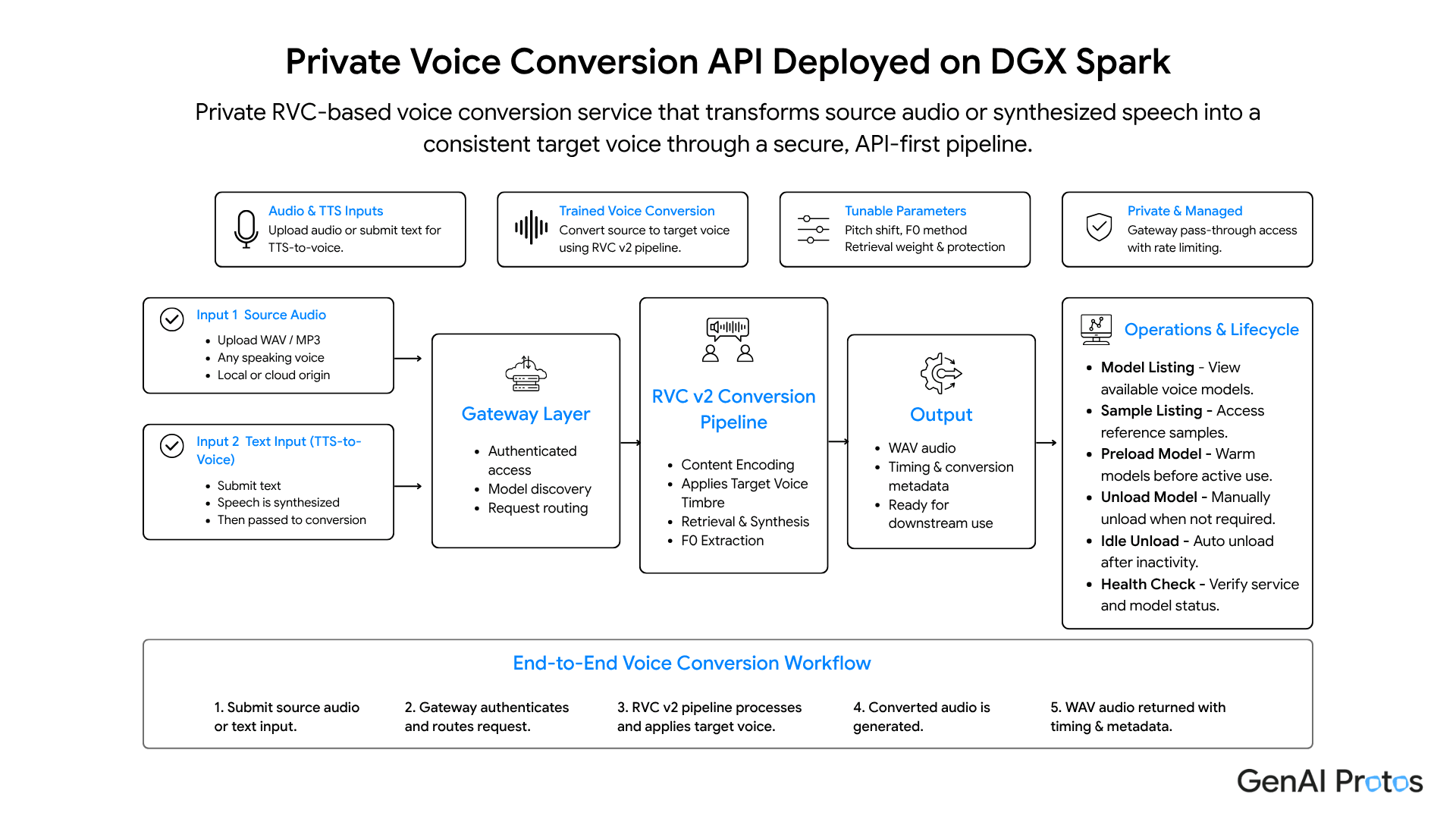
- Application layer
- Uploads audio or sends text for voice-converted output.
- Gateway layer
- Applies authenticated access and routes custom voice conversion requests.
- Conversion API
- Receives files or text, validates parameters, and manages conversion execution.
- RVC pipeline
- Uses content encoding, F0 extraction, retrieval, and synthesis stages to apply target voice timbre.
- Optional TTS lane
- Generates speech first, then passes it through conversion when text input is used.
- Operations lane
- Preload, unload, health, and model listing support reliable operatio
Prompt-to-Output Workflow
A user uploads source audio or submits text for conversion.
The gateway routes the request to the voice conversion service
For text input, speech is synthesized first and then passed to the conversion pipeline.
The conversion pipeline applies target voice characteristics and returns WAV output.
Operators can warm the model before active use or unload it after inactivity.
Implementation Highlights
- RVC serving
- The RVC inference pipeline was packaged as an API instead of a local audio script.
- Custom routes
- Gateway pass-through routes were used because the service does not match a native OpenAI endpoint shape.
- Lifecycle control
- Preload and unload controls reduce cold-start friction during planned use.
- Parameter control
- Pitch, retrieval weight, and protection settings expose practical audio tuning options.
- Catalog integration
- The service was registered with purpose, kind, and rate-limit metadata.
Measured Technical Details
Why This Matters
The value of this service is not only converting one voice into another. The stronger pattern is turning a custom voice conversion pipeline into a private API that product teams can call and operators can manage safely.
Results
GenAI Protos delivered an API-ready private AI service that can be discovered, called, monitored, and operated through the same model-serving pattern used across the wider private AI catalog.
| Outcome | What changed |
|---|---|
| Product-ready interface | Voice conversion became callable through a governed private API. |
| Two workflow paths | Teams can convert uploaded audio or generate speech and then convert it. |
| Operational control | Preload, unload, model listing, and health routes made the service easier to operate. |
| Reusable pattern | The pattern works for other custom voice conversion models that need private API packaging. |
Reusable Pattern
- Avoid exposing personal model names or training details in public case study copy.
- Treat conversion parameters as product-level controls, not only model internals.
- Use custom gateway routes when the model does not fit standard OpenAI endpoint shapes.
- Pair voice conversion with TTS when text-driven voice output is needed.
Build Private Voice Conversion Workflows Without One-Off Scripts
GenAI Protos helps teams convert voice models into private, API-ready services with gateway routing, lifecycle controls, and product integration.
Get custom solutions