Executive Summary
GenAI Protos deployed Seed-VC as a private zero-shot voice conversion service for speech and singing workflows. The service accepts source and reference audio, supports multiple model variants, exposes custom gateway routes, and includes preload, unload, model listing, and sample registry endpoints for product integration.
The focus is practical deployment: model packaging, gateway integration, operational controls, and reusable API access for product and engineering teams.
The content stays close to the documented technical build and avoids unsupported adoption or ROI claims.
At a Glance
- Use case
- Private zero-shot voice conversion for speech and singing.
- Input pattern
- Source audio plus reference speaker audio.
- Variants
- Tiny, standard, and singing voice conversion tiers.
- Serving pattern
- FastAPI backend exposed through custom gateway routes.
- Lifecycle
- On-demand model loading and idle unload.
- Operations
- Samples, model listing, preload, unload, and conversion routes.
The Challenge
Voice conversion teams often need to test multiple model tiers depending on latency, quality, and singing support.
A raw conversion repository is difficult to integrate into products because it lacks a stable request shape, sample registry, and operating controls.
The deployment needed to handle private audio while keeping conversion workflows behind authenticated access.
What GenAI Protos Built
- Packaged Seed-VC behind a FastAPI voice conversion service.
- Exposed three model variants through gateway catalog entries.
- Supported source and reference audio conversion through a custom API route.
- Added sample registry, model listing, preload, and unload controls.
- Used idle unload behavior to avoid keeping heavy models loaded unnecessarily.
Solution Architecture
The architecture separates the application interface, gateway layer, model service, runtime, and operations lane so the model can be consumed as a reusable private AI capability rather than a one-off local experiment.
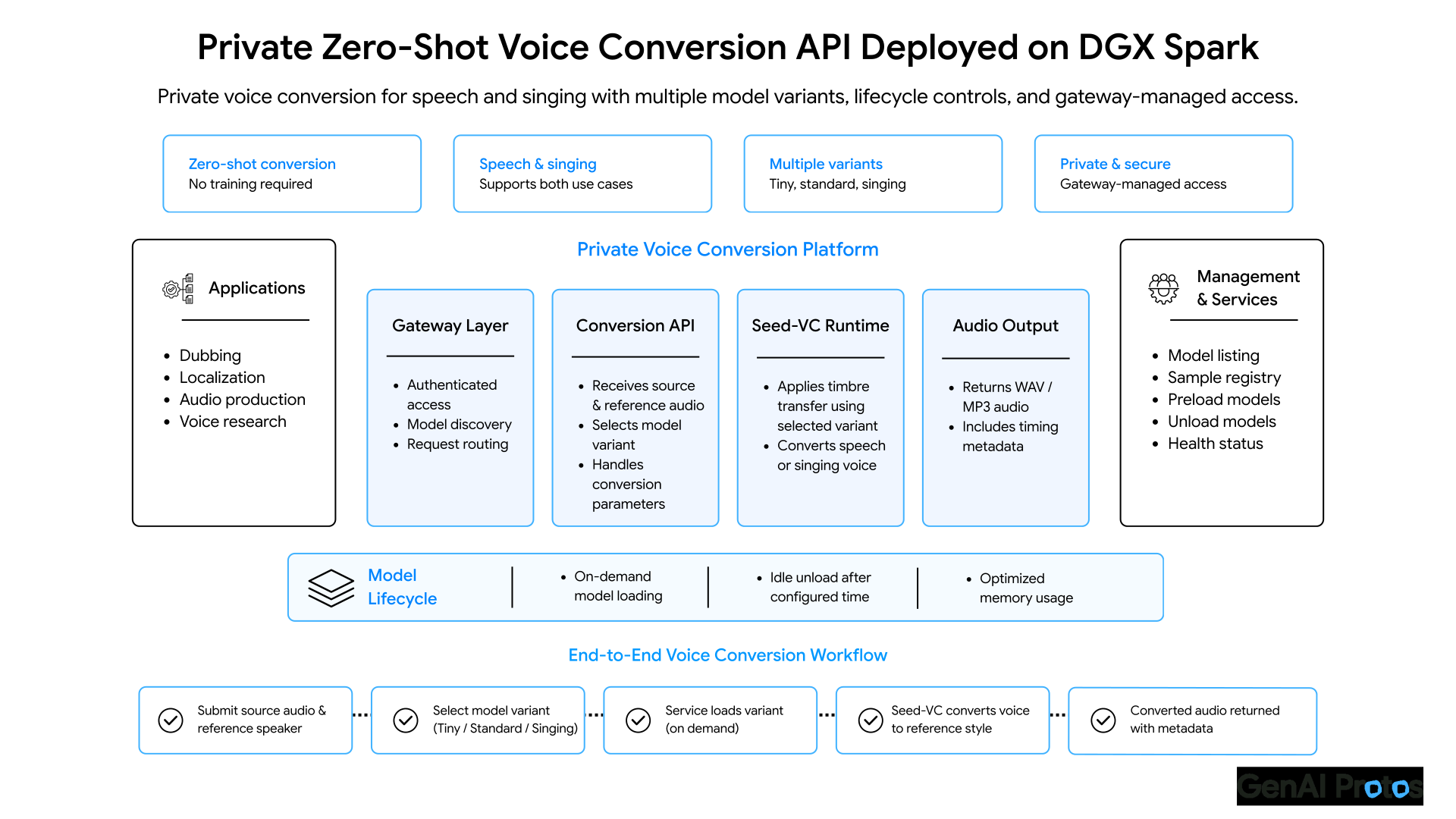
- Application layer
- Dubbing, localization, audio production, or research workflow submits source and reference audio
- Gateway layer
- Provides authenticated access and routes the request to the private conversion service.
- Conversion API
- Receives audio payloads, model variant, and conversion parameters.
- Seed-VC runtime
- Applies timbre transfer using the selected variant.
- Output layer
- Returns WAV or MP3 output for downstream editing or playback.
- Operations lane
- Models, samples, preload, unload, and health data support controlled use.
Prompt-to-Output Workflow
The zero-shot voice conversion workflow shows how source and reference audio, model variant selection, runtime loading, timbre conversion, and output metadata connect.
The application submits source audio and reference speaker audio.
The request selects a model variant based on use case and quality needs.
The service loads the selected variant when needed.
Seed-VC converts the source voice timbre toward the reference speaker.
The system returns converted audio and timing metadata for downstream workflows.
Implementation Highlights
This section summarises variant exposure, custom route design, on-demand loading, sample support, and private audio handling for the Seed-VC deployment.
- Variant exposure
- Three model variants were registered so teams can choose the right conversion profile.
- Custom route design
- Gateway pass-through routes handle the non-standard audio conversion request shape.
- On-demand loading
- Models load on first request and unload after idle time to reduce standing memory use.
- Sample support
- Sample registry endpoints make demos and repeatable testing easier.
- Private audio handling
- Audio conversion stays within the private deployment boundary.
Measured Technical Details
The technical details below record model variants, checkpoint sizes, memory profile, idle lifecycle, rate limits, and cost tracking status.
Why This Matters
The value of this build is not only zero-shot voice conversion. The stronger pattern is exposing reference-audio transformation as a private service with clear variant choices, lifecycle controls, and repeatable testing paths.
Results
GenAI Protos delivered an API-ready private AI service that can be discovered, called, monitored, and operated through the same model-serving pattern used across the wider private AI catalog.
| Outcome | What changed |
|---|---|
| Private conversion API | Zero-shot voice conversion became callable from product and research workflows. |
| Flexible tiers | Teams can select smaller, standard, or singing-focused conversion paths. |
| Operational control | Preload, unload, sample, and model routes make the service easier to operate. |
| Reusable audio pattern | The same model-wrapper approach can be reused for other reference-audio transformation models. |
Reusable Pattern
This pattern can be reused for reference-audio transformation services where model variants, sample registries, private audio boundaries, and lifecycle controls are important for product use.
- Expose model variants explicitly when each has different performance and use-case tradeoffs.
- Keep source and reference audio conversion behind a private authenticated gateway.
- Provide sample registries for repeatable QA and demos.
- Document conversion parameters without exposing internal storage paths.
Turn Voice Conversion Models Into Private Product APIs
GenAI Protos helps teams package reference-audio and voice conversion models into private APIs with model variants, lifecycle controls, and gateway access.
Get custom solutions