Executive Summary
High-velocity social data created an intelligence gap for the enterprise brand function. Legacy sentiment tools could score keywords, but they could not reason across social context, historical incidents, regulatory sensitivity and institutional knowledge fast enough for real-time response.
GenAI Protos designed and deployed a Real-Time Social Media Sentiment Intelligence Platform for a financial services and brand intelligence environment. The mandate was to process multi-source social streams at scale, classify sentiment with domain precision, ground reasoning in institutional context and route escalations with compliance-aware controls.
The delivered platform combines LangGraph-based multi-agent orchestration, hybrid RAG using Pinecone, BM25 and Neo4j, streaming ingestion with Kafka and Flink, and an LLMOps layer for observability, evaluation and auditability. It operates in production with 2.3M+ daily social signals, 94% sentiment accuracy, sub-800ms p95 latency and 99.7% platform uptime.
At a Glance
- Use case
- Real-time social media sentiment intelligence for brand monitoring, crisis response and escalation workflows.
- Industry context
- Financial services and enterprise brand intelligence.
- Engagement type
- Greenfield enterprise AI build.
- Production timeline
- 14 weeks from discovery to production.
- Primary data sources
- Twitter/X, Reddit, LinkedIn, news feeds and web signals.
- Core architecture
- Five specialised AI agents orchestrated through LangGraph with Advanced RAG and LLMOps observability.
- Measured outcomes
- 2.3M+ daily signals, 94% sentiment accuracy, sub-800ms p95 latency, 67% analyst time saved, 3.1x ROI at six months and 99.7% uptime.
The Challenge
The enterprise brand intelligence function was monitoring social media, news and regulatory forums across retail banking, wealth management and insurance lines of business. Existing tools included a commercial sentiment dashboard, a manual escalation log and keyword alerts. That stack could not support real-time signal interpretation at the required scale.
- Volume ceiling breach: during peak market events, social signal volume spiked 8 to 14x above baseline and batch-processing delays reached 45 to 90 minutes.
- Domain-blind classification: a general-purpose sentiment model misread financial-domain language, creating error rates that reached 31% in the client evaluation.
- Context amnesia: each signal was scored in isolation, with no direct link to prior brand incidents, regulatory filings, customer complaint patterns or institutional memory.
- No reasoning transparency: the dashboard returned scores without rationale, making escalation decisions hard to explain and audit.
- Manual escalation bottleneck: escalation decisions depended on analysts, which created missed windows when concurrent incidents occurred.
What GenAI Protos Built
GenAI Protos built a production-grade sentiment intelligence platform that turns live social and web signals into explainable sentiment insights, escalation tiers and analyst-ready action workflows. The system is not a static sentiment dashboard. It is a multi-agent intelligence layer that classifies, retrieves, reasons, explains and routes decisions in real time.
- A real-time ingestion layer for social platforms, news and web signals using Kafka, Flink and source-specific connectors.
- A multi-agent intelligence engine using LangGraph and Agno to coordinate specialised agents for routing, classification, entity resolution, RAG retrieval, reasoning and escalation formatting.
- A hybrid RAG layer using Pinecone dense retrieval, BM25 sparse retrieval and Neo4j graph traversal to add brand history, incident context and entity relationships to each decision.
- A dynamic LLM routing layer that assigns work across GPT-4o, Claude Sonnet and self-hosted Llama 3 models based on signal complexity, cost envelope and escalation risk.
- An LLMOps and governance layer with OpenTelemetry tracing, LangSmith evaluation, Prometheus and Grafana metrics, immutable audit logs, PII controls and human-in-the-loop review queues.
Solution Architecture
The platform was architected as a five-layer production AI system. Each layer has a clear responsibility, independently scalable compute and defined API contracts between components.
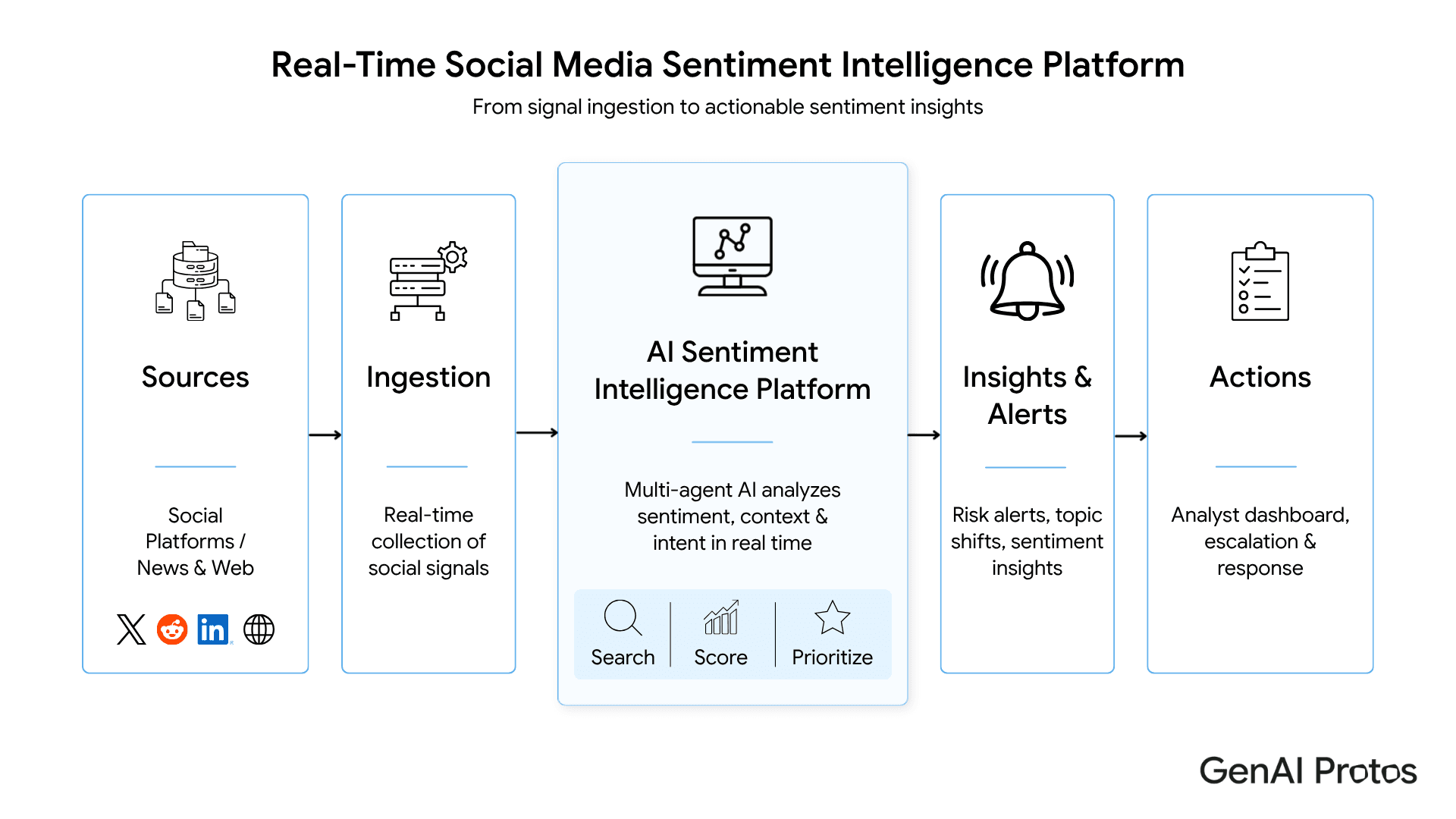
Prompt-to-Output Workflow
Social signals enter the platform through source-specific connectors for Twitter/X, Reddit, LinkedIn, news feeds and web signals.
Kafka receives and partitions events by source, while Flink handles deduplication, language routing and PII scrubbing before AI processing.
Pre-classification services enrich each signal with entity tags, reach weighting and topic classification before it enters the multi-agent graph.
The LangGraph workflow routes simple signals through a fast path and complex signals through a full five-agent path based on entity count, reach, regulatory keywords and risk sensitivity.
The RAG retrieval layer pulls relevant context from Pinecone, BM25 and Neo4j so the system can reason with brand history, past incidents and related entity context.
The output layer returns sentiment class, confidence score, uncertainty score, grounded rationale, escalation tier and audit trace for human review or automated routing.
Implementation Highlights
- Multi-agent orchestration
- A five-agent LangGraph workflow handles signal routing, domain classification, entity resolution, RAG retrieval, reasoning, synthesis and output formatting.
- Hybrid RAG
- Dense retrieval with Pinecone, sparse retrieval with BM25 and graph traversal with Neo4j are fused to ground sentiment decisions in relevant context.
- Streaming data engineering
- Kafka and Flink support multi-source ingestion, deduplication, language detection, PII scrubbing and backpressure handling at peak volume.
- Dynamic LLM routing
- A FastAPI LLM router assigns work to self-hosted Llama 3, Claude Sonnet or GPT-4o based on complexity and escalation risk.
- Governance and auditability
- OpenTelemetry, LangSmith, Prometheus, Grafana, immutable logs and human-in-the-loop queues make each AI decision observable and reviewable.
- Production deployment
- The system runs on Kubernetes with autoscaling, GitOps deployment, prompt versioning, canary rollout and disaster recovery planning.
Measured Technical Details
Why This Matters
The value of this platform is not only faster sentiment classification. The larger value is that social signals become explainable, context-aware, governed intelligence that brand, risk and communications teams can act on within response windows measured in minutes.
Results
The platform replaced a fragmented, partially manual brand intelligence process with a production AI system that continuously ingests, classifies, reasons and routes sentiment signals. Results were measured against the pre-deployment baseline established during discovery.
| Outcome | What changed |
|---|---|
| Sentiment accuracy | Improved from 69% to 94% in financial-domain classification. |
| Crisis response time | Reduced average signal-to-escalation time from 67 minutes to 11 minutes. |
| Analyst time saved | Reduced routine signal review time by 67%, allowing analysts to focus on higher-value work. |
| Platform latency | Moved from 45 to 90 minute batch windows to sub-800ms p95 structured insight delivery. |
| Missed brand incident rate | Reduced from 14% to 2.1% based on retrospective incident audit and platform logs. |
| SaaS licence savings | Eliminated a prior annual SaaS licence cost of $340,000. |
| Operational ROI | Delivered 3.1x ROI at six months based on finance-validated NPV modelling. |
Reusable Pattern
This use case can be reused as a pattern for enterprise teams that need real-time intelligence over high-volume unstructured signals. The same structure can support brand intelligence, regulatory monitoring, competitor intelligence, employee sentiment, customer support signal monitoring and market risk intelligence.
- Streaming foundation: ingest multi-source signals through event-driven pipelines rather than batch dashboards.
- Agentic intelligence: separate signal routing, classification, retrieval, reasoning and escalation into specialised agents.
- Grounded context: combine vector search, sparse retrieval and graph context so outputs are explainable and not isolated scores.
- Governed outputs: add confidence, uncertainty, citations, audit traces and human review paths for operational trust.
- Cost-aware production: route work across models based on complexity so quality and cost scale together.
Build Production AI Intelligence Systems That Teams Can Trust
GenAI Protos helps enterprise teams design and deploy production-grade AI systems with streaming data pipelines, multi-agent orchestration, Advanced RAG, LLMOps observability and governed escalation workflows.
Get custom solutions