Loading...
Protein Structure Generation
API-driven AI system enabling scalable protein structure prediction using NVIDIA AlphaFold2 and BioNeMo infrastructure.
AI Protein Structure Generation | GenAI Protos
Accelerate drug discovery with AI-powered protein structure generation. GenAI Protos delivers accurate, fast molecular modeling for biotech and pharma teams.
Our Solution
https://cdn.sanity.io/images/qdztmwl3/production/7597acbcd289c0bc1daced90ba02f0be420c51af-1920x1080.png
Executive Summary
Understanding protein structures is one of the most critical challenges in modern pharmaceutical research. Protein Structure Generation is an AI-powered platform that enables researchers to predict high-fidelity 3D protein structures from amino acid sequences using NVIDIA’s AlphaFold2 infrastructure. The solution provides a FastAPI-based middleware that abstracts the complexity of high-performance biological computation, allowing scientists and developers to access advanced protein folding predictions through a simple API workflow. By leveraging NVIDIA’s BioNeMo ecosystem, the system converts raw biological sequences into structured protein models efficiently and reliably.
Challenges
Traditional experimental techniques such as X-ray crystallography and Cryo-EM are expensive and time-consuming. Even digital protein folding simulations require powerful GPU clusters.
Extremely Complex Protein Folding Computation
Running AlphaFold2 locally involves managing massive biological databases such as UniRef90, BFD, and MGnify along with large compute resources.
Heavy Infrastructure Requirements
Protein folding predictions are computationally intensive and may take minutes or longer, making synchronous API processing inefficient.
Handling Long-Running AI Workloads
Biological sequence errors can cause costly computation failures if invalid amino acid inputs are submitted to prediction engines.
Data Validation and Input Integrity
Solution Overview
Protein Structure Generation introduces a lightweight AI middleware that acts as a bridge between user applications and NVIDIA’s AlphaFold2 inference infrastructure. The platform validates biological input sequences, manages asynchronous prediction workflows, and retrieves predicted protein structures through an intelligent job orchestration mechanism. This architecture simplifies complex protein folding workflows into a streamlined REST API interface accessible to researchers, developers, and bioinformatics tools.
How it Works
25825e493a08
block
f48a80181d3c
span
strong
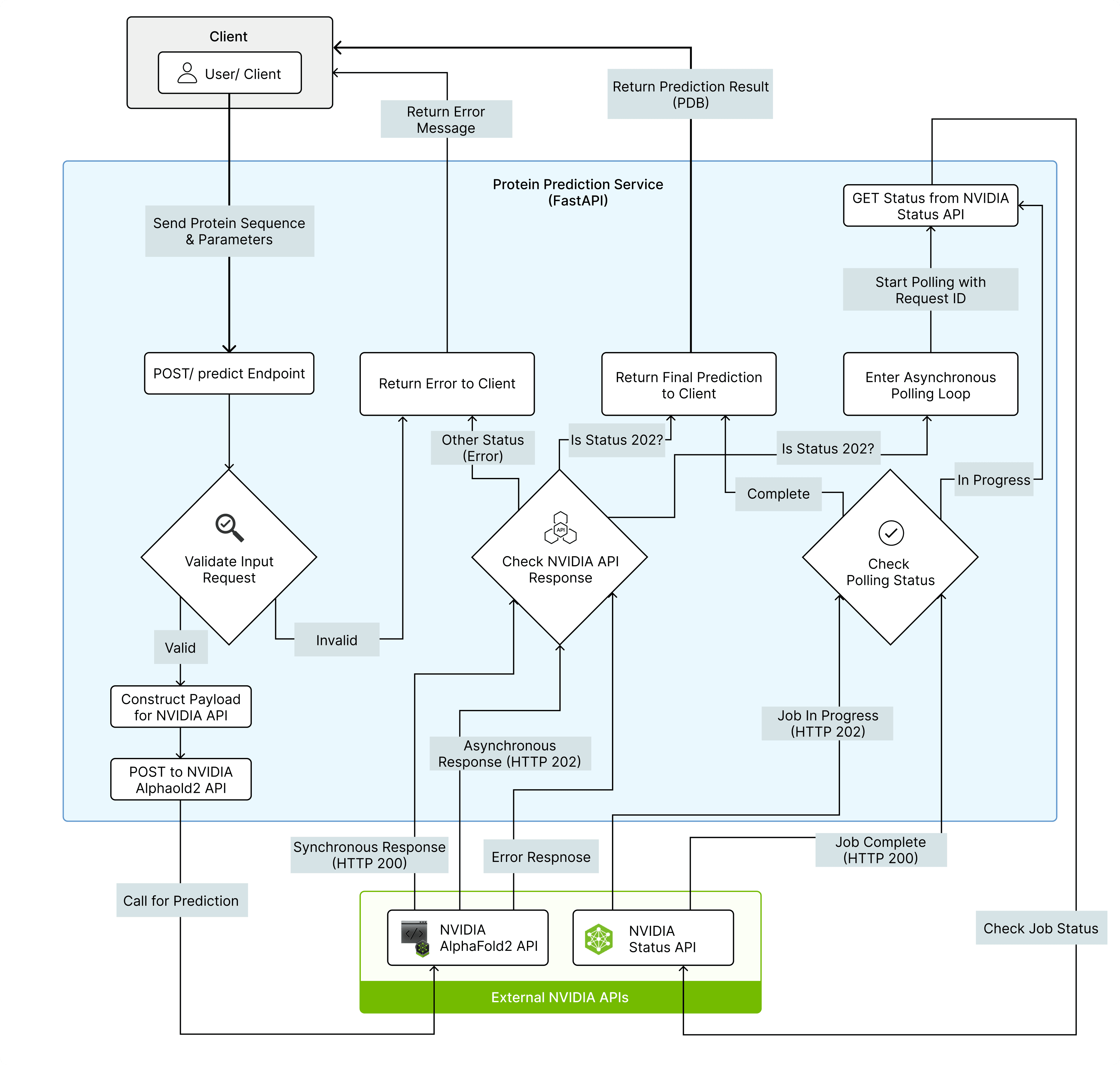
Sequence Submission
bullet
normal
600f82439a75
cc8381b2f07f
Researchers submit amino acid sequences through a REST API endpoint.
02b1827ddd8c
110b57ee7af4
Input Validation
d069c67e6030
876667f374df
The middleware verifies sequence correctness and validates selected genetic databases.
32130d7e96db
f63dc65f8724
Prediction Task Initialization
c2f8beab0b9a
be7d94535af4
The system sends a request to the NVIDIA AlphaFold2 service, which begins the protein folding simulation and returns a unique task ID.
efb250ea98d3
3bae187f658e
Asynchronous Polling Engine
33997cadeb2b
f8fba4570cf0
Instead of blocking the request, the middleware periodically polls the NVIDIA status endpoint to track prediction progress.
3d4486566b0c
e11361f2963c
Structure Retrieval
155bbe2ac6ea
f40660505473
Once the simulation completes, the predicted protein structure data (PDB format) is retrieved.
5b683ea4b1e3
33d38233c734
Structured Data Delivery
116b3d4ba30c
861ce7e6cb3c
The final structural prediction is delivered as a JSON response ready for downstream analysis and visualization.
0d95069e3ab2
image
Architecture Diagram - Protein Structure Generation
image-98618c61326e38956c7842e315178d5a312d5edb-3728x3545-png
reference
Key Benefits
Accelerates early-stage pharmaceutical development by enabling rapid protein structure analysis.
Faster Drug Discovery Research
Removes the need for expensive on-premise HPC clusters dedicated to protein folding.
Cost Optimization for Research Labs
Supports multiple prediction jobs across cloud or hybrid research environments.
Scalable Bioinformatics Infrastructure
Provides a standard REST interface that can integrate with LIMS systems and bioinformatics platforms.
Seamless Integration into Research Pipelines
Auto-generated Swagger documentation enables scientists to test the API without coding expertise.
Accessible for Researchers and Developers
Key Outcomes with Protein Structure Generation
Target
Accelerated Protein Structure Prediction
Reduces structural analysis timelines from weeks of experimental work to minutes using AI simulations.
Simplified Access to AlphaFold2
Provides a clean API abstraction for NVIDIA BioNeMo infrastructure without requiring HPC setup.
Efficient Asynchronous Job Handling
Long-running prediction tasks are managed using intelligent polling mechanisms.
High Data Integrity
Strict validation ensures accurate biological inputs and prevents invalid compute requests.
Parallel Job Execution
Multiple prediction tasks can run simultaneously, improving throughput for research teams.
Technical Foundation
Handles REST API development with high-performance asynchronous request processing for protein prediction workflows.
Backend Framework: FastAPI (Python ASGI Framework)
Lightweight ASGI server used to run the FastAPI application with efficient concurrent request handling.
Execution Engine: Uvicorn Server
Provides the deep learning model that predicts 3D protein structures from amino acid sequences.
AI Model Backend: NVIDIA BioNeMo AlphaFold2 API
Enables secure HTTP communication between the middleware service and NVIDIA AlphaFold2 APIs.
API Communication: Requests Library
Stores sensitive environment variables such as API keys and credentials securely outside the codebase.
Configuration Management: Python-dotenv
Ensures strict validation of protein sequences and request formats before sending them to the AI model.
Data Validation: Pydantic Schemas
Conclusion
Protein Structure Generation demonstrates how AI infrastructure can transform complex scientific workflows into accessible, scalable digital services. By combining a lightweight API layer with NVIDIA’s AlphaFold2 capabilities, the platform simplifies protein structure prediction for researchers and developers alike. This approach enables faster experimentation, reduced computational barriers, and more efficient scientific discovery paving the way for AI-driven innovation in bioinformatics and pharmaceutical research.

Build Production-Ready AI Systems for Protein Structure Prediction
Accelerate protein structure prediction and biological research using AI-powered computational workflows. Explore advanced AI engineering solutions and research automation platforms at: www.genaiprotos.com
Book a Demo
https://calendly.com/contact-genaiprotos/3xde

Understanding protein structures is one of the most critical challenges in modern pharmaceutical research. Protein Structure Generation is an AI-powered platform that enables researchers to predict high-fidelity 3D protein structures from amino acid sequences using NVIDIA’s AlphaFold2 infrastructure. The solution provides a FastAPI-based middleware that abstracts the complexity of high-performance biological computation, allowing scientists and developers to access advanced protein folding predictions through a simple API workflow. By leveraging NVIDIA’s BioNeMo ecosystem, the system converts raw biological sequences into structured protein models efficiently and reliably.
Traditional experimental techniques such as X-ray crystallography and Cryo-EM are expensive and time-consuming. Even digital protein folding simulations require powerful GPU clusters.
Running AlphaFold2 locally involves managing massive biological databases such as UniRef90, BFD, and MGnify along with large compute resources.
Protein folding predictions are computationally intensive and may take minutes or longer, making synchronous API processing inefficient.
Biological sequence errors can cause costly computation failures if invalid amino acid inputs are submitted to prediction engines.
Protein Structure Generation introduces a lightweight AI middleware that acts as a bridge between user applications and NVIDIA’s AlphaFold2 inference infrastructure. The platform validates biological input sequences, manages asynchronous prediction workflows, and retrieves predicted protein structures through an intelligent job orchestration mechanism. This architecture simplifies complex protein folding workflows into a streamlined REST API interface accessible to researchers, developers, and bioinformatics tools.
Researchers submit amino acid sequences through a REST API endpoint.
The middleware verifies sequence correctness and validates selected genetic databases.
The system sends a request to the NVIDIA AlphaFold2 service, which begins the protein folding simulation and returns a unique task ID.
Instead of blocking the request, the middleware periodically polls the NVIDIA status endpoint to track prediction progress.
Once the simulation completes, the predicted protein structure data (PDB format) is retrieved.
The final structural prediction is delivered as a JSON response ready for downstream analysis and visualization.

Reduces structural analysis timelines from weeks of experimental work to minutes using AI simulations.
Provides a clean API abstraction for NVIDIA BioNeMo infrastructure without requiring HPC setup.
Long-running prediction tasks are managed using intelligent polling mechanisms.
Strict validation ensures accurate biological inputs and prevents invalid compute requests.
Multiple prediction tasks can run simultaneously, improving throughput for research teams.
Handles REST API development with high-performance asynchronous request processing for protein prediction workflows.
Lightweight ASGI server used to run the FastAPI application with efficient concurrent request handling.
Provides the deep learning model that predicts 3D protein structures from amino acid sequences.
Enables secure HTTP communication between the middleware service and NVIDIA AlphaFold2 APIs.
Stores sensitive environment variables such as API keys and credentials securely outside the codebase.
Ensures strict validation of protein sequences and request formats before sending them to the AI model.
Protein Structure Generation demonstrates how AI infrastructure can transform complex scientific workflows into accessible, scalable digital services. By combining a lightweight API layer with NVIDIA’s AlphaFold2 capabilities, the platform simplifies protein structure prediction for researchers and developers alike. This approach enables faster experimentation, reduced computational barriers, and more efficient scientific discovery paving the way for AI-driven innovation in bioinformatics and pharmaceutical research.

Accelerate protein structure prediction and biological research using AI-powered computational workflows. Explore advanced AI engineering solutions and research automation platforms at: www.genaiprotos.com