
Most enterprise AI systems break atthe handoff. One agent completes its task, and the next agent either never receives it or has no standard way to respond. The result is silent failure, manual intervention, and systems that only work in controlled demos.
The a2a protocol was built to fix this. Released by Google in April 2025 and now a production standard under the Linux Foundation, it defines how autonomous AI agents discover each other, delegate work, and track outcomes across a live system. If your enterprise is evaluating or building multi-agent infrastructure today, this is the standard your architecture needs to be built around.
What the A2A Protocol Does for Enterprise Teams
Enterprise AI teams are not short on individual agents. What they lack is a reliable handoff layer between them. Without a shared standard, every agent integration is custom-built. The orchestrator must know how to call each sub-agent, what format to expect, how to handle failure, and how to retry. Add ten agents and the complexity multiplies ten times.
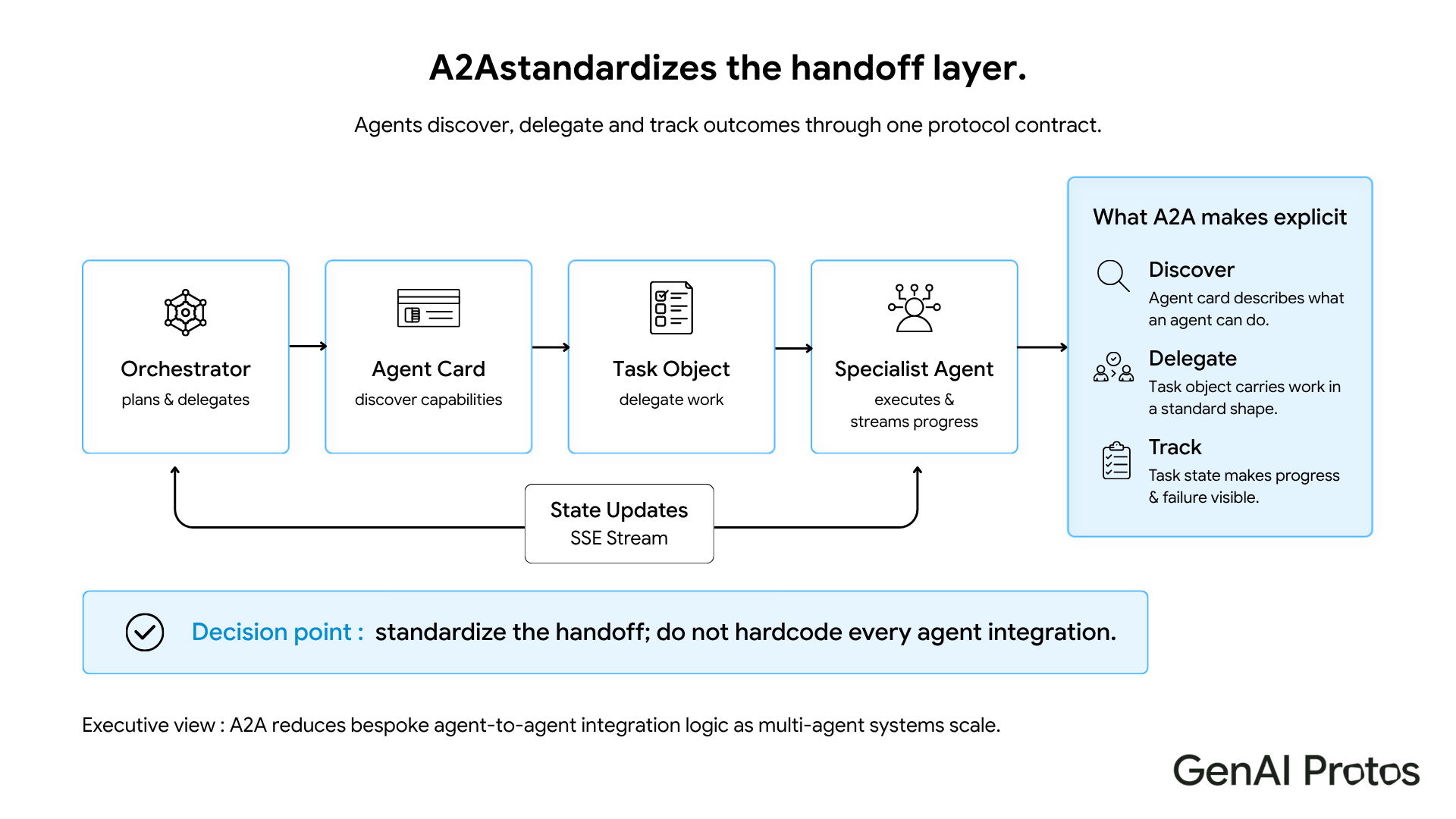
The a2a protocol replaces this with a uniform contract. Agents publish what they do. Tasks are passed in a defined format. Outcomes flow through a predictable state machine. Teams that implement it stop writing custom integration glue and start building reusable agent infrastructure.
Agent to Agent Communication: How the Protocol Structures It
The core value of the standard is making agent to agent communication predictable. Rather than agents calling each other through ad hoc API calls or hardcoded endpoints, every interaction follows the same structure: discovery, delegation, and outcome tracking.
An orchestrator agent reads another agent's published descriptor, sends it a task in the standard format, and then listens for state updates streamed back in real time. No polling. No custom callback logic per agent. Agent to agent communication works the same way regardless of which models or frameworks the agents are built on.
This is what makes the approach viable at enterprise scale. When a new agent joins the system, it publishes its descriptor and it works. No bespoke integration. No changes to the orchestrator.
GenAI Protos used this communication model when building FactPulse, a production multi-agent fact-checking system, where research, verification, and synthesis agents coordinate through structured task handoffs without any hardcoded agent-to-agent logic.
Agent Card A2A: How Agents Announce What They Do
Every agent that follows the standard publishes a JSON descriptor at /.well-known/agent.json. This is the agent card a2a structure. It contains the agent's name, description, capabilities, endpoint URL, supported input formats, authentication method, and version.
The agent card a2a is how orchestrators discover what an agent can do without any prior configuration. When evaluating vendors or building your own agents, confirm that every agent in your stack publishes a valid, versioned agent card. It is the foundation of a scalable, maintainable multi-agent system.
A2A vs MCP: Which Protocol Belongs Where in Your Stack
A2A vs MCP is the most common architectural question for teams building enterprise multi-agent systems. They are not competing standards. They solve different problems at different layers of the stack, and most enterprise systems need both.
MCP (Model Context Protocol) is vertical. It connects an LLM to a tool, a database, or an external service. The model is the caller. The tool is the receiver. One direction, one purpose.
The A2A standard is horizontal. It connects autonomous agents to other autonomous agents. One agent delegates a task to another. Both sides can run different models, sit on different infrastructure, and be maintained by different teams.
In a well-designed enterprise system, an agent might use MCP to retrieve data from a database, then use the A2A standard to pass that data to a downstream processing agent. When evaluating a2a vsmcp for your architecture, the answer isalmost always: use both, at the right layer.
A2A Protocol Authentication: What to Lock Down Before Going Live
A2A protocol authentication is the most skipped step in enterprise deployments and the most expensive to add after the fact. Teams configure agents, wire up the task pipeline, test the happy path, and ship. Then a security review flags that agent endpoints are not scoped or protected.
The agent card structure includes an authentication field. Define it from day one. In enterprise environments, this typically means OAuth 2.0 scopes tied to specific agent capabilities, with read and write permissions separated at the agent level. Do not leave this field empty during prototyping with a plan to fill it in later. Later rarely comes before a production incident.
A2A protocol authentication across federated identity environments is still evolving in the v1.0 specification. Build with that in mind. Define scopes narrowly and version your agent cards so auth changes can be rolled out without breaking dependent orchestrators.
GenAI Protos implemented scoped authentication across all six task states in the JIRA AI Agent built for an enterprise IT company, ensuring agent endpoints remain protected from prototype through production rollout.
A2A Protocol Specification: What the Standard Actually Defines
The a2a protocol specification defines three core objects that every compliant implementation must support: the Agent Card, the Task Object, and the State Machine.
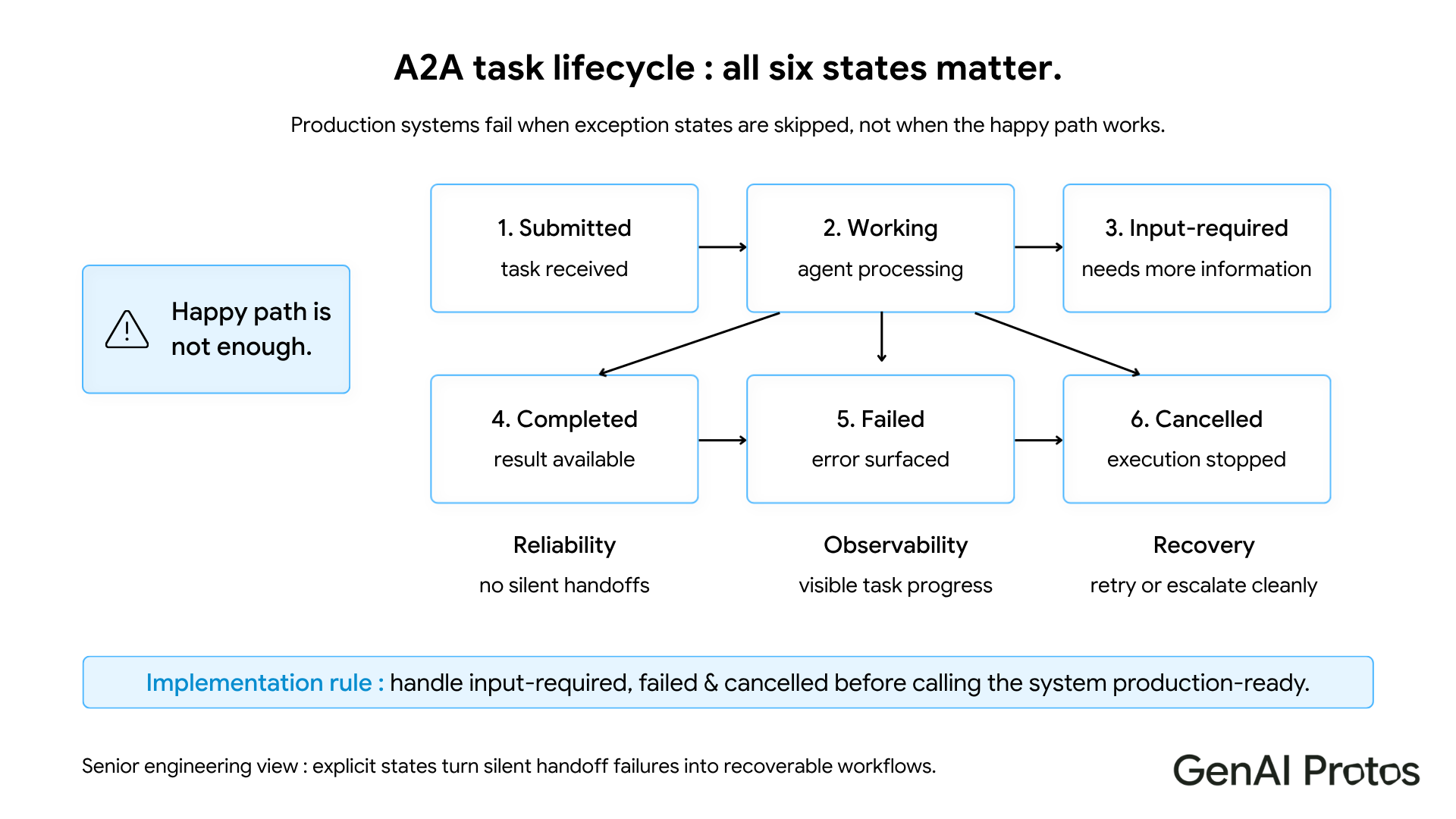
The Task Object is the unit of work. It carries a unique task ID, the input payload, and a state field that tracks progress. The a2a protocol specification mandates six states: submitted, working, input-required, completed, failed, and cancelled. State updates stream to the orchestrator via SSE so the orchestrator listens rather than polls.
Most teams implement three states and call it done: submitted, working, completed. That covers the happy path. The other three, input-required, failed, and cancelled, are where production systems break without warning. Build all six or do not go live.
The specification is maintained under the Linux Foundation and continues to evolve. Teams building on it now should pin to a version, monitor the changelog, and design their task pipelines to accommodate updates without a full rewrite.
Build Your Enterprise Agent Stack on a Standard That Holds in Production
Enterprise AI projects fail at the handoff more than anywhere else. Not because the models are wrong, but because the coordination layer was never properly designed. The a2a protocol gives teams a production-ready standard for agent discovery, task delegation, and outcome tracking that scales beyond the demo.
If your team is evaluating multi-agent architecture right now, start with the a2a protocol specification. Define your agent cards. Implement all six task states. Lock down authentication before the first production deployment. These three decisions separate systems that work in controlled environments from systems that hold up under enterprise load.
GenAI Protos builds production multi-agent systems for enterprise teams. If you want architecture designed to scale, not just to demo, talk to us.


