Your retrieval augmented generation demo was clean. Production broke it in week three. The same queries now hallucinate. p95 latency is 8 seconds. Compound queries spill past the context window. That is not a model problem, it is an architecture problem. A static embed-retrieve-generate pipeline was never designed for production query diversity. Agent RAG architecture adds the decision layer that static pipeline is missing. There are five patterns. Picking the wrong one is expensive.
Agentic RAG vs. Standard Retrieval Augmented Generation
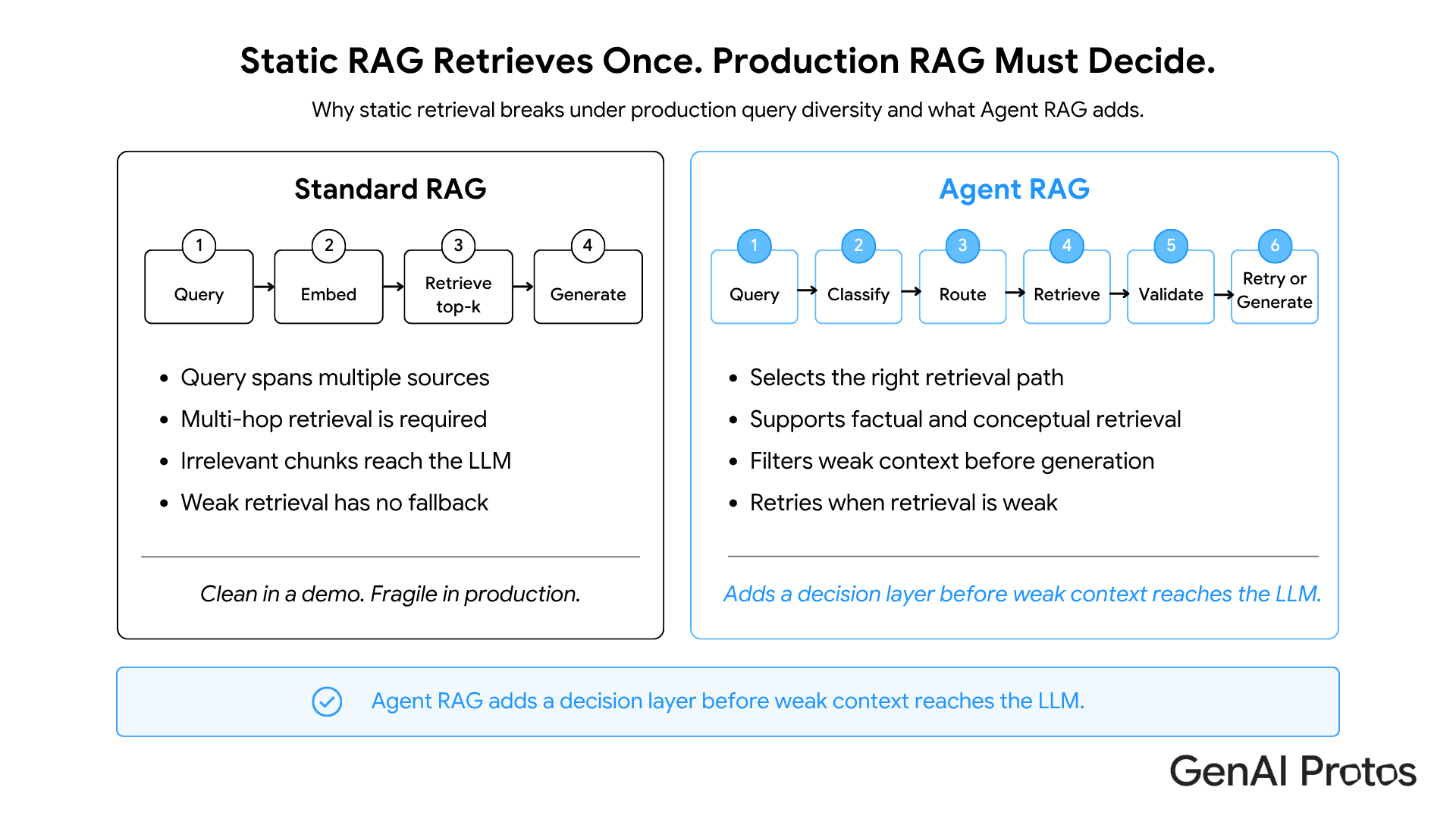
Standard retrieval augmented generation follows a fixed pipeline: embed the query, retrieve the top-k chunks, generate. Clean in a demo. In production it fails in four predictable ways: the query spans multiple data sources the single vector store cannot cover; the query is multi-hop and needs two retrieval passes combined; retrieved chunks are irrelevant but the LLM generates from them anyway; and the query is vague with no fallback. None of these failures are fixed by a better embedding model.
Agentic RAG replaces the fixed path with dynamic agent decisions. The agent selects the retrieval source, validates what came back, and retries when results are weak. That overhead, 200-800ms depending on pattern, earns its keep when your query distribution is diverse and your corpus has uneven coverage. Agent RAG architecture is the right investment when your static pipeline has already proven it cannot keep up.
The Three Layers of an Agentic RAG Pipeline
Build an agentic RAG pipeline in three layers, in this order. Most teams build validation first because corrective RAG sounds sophisticated. Then they discover routing was wrong, and validation has been compensating for a problem it did not cause.
Query Routing
Classify each incoming query before retrieval, which source, what type (factual or conceptual), simple or complex. Getting routing wrong forces every downstream layer to compensate. Validate routing accuracy in isolation before adding any other agent pattern.
Retrieval
Once routed, fetch the most relevant context. For factual queries, BM25 keyword search outperforms dense vector search. For conceptual queries, dense outperforms BM25. Hybrid retrieval RAG handles both. Before adding agent complexity, run 200 real production queries and measure retrieval precision. Target: above 0.75 before adding any agent layer.
Retrieval Validation
Score each retrieved chunk before it reaches the LLM. A cross-encoder reranker at 50-150ms is the minimum. Corrective RAG adds a reject-and-retry loop on top. Both prevent the LLM from generating confidently from irrelevant context, the source of most production hallucinations.
Five Production Agent RAG Architecture Patterns
Each pattern has a specific job, a specific latency cost and a specific use case. Choose based on your query distribution and corpus structure, not the most sophisticated architecture available.
RAG Routing Agent
A RAG routing agent classifies each incoming query by type, factual or conceptual, and sends it to the correct retrieval path. Factual queries go to BM25. Conceptual queries go to the dense vector store. Mixed queries hit both. Overhead: 200-400ms. A fine-tuned BERT-style classifier handles routing at near-zero per-query cost compared to an LLM-based router. Use a RAG routing agent the moment you have two or more qualitatively different retrieval source types.
Hybrid Retrieval RAG
Hybrid retrieval RAG combines dense vector search with sparse BM25 keyword search, then reranks the merged candidate set with a cross-encoder before generation. Use it when your corpus holds both conceptual content and precise factual lookups. Routing only to semantic search on factual queries drops recall 15-30%.
Process: Query → Dense retrieval + BM25 → Merge candidates → Cross-encoder reranking → Generation
The cross-encoder, BGE-reranker or Cohere Rerank, runs at 50-150ms. That is the cheapest accuracy improvement in any agent RAG architecture. Add hybrid retrieval RAG before corrective RAG or adaptive RAG.
Adaptive RAG
Adaptive RAG classifies queries before retrieval. Simple factual queries skip the agent layer entirely, direct retrieval, zero overhead. Complex queries trigger the full agentic RAG pipeline. Off-corpus queries get a rejection or web search fallback. If 60% of your production queries are simple lookups, adaptive RAG means those 60% pay standard RAG cost, not agent RAG cost. The classifier is a fine-tuned BERT-style model running at 40-60ms, not an LLM. Build adaptive RAG before corrective RAG. The ROI is immediate.
Corrective RAG
Corrective RAG adds a validation step between retrieval and generation. A lightweight evaluator scores each retrieved chunk. Below a relevance threshold of approximately 0.7 cosine similarity, the chunk is rejected and a re-query fires, broader search, reworded query or web fallback. Cost: one full evaluation pass per retrieval cycle, raising per-query compute 40-80% compared to standard retrieval augmented generation. Use corrective RAG when accuracy is non-negotiable and corpus coverage is uneven. Use a cross-encoder for the evaluation step, not a full LLM call.
Multi-Agent RAG
Multi-agent RAG is justified when you have three or more qualitatively different data sources that need separate retrieval logic, a structured database, an unstructured document store and a live API, for example. Start with one coordinator and one specialist sub-agent. Instrument inter-agent message counts. Chatty agents signal a decomposition problem. Validate the two-agent baseline before scaling. Every agent added multiplies latency and debugging surface.
How to Choose the Right RAG Pattern
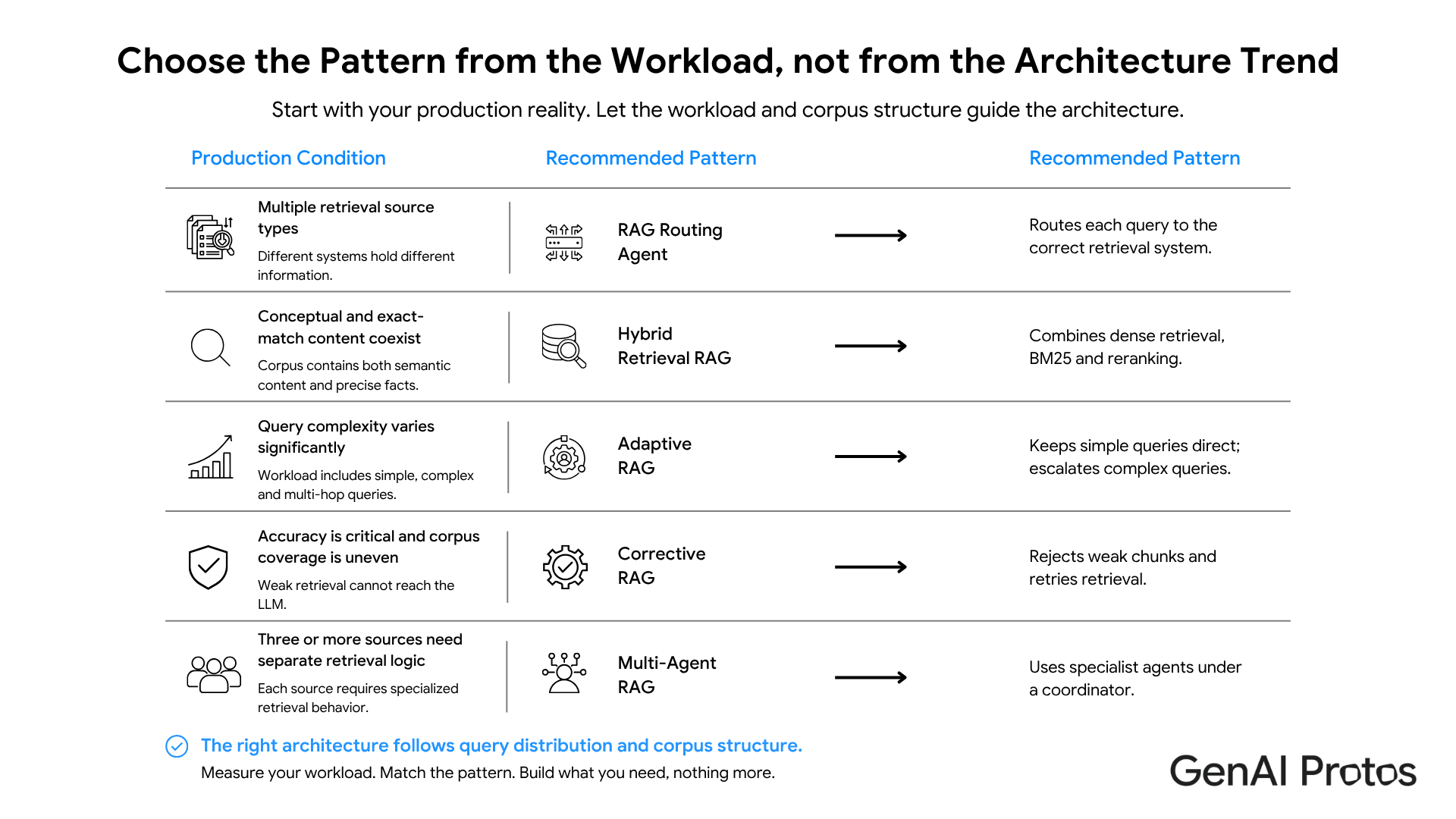
The pattern to build depends on your query distribution and corpus structure. Use this table as a starting point, then benchmark with your real production queries before committing to an agent RAG architecture.
| Pattern | Use when | Main benefit | Main trade-off |
|---|---|---|---|
| RAG routing agent | Multiple qualitatively different retrieval sources | Routes each query to the correct system | 200-400ms classification overhead |
| Hybrid retrieval RAG | Corpus holds both conceptual and exact-match content | Improves recall across all query types | Requires merging and cross-encoder reranking |
| Adaptive RAG | Query complexity varies significantly across your workload | Skips agent cost for simple queries | Requires a reliable query classifie |
| Corrective RAG | Retrieval accuracy is critical; corpus coverage is uneven | Rejects weak context before generation | Adds 40-80% per-query compute overhead |
| Multi-Agent RAG | Data sources require separate specialist retrieval logic | Supports specialised retrieval workflows | Higher complexity, latency and debug surface |
RAG Evaluation Metrics Every Production RAG System Must Track
Most agentic RAG implementations skip RAG evaluation until production breaks. Build your eval layer before launch. Six metrics that matter in every production RAG system:
- Retrieval recall: did the relevant evidence enter the candidate set at all? Precision alone is not enough, a system can retrieve only relevant chunks but still miss critical evidence.
- Retrieval precision: are the top-k chunks actually relevant? For the evaluation framework used here, precision below 0.75 should trigger retrieval-layer remediation before additional agent logic is introduced.
- Answer accuracy: does the generated response match ground truth? Measure against at least 200 real production queries, not your demo set.
- Groundedness / faithfulness: is every claim in the response supported by the retrieved context? Low groundedness means the LLM is generating beyond what was retrieved.
- Hallucination rate: for high-accuracy factual use cases, a rate above 2% should be treated as a launch blocker or escalation threshold in any production RAG system.
- p95 latency per pattern: RAG routing agent adds 200-400ms, query planning adds 400-800ms, corrective RAG adds one full evaluation call. Map each against your SLA before committing to a pattern.
Not sure which pattern fits your production query mix? GenAI Protos benchmarks routing accuracy, retrieval quality, latency and failure modes before recommending an agent RAG architecture. See GenAI Protos Full-Stack AI Engineering.
Production RAG System Observability: What to Instrument First
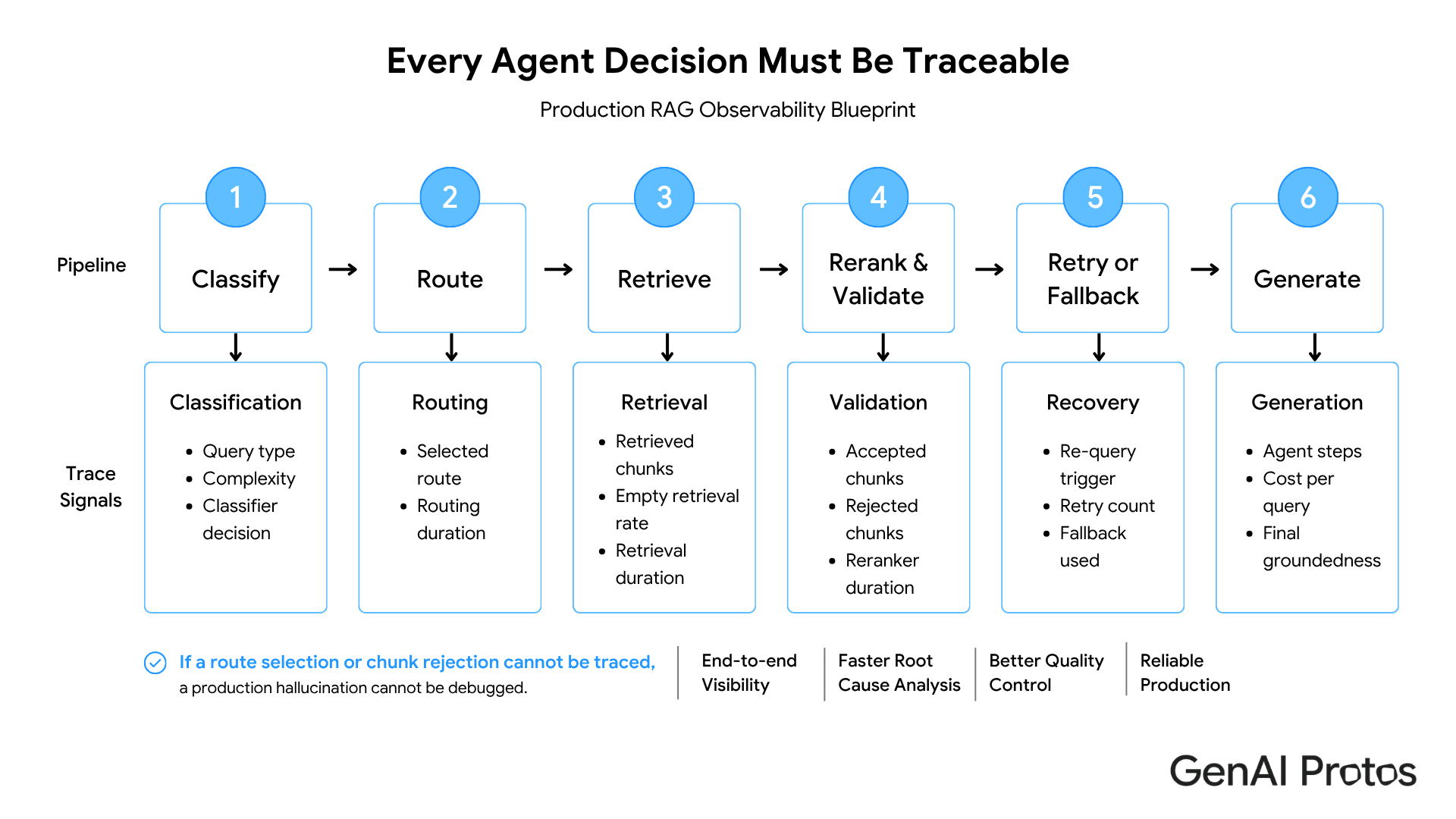
Use LangSmith for agent trace logging and Ragas for retrieval and generation quality metrics. Every production RAG system needs traces for: selected route, retrieved and rejected chunks, re-query triggers, retrieval duration, reranker duration, number of agent steps, retry count, empty retrieval rate and cost per query. If you cannot trace a routing decision or a chunk rejection, you cannot debug a production hallucination. OpenTelemetry GenAI semantic conventions provide the observability schema. Wire it from day one, not after something breaks.
Five Agentic RAG Implementation Mistakes to Avoid
These five mistakes appear in almost every agentic RAG implementation GenAI Protos reviews before engagement:
- Skipping RAG evaluation before launch. A failed agentic RAG implementation almost always skips this step. Run evaluation on a golden set of 200 real queries. Precision below 0.75 means no agent pattern will save you.
- Adding corrective RAG to hide bad chunking. Fix overlapping chunks, aligned embedding models and deduplicated indexes first. Agents amplify retrieval quality, they do not create it.
- Scaling to multi-agent RAG before the two-agent baseline is stable. Validate message counts, latency and hallucination rate at two agents first.
- Ignoring latency budgets in agentic RAG implementation. ReAct loops add 800ms-2s per iteration. If your user-facing SLA is 3 seconds, a 2-iteration loop consumes it before generation starts.
- Skipping observability. No trace of routing and chunk rejection decisions means no ability to debug production hallucinations. Wire OpenTelemetry GenAI semantic conventions from day one.
Key Takeaways
- Agent RAG architecture fixes what static retrieval augmented generation cannot: multi-source routing, multi-hop queries and retrieval validation before generation.
- Build in order: validate retrieval precision first, then add hybrid retrieval RAG and a RAG routing agent, then adaptive RAG, then corrective RAG, then multi-agent RAG.
- Hybrid retrieval RAG with a cross-encoder reranker is the cheapest accuracy gain in any agentic RAG pipeline. Add it before any other agent pattern.
- RAG evaluation is not optional. Track retrieval recall, precision, groundedness and hallucination rate on 200 real production queries before launch.
- Instrument every agent decision from day one, route chosen, chunks rejected, re-queries triggered. No trace means no ability to debug production hallucinations.
Conclusion
The right agent RAG architecture matches your actual query distribution, not the most sophisticated pattern available. Start with hybrid retrieval RAG and a RAG routing agent if you have multiple data source types. Add adaptive RAG before corrective RAG. Run RAG evaluation before you launch, not after something breaks. A sound agentic RAG implementation follows that order every time.


