Your CFO still waits 48 hours for a variance report. The question is not why the variance happened. The question is what to do about it now. By the time the report lands, the decision window has closed.
Finance teams are deploying AI to automate what they already do: faster reports, automated reconciliation, cleaner dashboards. That is useful. It is not the shift that changes the competitive position.
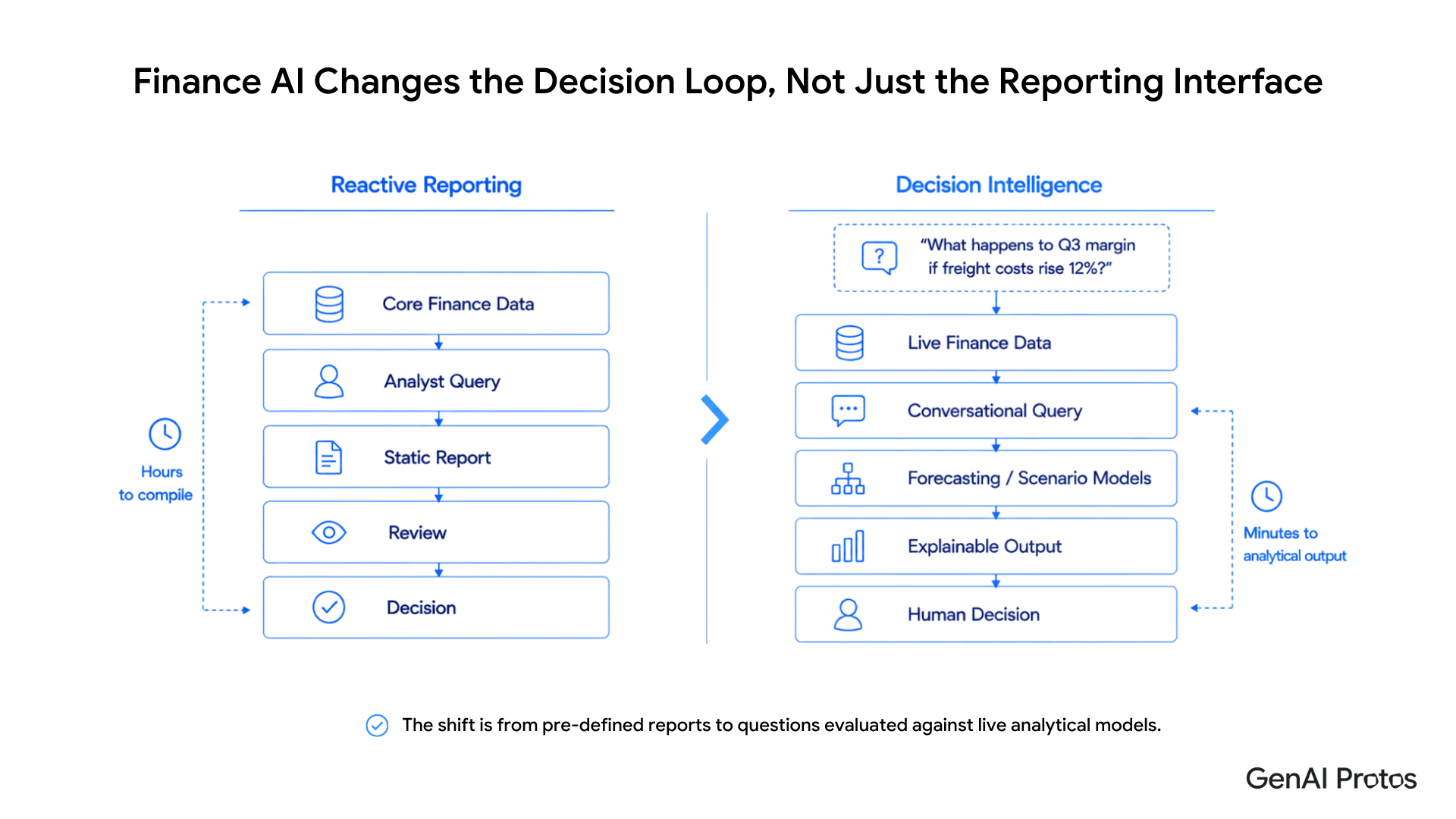
The shift is from reactive reporting to real-time decision intelligence. This article covers what AI in finance looks like when it crosses that line: agentic forecasting systems, production fraud detection architecture, explainability requirements, and where fintech AI earns its keep versus where it overpromises.
What AI in Finance Does at the Decision Layer
AI in finance that earns its keep at the decision layer does two things legacy systems cannot: it answers questions that were not pre-defined, and it runs scenario analysis in real time.
A traditional finance reporting system answers questions its architects thought to ask. A conversational forecasting AI answers the CFO's question at 9am, in natural language, against live data. "What happens to Q3 margin if freight costs increase 12%?" takes four minutes to run as a report. It takes 40 seconds when the finance AI has access to the forecasting model, the cost structure, and a natural language interface.
In a production deployment GenAI Protos built for a financial services organization, a conversational forecasting copilot replaced a static reporting stack that required analyst time to run and four hours to compile. The same analytical output now returns in under three minutes through a conversational interface. The analysts did not lose their jobs. They stopped spending 60% of their time running report queries and started spending it on interpretation and recommendation.
GenAI Protos also deployed a Real-Time Social Media Sentiment Intelligence Platform for a financial services organisation, processing 2.3 million daily social signals at 94% sentiment accuracy with sub-800ms p95 latency and 99.7% uptime. Analysts shifted from manual monitoring to reviewing AI-prioritised, context-grounded intelligence packages. Read more: genaiprotos.com/case-studies/
That is the honest version of what AI in finance does at the decision layer. It is not magic. It is structured access to existing analytical models through an interface that does not require SQL.
AI in Banking: Where Deployment Evidence Is Strongest
AI in banking has the clearest production evidence in three areas: fraud detection, credit scoring, and customer service automation.
AI fraud detection in banking is not new.
It has been in production at scale since the early 2010s. What has changed is the architecture. Legacy fraud detection used rule-based systems: if transaction amount exceeds threshold X in geography Y, flag it. Modern AI fraud detection uses behavioral anomaly models that learn each customer's spending patterns and flag deviations from that specific baseline, not from a population average.
The production outcomes:
False positive rates on fraud alerts dropped 40 to 60% when banks moved from rule-based to ML-based fraud detection. Customer friction from incorrectly blocked transactions reduced by the same margin. The improvement is not in detection rate, which was already high for rule-based systems. It is in precision: flagging actual fraud without blocking legitimate transactions.
Credit scoring AI shows similar precision improvements:
15 to 25% better default prediction compared to traditional scorecard models when trained on alternative data sources including behavioral and transactional patterns. The trade-off is model complexity, which creates explainability challenges for regulatory review.
AI Applications in Finance: The Production Map
AI applications in finance that have demonstrated production ROI fall into five categories: fraud detection, credit decisioning, regulatory reporting automation, customer service, and investment analytics.
Fraud detection and credit decisioning are covered above. Regulatory reporting automation is the least glamorous and most consistently deployed. Financial institutions spend 3 to 5% of revenue on compliance and regulatory reporting. AI systems that automate data extraction, validation, and report compilation from core banking systems reduce that cost by 30 to 45% and reduce reporting cycle time from days to hours.
Customer service AI in banking handles Tier 1 inquiries at 60 to 70% autonomous resolution rates for straightforward queries: account balance, transaction history, basic product questions, branch hours. Complex inquiries involving disputes, fraud reports, and account issues escalate to human agents. The AI handles the volume. The humans handle the judgment.
Investment analytics AI spans a wide range from algorithmic execution to portfolio risk modeling. The production applications with clearest ROI are risk monitoring, anomaly detection in portfolio positions, and earnings estimate synthesis for equity research teams.
What Agentic Finance AI Looks Like in Production
This is how GenAI Protos built a conversational forecasting copilot that replaced static reporting with real-time scenario analysis. Explore the approach and the production architecture behind it.
→ Explore the Practice | Book a Call
Explainable AI in Finance: Why It Is Not Optional
Explainable AI in finance is a regulatory requirement, not a design preference.
In regulated financial environments, credit decisions, loan approvals, and risk ratings made by AI models must be explainable to regulators and, in consumer lending, to applicants. The EU AI Act, ECOA in the United States, and equivalent frameworks in most major markets require that financial institutions be able to explain why an AI model made a specific decision, in terms a non-technical reviewer can assess.
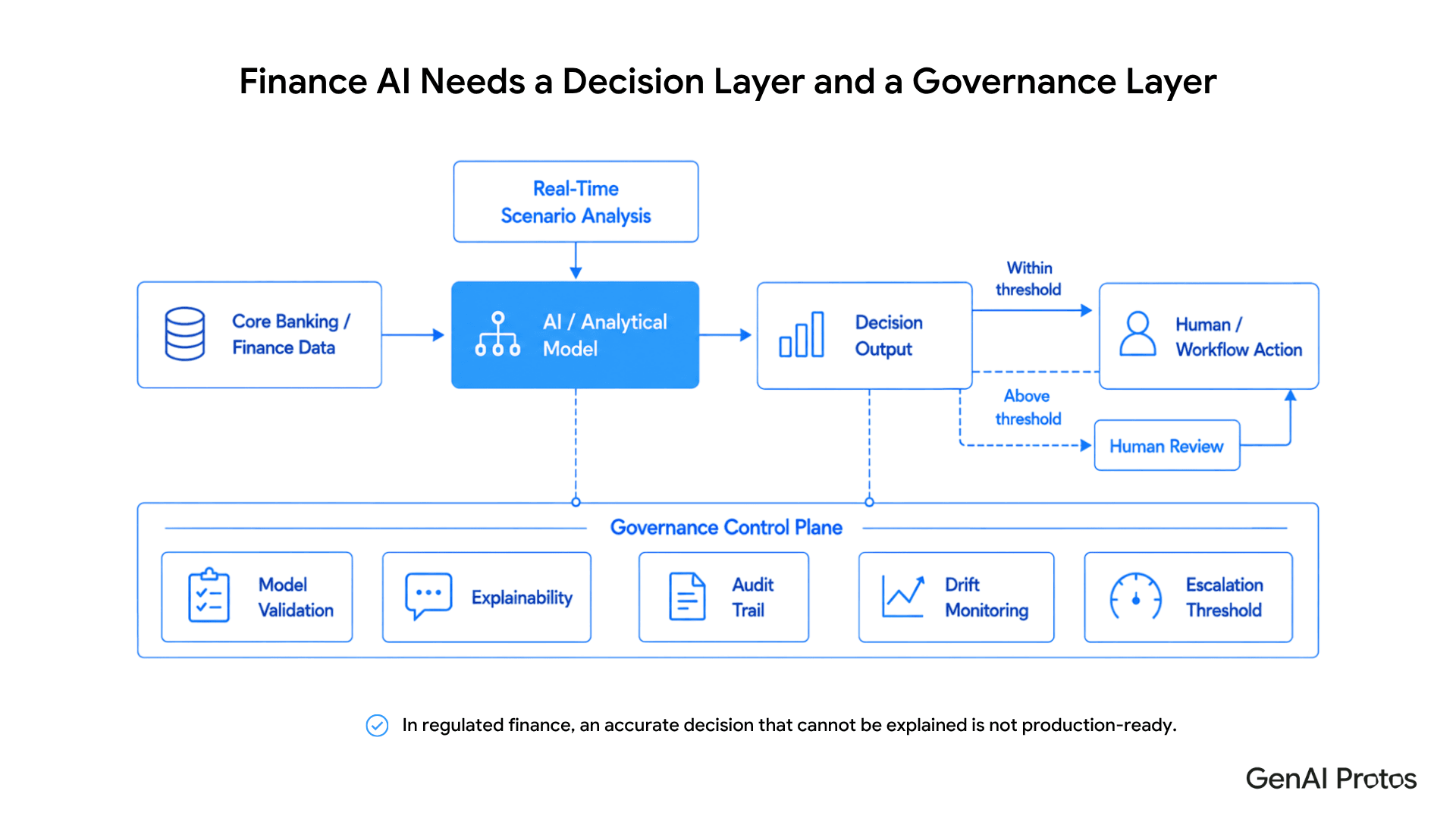
Black-box models, including standard deep learning architectures, cannot meet this requirement without an explainability layer. The production architecture for explainable AI in finance typically uses one of three approaches: inherently interpretable models (logistic regression, decision trees) for high-stakes decisions where accuracy trade-offs are acceptable; SHAP (Shapley Additive Explanations) values added to more complex models to produce feature attribution reports; or a hybrid where a black-box model generates predictions and an interpretable model provides the explanation.
The cost of not building explainability in from the start: regulatory review flags, deployment delays of six to twelve months, and potential model rollback requirements. Teams that retrofit explainability after model training pay a significantly higher cost than teams that design for it from day one.
Fintech AI: Where Emerging Applications Are Gaining Ground
Fintech AI is expanding into three areas where the evidence is early but the trajectory is clear: agentic finance workflows, embedded financial services, and alternative lending.
Agentic finance AI goes beyond the conversational interface. In an agentic architecture, the AI does not just answer questions. It takes actions: initiating reconciliation processes, flagging transactions for human review, triggering compliance workflows, and executing defined financial operations within pre-approved parameters. The agentic layer operates under human oversight with defined action boundaries. This is not autonomous finance AI. It is AI-assisted finance operations with a human-in-the-loop for decisions above a defined threshold.
Embedded financial services AI allows non-financial platforms to offer financial products (lending, insurance, payments) with AI-driven underwriting. The underwriting models run at point-of-sale speed: credit decisions in under two seconds on alternative data. Traditional bank underwriting takes days. The accuracy gap between two-second AI underwriting and multi-day bank underwriting is narrowing and in some lending categories has closed.
What Finance Teams Get Wrong About AI Implementation
The most common mistake:
Building AI on top of legacy data infrastructure instead of fixing the data infrastructure first.
Finance AI models are only as reliable as the data they train on. Organizations with fragmented data across multiple core banking systems, siloed reporting environments, and inconsistent data definitions across business units produce AI models that are accurate on training data and unreliable in production. The data unification work is not exciting. It is the work that determines whether AI in finance delivers decision intelligence or expensive confusion.
The second mistake:
Not accounting for model monitoring costs. AI models drift. A credit scoring model trained on pre-pandemic economic data performs differently in a post-pandemic economy. A fraud detection model trained in a low-inflation environment misfires in a high-inflation environment. Model monitoring is not a one-time setup. It is an ongoing operational cost that needs to be budgeted before deployment.
CONCLUSION
AI in finance that moves from reactive reporting to real-time decision intelligence requires three things the majority of deployments skip: unified data infrastructure, explainability architecture built from day one, and a model monitoring program that treats deployment as the start of the work, not the end. The organizations seeing the clearest ROI from finance AI are not the ones who deployed the most sophisticated models. They are the ones who built the data and governance layer correctly before deploying any model. See how we architect finance AI that meets regulatory requirements at GenAI Protos


