
Most engineering teams add AI one vendor at a time. First a chatbot. Then an image generator. Then speech-to-text. Each capability means another API contract, another credential set, another billing model, and another integration pattern to maintain. Six months later the AI stack is not a platform. It is a list of subscriptions.
GenAI Protos built GP Studio to make that stop. GP Studio is our enterprise ai platform running nine distinct AI capabilities on hardware we own, with no per-request API charge and no third-party dependency for every new modality we add.
This post covers what GP Studio is, how the unified AI architecture works, when building your own AI platform makes sense over buying API access, and what the self-hosted trade-off looks like in practice.
What a Unified AI Platform Actually Solves
A unified ai platform solves one specific problem: the fragmentation that accumulates when each AI capability is a separate vendor relationship.
Without one, the AI stack looks like this in practice. Conversation: one provider. Image generation: a second. Speech recognition: a third. Text-to-speech: a fourth. Video generation: you are now on your fifth vendor, fifth credential set, and fifth billing model, for a single product. Each integration is a new learning curve. Each vendor is a new point of failure.
A unified ai platform addresses this by consolidating capabilities under one system and one operational model. GP Studio is how GenAI Protos built that consolidation. Nine capabilities, one platform, one hardware footprint, one team that understands all of it.
GP Studio's Multimodal AI: 9 Capabilities Running Now
Multimodal ai means the platform handles more than text. It handles text, images, audio, voice, video, 3D, and music from the same system, on the same hardware. These are not proposed roadmap items. They are running now.
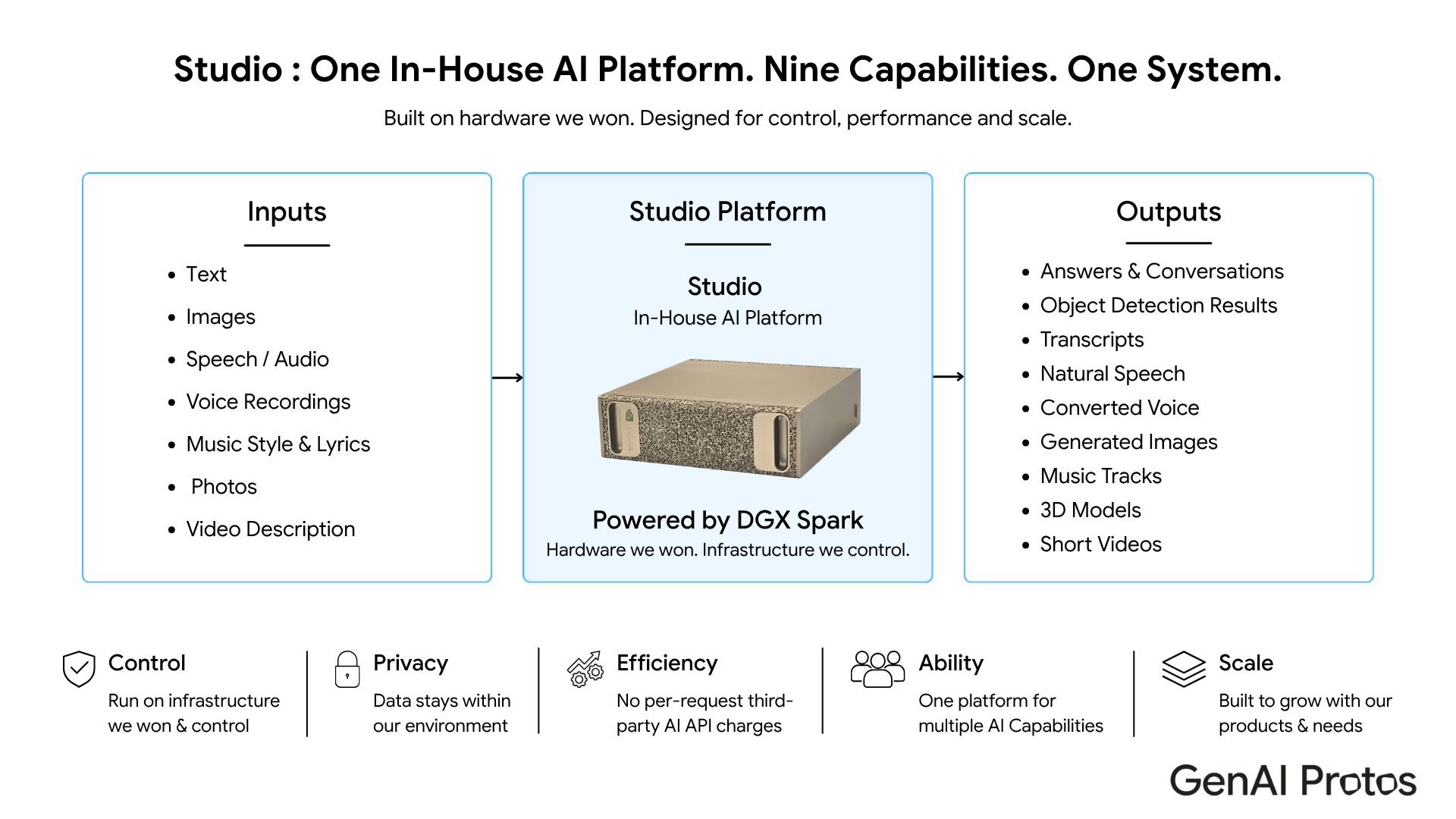
1. Conversation and image understanding: chatbot-style interaction, image description, and text extraction from images
2. Natural-language object detection: describe what to find in an image in plain language; GP Studio draws the boxes
3. Speech-to-text: 40 languages, with punctuation and capitalisation in the transcript
4. Text-to-speech: natural-sounding audio from written text, multiple voice options
5. Voice-to-voice conversion: takes a voice recording and re-renders it in another voice, near real-time
6. Image generation and editing: generate images from text descriptions, then edit and enlarge them
7. Music composition: full tracks from style description and lyrics, instruments and vocals included
8. Photo-to-3D generation: one photograph becomes a rotatable 3D model
9. Short-video generation: video clips from written prompts, generated on GP Studio's own system
GenAI Protos builds multimodal ai systems for enterprise clients. Explore our enterprise AI development work to see how GP Studio informs client builds.
Why GP Studio Self-Hosts LLM and AI Workloads Instead of Using APIs
The self hosted llm decision is not primarily about cost. It is about control over where workloads run.
When AI processing happens through an external API, three things happen: data leaves your infrastructure, cost scales with usage, and the system is owned by someone else. For most consumer applications, that trade-off is acceptable. For enterprise products handling proprietary or sensitive data, it requires a deliberate decision.
GP Studio runs on a DGX Spark, a compact system purpose-built for AI inference. The hardware sits on infrastructure GenAI Protos owns. Supported workloads do not leave it.
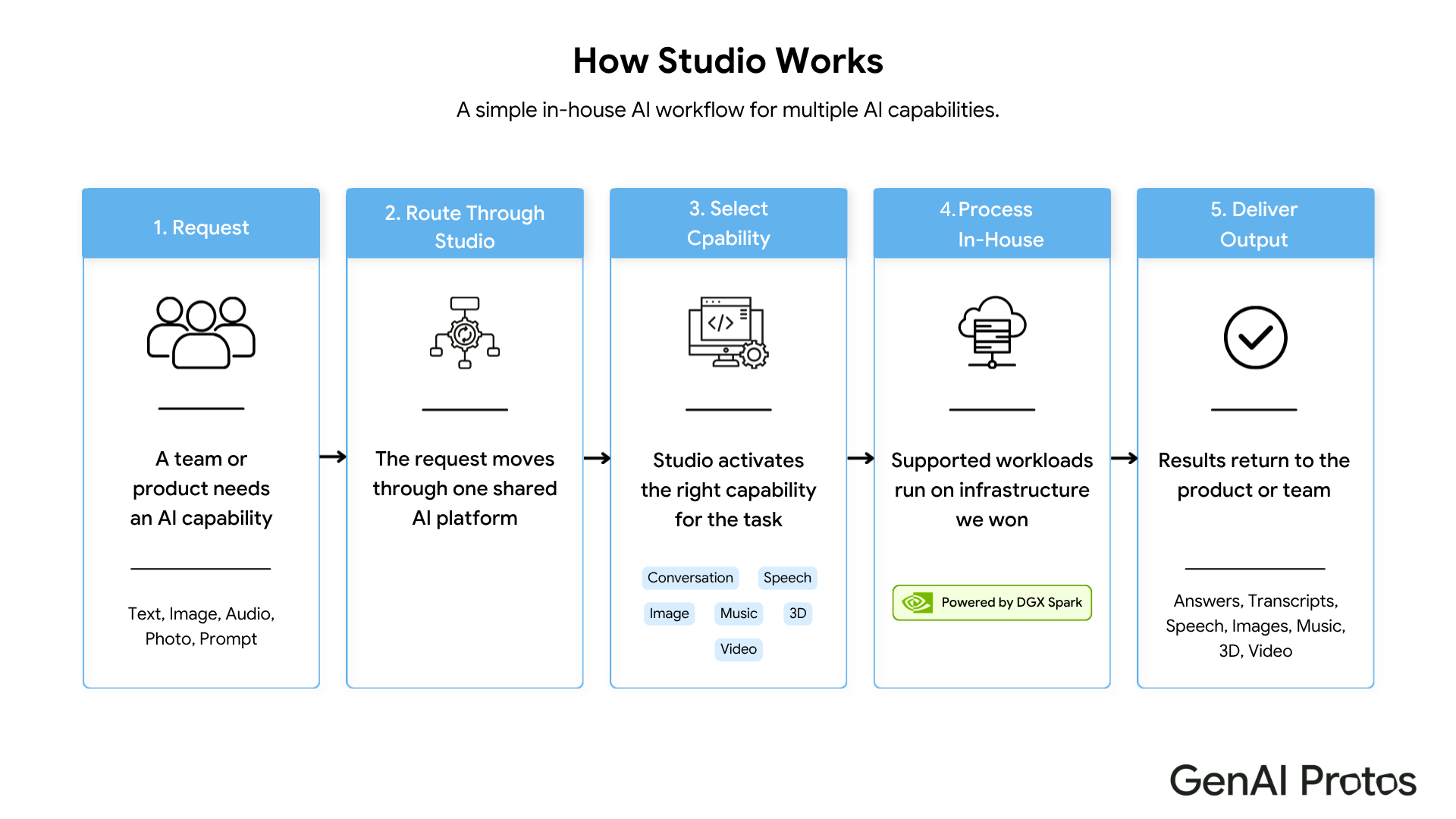
The trade-off is real. Owned infrastructure carries a capital cost and operational overhead. There is no vendor on-call when something breaks. Our engineering team owns the uptime. That is the cost of the control. For workloads where data residency and infrastructure ownership matter, it is a cost worth carrying.
See the infrastructure and self-hosted deployment decisions behind GenAI Protos' NVIDIA DGX Spark technology page.
Build Your Own AI Platform vs API Access: The Honest Trade-off
The build your own ai decision comes down to one question: how many AI capabilities do you need, and how often does that number grow?
At one or two capabilities, buying API access is almost always faster. Integration is quick, cost is predictable per request, and there is no infrastructure to manage. That is the correct choice at that stage.
The equation shifts past three modalities. Every new capability is another vendor evaluation, another contract, and another integration pattern your team maintains indefinitely. The coordination overhead compounds.
GP Studio changed GenAI Protos' starting point. Instead of asking which outside provider to integrate next, the team asks whether the capability can run through the platform we already own. That question is faster to answer when the enterprise ai platform already supports nine modalities.
Build Your Own AI vs Buy API: Decision Framework
| Decision | Condition |
|---|---|
| Build your own AI platform when | You need 3+ AI modalities, have infrastructure capacity, and handle data that must stay on your own systems |
| Buy API access when | You need 1-2 capabilities, speed to ship matters more than control, and data residency is not a constraint |
GenAI Protos helps enterprise teams evaluate this decision. See our enterprise AI development approach and how we scope in-house platform builds.
What Teams Get Wrong When Building an Enterprise AI Stack
Three mistakes account for most failed enterprise ai platform builds.
Mistake 1: Treating each AI capability as a separate project.
The team that builds a chatbot, then a separate image tool, then a separate speech module has not built a platform. It has built three disconnected integrations that each team member must understand, monitor, and maintain independently. The platform comes from deliberate architecture, not from accumulating tools.
Mistake 2: Ignoring data flow until there is a compliance problem.
Where AI processing happens is an architecture decision. If your product handles sensitive or proprietary data, the question of whether that data leaves your infrastructure belongs in the initial design, not in a post-incident review.
Mistake 3: Assuming API access scales cleanly.
Per-request pricing is predictable at low volume. At scale, it introduces a usage-cost variable that compounds across every modality in the stack. Teams that do not model this before choosing managed APIs often discover the problem after the budget conversation.
How to Decide If an Enterprise AI Platform Is Right for Your Team
The one move to make first is not choosing a framework or picking a vendor. It is writing down which AI capabilities you need in the next 12 months, including the ones you might add if the first ones work. That list determines whether building your own AI platform makes sense or whether managed API access is the correct answer for your stage.
GP Studio is GenAI Protos answer for our own stack. Nine modalities, one hardware footprint, no per-request API charge. The enterprise ai platform model works when you have the infrastructure investment capacity and the modality count to justify it. That is not every team. It is the right team when it fits.


