Your team spent three months building an agentic AI prototype. It passed every internal demo. Then you tried to ship it, and the framework decisions made in week one started compounding as technical debt. Wrong orchestration model. No state persistence. Zero cost controls. That is not a tool failure. That is a selection problem, and it is the most common reason enterprise agentic AI projects stall between pilot and production.
This guide covers the five best multi-agent AI frameworks and platforms in 2026: LangGraph, CrewAI, AutoGen, Google ADK, and Amazon Bedrock AgentCore. Not which one has the most GitHub stars. Which one fits your workflow shape, your infrastructure, and your production requirements. For a broader view of how these fit into a full agentic stack, see What Is Agentic AI? Stack, Components, Tools and Architecture Decisions.
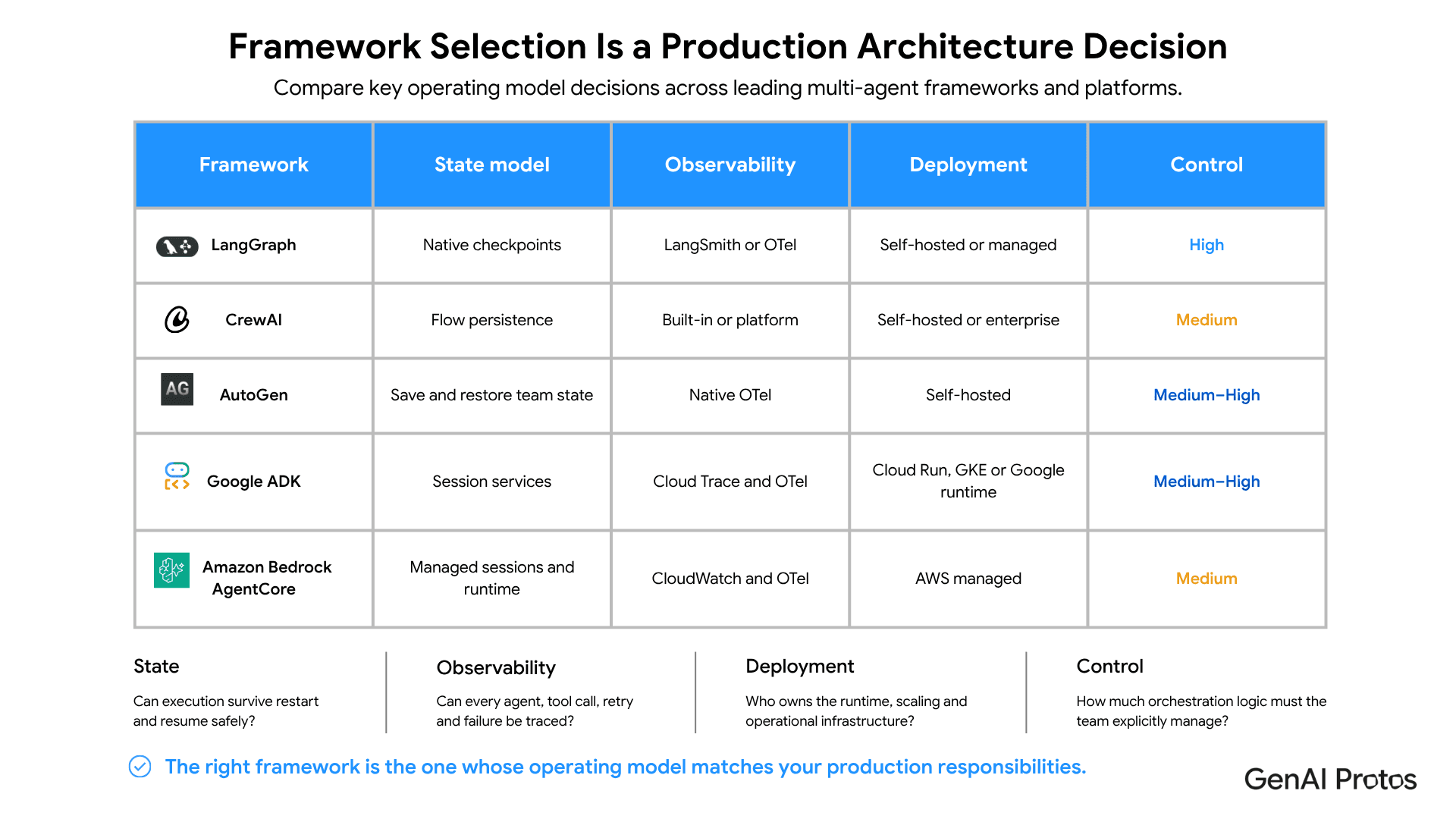
Framework Comparison: Five Options at a Glance
| Framework | Best Fit | State Model | Observability | Deployment | Control |
|---|---|---|---|---|---|
| LangGraph | Stateful branching workflows | Native checkpoints | LangSmith / OTel | Self-hosted or managed | High |
| CrewAI | Role-based crews and flows | Flow persistence | Built-in / platform | Self-hosted or enterprise | Medium |
| AutoGen | Conversational / distributed teams | Save / load team state | Native OTel | Self-hosted | Medium-High |
| Google ADK | Google-aligned agent development | Session services | Cloud Trace / OTel | Cloud Run, GKE, Google runtime | Medium-High |
| Bedrock AgentCore | Managed AWS agent workloads | Managed sessions/runtime | CloudWatch and OTel | AWS managed | Medium |
What Enterprise Teams Need From an AI Agent Framework
An AI agent framework is the orchestration layer that controls how agents communicate, how state is managed, and how tool calls are executed. Get this wrong and the rebuild cost at scale is significant.
Four factors determine production fit.
State persistence
Multi-step workflows require state that survives process restarts, parallel execution, and failure recovery. LangGraph provides checkpoint-based persistence as a core graph capability, including fault recovery and execution replay. CrewAI Flows also supports persistent execution, stateful workflows, and resumption of long-running tasks. AutoGen supports saving and restoring agent and team state across sessions. The implementation model and operational maturity differ across frameworks, so teams should evaluate recovery mechanisms, storage backends, and deployment requirements before selecting.
Cost controls.
Conversational multi-agent workflows can become expensive because context grows across turns. Estimate cost using measured input and output tokens per agent, expected turns, retry rates, and daily execution volume rather than turn count alone. A useful baseline: cost per workflow = model input cost + model output cost + tool execution cost + retry cost. Enforce token limits and message budgets before production.
Observability.
Observability maturity differs across frameworks and platforms. AutoGen supports OpenTelemetry tracing natively. Google ADK integrates with Cloud Trace and OTel instrumentation. Amazon Bedrock AgentCore provides managed observability through CloudWatch, including metrics, spans, latency, token usage, error rates, and workflow-level tracing. LangGraph commonly uses LangSmith or OpenTelemetry instrumentation. Compare what is automatic, what requires configuration, and whether traces export to your existing monitoring platform.
Compliance.
Compliance fit depends less on the framework name and more on where models and tools execute, how identities and secrets are managed, what telemetry is retained, and whether the runtime supports your organisation's data residency and audit requirements. Evaluate each option against your specific regulatory framework before selecting.
The Five Frameworks and Platforms: What They Actually Do
LangGraph
LangGraph models workflows as directed graphs where nodes are processing steps and edges define transitions. State persists across steps through native checkpoints, with support for fault recovery, human-in-the-loop pauses, and execution replay. Conditional routing and retry logic are first-class features, not afterthoughts. For production systems where reliability and cost control are non-negotiable, LangGraph is the strongest open-source foundation in this comparison. GenAI Protos designs and deploys LangGraph-based production pipelines. See our Multi-Agent Expertise for deployment patterns and typical project scopes.
CrewAI
CrewAI organises agentic AI systems as role-based teams. A researcher, an analyst, a writer: each agent has a defined goal, a toolset, and handoff logic. Sequential and parallel execution are well-supported. CrewAI Flows extends the framework into persistent, event-driven workflows with state management, execution resumption, and structured routing. For content generation, research pipelines, and report automation, it ships quickly and the agent definitions remain readable for non-technical reviewers. Evaluate whether its role-based and flow abstractions match your required branching and recovery model.
AutoGen (Microsoft)
AutoGen models agent interaction as conversation. Agents exchange messages, critique output, and execute code dynamically. It has strong code-execution and conversational team patterns, making it a relevant choice for code-generation, software-engineering, and research workflows. AutoGen includes built-in termination conditions, persistent team state, and native OpenTelemetry tracing. Conversational rounds compound context length, so cost grows faster at volume than in graph-based or role-based frameworks.
Google ADK
Google's Agent Development Kit is Google's multi-agent AI platform, released in 2025. SDK-first, multi-framework compatible, and built for Gemini-native deployments. Supports sequential, parallel, and loop-based multi-agent orchestration with session-state services and Cloud Trace and OTel instrumentation. Evaluate documentation coverage and community support for your specific infrastructure before committing, particularly for non-Google Cloud deployments.
Amazon Bedrock AgentCore
Amazon Bedrock AgentCore is AWS's next-generation managed runtime for production agent workloads. It provides managed sessions, scaling, authentication controls, and built-in observability through CloudWatch and OpenTelemetry-compatible telemetry, including metrics, spans, latency, token usage, error rates, and workflow-level tracing. For teams building on AWS who want managed infrastructure with minimal operational overhead, it is the recommended path for new workloads.
Note: Amazon Bedrock Agents Classic, the predecessor service, is entering maintenance mode. AWS recommends AgentCore for new agent workloads. Existing Agents Classic implementations continue to be supported. For regulated-industry deployments on AWS, see GenAI Protos Private AI Solutions.
Framework Decision Guide
Pick by workflow shape, not community momentum.
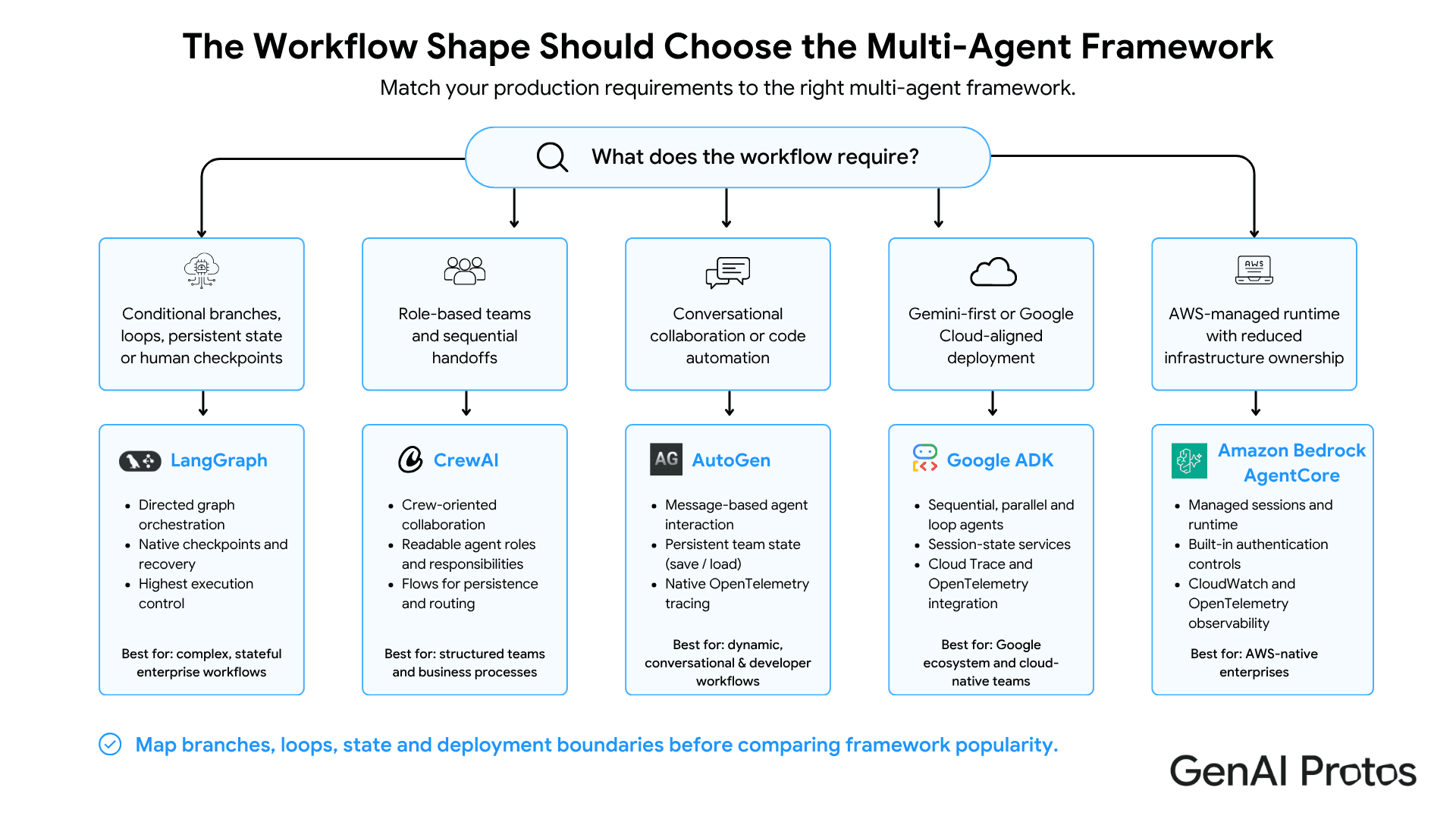
ChooseLangGraph for workflows with conditional branches, loops, human-in-the-loop pauses, or session-persistent state. It is the right AI agent framework for customer-facing production systems where a wrong output has real consequences.
ChooseCrewAI when your pipeline maps to roles and you need a working system quickly. Research automation, content generation, and report pipelines are its home ground. CrewAI Flows extends it for more structured, persistent workflows.
ChooseAutoGen when code generation and agent debate are central to the outcome. Set explicit termination conditions before deploying.
Choose Google ADK for Gemini-first and Google Cloud-native stacks.
Choose Amazon BedrockAgentCore for AWS teams that want fully managed infrastructure with built-in observability and scaling, without owning the runtime.
For RAG-heavy agentic AI pipelines, see GenAI Protos RAG Applications Expertise.
What Enterprise Teams Get Wrong
Choosing based on GitHub stars. CrewAI leads on community momentum. It is the wrong choice for stateful, branching production workflows, which describes most enterprise agentic AI requirements. Match the framework to your workflow topology, not the trending repository.
Skipping observability configuration. Most frameworks and platforms now provide observability tools, but connecting them to your existing monitoring platform still requires deliberate setup. Define your tracing and alerting requirements before selecting a framework, and verify that traces export to your existing platform before going live.
Mixing frameworks at the same orchestration level. LangGraph as the outer layer with CrewAI running inside a specific node is a valid pattern. Two competing frameworks at the top orchestration level is not. Integration overhead compounds with every new agent added.
Assuming the framework solves prompt quality. Framework selection determines orchestration reliability. Prompt quality, tool schema design, and retrieval architecture determine whether the multi-agent orchestration layer produces correct output. These are separate engineering problems, and both must be solved.
Key Takeaways
- LangGraph: production-grade for complex stateful workflows. Native checkpoints, human-in-the-loop support, and conditional routing. Most control.
- CrewAI: fast to build for role-based pipelines. CrewAI Flows adds persistence and event-driven routing for more complex workflows.
- AutoGen: strong code-execution and conversational agent patterns. Built-in OTel tracing. Context grows across turns, so token cost scales with complexity.
- Google ADK: built for Gemini and Google Cloud stacks. Session services and Cloud Trace integration. Evaluate documentation depth for your target infrastructure.
- Bedrock AgentCore: fully managed, AWS-native, with built-in CloudWatch and OTel observability. Minimal infrastructure to own. AWS recommends it for all new agent workloads.
- Framework selection is one decision. Observability configuration, prompt quality, state design, and tool schema accuracy determine whether the production system works.
Conclusion
The first move is not picking a framework. It is mapping your workflow as a flowchart, with branches, loops, and human checkpoints clearly marked. If the map has conditional paths and persistent state, LangGraph is the right foundation. If it maps cleanly to roles and sequential steps, start with CrewAI. If you run on AWS and want managed infrastructure, start with Bedrock AgentCore. That decision prevents the costly rebuild that happens when the wrong orchestration model meets a production workload.


