Agentic AI is an AI system that receives a goal, maintains state, selects and uses tools, evaluates intermediate results and decides what action to take next. Unlike a single-response Generative AI feature, an Agentic AI system operates through a controlled multi-step execution loop, planning, acting, evaluating and terminating. The sections below cover the complete stack: components, tools, framework comparison and production architecture decisions.
Most Agentic AI explanations describe planning, tools and autonomous actions. Production teams need a different answer: which components must be engineered, where failures occur, how frameworks differ and what must be monitored after go-live. This post covers all of it.
Agentic AI vs Generative AI: Where the Stack Actually Diverges
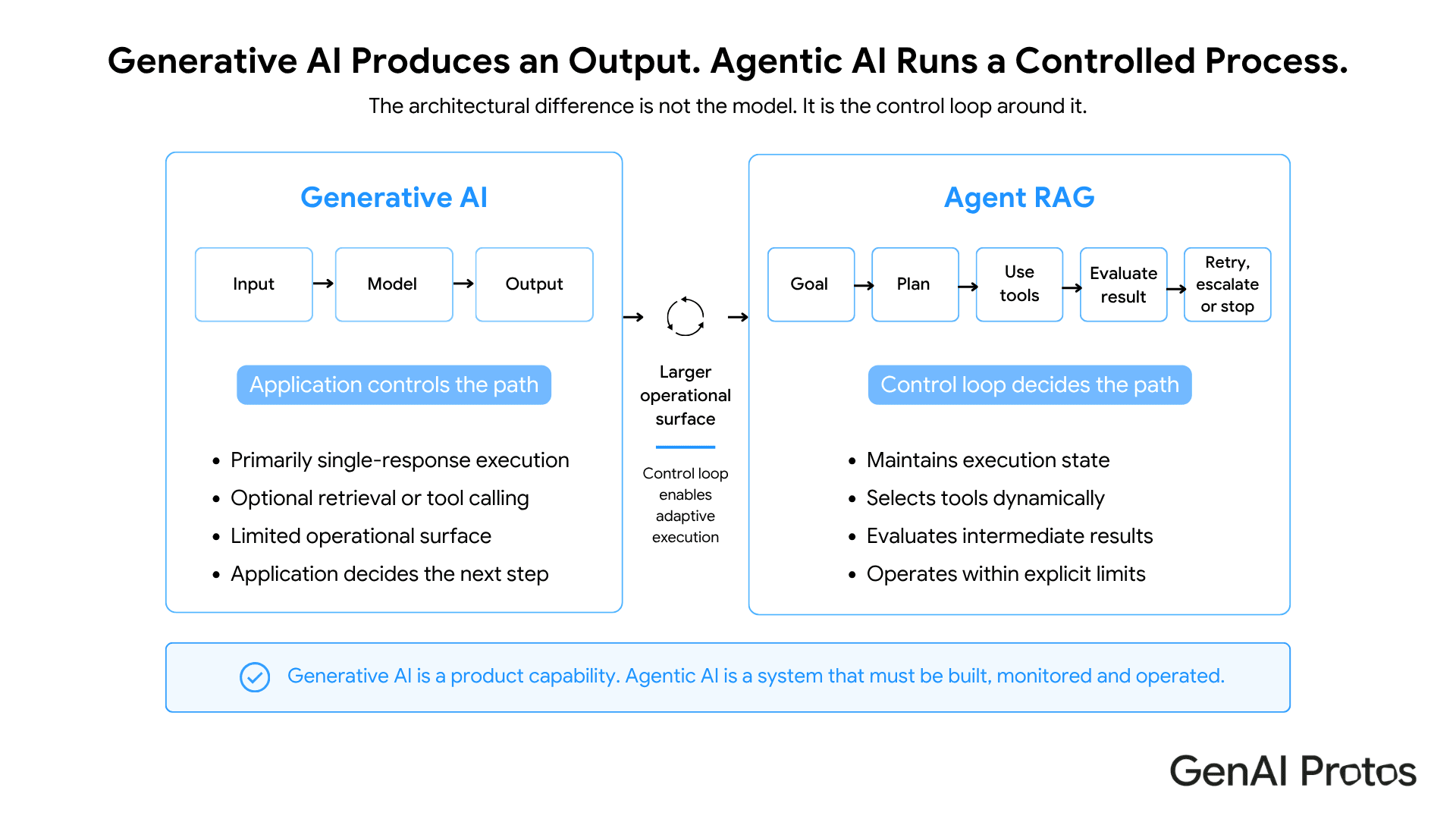
Agentic AI vs Generative AI is a system-design distinction, not a naming debate, and it changes every architectural decision downstream.
A basic Generative AI interaction transforms an input into an output. Applications may add retrieval, conversation history or tool calling, but the execution path remains primarily application-directed. Agentic AI adds a control loop that decides which steps to take, which tools to invoke, how to evaluate intermediate results and when to stop.
For enterprise teams, the practical implication is direct: Generative AI is a feature you add to a product. Agentic AI is a system you build, monitor and operate. The operational surface, error handling, cost controls, tracing and termination conditions, is fundamentally larger.
How Does Agentic AI Work: The Four-Layer Execution Loop
How Does Agentic AI Work? Four execution layers run in a loop until the system reaches a stopping condition.
Layer 1, Perception: the agent receives a task and queries for relevant context from memory or a retrieval store. It parses the input into a structured goal.
Layer 2, Planning: a reasoning model using structured planning or ReAct-style action-observation loops breaks the goal into subtasks and selects which tool or subagent handles each one.
Layer 3, Action: the agent calls external tools, APIs, database clients, code executors, search indexes, web browsers, and receives results.
Layer 4, Evaluation and Termination: the system evaluates tool results and output quality using deterministic checks, model-based scoring or human approval. It then retries, escalates or terminates according to explicit limits, including a maximum-iterations budget and a cost ceiling.
The most common failure points: a tool returning an unexpected schema, a planning loop that exceeds its token budget, or an orchestrator with no termination condition.
The Five Core Components of an Agentic AI Architecture
Agentic AI architecture is built from five execution components, supported by three cross-cutting production controls. The diagram below shows the complete stack.
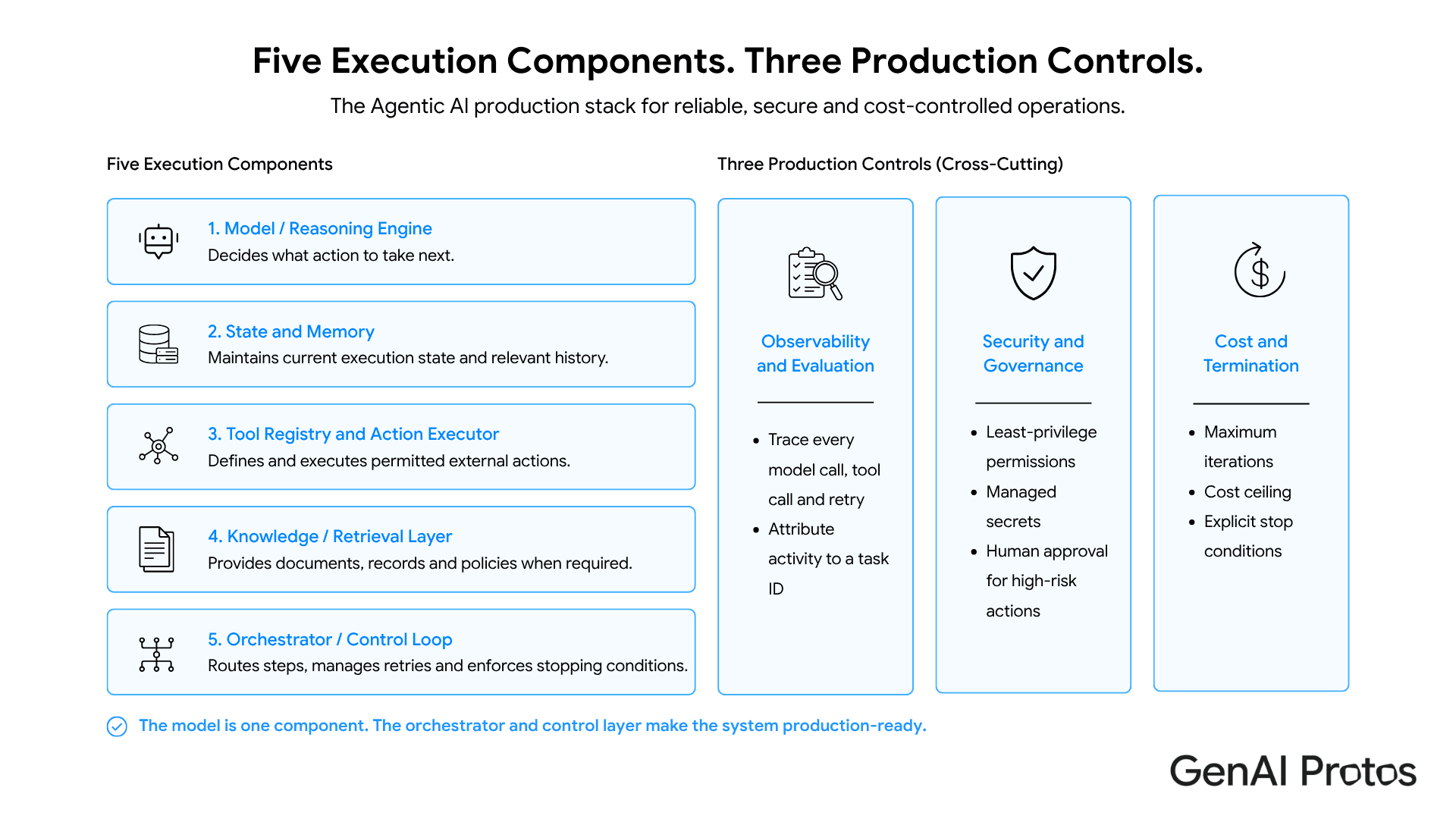
1. Model / Reasoning Engine
The LLM that decides what to do next. Frontier and open-weights models are viable, the choice affects cost per task, function-calling reliability and planning quality on long task horizons. Smaller or lower-cost models may require tighter task decomposition and stronger validation on complex, long-horizon workflows. Examples active July 2026: Claude Opus 4.8, GPT-4o series, Gemini 2.0, Llama 3.1.
2. State and Memory
Short-term state lives in the context window. Long-term memory is a vector store, key-value store or graph database. Episodic memory logs prior agent runs. Not all production workflows require persistent memory, a short, deterministic pipeline may only need execution state. Add long-term memory when the agent must learn from or reference prior tasks.
3. Tool Registry and Action Executor
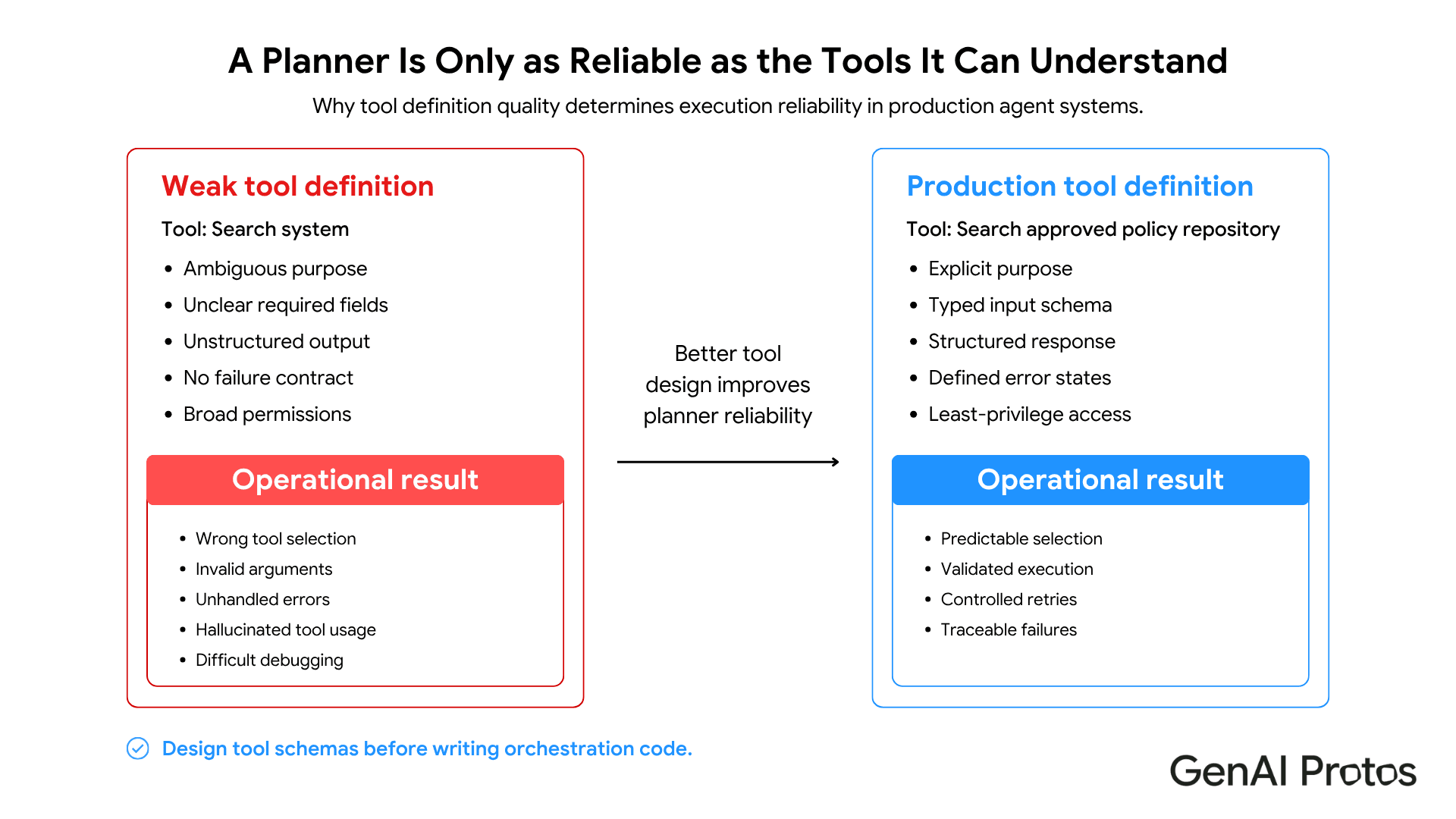
The set of tools the agent can call, APIs, code runners, browsers, database clients. Tool schemas must be precise. Action-layer failures frequently originate in ambiguous tool schemas, weak error handling or authentication issues, not only in the model.
4. Knowledge / Retrieval Layer
A RAG pipeline providing relevant documents, records or policies at query time. This layer is required for knowledge-intensive workflows, but an agent that operates entirely through structured APIs may not need it. See our Agent RAG architecture guide for component-level design decisions.
5. Orchestrator / Control Loop
The control loop managing agent state, routing between agents in multi-agent setups, handling retries and enforcing termination conditions. Model replacement is generally easier than redesigning the orchestration layer, but still requires compatibility, safety and regression evaluation. The orchestrator is where most engineering effort lives.
Production Control: Observability and Evaluation
Every tool call, LLM invocation and retry must be traced with a task ID. Evaluation runs continuously in production, not only during pre-launch testing. NIST AI RMF 1.0 treats monitoring and measurement of AI system behaviour as a core operational control, not an optional addition. See NIST AI RMF 1.0 for the full governance framework.
Production Control: Security, Permissions and Governance
Tool permissions should be scoped to the minimum required. Secrets must be stored in a managed vault, not passed through orchestrator state. Human approval gates are required for high-risk or irreversible actions. For regulated industries, our private AI deployment guide addresses access controls, audit logging and data-residency decisions.
Production Control: Cost and Termination
Every Agentic AI architecture must have a max-iterations limit and a cost ceiling. Agents without termination conditions run until credits are exhausted. Wire these controls on day one, retrofitting them into a running system is significantly harder.
Agentic AI Tools Compared: What Each Layer Needs in Production
Agentic AI tools fall into five categories. Buy before you build where the commodity layer is mature.
Inference providers
OpenAI, Anthropic, Google Vertex AI, Amazon Bedrock. Evaluate on function-calling accuracy, latency at p95 and cost per million tokens, not benchmark leaderboard positions. The gap between providers narrows every quarter.
Orchestration tools
LangChain (broad, well-documented), LangGraph (graph-based, built for complex branching), CrewAI (role-based agents), AutoGen (conversational multi-agent). Each makes different trade-offs between flexibility and abstraction.
Memory tools
Mem0 and Zep for managed memory, Weaviate and Qdrant with memory abstractions, Redis for short-term state. Do not use in-memory Python objects beyond local prototyping, they do not survive restarts or horizontal scaling.
Observability tools
LangSmith, Phoenix Arize, Helicone, Langfuse. Agentic AI tools without an observability layer are undebuggable in production. Every tool call, LLM invocation and retry must be attributed to a task ID and traced end-to-end.
Integration and tool protocols
Tool communication has shifted towards protocol-based standardisation. The Model Context Protocol (MCP) provides a standardised method for connecting Agentic AI systems to tools and data sources, covering API schemas, credential management, sandboxed code execution and tool permissions. MCP is now a standard component of the enterprise Agentic AI stack.
The right combination of agentic ai tools depends on your latency budget, compliance requirements and team familiarity, not GitHub star counts.
Agentic AI Frameworks: LangGraph vs CrewAI vs AutoGen vs Bedrock Agents
Agentic AI frameworks handle state, agent-to-agent communication and execution differently. The wrong choice costs months of retrofitting when requirements change.
| Framework | Best fit | Orchestration model | Control | Observability | Managed runtime |
|---|---|---|---|---|---|
| LangGraph | Complex branching, stateful workflows | Directed graph (nodes and edges) | High | Strong, LangSmith or OTel instrumentation | No (self-hosted) |
| CrewAI | Role-oriented crews, event-driven flows | Crew-based multi-agent collaboration | Medium | Built-in crew logging; platform options | Optional (CrewAI Enterprise) |
| AutoGen | Conversational multi-agent, code generation | AgentChat or event-driven Core (Microsoft) | Medium, High | Logging, callbacks, OTel support | No (self-hosted) |
| Bedrock Agents | AWS-integrated, managed infrastructure | Managed runtime with built-in guardrails | Low, Medium | CloudWatch metrics, step-level tracing | Yes (fully managed) |
LangGraph is the highest-control option. Execution is modelled as a directed graph where nodes are agent steps and edges are conditional transitions. Strong for teams with complex branching logic who need full trace visibility at every node. Observability is typically wired through LangSmith or OpenTelemetry-compatible instrumentation, it is not automatic in the open-source framework.
CrewAI abstracts agents as roles collaborating on shared tasks. Current capabilities include crews, flows, persistence, guardrails and human-in-the-loop support. Fastest path to a working multi-agent pipeline for document processing, research and sequential workflows.
AutoGen (Microsoft) provides both a high-level AgentChat API and a lower-level event-driven Core for distributed multi-agent runtimes. Strongest for code-generation and research automation. Supports persistent state, termination conditions and OpenTelemetry logging.
Amazon Bedrock Agents is fully managed: tool execution, knowledge-base integration and guardrails are built in. Step-level tracing is available via CloudWatch. Ideal for teams on AWS who want to reduce operational burden. Less control over the orchestration loop.
When evaluating agentic ai frameworks, test on three axes: how does agentic ai work in your specific task structure, what does the framework expose for observability, and how does it handle tool failures and retries.
Agentic AI Examples: Three Reference Architectures
Three agentic ai examples drawn from Agentic AI deployments, illustrating how component choices align with use-case requirements and operational constraints.
Reference architecture 1: Compliance document review
Stack: LangGraph orchestrator + large reasoning model + Weaviate retrieval + custom policy-check tools. The agent compares new regulatory filings against internal policies. Typical runtime in comparable deployments: 8-12 minutes per filing, compared with 4-6 hours for manual review. Batch-overnight latency profile.
Reference architecture 2: Code review and PR triage
Stack: AutoGen multi-agent + frontier reasoning model + GitHub API + Redis state management. Agents classify PRs by risk, draft review comments and flag breaking changes. Typical p95 latency in observed deployments: under 90 seconds per PR.
Reference architecture 3: Enterprise knowledge Q&A
Stack: CrewAI + Llama 3.1 (on-premises deployment) + pgvector + Confluence connector. Answers employee policy questions with citations. An on-premises model was selected in this architecture to meet the organisation's specific data-residency and processing-boundary requirements, not as a universal requirement for regulated sectors. See our private AI deployment guide for isolation and access-control decisions.
These agentic ai examples share one pattern: the orchestration layer requires the most engineering effort. The model is a configuration decision. The control loop is the work.
What Teams Get Wrong When Building an Agentic AI Stack
Teams that understand What Is Agentic AI conceptually still make the same three mistakes when they start building.
Common pitfall: starting with the model choice. What to do instead: design tool schemas first. Planner reliability depends on tool clarity. Vague tool descriptions cause hallucinated tool usage regardless of model size.
Common pitfall: no termination condition. What to do instead: every Agentic AI architecture must have a max-iterations limit and a cost ceiling. Wire these on day one.
Common pitfall: skipping observability until production breaks. What to do instead: trace every tool call and LLM invocation from the first deployment. Execution failures in multi-step agent loops are not debuggable from final output logs alone.
Key Takeaways
- What Is Agentic AI is best answered at the stack level: five execution components (model, memory, tools, retrieval, orchestrator) plus three production controls (observability, security, cost and termination).
- Agentic AI vs Generative AI is a system-design distinction: Agentic AI adds a control loop, state and tool access around the same underlying LLM.
- Agentic AI architecture fails most often at the tool and orchestration layers. Design tool schemas before writing orchestration code.
- Agentic AI frameworks differ fundamentally: LangGraph for explicit graph-based control, CrewAI for role-based crew pipelines, AutoGen for conversational multi-agent, Bedrock Agents for managed AWS deployment.
- Agentic AI tools selection depends on latency budget, compliance requirements and team familiarity. Add MCP-based integration to ensure tool interoperability.
- Real agentic ai examples show orchestration as the primary engineering challenge, not the model. Plan for it from day one.
Conclusion
What Is Agentic AI is the right first question. What it costs to run one in production, in compute, in engineering hours, in observability tooling, is the harder answer.
The one move to make first: design your tool schemas before writing orchestration code. The planner can only be as reliable as the tools it has access to.


