
The knowledge graph vs vector database decision is made incorrectly when it is made as a concept comparison. Both architectures answer different queries well. The real decision is operational: which architecture can your team build, maintain, and fund at the scale your use case requires. This guide covers the data engineering and ownership requirements for each.
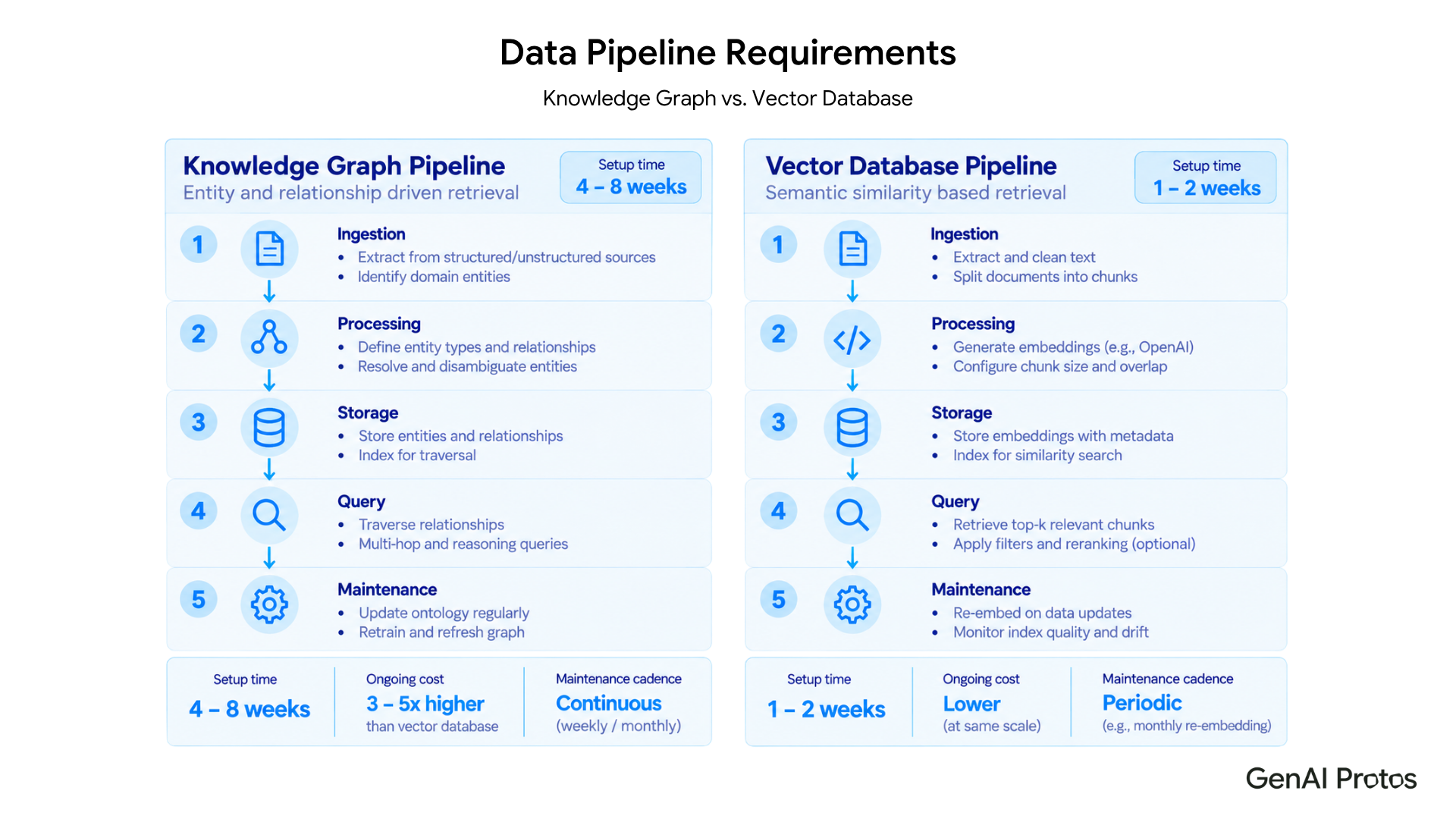
A vector database requires an embedding pipeline, a chunk configuration, an index, and a re-embedding schedule. A knowledge graph requires an ontology, an entity resolution pipeline, a graph refresh cadence, and named ownership of the ontology. Neither requirement is invisible but teams frequently select the knowledge graph without scoping its operational cost before committing.
The knowledge graph vs vector database question is not which retrieves better for your query type. It is which your team can build and own long-term without technical debt that degrades retrieval quality.
What the Vector Database Data Pipeline Actually Requires
Production vector database requires: document ingestion pipeline with chunking, embedding model, index storage, and re-embedding schedule. Chunk size affects retrieval precision. For enterprise corpora, 256-512 token chunks with 10% overlap is a reliable starting point.
Ingestion pipeline decisions: chunk size affects retrieval precision. For enterprise corpora, 256-512 token chunks with 10% overlap is a standard starting point.
The GraphRAG research demonstrated that combining graph-based entity retrieval with vector similarity search produces significantly better results on relationship-dependent queries than either approach alone.
What the Knowledge Graph Data Pipeline Actually Requires
Vector databases are appropriate for the majority of enterprise RAG use cases. Advanced RAG design for enterprise retrieval applications covers the full retrieval design space. Vector search is the right starting architecture when:
- Ontology design: entity types, relationship types, and attribute schema must be defined before populating the graph. Ontology design typically takes 4-8 weeks for 5-10 entity types. Changes after launch require re-processing affected documents.
- Entity resolution: every entity mention must be normalized to a canonical graph node. NER, coreference resolution, and disambiguation rules required. Resolution errors directly degrade retrieval quality.
- Graph refresh cadence: unlike a vector index that accepts new embeddings continuously, a knowledge graph requires validation before new nodes and edges are added. Typical production refresh cycles run nightly or weekly, not in real time. This creates a freshness lag for time-sensitive data that must be planned for in the data architecture.
- Ownership: the ontology must have a named domain owner who understands the business domain. When ownership is assigned to data engineering only, ontology drift accumulates within 6-12 months.
Three Operations Scenarios That Determine the Right Architecture
A knowledge graph outperforms vector retrieval when Structured and unstructured data for enterprise AI your query answers depend on entity relationships, regulatory hierarchies, supply chain dependencies, or multi-hop reasoning chains that similarity search cannot represent.
Internal knowledge management with relationship traversal:
An engineering team querying past incidents by root cause requires relationship traversal which past incidents share the same underlying cause? A vector database returns semantically similar incident reports, not causally related ones. A knowledge graph traverses the incident-to-cause relationship correctly but requires an ontology that captures those causal links. If your team can own that ontology, the graph outperforms vectors for this query type.
Product catalog with contract-tier rules:
A B2B platform recommending products based on contract tier, feature compatibility, and customer segment requires entity-relationship traversal. Vector search returns semantically similar products not contractually permitted ones. The knowledge graph handles this correctly if the product-contract-feature ontology is maintained. Teams without a dedicated catalog owner should use a hybrid: vector search with a structured rules-based filter layer instead of a full knowledge graph.
High-volume semantic search without complex relationships:
An FAQ system, documentation search tool, or customer support assistant querying a single well-maintained corpus fits vector database operations. Re-embedding is lower cost than graph maintenance, latency is lower, and no ontology is required. Adding a knowledge graph to this use case increases operational overhead without retrieval benefit.
The Entity-Linkage Cost Mitigation Strategy
The GraphRAG hybrid model routes queries to the graph layer for entity and relationship resolution first, then uses the resolved entity context to scope a vector similarity search within the relevant document cluster. Neo4j Cypher Manual with GenAI integrations covers the integration patterns between graph query and vector retrieval.
The Entity-Linkage Cost Mitigation Strategy reduces the primary overhead of GraphRAG: maintaining entity linkage across documents in a changing corpus. The strategy routes queries to the graph layer only when those queries require entity relationship traversal. All other queries go directly to the vector layer. This prevents the graph from becoming the bottleneck for high-volume semantic queries while preserving relationship-traversal performance for the queries that need it.
Implementation: tag each query at the routing layer with a traversal flag. Queries classified as single-hop or semantic go to the vector layer. Queries classified as multi-hop or relationship-dependent go to the graph layer. In most enterprise deployments, this routing reduces graph query volume by 60-80% and cuts graph infrastructure costs proportionally.
Design Your Enterprise Retrieval Architecture with GenAI Protos
GenAI Protos architects hybrid GraphRAG pipelines and knowledge graph integrations for enterprise AI systems. Book a retrieval architecture review to assess whether your current setup fits your query patterns. Book a Retrieval Architecture Review
Contact UsA Three-Question Selection Test
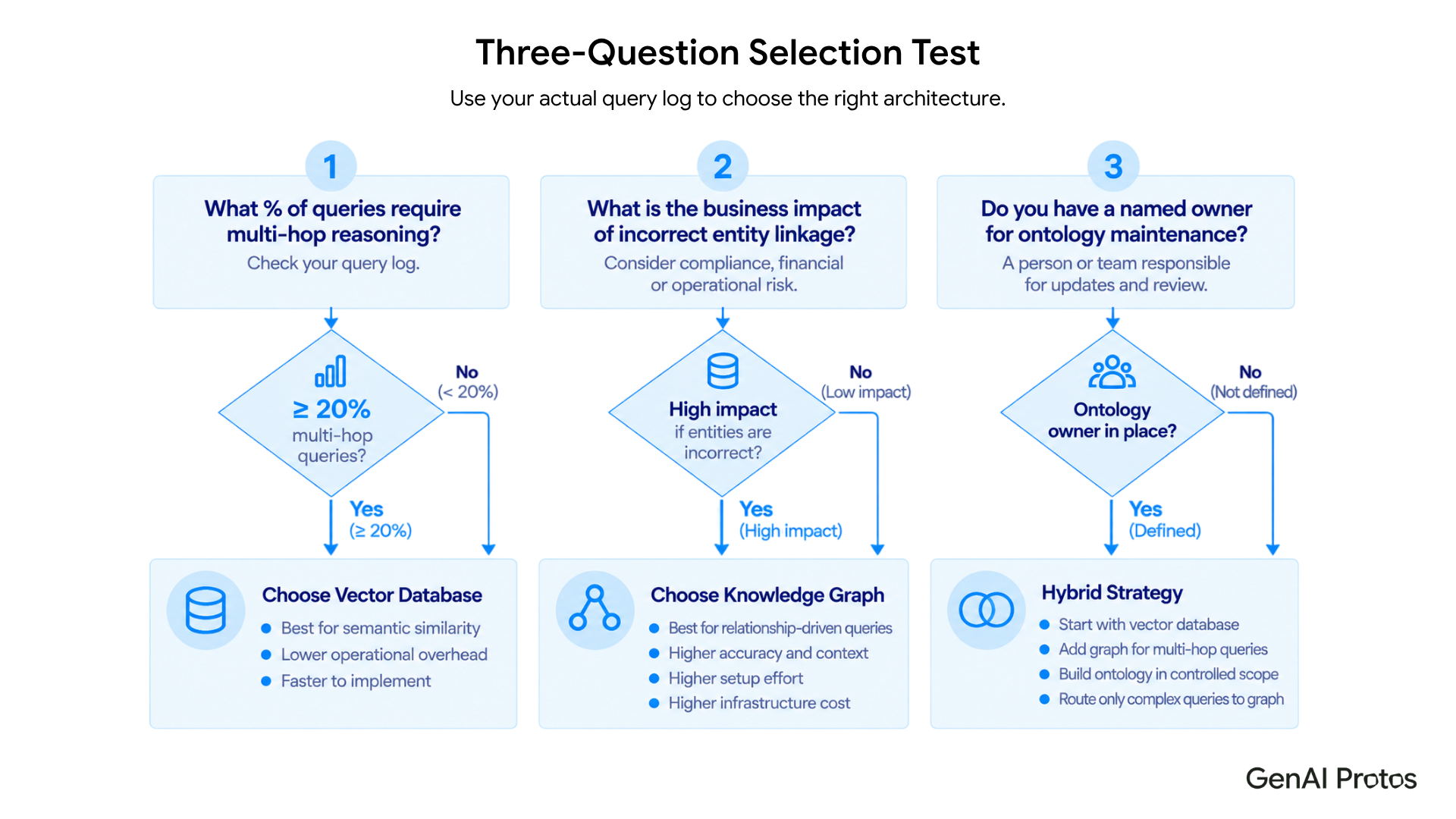
Before committing to either architecture, apply these three questions to your production query log:
Question 1: What percentage of your query log requires traversing relationships between entities to produce a correct answer? Sample 100 recent queries. Classify each as single-hop (semantic similarity is sufficient) or multi-hop (entity relationships are required). If fewer than 20% are multi-hop, a vector database with a structured filter layer covers your requirements at a fraction of the operational cost.
Question 2: What is the cost of an incorrect entity linkage? If an entity resolution error produces a wrong product recommendation or a compliance violation, the knowledge graph accuracy advantage justifies its operational cost. If the failure mode is a slightly irrelevant result with no material downstream impact, vector search is adequate.
Question 3: Who owns the ontology? Name the specific person and team responsible for adding new entity types, updating relationship definitions, and reviewing entity resolution errors on a recurring schedule. If you cannot name that person before building the graph, the ontology will drift and retrieval quality will degrade within 12 months of launch.
If Questions 1 and 2 both point toward the knowledge graph but you cannot answer Question 3, the recommended path is: start with a vector database and a structured filter layer, build and validate the ontology in a controlled scope, and migrate the multi-hop query class to the graph layer once ontology ownership is established and operating.
GraphRAG Operational Cost, Data Maintenance, and Ownership
GraphRAG in production carries four ongoing cost categories:
Ontology maintenance: every new entity type requires work. Budget 0.5-1 engineering days per entity type change monthly.
Entity resolution: retraining required as vocabulary drifts. Budget quarterly retraining cycles.
Graph refresh cost: document updates trigger re-processing for extraction and validation. At 1,000 updates monthly, budget 80 compute hours plus manual review.
Infrastructure cost: a production knowledge graph at enterprise scale typically requires 3-5x the infrastructure cost of an equivalent vector database at the same query volume. Graph query engines carry higher per-query compute and storage costs than vector databases. Factor this into the total cost of ownership comparison before selecting the architecture.
What Teams Get Wrong
Most common mistake: selecting the knowledge graph based on a demo query without sampling the full production log. If 85% of queries are single-hop, graph infrastructure costs 3-5x to serve 15% of the query volume.
Second mistake: treating entity resolution as setup. Resolution quality degrades with corpus evolution. New entities and vocabulary shifts create silent errors.
Key Takeaways
- Vector database requires: embedding pipeline, chunk configuration, and re-embedding schedule. Lower operational cost for high-volume queries.
- Knowledge graph requires: maintained ontology, entity resolution pipeline, refresh cadence, and domain owner. 3-5x cost vs. vector database at same scale.
- Use the Three-Question Selection Test on your actual production query log before committing to either architecture. The answers change significantly when applied to real queries vs. hypothetical use cases.
- The Entity-Linkage Cost Mitigation Strategy routing by traversal requirement reduces GraphRAG infrastructure cost by 60-80% in hybrid deployments by sending only multi-hop queries to the graph layer.
- Name the ontology owner before building the graph. Ontology drift without a named owner degrades retrieval quality faster than any other single operational failure mode.
Conclusion
The knowledge graph vs vector database decision is an operations decision. Both architectures retrieve correctly for their target query types the question is which your team can build and maintain without technical debt that degrades retrieval quality.


