The data engineering team spent 18 months building a datalake house . It is clean, well-partitioned, and queryable. The AI team wants to build a natural language query interface. They ask the data team for schema documentation, a data dictionary, and the business logic definitions for key metrics. There is no data dictionary. Business logic for "revenue" is split across 12 dbt models with inconsistent logic across regions. The AI cannot be grounded in data it does not understand.
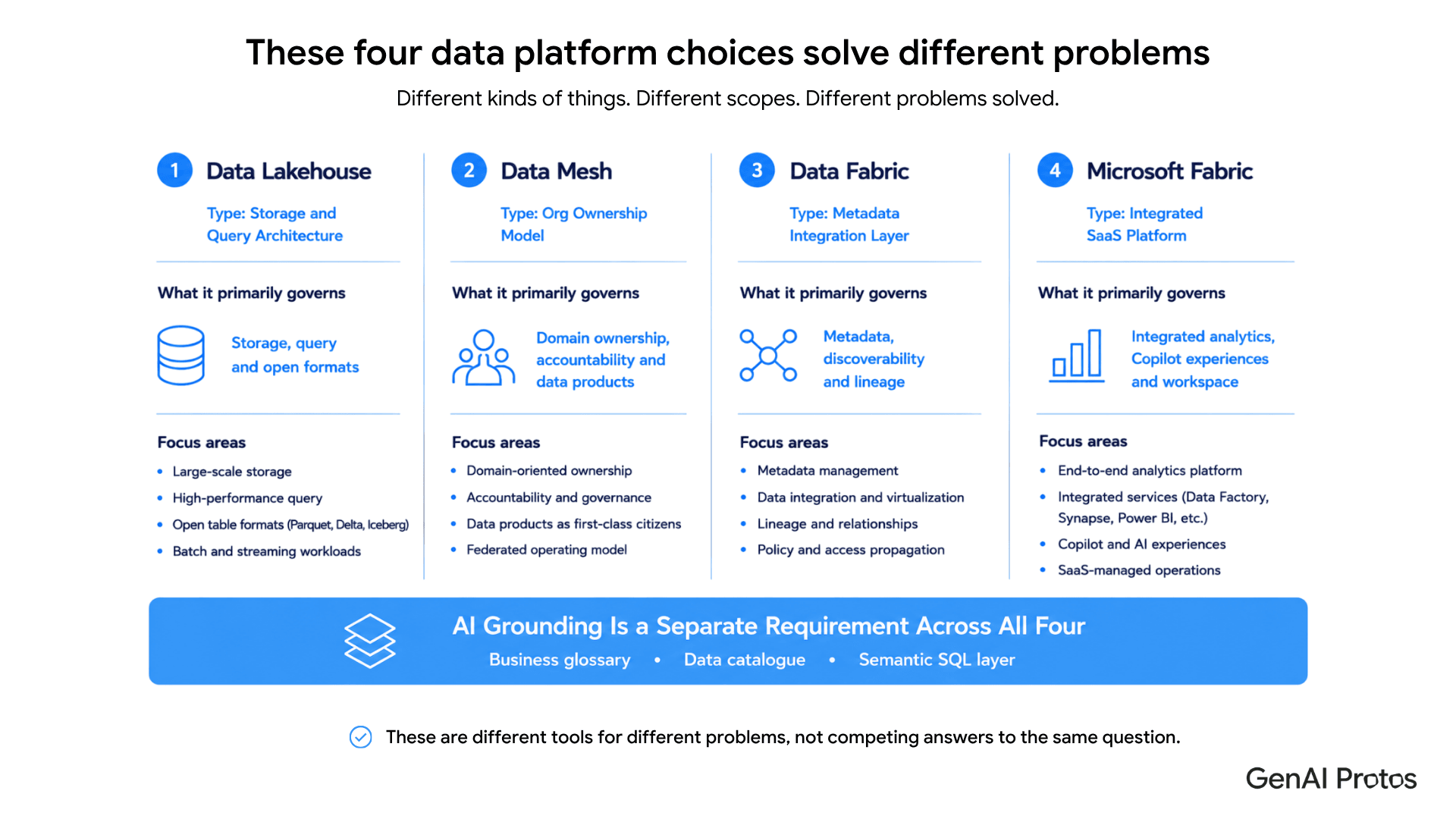
The data platform architecture decision is not just a data engineering problem. It is an AI strategy problem. How your data platform organizes, documents, and exposes data determines whether AI can use it reliably or whether AI outputs are hallucinations grounded in ambiguous data. This post compares four things that often get grouped under "data platform" but are distinct in nature: a data storage and query architecture (datalakehouse ), an organizational operating model (data mesh), a metadata-driven integration layer (data fabric), and a SaaS analytics platform (Microsoft Fabric). The comparison focuses on the dimension that matters most for AI applications: how well each exposes business logic to AI systems.
Architecture 1: Data Lakehouse (Data Storage and Query Architecture)
What it is:
A datalakehouse combines the storage economics of a data lake (raw files in object storage like S3 or ADLS) with the query performance and ACID transaction support of a data warehouse. Table formats like Delta Lake, Apache Iceberg, and Apache Hudi enable SQL query engines to treat object storage like a database. Databricks, Snowflake, and Apache Spark implement this architecture.
Strengths for AI:
A lakehouse stores all historical data in open formats accessible to AI training pipelines. Machine learning workflows can access raw data without moving it to a separate store. LLM fine-tuning pipelines integrate naturally with lakehouse data in this architecture. Feature stores integrate naturally with lakehouse data.
Limitations for AI grounding:
A lakehouse stores data. It does not inherently document what the data means. The business logic that defines "active customer" or "net revenue" lives in transformation code (dbt models, Spark jobs), not in the data itself. AI systems querying a lakehouse encounter ambiguous column names, undocumented business rules, and inconsistent metric definitions across tables.
AI readiness score:
Medium. Requires an external data dictionary and semantic layer to expose business logic to AI systems reliably.
Architecture 2: Data Mesh (Organizational Operating Model)
What it is:
Data mesh is an organizational and architectural pattern that distributes data ownership to domain teams (the business units that produce the data) rather than centralizing it in a data engineering team. Each domain publishes "data products" -- curated, documented, versioned datasets with explicit ownership and quality SLAs. The concept was defined by Zhamak Dehghani in 2019 and published by Martin Fowler.
Strengths for AI:
Domain-owned data products have explicit owners who understand the business logic. When the AI asks "what does active customer mean in the CRM data product," there is a named owner who can answer. Documentation is a first-class requirement of a data product, not an afterthought. This is the architectural pattern best suited to AI grounding because business logic accountability is built into the model.
Limitations for AI:
Data mesh is an organizational pattern, not a technology stack. Implementing it requires domain teams to accept data ownership responsibilities they may not have the technical capacity for. Cross-domain queries require federation across independently managed data products, which adds latency and complexity. The cultural and organizational change is significant. Teams that try to implement data mesh as a technology project without organizational change get a distributed data lake with no domain ownership and worse documentation.
AI readiness score:
High, when implemented with genuine domain ownership. Low, when implemented as a technology pattern without the organizational model.
Architecture 3: Data Fabric (Metadata-Driven Integration Layer)
What it is:
Data fabric is a metadata-driven architecture that uses AI and machine learning to connect, integrate, and expose data across heterogeneous sources. Rather than centralizing data (as a warehouse does) or distributing ownership (as a mesh does), this layer sits above existing data sources and uses intelligent metadata management to present a unified view. Gartner popularized the term. Vendors including Informatica, IBM, and Talend implement it.
Strengths for AI:
Its metadata layer is explicitly designed to make data discoverable and understandable. The metadata captures data lineage, relationships between datasets, and semantic definitions. This metadata is directly useful for AI grounding: when an AI needs to understand what tables are related, what a field means, and where the data came from, the datafabric 's metadata layer contains this information.
Limitations for AI:
Implementations of this integration layer are often vendor-specific and expensive. The quality of the metadata layer depends on the quality of the metadata that has been curated and maintained. A data fabric with poor metadata is a sophisticated indexing layer over ambiguous data. It does not resolve ambiguity. It organizes it.
AI readiness score:
High for metadata and discoverability. Implementation complexity and cost are significant barriers.
Architecture 4: Microsoft Fabric (SaaS Analytics Platform)
What it is:
Microsoft Fabric, released in 2023, is an end-to-end analytics platform that integrates data engineering (Lakehouse and Data Factory), data warehousing (Synapse Analytics), data science (notebooks with Python/R), real-time analytics (Eventhouse), and business intelligence (Power BI) into a unified workspace with a shared storage layer (OneLake). It is Microsoft's unified answer to the fragmentation of the Azure data stack.
Strengths for AI:
Its integration with Microsoft Copilot and Azure OpenAI makes it one of the more deeply AI-integrated commercial analytics platforms in 2026. Copilot in Power BI enables natural language questions over Power BI semantic models. The semantic model (formerly Analysis Services model) in Power BI captures business logic, metric definitions, and relationships in a structured, queryable format that AI can use directly. This is the critical bridge: business logic encoded in a Power BI semantic model is accessible to Copilot without additional grounding engineering.
Limitations for AI:
The platform is a Microsoft ecosystem product. Teams invested in AWS, GCP, or open-source stacks face significant migration cost to access these AI integration features. The Copilot features are most powerful when data is in OneLake and business logic is in a Power BI semantic model. Data outside this model requires additional integration work.
AI readiness score:
High for Microsoft ecosystem teams. Low to medium for non-Microsoft environments.
The AI Grounding Problem: What All Four Architectures Must Solve
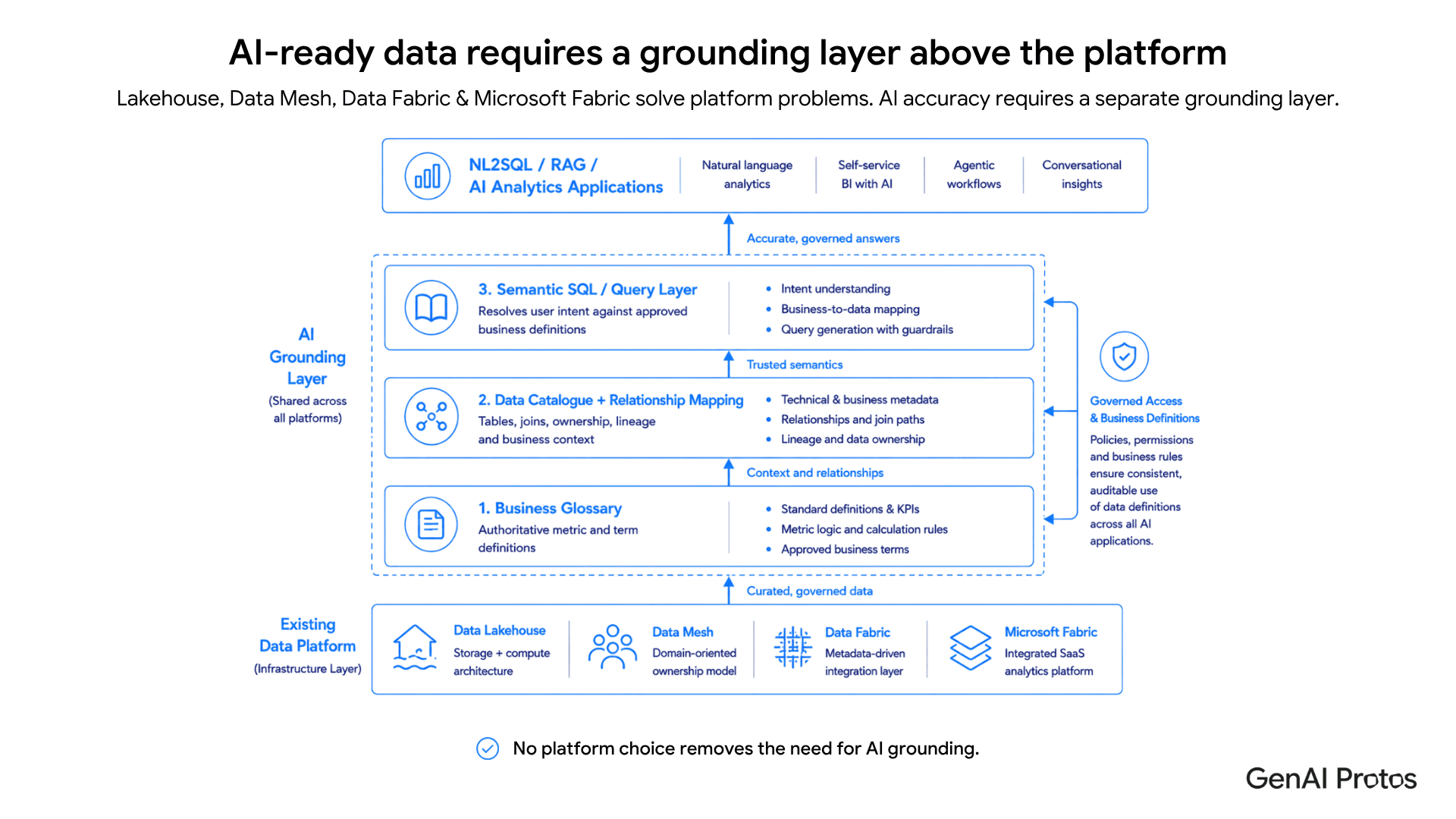
Regardless of which data platform architecture you choose, AI systems that query your data need three things that none of the four architectures provide by default:
A business glossary.
Definitions of key business metrics in natural language, with the authoritative definition and the table or model that implements it. The GenAI Protos guide to GenAI on existing data platforms explains why even technically sound data platforms need this semantic layer before AI can query them reliably. The Intelligent Data Dictionary solution GenAI Protos deploys builds and maintains this glossary as a queryable, AI-accessible layer above the data platform.
A data catalogue with relationship mapping.
Which tables contain which data, how tables relate to each other, and which joins are correct for which analytical purposes. The Fast Data Catalogue solution indexes the data platform schema and enriches it with business context and relationship metadata, making it discoverable by AI systems and human analysts.
A SQL interface with business logic grounding.
Natural language queries against the data platform must be grounded in the schema and business logic before they generate SQL. The Chat with SQL solution combines the data dictionary and catalogue context to ground NL2SQL queries in verified business definitions.
These three components are the AI-readiness layer that sits above any of these architectures. They are what transform a technically sound data platform into one an AI system can use reliably.
Architecture Selection Guide
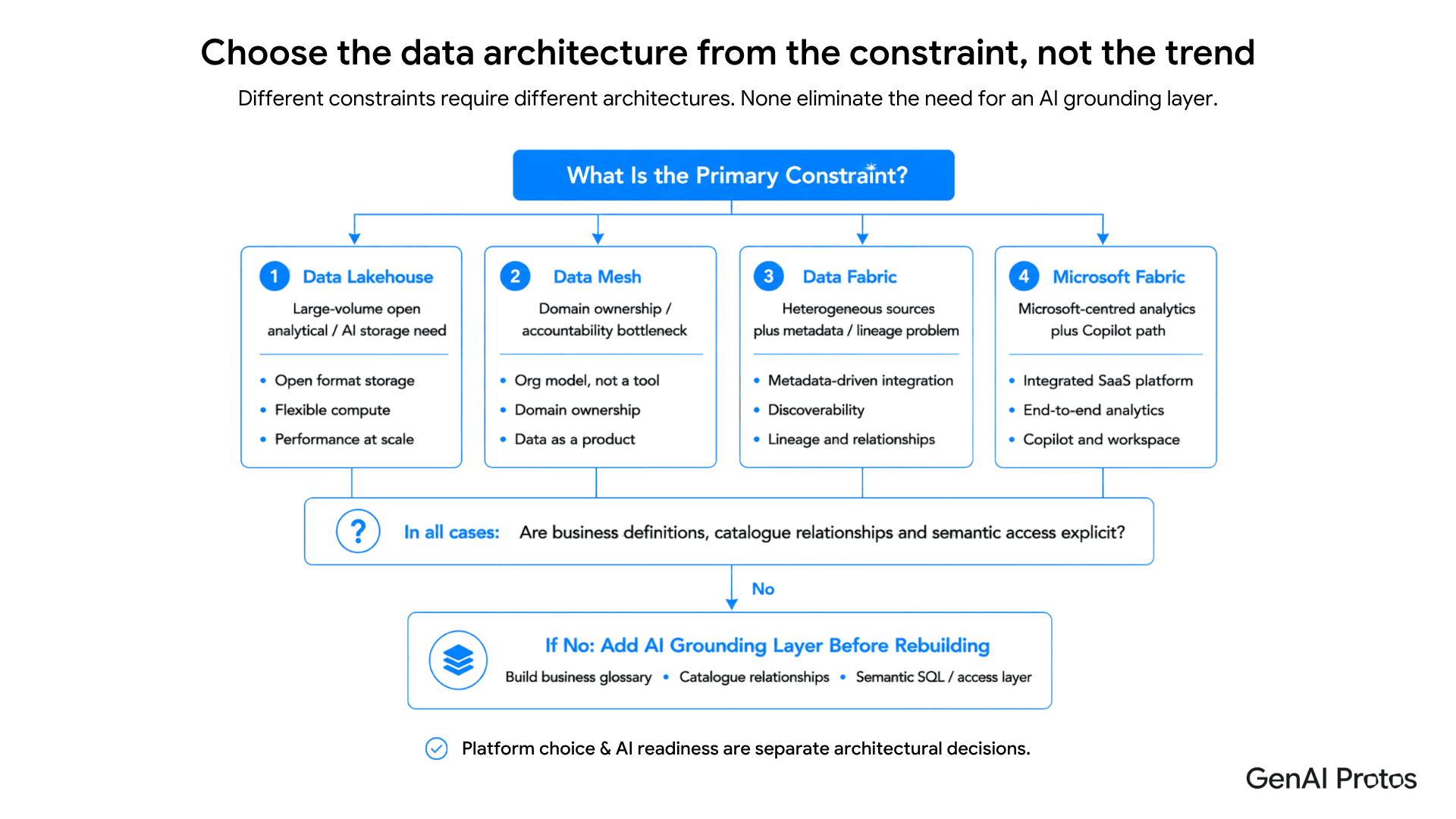
Choose Data Lakehouse if:
You need unified AI/ML training and analytical query access on large volumes of data with open formats and cost-effective storage. Add a semantic layer and data dictionary to make it AI-queryable. The GenAI Protos AI Data Engineering Services team implements these layers above any existing platform architecture.
Choose this operating model if:
You have mature domain teams willing to own data products, you have cross-domain data quality problems caused by central data team bottlenecks, and you can invest in the organizational change required. The business logic accountability this creates is a high-value property for AI grounding.
Choose this integration layer if:
You have a complex heterogeneous data estate with many sources, metadata and data lineage are your primary pain points, and you have the budget for enterprise data integration tools.
Choose this SaaS platform if:
Your analytics and BI stack is Microsoft-based, you want the shortest path to Copilot-enabled natural language analytics, and you are willing to centralize on the Microsoft ecosystem.
Key Takeaways
- All four data platform architectures have different AI-readiness profiles. The business logic exposure problem exists across all of them.
- Data mesh often provides strong AI grounding potential when domain ownership and documentation are genuinely implemented. The organizational change required to get there is the hard part.
- Microsoft Fabric's Copilot integration offers a relatively turnkey AI analytics experience for teams already in the Microsoft ecosystem; teams on other stacks require additional integration work.
- For reliable AI grounding, most data platform deployments benefit from adding three layers: a business glossary, a data catalogue, and a semantic SQL interface. The specific implementation depends on the platform and the existing data documentation state.
- The lakehouse pattern is a common enterprise foundation. For most teams, adding the AI grounding layer above the existing platform is lower-risk than a platform migration.
Conclusion:
An AI-ready data platform requires more than storage and compute. GenAI Protos helps organisations connect catalogues, business definitions, semantic access and governed data pipelines so AI systems can interpret enterprise data accurately across the existing platform landscape.


