
Most teams choose their orchestration framework before they understand their workflow. They see a conference talk. They find a trending GitHub repo. They build. Six months later, they rebuild because the framework model does not fit how the workflow actually runs.
The langgraph vscrewai question is real, and it is worth answering precisely. But the teams who ask it first are asking in the wrong order. The prior question is: what is the shape of your workflow? That answerdetermines the framework. Not the star count. Not the ecosystem. The workflow shape.
If your enterprise is currently evaluating or rebuilding your multi-agent stack, this guide gives you the decision framework, not the hype.
What an AI Agent Orchestration Framework Actually Decides
An ai agent orchestration framework manages one thing: how work moves between agents. It handles task routing, state passing, failure recovery, and execution sequencing. That is its job. Everything else, data quality, prompt consistency, output evaluation, remains yours.
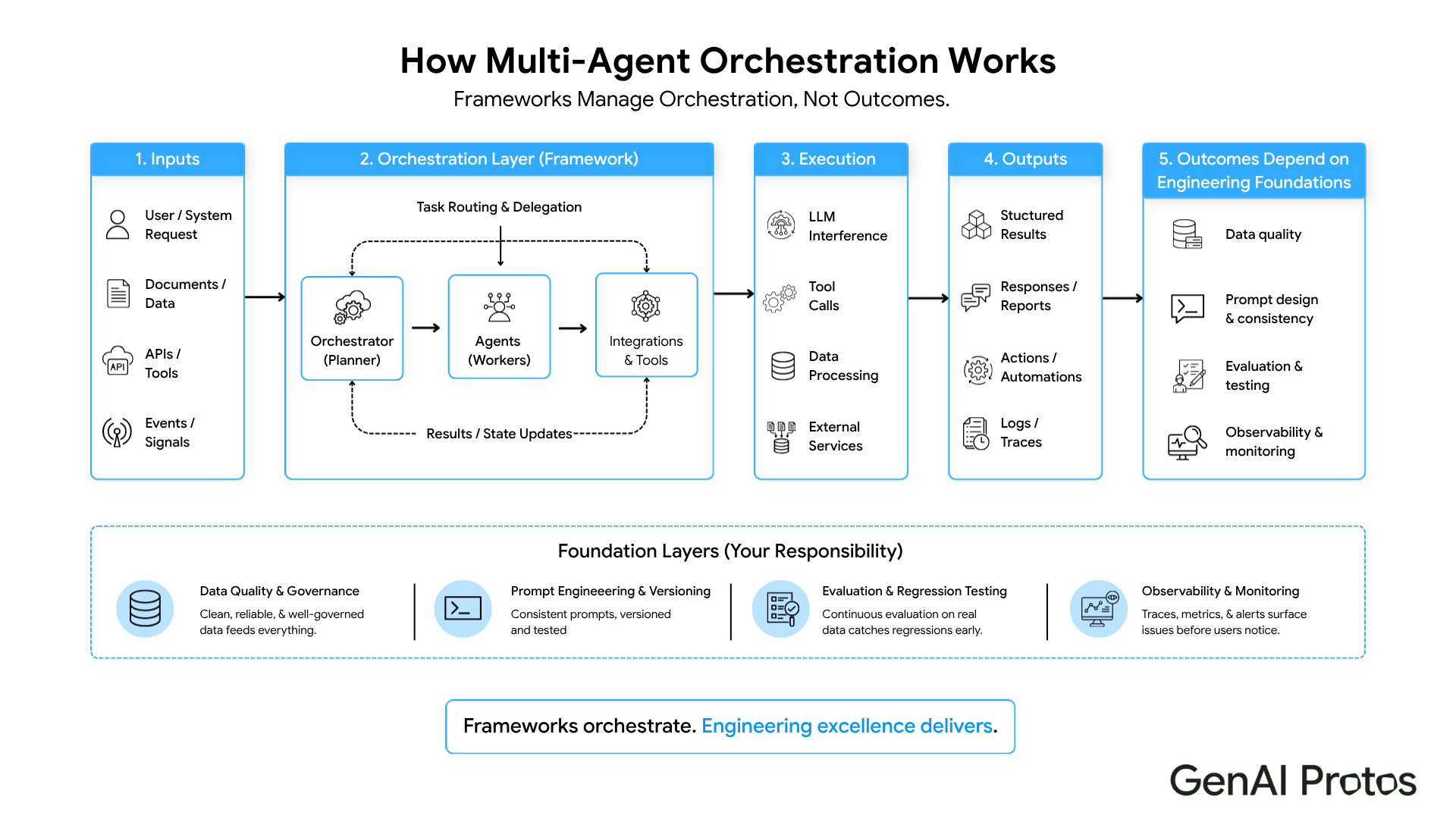
Three workflow shapes map cleanly to three frameworks. Get this mapping right and the framework stays out of your way. Get it wrong and you spend your engineering cycles fighting the abstraction.
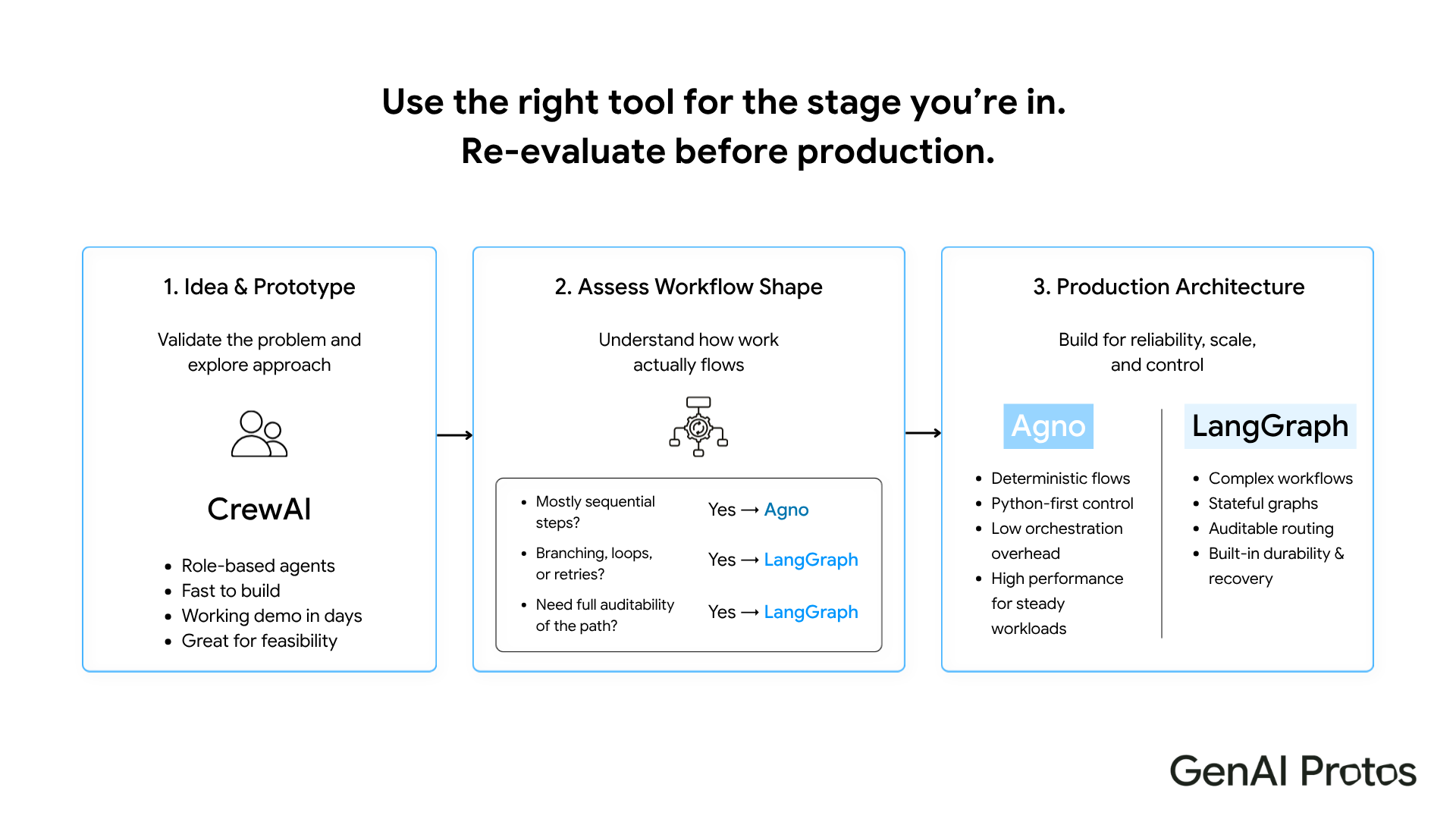
Sequential Python flow with explicit control: Agno.
Conditional graph with branching, loops, and auditable routing: LangGraph.
Role-based team for rapid feasibility validation: CrewAI.
If you are selecting an ai agent orchestration framework without having answered which of these three shapes describes your workflow, stop. Answer that first.
Agno Framework: When Python Control Beats Configuration
The agno framework is Python-first. Agents are Python classes. There is no DAG to define, no graph to configure, no abstraction layer between your code and execution. Startup overhead is low. Coordination logic is yours to write.
That trade-off is explicit: Agno does not manage retry behavior, branching conditions, or state persistence on your behalf. For teams with deterministic pipelines and steady-state inference workloads, that is a feature. For teams that want the framework to handle coordination complexity, that is friction.
Good fit for the agno framework: production agents with predictable sequential flow, teams that prefer code over configuration, and systems where orchestration overhead directly impacts latency budgets.
GenAI Protos builds on the Agno framework for clients who need explicit Python control without the DAG overhead. If that matches your workflow, it is worth evaluating seriously.
See how this pattern applies in production: GenAI Protos Agno technology page covers the architecture decisions behind Python-first agent design.
When LangGraph Earns Its Complexity
LangGraph models workflows as state machines. Nodes perform work. Edges define transitions. Conditional routing makes branching explicit and inspectable before the run starts. LangSmith observability integrates directly, so traces require no additional instrumentation.
This matters when the workflow has loops, when branching depends on intermediate results, or when a compliance or audit requirement means you need to show exactly which path a run took. The graph forces control flow to be visible rather than implicit.
The trade-off: ramp-up time is higher. Simple sequential tasks become over-engineered when expressed as graphs. In a langgraph vscrewai evaluation for a workflow that isactually a straight sequence, LangGraph will cost more time than it returns. It pays off when workflow complexity justifies the model, not before.
For enterprise teams doing a langgraph vscrewai assessment:LangGraph is the right call when the workflow has branching logic that must be inspectable and recoverable. It is not the right call by default.
GenAI Protos used a state machine architecture when building FactPulse, a production multi-agent fact-checking system, where branching research paths and auditable routing made LangGraph the right call.
LangGraph Production: What Gets Harder After the Demo
Getting a langgraph production deployment past the demo is where most enterprise teams stall. The graph runs cleanly in development. In production, three things break it.
First, state management at scale. LangGraph's state machine requires careful design of what persists between nodes. Teams that sketch the graph without specifying state schemas upfront spend weeks refactoring when production payloads arrive.
Second, error recovery across conditional branches. A node failure mid-graph leaves partial state. Without explicit failure handling per branch, the orchestrator has no clean recovery path.
Third, LangSmith dependency. Teams that rely on LangSmith for observability during development often underestimate what is required to replicate that visibility in a locked-down enterprise environment. Plan for this before launch, not after.
CrewAI: The Right Tool for the Right Stage
CrewAI is a prototyping tool. That is not a criticism. It is the most precise description of where it earns its place.
Role-based agent design lets a team sketch a multi-agent pipeline quickly. A working demo in a day is achievable. That demo answers one question well: is this workflow feasible with agents at all? It does not tell you how the system behaves under load, with noisy inputs, or after the prompt changes.
In a langgraph vscrewai comparison for production,CrewAI loses because it was not built for it. Use it to prove feasibility. Then assess whether the architecture needs to change before you commit to production infrastructure. Most of the time, it does.
The langgraph vscrewai decision at the prototyping stage and at the production stage are different decisions. Treat them separately.
Multi Agent System Architecture: What No Framework Solves
The multi agent system architecture conversation almost always collapses into a framework debate. That is the wrong frame.
Agno, LangGraph, and CrewAI all manage execution flow. None of them validate that agent inputs are clean. None of them guarantee that prompts produce consistent outputs. None of them tell you when output quality degrades.
A production-grade multi agent system architecture requires four layers the framework does not provide: data quality controls before agents receive inputs, prompt versioning and regression testing, an evaluation loop that runs on real production samples, and observability that surfaces silent degradation before users notice it.
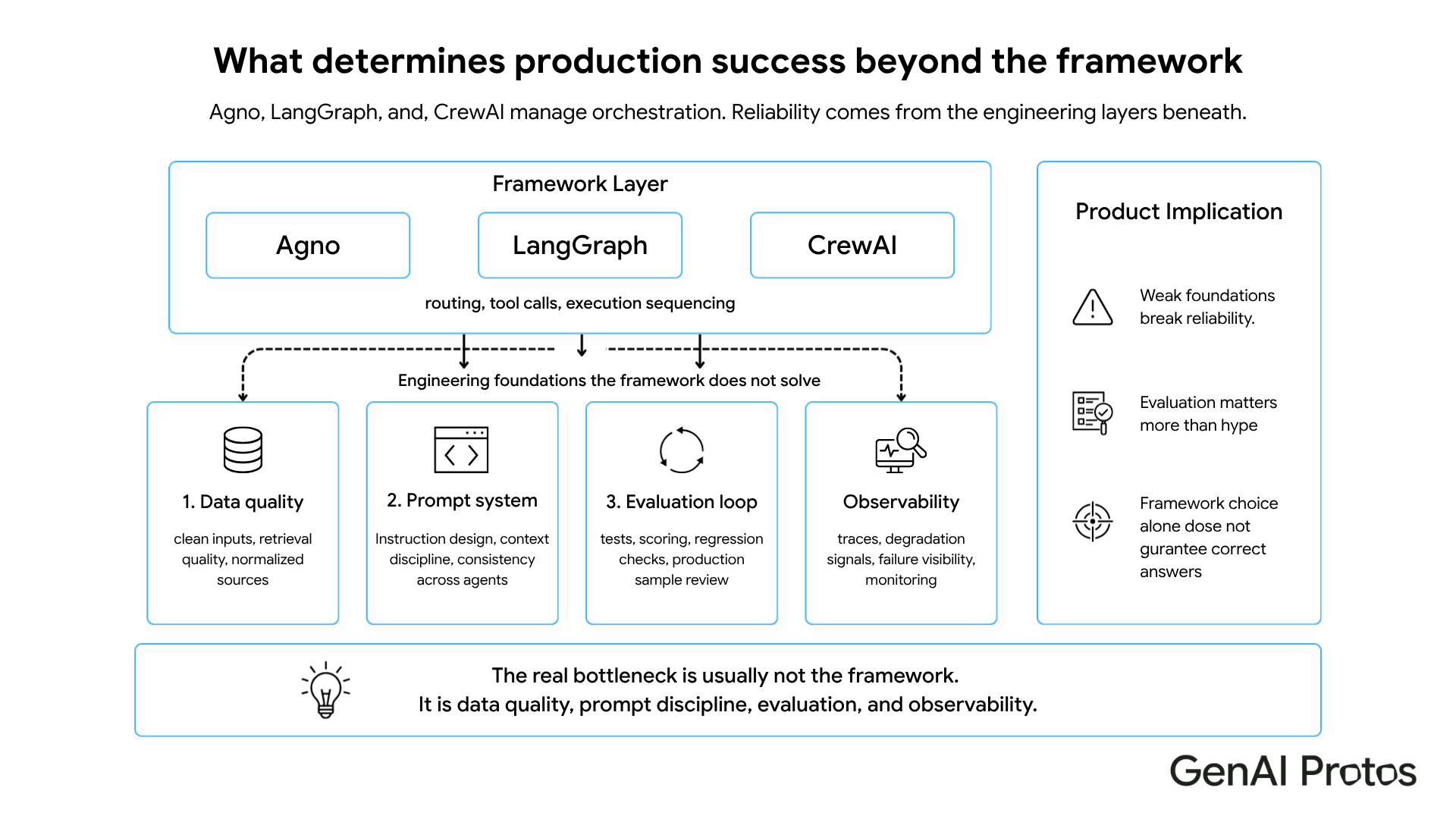
The teams that struggle are rarely struggling because they chose the wrong framework. They are struggling because the agents are getting bad inputs, the prompts are not consistent, and there is no evaluation loop. Fix the architecture. The framework choice matters less than that.
GenAI Protos addresses all four layers when building enterprise systems. See how in the JIRA AI Agent case study, built with full observability, state handling, and production error recovery.
What Teams Get Wrong When Choosing Between Frameworks
Three mistakes account for most multi-agent rebuilds.
Mistake 1: Choosing the framework beforecharacterising the workflow. Teams pick LangGraph because it looks rigorous, then spend weeks fighting the graph model for a workflow that was a sequential Python flow. Characterise first. Select second.
Mistake 2: Expecting the framework to solve data and prompt quality. No ai agent orchestration framework handles this. It is outside the framework layer entirely. Teams that do not invest here hit a ceiling regardless of which framework they chose.
Mistake 3: ShippingCrewAI prototypes as production systems. A fast prototype is evidence of feasibility. It is not evidence of production readiness. Treat them as different milestones.
Key Takeaways
- Workflow shape determines framework choice. Sequential flow: Agno framework. Conditional graph: LangGraph. Role-based prototype: CrewAI.
- LangGraph vsCrewAI is not a quality comparison. They solve different problems atdifferent stages.
- LangGraph production deployments fail most often on state schema design and error recovery, not the graph model itself.
- No ai agent orchestration framework solves data quality, prompt consistency, or evaluation. Those are your responsibility.
- Build the evaluation layer. In a multi agent system architecture, that matters more than the framework choice.
The One Move to Make First
Before evaluating langgraph vscrewai , write one sentence: what is the shape of our workflow? Sequential, conditional, or role-based. That sentence makes the langgraph vscrewai choice obvious.
After the framework is chosen, the second move is building the evaluation layer. Not the UI. Not the scaling plan. The evaluation loop that tells you when output quality degrades. That is what separates multi-agent systems that survive the pilot from the ones that get quietly shut down.


