Most retail personalization projects are built on one signal: purchase history. A customer bought running shoes three months ago. The system recommends more running shoes. The customer already owns three pairs and is browsing for hiking gear.
That is not personalization. That is a recommender system running on stale data.
Retail AI that actually moves revenue metrics operates on real-time intent, not historical behavior. This article covers what that looks like in production, the architecture that delivered a 35% incremental revenue uplift, and where ecommerce AI earns its keep versus where it runs into trouble.
What Retail AI Actually Does in Production
Retail AI in production is an intent layer that unifies behavioral signals from multiple sources in real time and uses them to drive personalized experiences at scale.
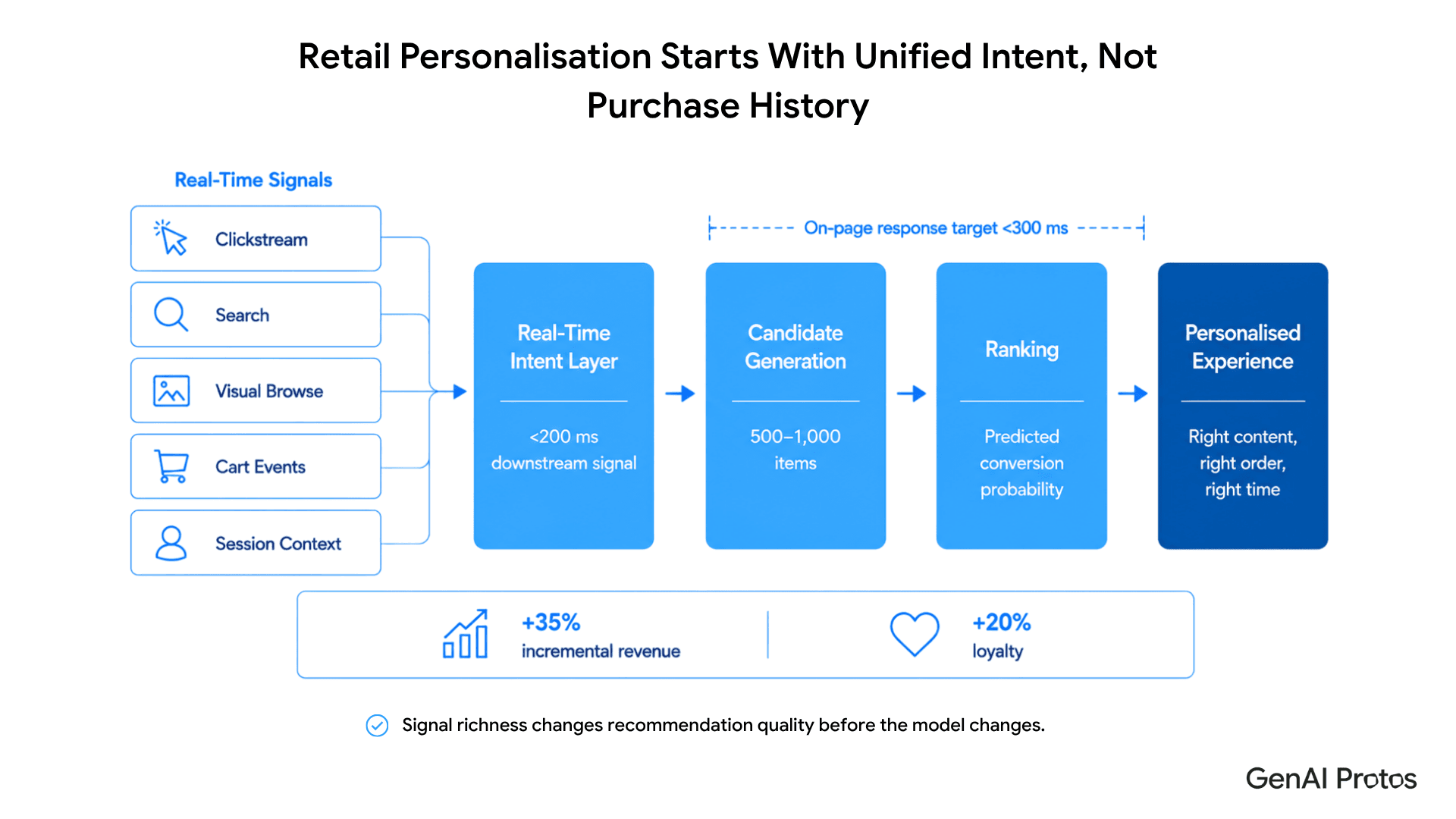
The distinction between a legacy recommender and production retail AI is the signal set. A legacy recommender uses purchase history and sometimes browse history. Production retail AI ingests five to seven signal types simultaneously: clickstream, search queries, visual browse behavior, cart events, session context, time-on-page, and return visit patterns.
The result of unifying these signals is not incremental. In a retail AI platform GenAI Protos deployed for a mid-market ecommerce operator, unifying five intent signals instead of one produced a 35% incremental revenue uplift and 20% improvement in customer loyalty metrics over 90 days. The same recommendation infrastructure, fed with richer intent data, produced meaningfully different outputs.
Read the full case study: AI-Powered Retail Personalisation Platform → genaiprotos.com/case-studies/ai-powered-retail-personalisation-platform/
AI in retail that runs on a single signal source will not deliver these results. The signal unification architecture is what makes the difference.
AI in Retail Industry: The Three Production Layers
AI in the retail industry earns its keep across three distinct layers: intent capture, recommendation, and fulfilment.
Layer 1 is intent capture.
This is the real-time ingestion and unification of behavioral signals into a customer intent model. The intent model does not predict what a customer bought. It predicts what they are trying to accomplish in this session, right now. A customer who searched "trail running," browsed three jacket pages, and added a hydration vest to their cart is signaling outdoor activity intent. The intent model captures this signal and passes it downstream within 200 milliseconds.
Layer 2 is the recommendation engine.
This layer takes the real-time intent signal and ranks the product catalogue against it. The architecture uses a two-stage approach: candidate generation (narrow the catalogue to 500 to 1,000 relevant items) followed by ranking (order those items by predicted conversion probability). Response time in production needs to be under 300 milliseconds for on-page recommendations. Above that threshold, conversion rates drop measurably.
Layer 3 is agentic fulfilment.
This is where multi-agent AI handles inventory availability checks, substitution logic when a first-choice item is out of stock, and cross-channel coordination between online and in-store inventory. This layer is where most retail AI deployments are underdeveloped. The recommendation was right. The fulfilment coordination let the sale down.
How We Built a 35% Revenue Uplift With Retail AI
This is how GenAI Protos unified five customer intent signals into a real-time personalisation engine that delivered a 35% revenue uplift. Explore the production architecture behind the result.
→ Explore the Practice | Book a Call
Ecommerce AI: Where the Numbers Are Clearest
Ecommerce AI has the clearest ROI evidence of any retail AI application, because the conversion signal is direct and measurable.
AI-powered product recommendations on ecommerce platforms consistently produce 15 to 35% revenue uplift compared to rule-based recommendation systems. The variance depends on catalogue size, signal richness, and model freshness. Catalogues under 10,000 SKUs with daily model refresh cycles land at the lower end. Larger catalogues with real-time intent signals and hourly model updates land at the higher end.
AI ecommerce personalization also improves basket size. When recommendations are based on session intent rather than purchase history, average order value increases 12 to 18%. The customer is seeing products that match what they are trying to do today, not what they did three months ago.
Dynamic pricing AI on ecommerce platforms produces 8 to 15% gross margin improvement when implemented with proper guardrails. Guardrails matter. Dynamic pricing without constraints produces customer trust issues that erode the margin gains within two to three months.
What AI in Retail Does Not Yet Do Well
AI in retail does not yet deliver reliable results in three areas: cross-channel physical and digital coordination, high-stakes product categories requiring consultation, and real-time customer service for complex complaints.
Cross-channel coordination sounds solved. It is not. Real-time inventory synchronization between digital and physical inventory systems is harder than the vendor demos suggest, especially for retailers running legacy ERP systems. The recommendation AI knows the customer wants a product. The fulfilment layer does not always know the product is available at their nearest store.
High-stakes product categories, luxury goods, high-value electronics, healthcare products, have lower AI recommendation acceptance rates because customers want consultation, not algorithmic suggestions. AI-assisted recommendations in these categories work when they surface information, not when they drive decisions.
Customer service AI for complex complaints involving refunds, damaged goods, and policy exceptions has a high escalation rate. The AI handles simple queries well: order status, return initiation, basic product questions. Complex complaint resolution still lands with human agents in the large majority of cases.
What Retail Teams Get Wrong When Deploying AI
The single most common retail AI deployment mistake:
Building personalization on top of a fragmented data infrastructure.
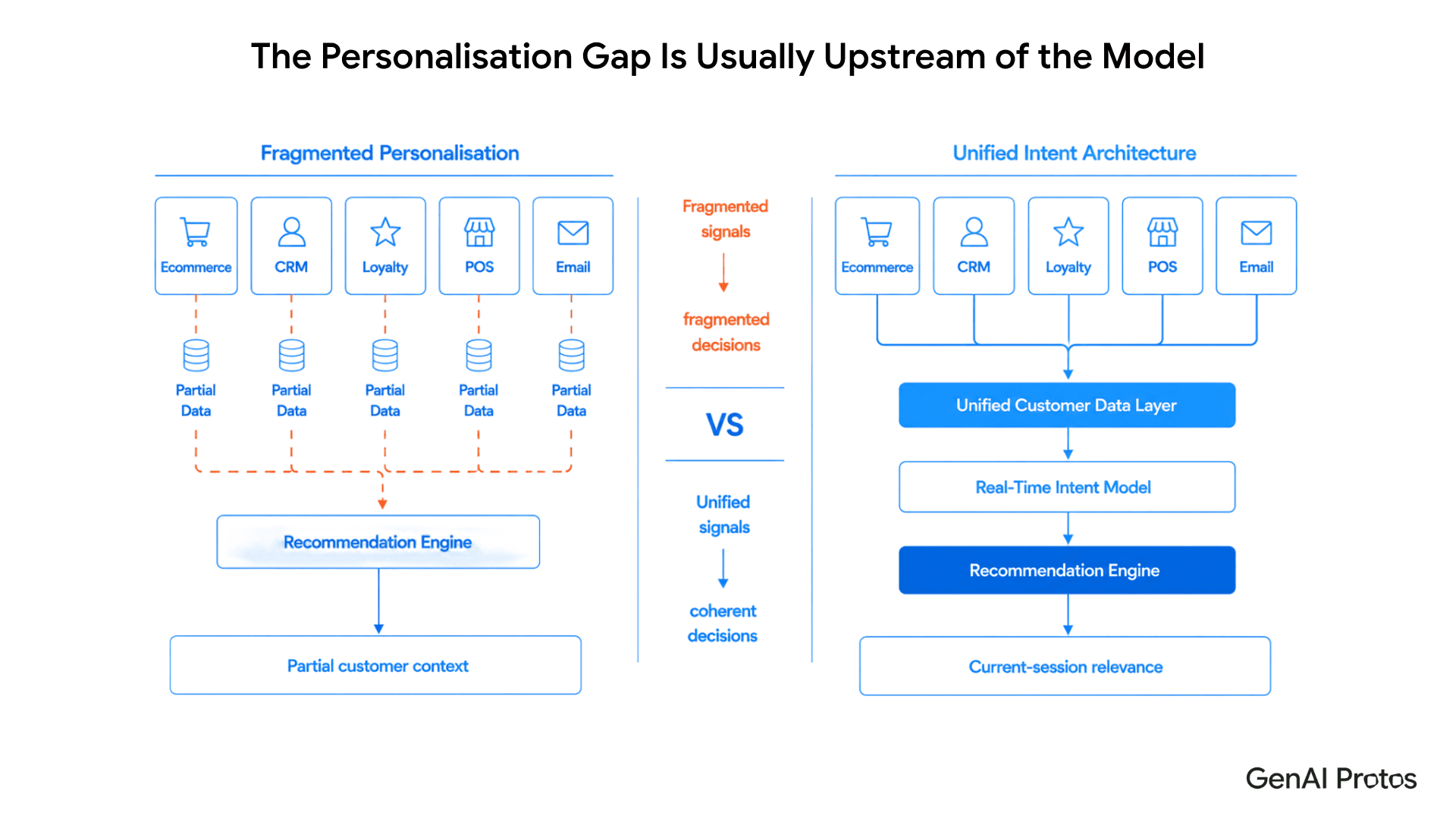
Retail organizations typically have customer data split across three to five systems: ecommerce platform, CRM, loyalty program, in-store POS, and email platform. Retail AI built on top of a fragmented data layer produces fragmented personalization. The AI sees a partial customer picture and makes partial recommendations.
The prerequisite for production retail AI is a unified customer data layer. This is not a short project. It takes 12 to 16 weeks minimum for mid-market retailers. But it is the work that determines whether the AI investment produces 35% revenue uplift or 3%.
The second mistake:
Measuring clicks instead of revenue. Click-through rate on recommendations is a vanity metric. Revenue per session, average order value, and customer lifetime value are the metrics that matter. Teams that optimize for CTR produce high-click, low-conversion recommendation systems.
The third mistake:
Not refreshing recommendation models frequently enough. A model trained on last month's purchase data misses current trends. In fashion and seasonal categories, model staleness is a direct revenue leak.
CONCLUSION
Retail AI built on real-time unified intent delivers measurable revenue results. The 35% uplift is not a benchmark number. It is a production outcome from a specific architecture. The difference between that outcome and a failed personalization project is not the AI model. It is the data layer, the signal richness, and the fulfilment coordination. If your retail personalization is running on purchase history alone, you are leaving a significant revenue gap on the table. The AI to close it exists. The data infrastructure to feed it is the work. Explore how we build real-time retail AI platforms at GenAI Protos


