
Your enterprise AI backlog has thirty use cases on it. Six of them came from a leadership offsite. Four are things your data science team has wanted to build for two years. Three were submitted after a competitor announced a similar feature. The remaining seventeen are a mixture of good ideas and technically impossible requests, and you cannot tell which is which from the submission form.
The backlog is not the problem. The problem is the absence of a scoring framework that separates use cases with genuine production potential from use cases that collapse under data, integration, or organizational constraints the moment you try to build them.
This AI use case prioritization framework introduces the Data Friction Index for evaluating data readiness before a use case enters the Value-Effort Matrix, three worked examples with structured scoring, and a 90-day sequencing roadmap that converts the prioritized list into a delivery schedule.
Why Most AI Use Cases Stall Before Production
Enterprise AI projects fail at the data layer, not the model layer. A use case that requires clean, labeled, accessible data to produce a reliable output will stall in data engineering indefinitely if that data readiness gap is not assessed before the build begins.
The second failure mode is value ambiguity. A use case with a compelling business narrative but no measurable success metric cannot be validated after delivery. If there is no agreed definition of what "success" looks like before the build starts, there is no way to demonstrate ROI after it ships.
Prioritization frameworks that evaluate only business value without assessing data readiness select the use cases with the best presentations, not the ones with the clearest path to production.
The Data Friction Index
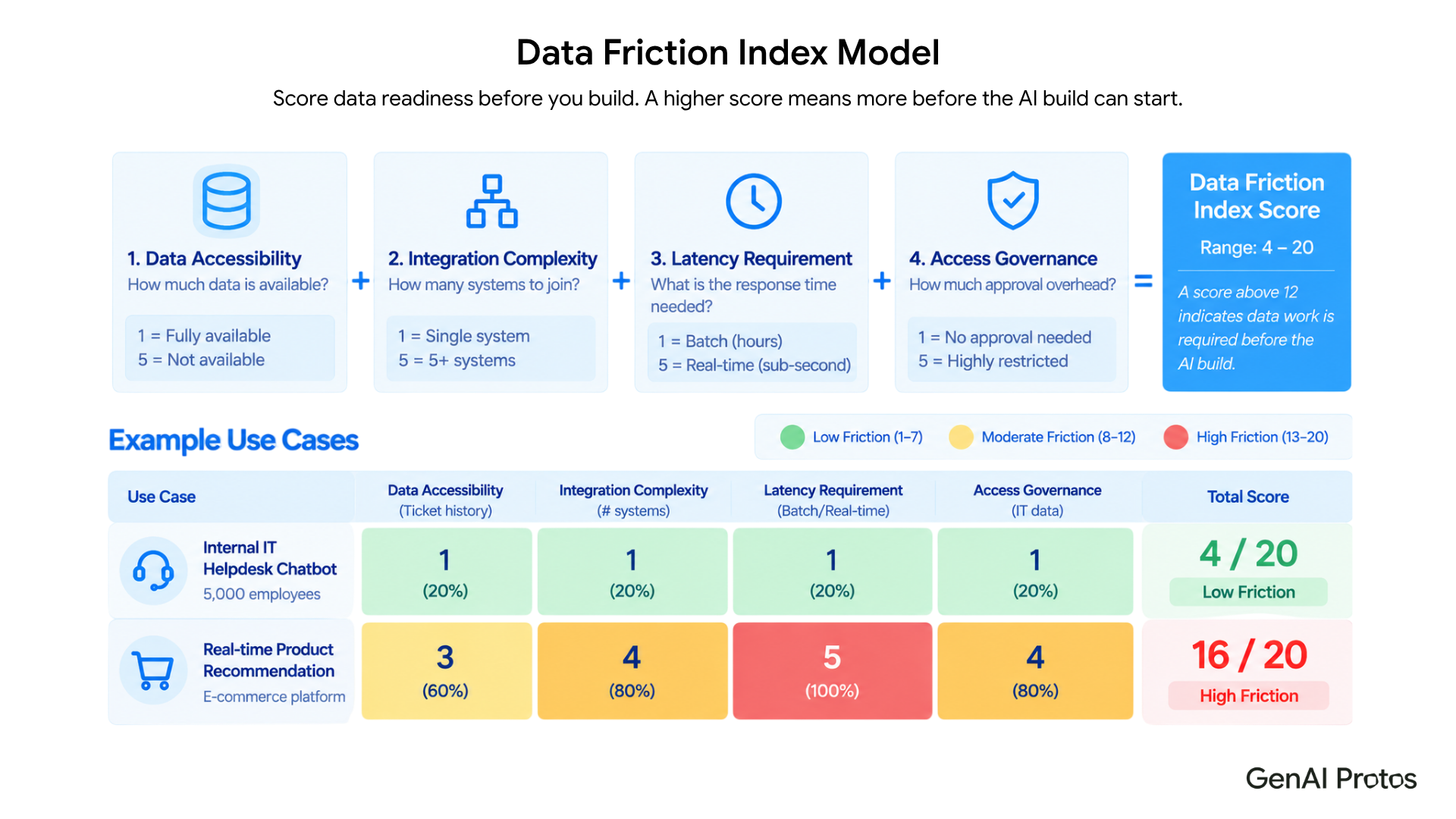
The Data Friction Index scores a use case across four components before it enters the Value-Effort Matrix. AI data engineering services for enterprise readiness covers the data preparation work that reduces friction scores.
Data availability:
Is the required data accessible? Does it exist in a queryable system, or does it require manual extraction, format conversion, or a new data collection process?
Data quality: Is it clean and sufficiently labeled for the intended use? A document classification model needs labeled examples. A retrieval system needs clean, complete document text. Missing or inconsistent data requires remediation before the build.
Data access latency:
Can the data be retrieved in the time the application requires? A real-time recommendation system needs sub-second data access. A batch reporting system can tolerate higher latency. Mismatch between application latency requirements and data retrieval speed is a deployment blocker.
Data governance clearance:
Is there authorization to use this data for AI training or inference? For customer data, PII, or regulated information, governance clearance requires legal and compliance review. Do not assume clearance; verify it explicitly before the build begins.
Score each component on a 1-to-5 scale where 1 is fully resolved and 5 is blocked. A total Data Friction Index score above 12 indicates the use case needs data infrastructure work before it is ready for AI development. Return it to the data engineering roadmap, not the AI build queue.
The Value-Effort Matrix
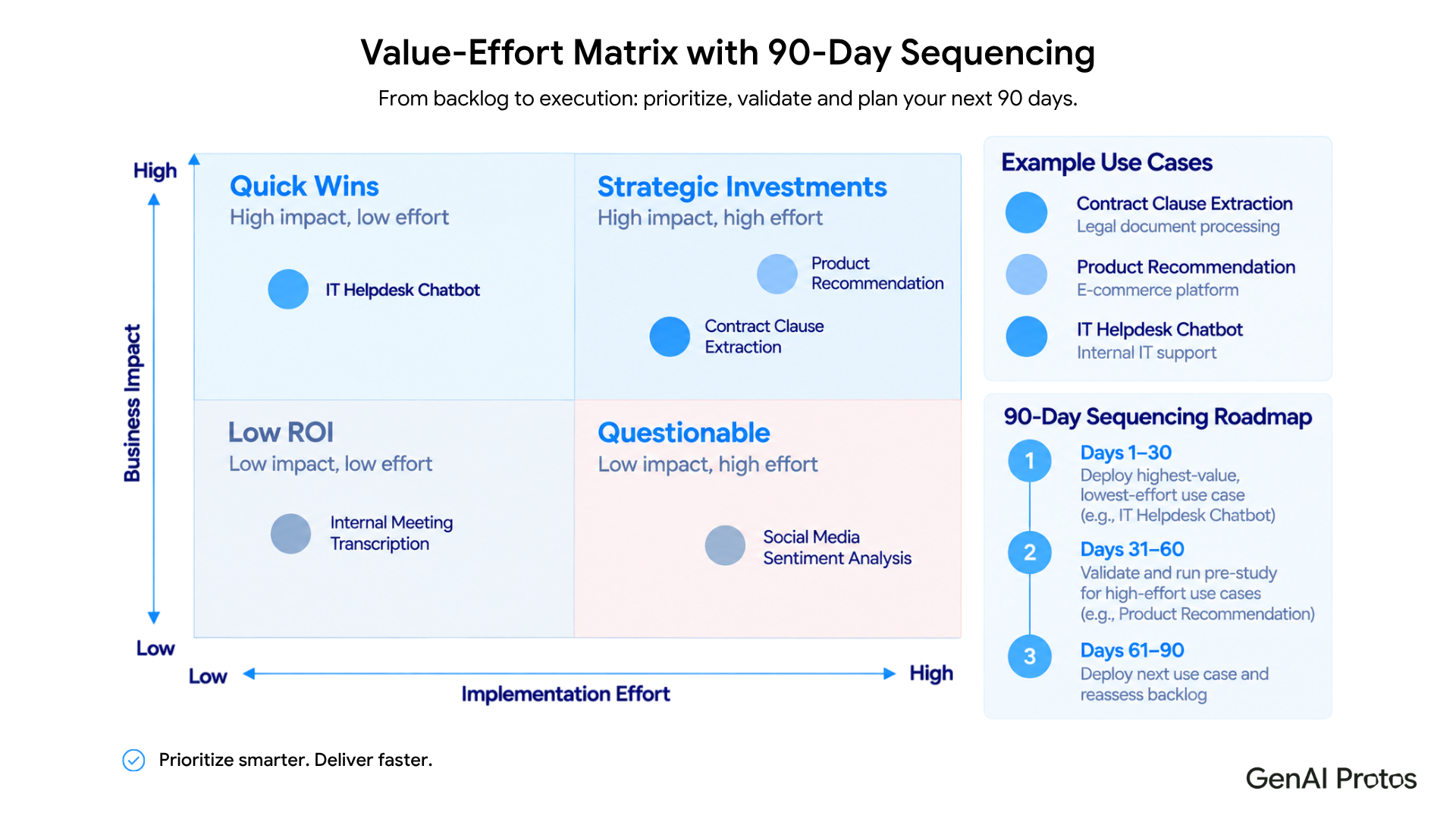
The Value-Effort Matrix is calibrated for AI use cases. Moving from AI proofs-of-concept to platform-scale deployment covers the platform infrastructure that enables the use cases that pass this stage. Value is a composite of revenue or cost impact, strategic alignment with current AI platform capabilities, and speed to a measurable outcome. Effort includes development time, data readiness score, integration complexity, and model validation requirements.
Use cases that score high on value and low on effort are first-priority candidates. Use cases that score high on value and high on effort require a pre-study sprint to reduce effort uncertainty before they enter the build queue. Use cases that score low on value regardless of effort should be removed from the backlog.
Three Worked Examples with Structured Scoring
Example 1: Automated contract clause extraction for a legal team. Business problem:
Junior lawyers spend 40% of their time manually identifying and extracting standard clauses from vendor contracts before a senior review can begin. Data friction: low. The contract repository is accessible, documents are in standard PDF format, and the legal team has clearance to use vendor contracts for model training. Business impact: reduction in hours spent on pre-review extraction, allowing senior lawyers to begin review faster. Implementation effort: moderate. Requires a document parsing pipeline, clause classification model, and integration with the existing contract management system. Governance: straightforward, as the data is already under legal control. Decision: prioritize in the first 90 days. The data is ready, the business impact is measurable in hours saved, and the integration scope is bounded.
Example 2: Real-time product recommendation for an e-commerce platform. Business problem:
Recommendation relevance is low on product category pages, with high bounce rates on items surfaced by the current rule-based system. Data friction: moderate to high. Customer interaction data is available but requires join operations across three separate data systems, and the real-time serving latency requirement is below what the current data pipeline can sustain. Business impact: illustratively, improving recommendation relevance could increase click-through and reduce bounce rates. Implementation effort: high. The data latency problem must be resolved before a real-time model can be deployed, requiring a data infrastructure change that is independent of the AI build. Decision: validate first. Commission a one-sprint data infrastructure assessment before the use case enters the build queue. If the latency gap can be closed, the use case moves to first-priority. If not, it waits for the data infrastructure roadmap.
Example 3: Internal IT helpdesk chatbot for a 5,000-employee organization.Business problem:
First-tier IT support handles a high volume of repetitive queries about password resets, VPN setup, and software access requests. Each query requires a human agent response. Data friction: low. The helpdesk ticket history is accessible, tickets are well-labeled by category, and the IT team has governance clearance. Business impact: measured in deflection rate: the fraction of first-tier queries resolved without a human agent. Implementation effort: low to moderate. A retrieval-augmented chatbot against the helpdesk knowledge base is a well-understood implementation pattern. Decision: prioritize. Low data friction, clear success metric, bounded scope, and a measurable business outcome. This is a first-90-day candidate.
Prioritize Your Enterprise AI Roadmap with GenAI Protos
GenAI Protos runs AI use case prioritization workshops for enterprise teams that need a structured path from backlog to production. Book a session to apply the Data Friction Index and Value-Effort Matrix to your current use case list.
Contact UsThe 90-Day Sequencing Roadmap
Days 1 to 30
Deploy the highest-value, lowest-friction use case from the prioritized list. The goal of this sprint is a working prototype that can be evaluated against a defined success metric. Do not attempt multiple builds in parallel during the first 30 days. Organizational confidence in AI delivery is built through one successful delivery, not through five simultaneous partial builds.
Days 31 to 60
Validate the first delivery against its success metric. Begin the pre-study sprint for any high-value, high-effort use case that has been waiting for effort clarification. Begin the data infrastructure remediation for any use case currently blocked by a high Data Friction Index score.
Days 61 to 90
Deploy the second use case from the prioritized list, using the infrastructure and delivery process established in the first sprint. Review the backlog against updated data friction scores, as infrastructure remediation from the previous phase may have unblocked additional use cases.
What Teams Get Wrong
The most common mistake is over-weighting business value without assessing data readiness. A use case with a compelling ROI narrative but a high Data Friction Index will consume engineering time without producing a working system. The Data Friction Index must be scored before the use case enters value-effort assessment, not after.
The second mistake is treating the prioritization session as a one-time event. Backlog priorities shift as infrastructure changes, new data sources become available, and business requirements evolve. Re-run the prioritization framework quarterly, or whenever a significant change in data availability or business strategy occurs.
Key Takeaways
- Score data readiness with the Data Friction Index before any use case enters value-effort assessment.
- Use the Value-Effort Matrix to compare across composite value and effort dimensions, not simple impact versus complexity.
- The 90-day roadmap sequences delivery rather than attempting parallel builds that fragment engineering focus.
- Rerun prioritization quarterly or when data availability or business strategy changes significantly.
Conclusion
The AI backlog problem is not a shortage of ideas. It is the absence of a scoring mechanism that separates use cases with a production path from ones that look strategic and remain pilots. The Data Friction Index is that mechanism. Run it before your next prioritization session.


