
Private LLM deployment does not start as an IT decision. Your legal team said no to the public API. Your data team confirmed the vendor's "managed private" option still routes tokens through a shared inference cluster. Your security team wants a network diagram that does not exist yet.
The choice between on-premises and a private cloud VPC is not a technology preference. It is a compliance architecture decision. The infrastructure you choose determines what data leaves your perimeter, under what legal framework, and with what recourse when something goes wrong.
This blueprint covers what most vendors skip: a neutral system-level comparison of on-premises versus enterprise VPC architectures for private LLM deployment, including the Hybrid Token-Splitting Pattern for organizations whose workloads span both deployment models, and a Four-Dimension Scoring Matrix for committing to infrastructure against your specific compliance obligations.
Why Standard Cloud APIs Fail Regulated Enterprises
Private LLM deployment starts as a security question and lands as a sovereignty question. These are different problems.
Security asks: can an attacker intercept the token stream? Sovereignty asks: does the data physically leave our jurisdiction? A VPC with strict security group rules answers the first question. It does not automatically answer the second.
For healthcare networks, financial institutions, and defense-adjacent contractors, HIPAA, GDPR Article 46, and ITAR set the boundaries. Standard cloud inference APIs that route through shared endpoints do not satisfy these requirements regardless of in-transit encryption.
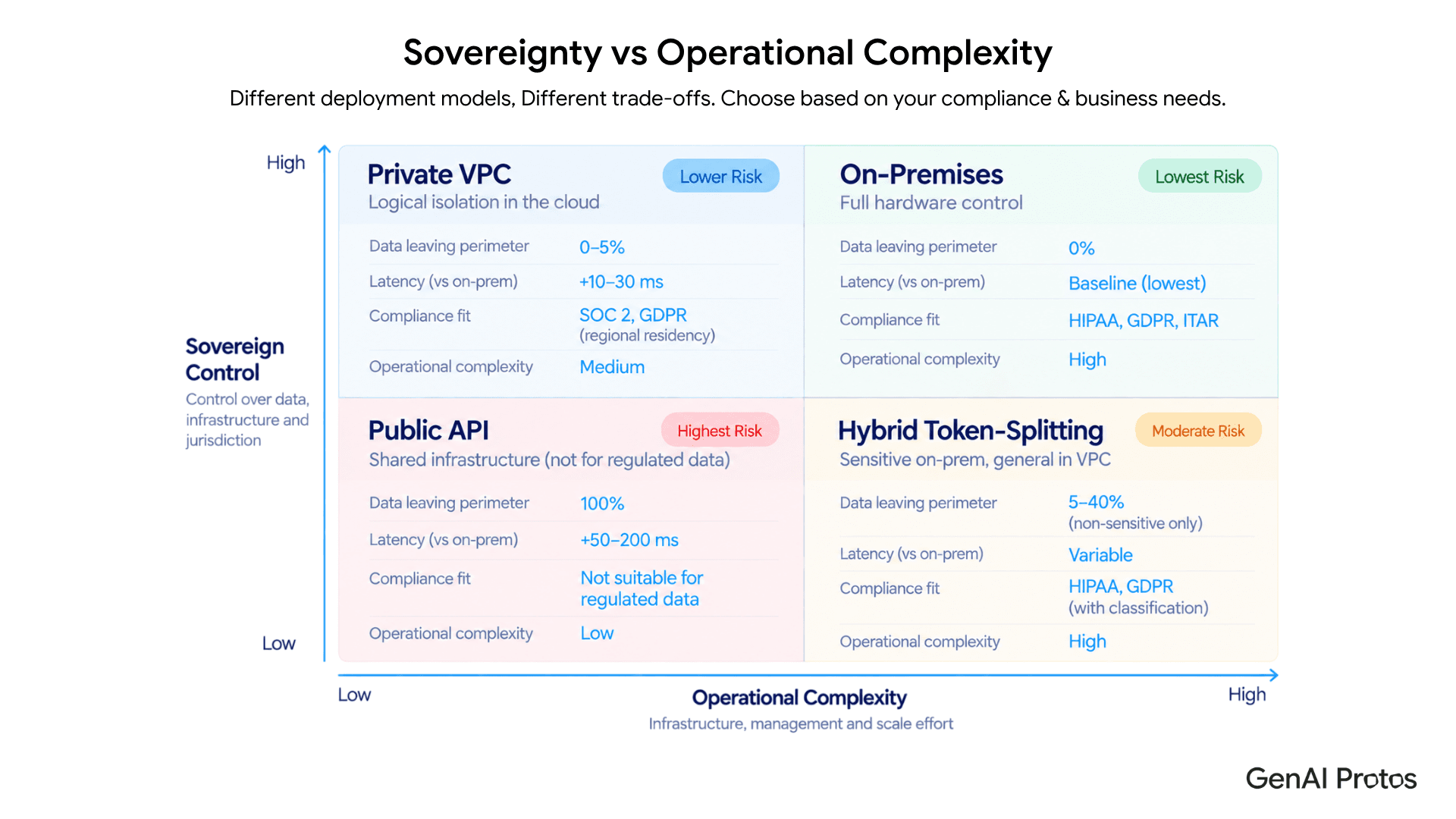
On-premises deployment provides the highest level of direct infrastructure control. Every token generation step runs on hardware the organization physically controls, within its own network boundary, with no third-party data handling in the inference path.
A private cloud VPC provides logical network isolation at lower upfront investment. Where physical tenancy separation is contractually guaranteed and the applicable compliance frameworks accept logical isolation as sufficient, VPC-based deployment is a valid path.
The right architecture depends on your specific compliance obligations, threat model, and throughput requirements. Neither path is universally superior.
The Hybrid Token-Splitting Pattern: Route by Sensitivity, Not Workload
Most enterprise teams treat this as binary: everything on-premises or everything in the VPC. That framing artificially inflates cost and complexity.
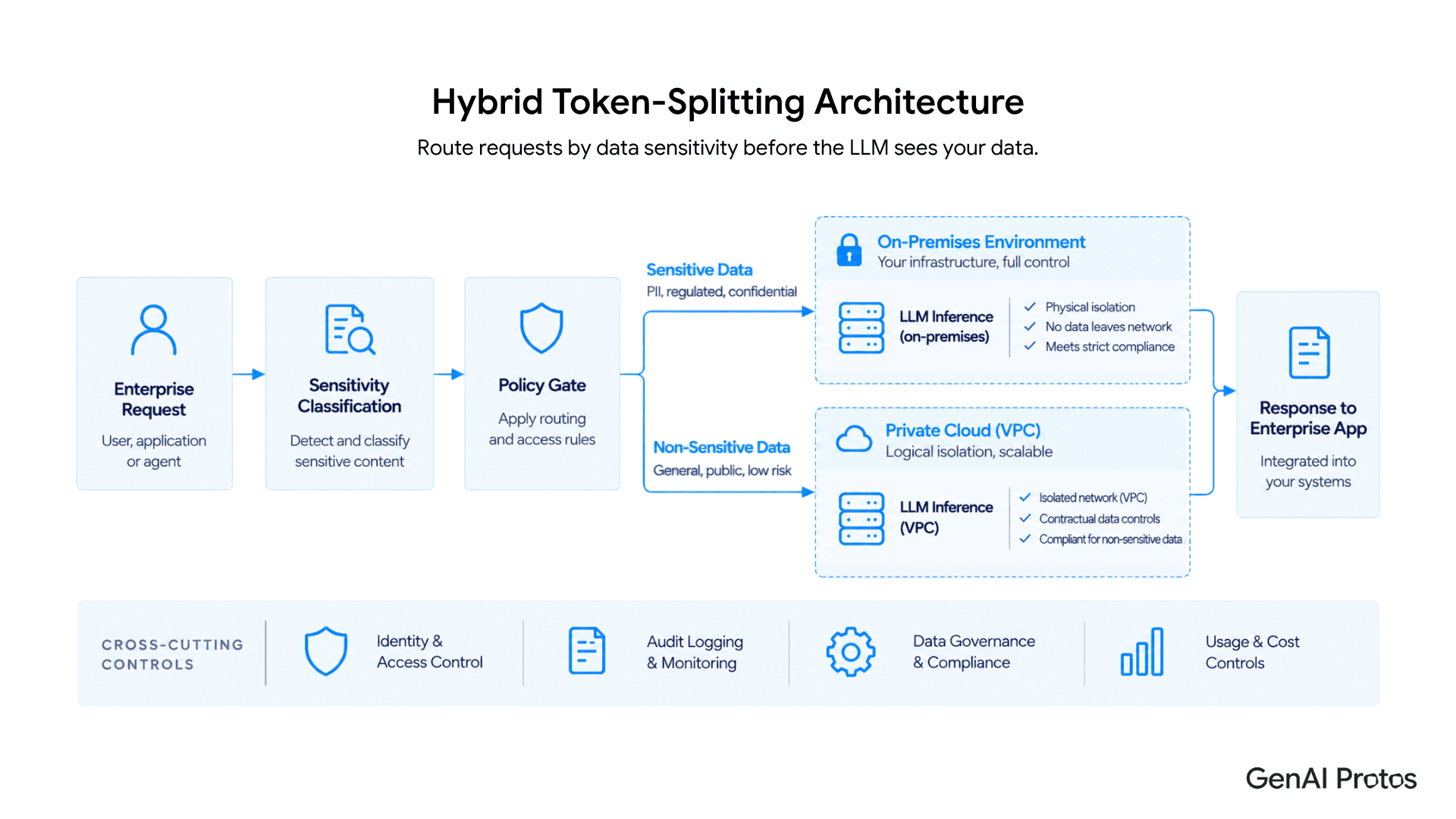
The Hybrid Token-Splitting Pattern routes token generation based on payload sensitivity, not workload type. A classification layer at the API gateway evaluates each request against a sensitivity policy before routing. Private AI security architecture and data controls covers the access management framework that makes this pattern auditable.
Low-sensitivity queries go to the VPC with full elastic scaling: HR policy lookups, documentation retrieval, code completion on non-proprietary repositories. High-sensitivity queries route to on-premises inference: contract review, patient record analysis, export-controlled design work.
One important consideration before going live: validate the classification layer against false positives and false negatives on a representative sample of your actual production traffic before routing decisions have real compliance consequences.
What teams consistently get wrong: they build classification logic inside the model context window, letting the LLM decide its own data handling. Classification must run deterministically at the gateway, before the LLM sees the pay load.
Four-Dimension Scoring Matrix for Your Architecture Decision
Before committing to any infrastructure spend, evaluate both options across these four dimensions weighted by your compliance profile. Self-hosted LLM vs API infrastructure comparison covers the cost structure for self-hosted versus managed inference in detail.
Data sovereignty:
Does your compliance framework require physical hardware control, or is contractual data isolation sufficient? On-premises is the only option when physical tenancy is mandated.
Cost and capacity:
On-premises capital expenditure is front-loaded. VPC cost scales with usage. Model the three-year total cost of ownership at your projected inference volume before comparing options.
Operational overhead:
On-premises GPU cluster management, driver updates, and hardware failure response require dedicated engineering capacity. VPC shifts that operational layer to the cloud provider.
Latency and throughput:
On-premises inference avoids network round-trips to cloud endpoints. For latency-sensitive applications with high concurrency, proximity to the inference hardware matters.
| Dimension | On-Premises | Private VPC | Hybrid |
|---|---|---|---|
| Data Control | Physical hardware custody; highest isolation; required for ITAR and mandated physical tenancy | Logical isolation; contractual data-processing agreement; acceptable under SOC 2, GDPR residency controls | Sensitive workloads on-premises; general workloads in VPC; classification layer enforces boundary |
| Scalability | Fixed hardware ceiling; capacity planning required; GPU procurement cycles are weeks to months | Elastic scale on demand; no hardware procurement cycle; scales to burst workloads without pre-provisioning | On-premises handles baseline sensitive load; VPC absorbs volume spikes for non-sensitive workloads |
| Latency | Latency Lowest latency; no WAN round-trip; direct GPU access from application network | Adds WAN round-trip; acceptable for non-latency-sensitive workflows; regional endpoints reduce delay | Latency-sensitive sensitive queries stay on-premises; latency-tolerant general queries route to VPC |
| Cost Model | Cost Model High upfront CapEx; low marginal cost per inference at scale; requires dedicated ops capacity | Low upfront cost; OpEx scales with usage; cost increases significantly at sustained high concurrency | CapEx limited to baseline on-premises capacity; VPC absorbs variable load cost-efficiently |
| Best-Fit Scenario | Best-Fit Scenario Export-controlled workloads, regulated healthcare data, mandated physical isolation requirements | Standard regulated enterprises where contractual isolation satisfies compliance; variable inference demand | Mixed classification environments; teams with some regulated and some general workloads on the same platform |
For enterprises whose compliance obligations center on standard SOC 2 or GDPR data-residency controls, VPC-based deployment with contractual tenancy guarantees is often sufficient. For export-controlled material or mandated physical isolation requirements, on-premises inference is the correct starting point.
A financial-services team processing internal policy documents may be able to meet requirements using regional VPC controls and approved provider safeguards. A defense-adjacent workflow handling export-controlled design material will need on-premises inference or a strictly controlled hybrid route. The selection should be grounded in data classification, workload volume, required isolation level, and the organization's specific legal and regulatory obligations.
Get Your Architecture Decision Right the First Time
GenAI Protos runs architecture scoping sessions for enterprises before any infrastructure commitment. Apply the four-dimension scoring matrix to your actual compliance profile. Book an Architecture Review
GPU Cluster Configuration: What the Architecture Looks Like
For on-premises LLM deployment, the standard production stack uses NVIDIA A100 GPUs in either 40GB or 80GB VRAM configurations, with NVLink or NVSwitch interconnects for multi-GPU model sharding. Custom private AI and edge AI solutions covers the deployment architecture for on-premises and edge inference configurations.
For VPC-based private deployment, AWS p4d and p4de instances, Azure NDm A100 v4, and GCP A2 Ultra each provide dedicated GPU capacity within logically isolated network segments. Verify that the specific instance type your provider offers carries a data-processing agreement that satisfies your compliance framework.
Keep fine-tuning compute separate from inference compute on both architectures. Fine-tuning workloads are bursty and memory-intensive. Mixing them with production inference on the same cluster causes queue starvation under production load.
What Teams Get Wrong at the Architecture Stage
Three mistakes appear consistently.
Conflating network isolation with data sovereignty. A VPC with strict security group rules is not the same as data residency. Verify what your cloud provider's data-processing agreement actually commits to before treating VPC isolation as a compliance answer.
Sizing for peak load without a queuing strategy. Every on-premises deployment hits a hardware ceiling. The question is not whether you will hit it but what happens to requests when you do. Design the queuing and graceful degradation behavior before the hardware is procured.
No defined token budget per request. Unconstrained generation on private infrastructure is the fastest path to out-of-memory failures on GPU nodes. Define maximum output token limits per request and enforce them at the inference API layer.
Key Takeaways
- Private LLM deployment is a compliance architecture decision before it is a technology decision.
- On-premises provides the highest direct infrastructure control. VPC provides elastic scale with logical isolation, acceptable under many compliance frameworks.
- The Hybrid Token-Splitting Pattern eliminates the false binary: route by payload sensitivity, not workload type.
- Validate classification logic against false positives and false negatives before routing sensitive data in production.
- Classify routing deterministically at the gateway. Never use the LLM to decide its own data handling.
- Keep fine-tuning compute separate from inference compute to prevent queue starvation under load.
Conclusion
The first move is not choosing on-premises or VPC. It is writing your compliance requirement in one sentence: does your data need to remain under your physical control, or is contractual isolation sufficient? That answer makes the architecture decision almost automatic.
GenAI Protos has deployed private AI on both paths and built production hybrid architectures for regulated enterprises. If you are at the architecture decision stage, apply the four-dimension scoring matrix to your actual compliance profile before committing to infrastructure.


