
Many enterprises have deployed AI systems without the governance structures to answer a regulator's or procurement team's question: "What controls do you have in place to ensure this AI system operates safely, fairly, and within its intended scope?" The gap between deploying AI and governing AI is where regulatory exposure accumulates.
Implement an AI Governance
Build your AI governance program with GenAI Protos from ground up.
Contact UsThe NIST AI Risk Management Framework (AI RMF 1.0, released January 2023; check nist.gov for any updated versions) is a voluntary framework for enterprise AI governance in the United States. It is referenced in various regulatory implementation documents and has been adopted by US federal agencies as a baseline. Large enterprise procurement requirements increasingly reference it, though adoption patterns vary by industry and organization size. This post walks through its four core functions, translates each into concrete implementation practices, and maps the responsible AI controls that make AI governance reviewable. Note: the recommendations in this post reflect GenAI Protos' implementation practices aligned to the framework; the NIST AI RMF itself is a voluntary guide, not a set of regulatory requirements.
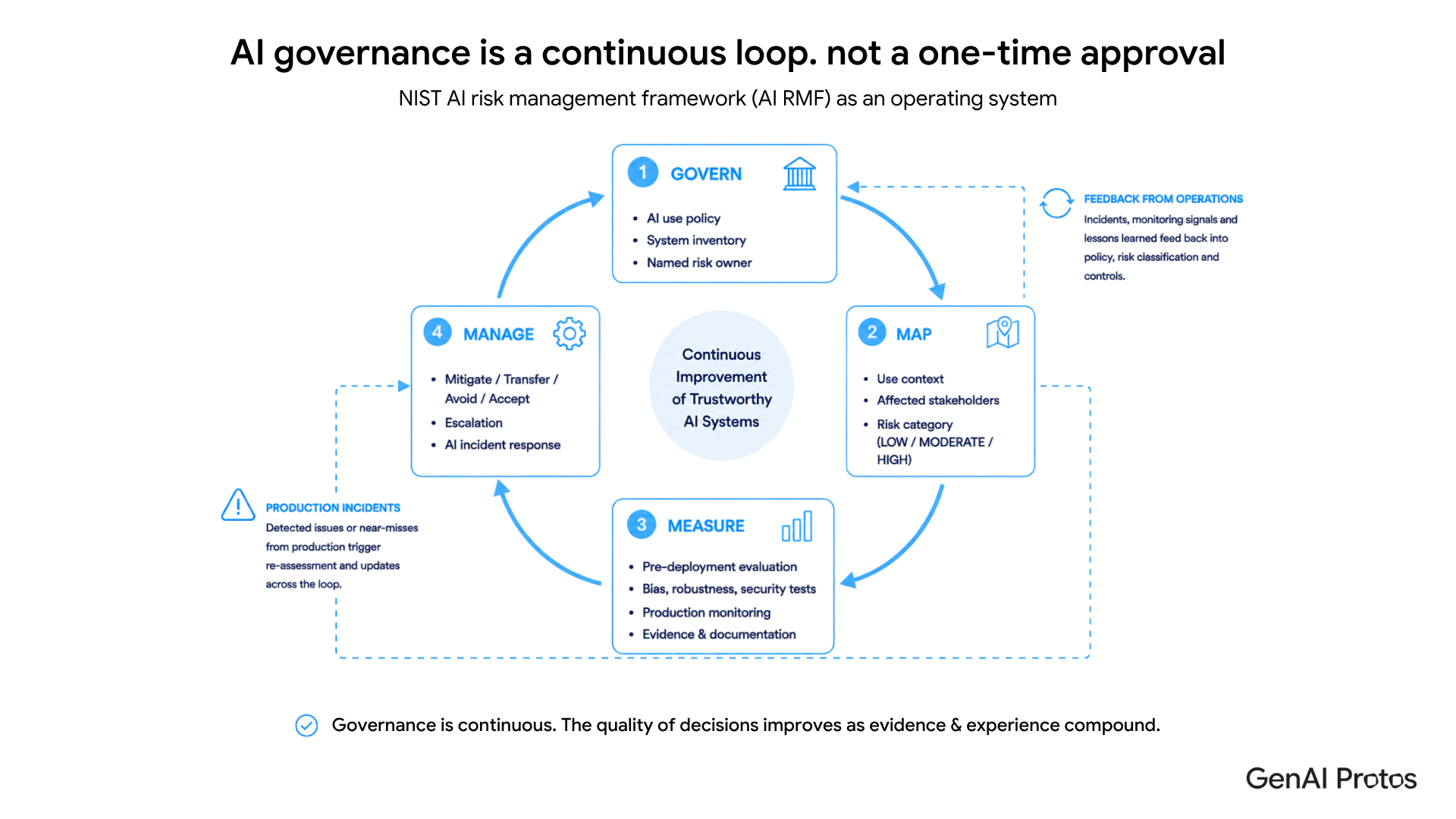
NIST AI RMF Function 1: GOVERN
The GOVERN function establishes the organizational foundation for AI risk management. It is the first function in the framework and the most frequently skipped.
The GOVERN function organises practices around a named accountability structure (who is responsible for AI risk decisions), policies that define what AI use is and is not permitted, processes for documenting AI system deployment decisions, and workforce training on AI risks and responsibilities.
Implementation for enterprise:
AI use policy.
A written policy that defines permitted and prohibited AI use cases within the organization. At minimum: what categories of decisions AI systems may influence (and which require human sign-off), prohibited uses (fully automated hiring decisions, real-time biometric surveillance in jurisdictions where prohibited), and the approval process for deploying a new AI system. This policy is a key document in AI governance reviews and procurement audits.
AI inventory.
A registry of all AI systems deployed or under development in the organization. Each entry records: system name, purpose, vendor or internal provenance, deployment environment, data processed, risk level assessment, and named owner. Organizations subject to the EU AI Act's Annex III high-risk classification will need an inventory that supports conformity assessment documentation. Organizations without one frequently discover AI systems deployed in business units without central knowledge.
Named AI risk owner.
The GOVERN function emphasises clear accountability. This is typically the Chief AI Officer, CISO, or a dedicated AI Risk Committee. The practical goal: a specific person can be asked "who approved this AI system's deployment and what was the risk assessment?" and give a clear answer. Organizations deploying AI agents should review the GenAI Protos guide to AI Agent Governance for how GOVERN practices map to agentic system deployments.
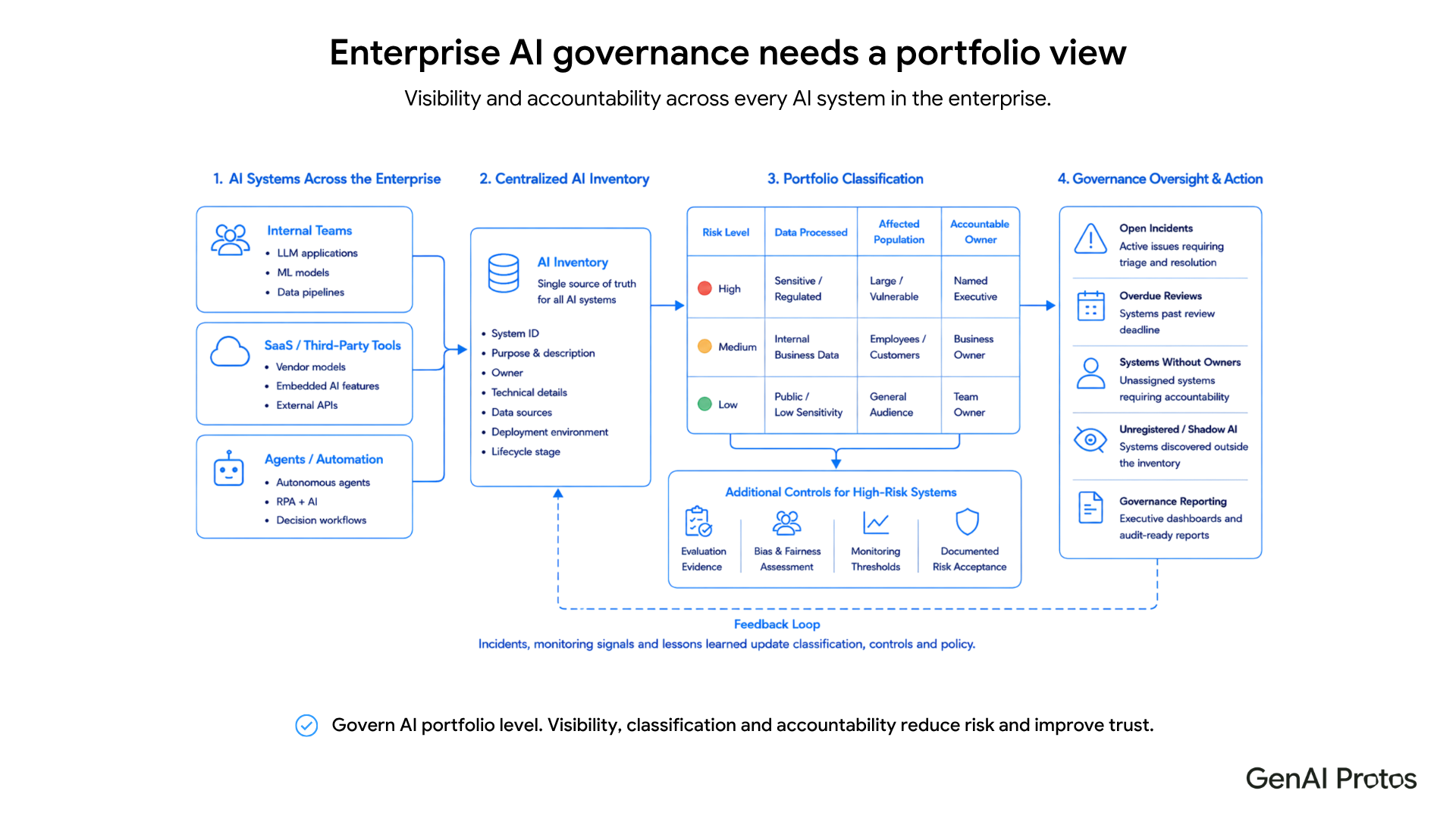
NIST AI RMF Function 2: MAP
The MAP function categorizes AI risks: what risks does a specific AI system present, to whom, and at what likelihood and severity.
The MAP function organises practices around identification of the AI system's purpose and context, identification of affected stakeholders (users, third parties, society), a risk taxonomy applied to the system, and an assessment of the system's risk level relative to its deployment context.
Implementation for enterprise:
Risk categorization. Apply a consistent risk taxonomy to every AI system in the inventory. The framework suggests risk dimensions including: risk to individuals (privacy, safety, civil rights), risk to the organization (operational, reputational, financial), and risk to society (fairness, environmental, systemic). Rate each dimension as low/medium/high based on the system's role and deployment context.
Stakeholder impact mapping. For each AI system, document who is affected by its outputs: direct users, indirect stakeholders, and third parties who receive decisions the AI influences. A hiring AI affects candidates who never interact with the system. A credit AI affects applicants. This mapping is required for both the EU AI Act's high-risk classification and for responsible AI documentation that satisfies procurement audits.
Context-specific risk assessment. The same AI capability carries different risk levels in different contexts. A language model used for internal code review has low risk. The same capability used to generate public-facing legal documents has high risk. The MAP function emphasises that risk should be assessed in context, not just by technology category.
Explore our implementation service: Full-Stack AI Engineering connects governance requirements with evaluation, monitoring, access controls and operational evidence.
NIST AI RMF Function 3: MEASURE
The MEASURE function quantifies AI risks through testing, evaluation, validation, and verification. This is the technical implementation of AI risk management that connects governance policy to measurable system behavior.
The MEASURE function organises practices around pre-deployment testing against defined performance criteria, bias and fairness testing across relevant demographic groups, ongoing monitoring of system behavior post-deployment, and documentation of test results sufficient for audit.
Implementation for enterprise:
Pre-deployment evaluation protocol. Every AI system above a defined risk threshold requires pre-deployment evaluation covering: accuracy on a task-representative test set, bias assessment across protected characteristics where relevant, robustness testing (performance on out-of-distribution inputs), and security testing (prompt injection, data poisoning, adversarial examples). Document the evaluation design, the dataset used, the results, and the pass/fail criteria.
Bias documentation. For AI systems that make decisions affecting people, document disparate impact analysis across protected characteristics. This is required under the EU AI Act for high-risk systems and is an expectation in responsible AI procurement audits. Measure decision rates and error rates by group. Document disparities and the rationale for accepting or mitigating them.
Ongoing monitoring. Post-deployment monitoring tracks performance metrics against the pre-deployment baseline. Alert thresholds for metrics including accuracy, refusal rate, error rate, and bias indicators. Review cadence should be proportionate to the system's risk level and rate of change in its operating environment. When a metric drops below threshold, the MEASURE function calls for a documented investigation and response.
AI compliance documentation. Everything in the MEASURE function must be documented in a form that satisfies regulatory review. Evaluations run but not documented do not count for compliance purposes. Use a standardized evaluation record format that captures: date, system version, evaluator, methodology, dataset, results by metric, pass/fail determination, and approving authority.
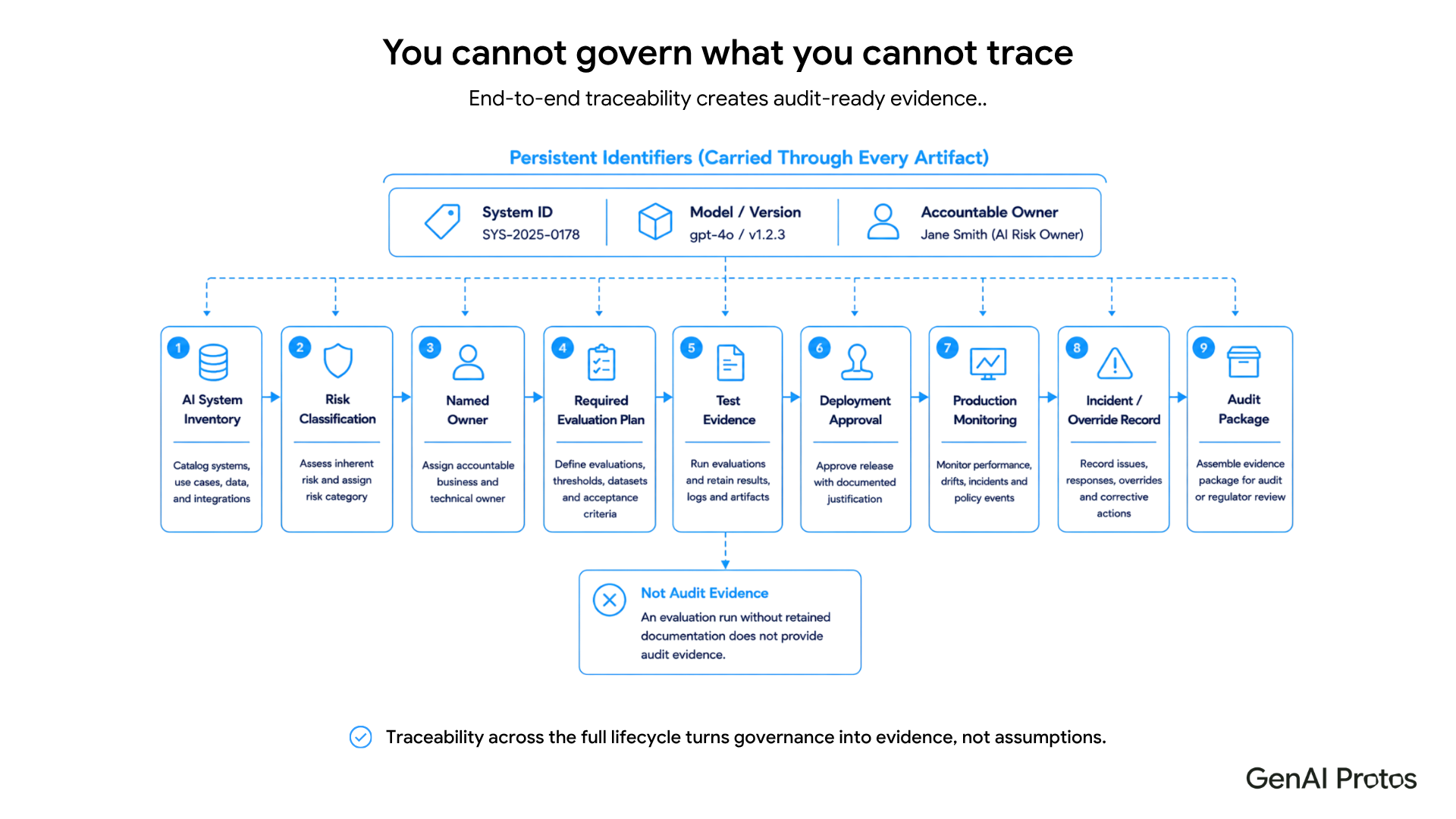
NIST AI RMF Function 4: MANAGE
The MANAGE function is about responding to identified AI risks: prioritizing, mitigating, and residual risk acceptance.
The MANAGE function organises practices around risk prioritization based on likelihood and severity, documented risk response plans for identified risks, escalation procedures for unexpected AI system behavior, and incident response plans for AI failures that cause harm.
Implementation for enterprise:
Risk treatment decisions. For each identified risk in the MAP function, document the treatment decision: mitigate (implement a control to reduce the risk), transfer (insurance, contractual liability allocation), avoid (do not deploy the AI system in this context), or accept (acknowledge the risk and deploy with monitoring). Risk acceptance requires documented approval from the named AI risk owner, not from the deployment team.
Incident response for AI systems. Define what constitutes an AI incident (material harm to a user, discriminatory outcome, security breach, regulatory violation) and the response procedure: who is notified within what timeframe, what investigation is conducted, what remediation is required, and when external notification is required (regulatory bodies, affected individuals, board of directors). The framework does not specify incident response procedures but requires that they exist.
Continuous improvement loop. The MANAGE function closes the governance loop: incidents and monitoring findings feed back into the GOVERN and MAP functions to improve policies, risk categorizations, and evaluation criteria. AI risk management is not a one-time assessment. It is an operating system.
Relevant solution: Bank Compliance Lookup shows how GenAI Protos applies governed retrieval and traceable answers in a regulated enterprise workflow.
Responsible AI in Practice: What It Looks Like Day-to-Day
Responsible AI is not a values statement. It is a set of operating procedures: pre-deployment checklists, documented evaluations, monitoring dashboards, and escalation protocols.
A team with a functioning AI governance program can answer five questions: Who approved this system's deployment? What evaluation was completed before launch? What is the system's current performance and bias profile? What incidents have occurred and how were they resolved? What is the process for raising a concern about this system's behavior?
Organizations that cannot answer these questions have AI systems but not AI governance. The gap is not technical. It is process, documentation, and AI compliance accountability. Organizations in regulated industries face additional requirements beyond the NIST framework. The GenAI Protos guide to why regulated industries need private AI covers the compliance constraints specific to healthcare, finance, and legal. A well-structured ai governance program addresses these constraints proactively rather than reactively.
Key Takeaways
- The NIST AI RMF has four functions: GOVERN (accountability and policy), MAP (risk categorization), MEASURE (evaluation and monitoring), and MANAGE (risk response and incident management).
- An AI use policy, an AI system inventory, and a named risk owner are the foundation of the GOVERN function. Organizations that have not started here often find gaps when governance reviews or procurement audits arrive.
- Pre-deployment evaluation documentation is among the first things auditors and regulators request. Run the evaluation and document it in a format that survives audit.
- Responsible AI is operational: checklists, documented evaluations, monitoring, and escalation protocols. It is not a values statement.
- The framework is voluntary. It is referenced in various regulatory implementation documents and cited in large enterprise procurement requirements; the specific weight given to NIST AI RMF alignment varies by jurisdiction and context.
Conclusion
AI governance becomes operational when ownership, risk classification, testing, monitoring and response processes are connected. GenAI Protos helps enterprises turn governance frameworks into documented controls that can be maintained across a growing portfolio of AI systems.


