
Most production AI failures are not model failures. They are context failures. The model received the wrong information, or too much information, or the same information structured in a way that buried the relevant part 40,000 tokens from where the model was reasoning. Context engineering is the discipline of deciding what enters the context window, in what order, and in what format to reliably produce the output you need. For enterprise LLM deployments running in production at scale, it is the engineering investment that separates working systems from systems that work in demos.
Context Engineering vs Prompt Engineering: The Distinction That Changes Everything
Prompt engineering
Optimizes the instruction you give the model. A well-engineered prompt is specific, includes examples, specifies the output format, and handles edge cases. It is a necessary skill and it reaches its limit when the model needs information the prompt alone cannot provide.
Context engineering
Handles what the model needs to know, not just what you ask it to do. It answers four questions: What information does the model need access to? Where does that information live? How do you retrieve it and format it for the model? How do you manage what to include when the total available information exceeds the capacity limit?
In 2026, model context can hold 128,000 to 1,000,000 tokens depending on the model. That sounds like enough for any use case. In practice, model performance degrades on information buried in the middle of a long context (the "lost in the middle" problem documented in Liu et al. 2023). Information placed towards the beginning and end of a long context is generally recalled more reliably than information positioned deep in the middle, though the magnitude of this effect varies by model and context length. The discipline is partly about what to include and partly about where to place it.
What Lives in the Model Context
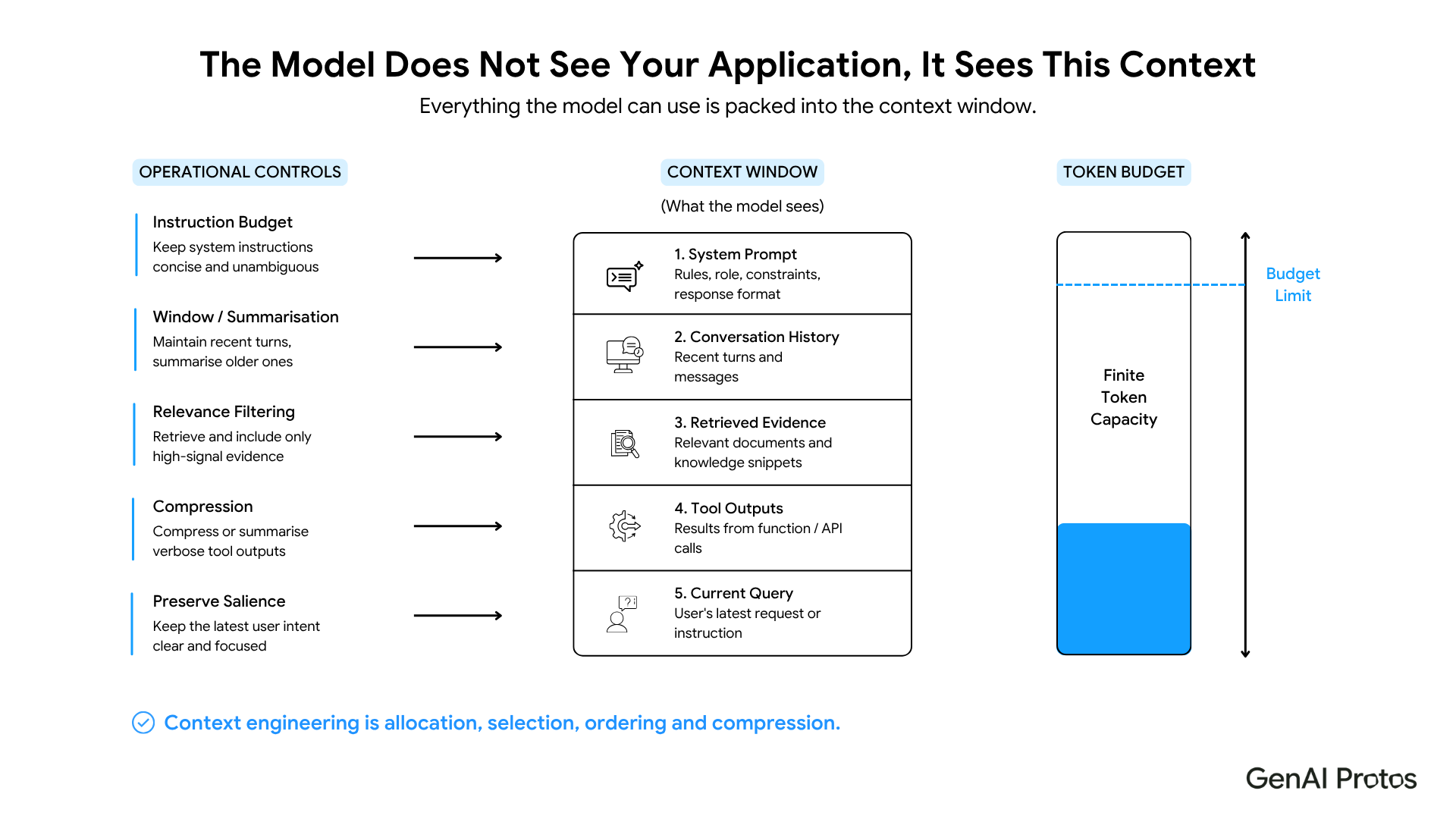
Every model invocation receives five possible inputs.
The system prompt
Defines the model's role, constraints, persona, and any standing instructions. It appears at the start of every context. For enterprise deployments, the system prompt carries the role definition, safety instructions, output format requirements, and references to available tools. A prompt that tries to handle everything becomes a wall of text the model partially ignores. Set an explicit token budget for instructions and enforce it; there is no universal number, but focus and brevity consistently outperform exhaustiveness.
Conversation history
Stores previous turns in a multi-turn interaction. For stateless API calls, this must be explicitly managed: your application must load and send the relevant prior turns with each request. LLM memory is not automatic. It is a design choice. Most enterprise teams underestimate how quickly conversation history grows and how significantly it affects cost and latency.
Retrieved context
Is information fetched from external sources at query time: RAG results, database lookups, API responses, document excerpts. This is the most variable component. Retrieved context can be 500 tokens or 50,000 tokens depending on what the retrieval system returns. The RAG architecture decisions made at the retrieval layer directly determine the context quality the model works with.
Tool outputs
Are the results returned when the model invokes a tool during an agentic workflow. Tool outputs can be verbose. A database query that returns 500 rows does not belong in model context. Summarize and filter tool outputs before including them.
The current query
Is the user's message or the current task instruction. It should always be the most recent input and should be positioned for maximum retrieval salience.
Explore our retrieval expertise: GenAI Protos designs RAG Applications that retrieve the right evidence and structure it for reliable model context.
LLM Memory Patterns for Multi-Turn Enterprise Agents
Single-turn LLM applications have no LLM memory problem. You send a context, get a response, done. Multi-turn agents accumulate context across many turns and must decide what to keep, what to compress, and what to discard. The patterns and trade-offs for handling this are covered in the GenAI Protos guide to Agentic AI Memory in Production.
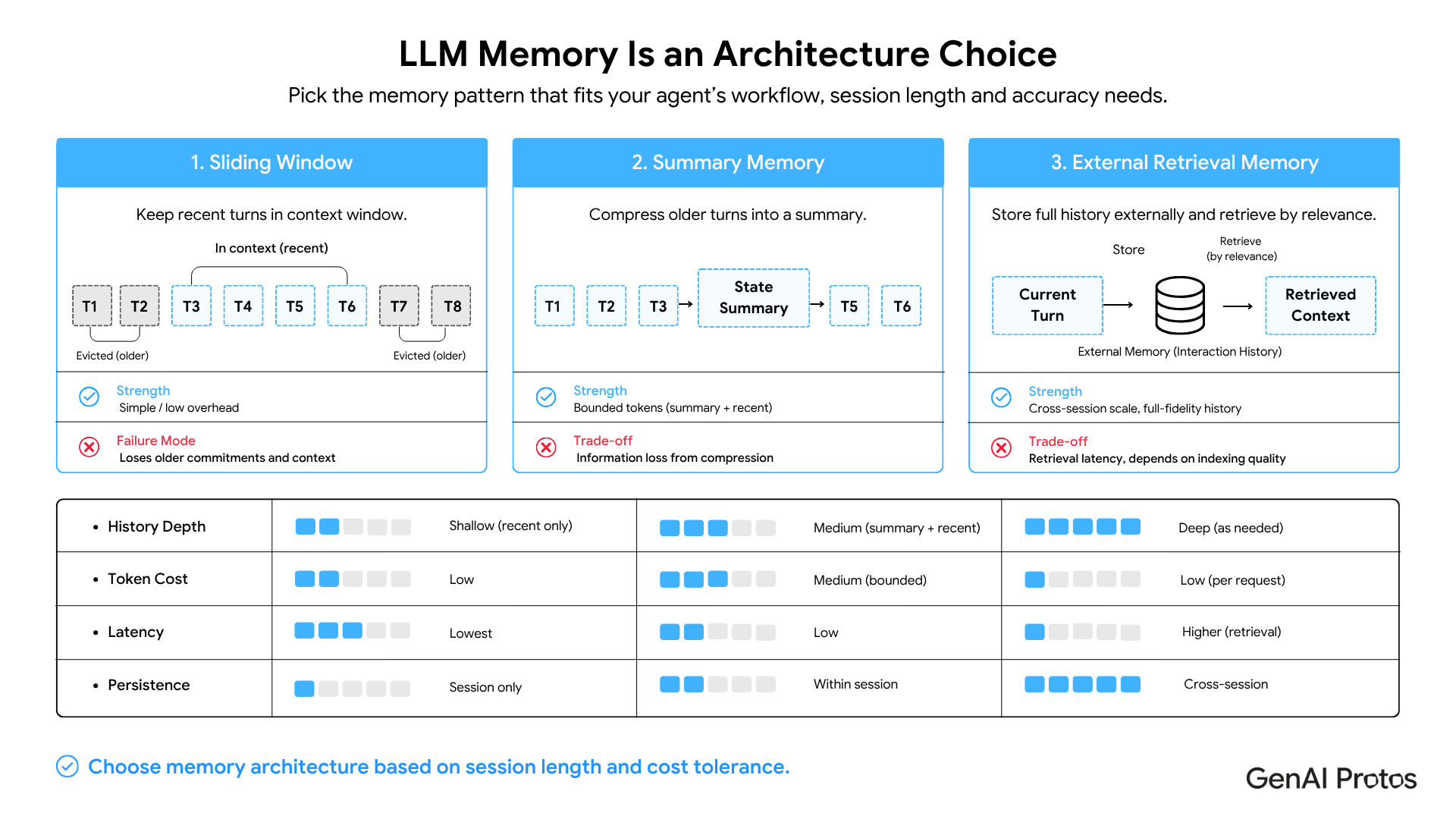
Sliding window memory keeps the N most recent turns. It is simple and works well when each turn is relatively independent. It fails when the agent needs to recall something said 20 turns ago that is no longer in the window.
Summary memory periodically compresses older conversation history into a summary. The full history is replaced with a summary that preserves key decisions, facts established, and open questions. This keeps token usage bounded while preserving long-term continuity. The compression step costs inference time and introduces information loss. For most enterprise agent workflows, this trade-off is acceptable.
External memory with retrieval stores conversation history in a vector database and retrieves relevant past interactions at each turn. This scales to unlimited history but adds retrieval latency and requires careful design of what to store and how to index it. The multi-agent orchestration layer uses this pattern for long-running agent workflows that persist state across sessions.
Scratchpad memory gives the agent a dedicated token budget for intermediate reasoning and working notes within a task. This is separate from conversation history. It allows the agent to maintain task state without bloating the history log.
Context Size Management at Scale
Cost generally scales with token count: longer contexts cost more per call. The exact relationship is not always linear - cached tokens, reasoning tokens, tiered pricing and provider billing models vary significantly. Understanding the seven core LLM concepts that drive token economics helps teams design context budgets that balance quality with cost. For enterprise deployments running tens of thousands of daily calls, optimizing what enters the model context is a cost engineering problem, not just a quality problem.
Three practices reduce context costs without degrading output quality.
Relevance filtering at retrieval
Return only the passages most relevant to the current query, not all matching documents. A retrieval pipeline that returns 30 chunks when 5 would answer the question is burning context budget on noise.
Tool output compression
Summarize verbose tool outputs before including them in context. A tool that returns a 200-row CSV should include only the top 10 rows plus a summary in the context. The full result can be stored externally and retrieved if the model needs it.
Prompt caching
Anthropic and OpenAI both support caching of repeated context prefixes. System prompts that are identical across calls are a candidate for caching. Cached tokens cost significantly less than uncached tokens; the exact discount varies by provider and pricing tier. For high-volume deployments with a fixed system prompt, verify current caching pricing before projecting savings.
Symptoms of a Context Architecture Problem
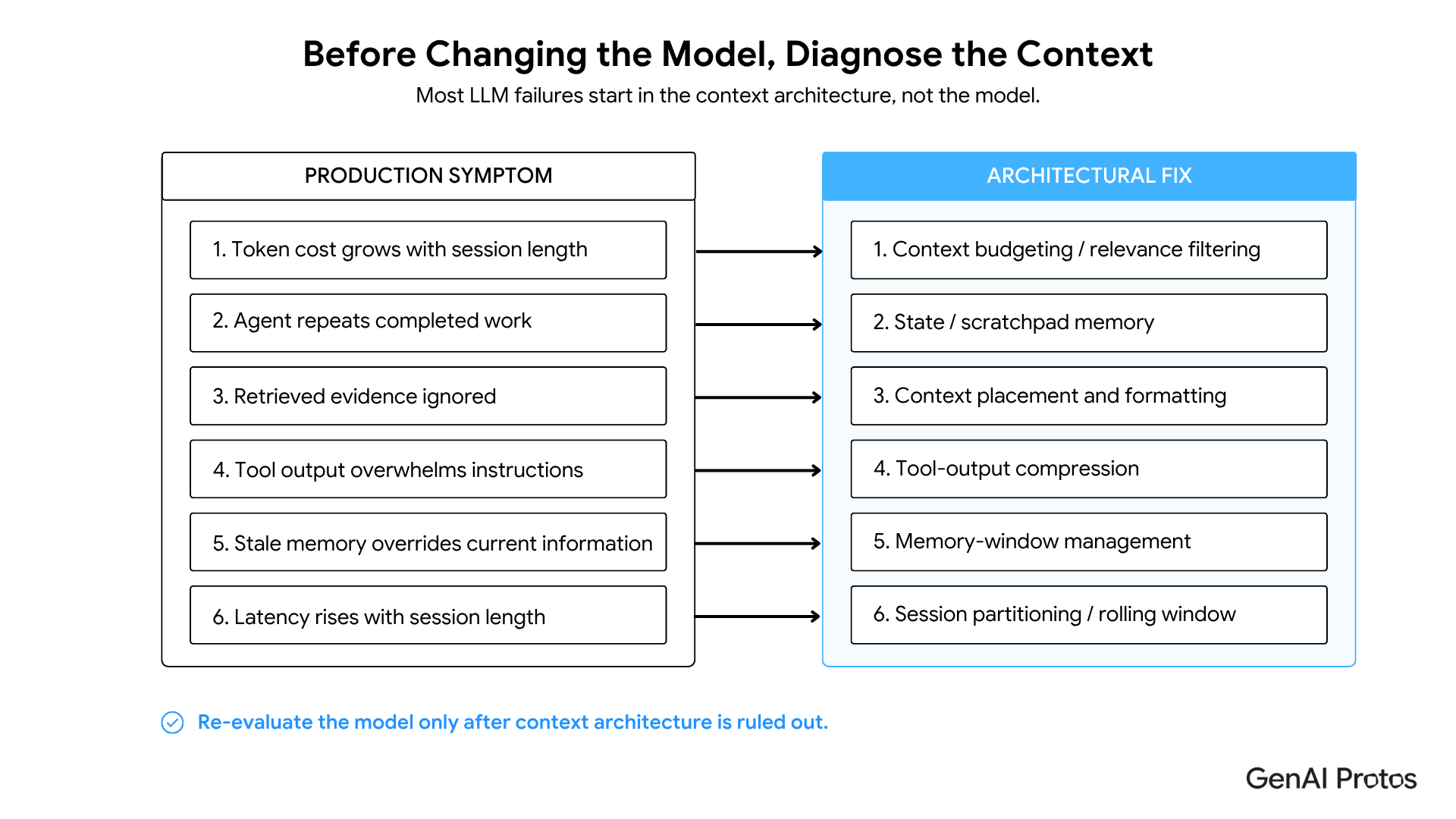
Before optimizing, know what you are diagnosing. These signals indicate a context design problem rather than a model quality problem.
- Token cost increasing across long sessions, even when query complexity stays constant
- Agents repeating work already completed earlier in the session
- Relevant documents retrieved but ignored or contradicted by the model output
- Tool output overwhelming task instructions, causing the model to lose track of the original goal
- Old memory from earlier turns overriding more recent and current data
- Latency increasing with conversation length beyond what the model's context processing would explain
Each symptom points to a specific architectural fix: cost growth suggests retrieval filtering; repeated work suggests scratchpad memory or state tracking; ignored context suggests position and formatting; tool output flooding suggests output compression; memory staleness suggests explicit window management; latency scaling suggests context budgeting. Diagnose the symptom first before redesigning the full system.
Relevant solution: The RAG Enterprise Knowledge Agent demonstrates grounded access to distributed enterprise knowledge through governed retrieval.
What Teams Get Wrong
Treating context as unlimited
Context windows are large but not free. Every token costs money and adds latency. Design context budgets explicitly: how many tokens for instructions, for conversation history, for retrieved context, for the current query.
Ignoring position effects
Relevant information in the middle of a 100,000-token context is less reliably recalled than the same information at the beginning or end. Place the most critical context near the start of the prompt, not buried in the middle of a document dump.
Skipping LLM fine-tuning when context engineering alone is insufficient. When the same information appears in every model call, evaluate whether it belongs in fine-tuned model weights, a deterministic configuration layer, or a retrieval system. Fine-tuning reduces token usage and improves consistency for stable, high-frequency domain knowledge - but frequently accessed content that changes, needs to be audited, or must be testable often belongs in retrieval or configuration instead. The approaches are complements, not alternatives, and the right mix depends on the update frequency and testability requirements of the information.
Key Takeaways
- Context engineering is the discipline of deciding what enters the context window, in what order, and in what format.
- The five context window components are: system prompt, conversation history, retrieved context, tool outputs, and the current query.
- LLM memory is not automatic. It is a design choice with three main patterns sliding window, summary memory, and external memory with retrieval.
- Context costs generally scale with token count, though cached tokens, reasoning tokens and provider pricing tiers affect the exact relationship. Relevance filtering, output compression, and prompt caching reduce costs without degrading quality.
- Information in the middle of a long context is recalled less reliably than information at the start or end. Position matters.
Conclusion
Context quality determines whether an enterprise LLM remains grounded, efficient and consistent across long-running workflows. GenAI Protos designs retrieval, memory and context-budget architectures that give models the right information at the right stage of each task.


