
The healthcare AI pilot passed every internal review. The imaging model flagged 97% of target findings in the validation set. Then it went live. Radiologists started overriding its recommendations within the first week because the false positive rate on edge cases was eating their review time. The 97% was real. It was also the wrong number to optimize.
Healthcare AI in clinical environments is not a technology problem. It is a measurement and workflow problem. The question is never "does the model work?" It is "what does this model change about the workflow, and does that change help or slow the clinician?" This post maps where clinicalai delivers measurable value today, wheremedicalai creates liability, and what the compliance layer actually requires before a healthcare system goes live.
Where Healthcare AI Earns Its Keep
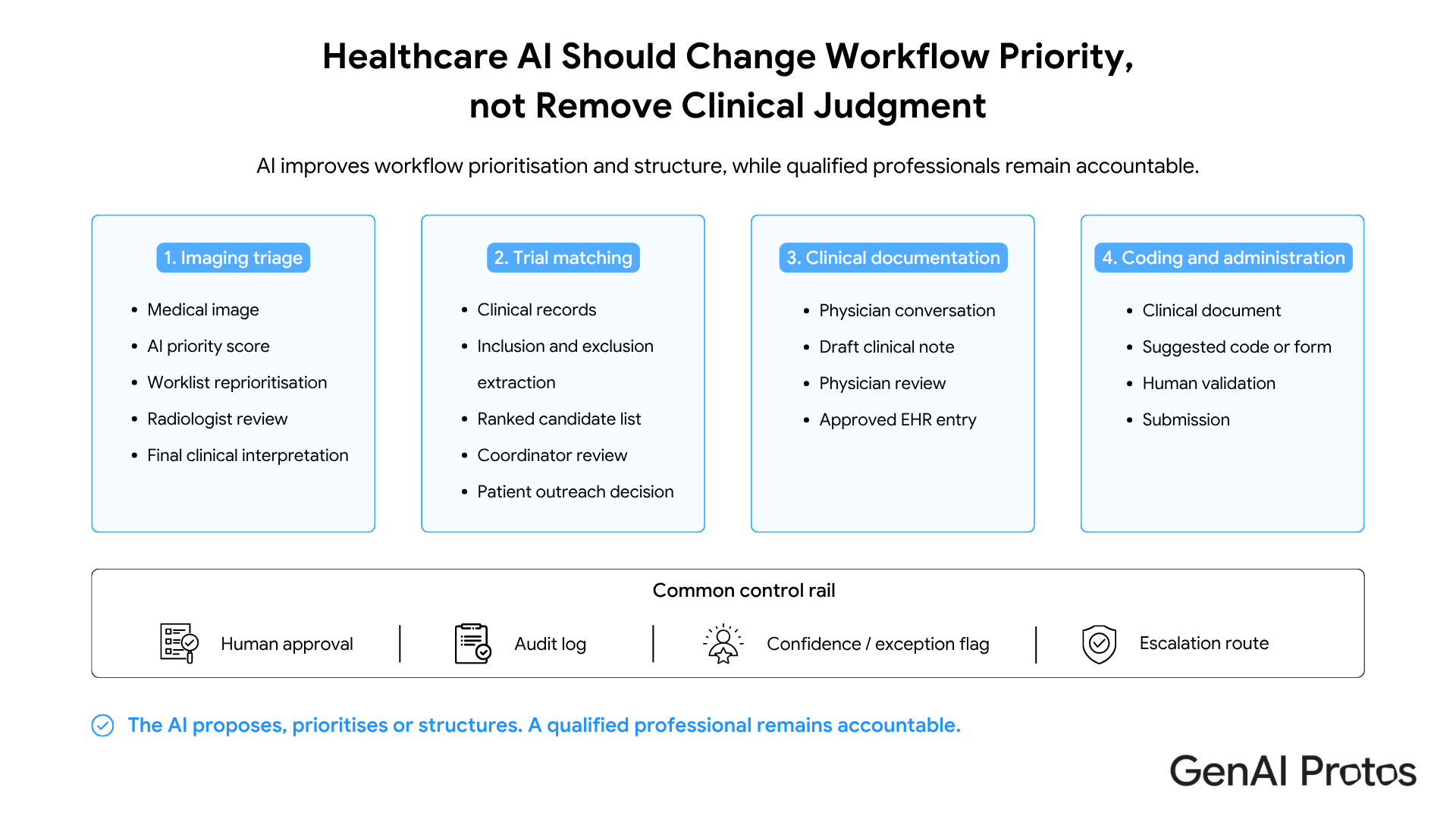
Four healthcareai workflow categories currently show meaningful production adoption. Readiness still depends on the specific product, intended use, localvalidation and workflow controls.
AI imaging triage. AI imaging tools that flag priority findings for radiologist review have a clear, measurable ROI: reduced time-to-read for urgent findings. A 2024 study in Radiology AI reported a median time-to-report reduction of 43 minutes for critical findings at a single 400-bed hospital. Outcomes vary by implementation, scanner protocol, patient volume and baseline workflow. The model does not replace the radiologist. It changes the queue order. GenAI Protos builds this pattern into the AI-Powered Radiology Intelligence Platform, which integrates triage flagging with existing PACS workflows.
Clinical trial patient matching. Identifying eligible patients for clinical trials requires matching inclusion and exclusion criteria across unstructured clinical notes, lab results, and medication histories. This is manual work that takes 15 to 20 minutes per chart. Medicalai that readsunstructured notes and flags potential matches at scale reduces screening time in documented implementations. A TrialGPT study reported a 42.6% reduction in coordinator screening time. Results vary by protocol complexity, criteria specificity and system configuration. The Clinical Trial Assistant handles this exact workflow, returning ranked candidate lists for coordinator review.
Clinical documentation. AI-generated structured summaries from physician dictation or post-visit notes reduce documentation time without changing clinical judgment. Teams using ambient documentation tools report time savings per physician per day. Published results vary considerably across tools, workflows and user groups. One pragmatic randomised trial found approximately 22 minutes per day on average; other implementations report different figures depending on tool configuration and workflow integration. The risk profile is lower than diagnostic use cases because the physician reviews every output before it enters the record.
Administrative and coding workflows. ICD-10 code suggestion, prior authorization document preparation, and claims data extraction are repeatable, structured tasks where medicalai can approach the accuracy of experienced coders on standard cases in controlled evaluations, though performance should be validated against your documentation style, payer mix and code complexity. The value is throughput, not judgment.
Relevant implementation: See the AI-Powered Radiology Intelligence Platform to understand how GenAI Protos connects AI triage, PACS workflows and clinician review.
AI Diagnostics: Where the Accuracy Numbers Hold
AI diagnostics tools have demonstrated radiologist-level or better performance on narrow, well-defined tasks in controlled settings. The specifics matter.
For diabetic retinopathy detection from fundus images, FDA-cleared medicalai systems have shown sensitivity above 87% and specificity above 90% in specific prospective studies. For specific types of chest X-ray findings such as pneumothorax and nodule detection, ai imaging tools perform comparably to radiologists on matched datasets. Performance figures vary across datasets, patient populations and acquisition protocols.
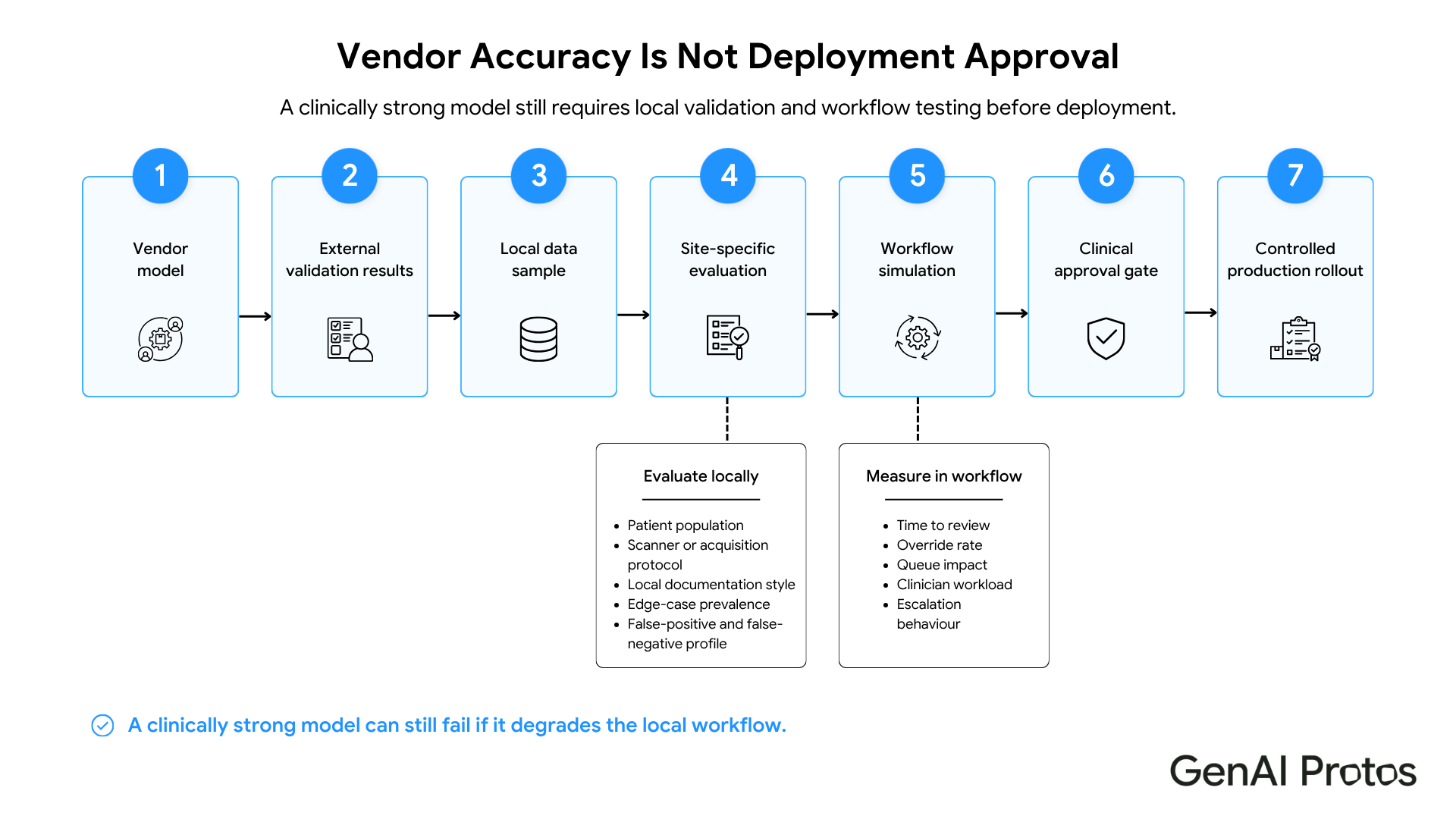
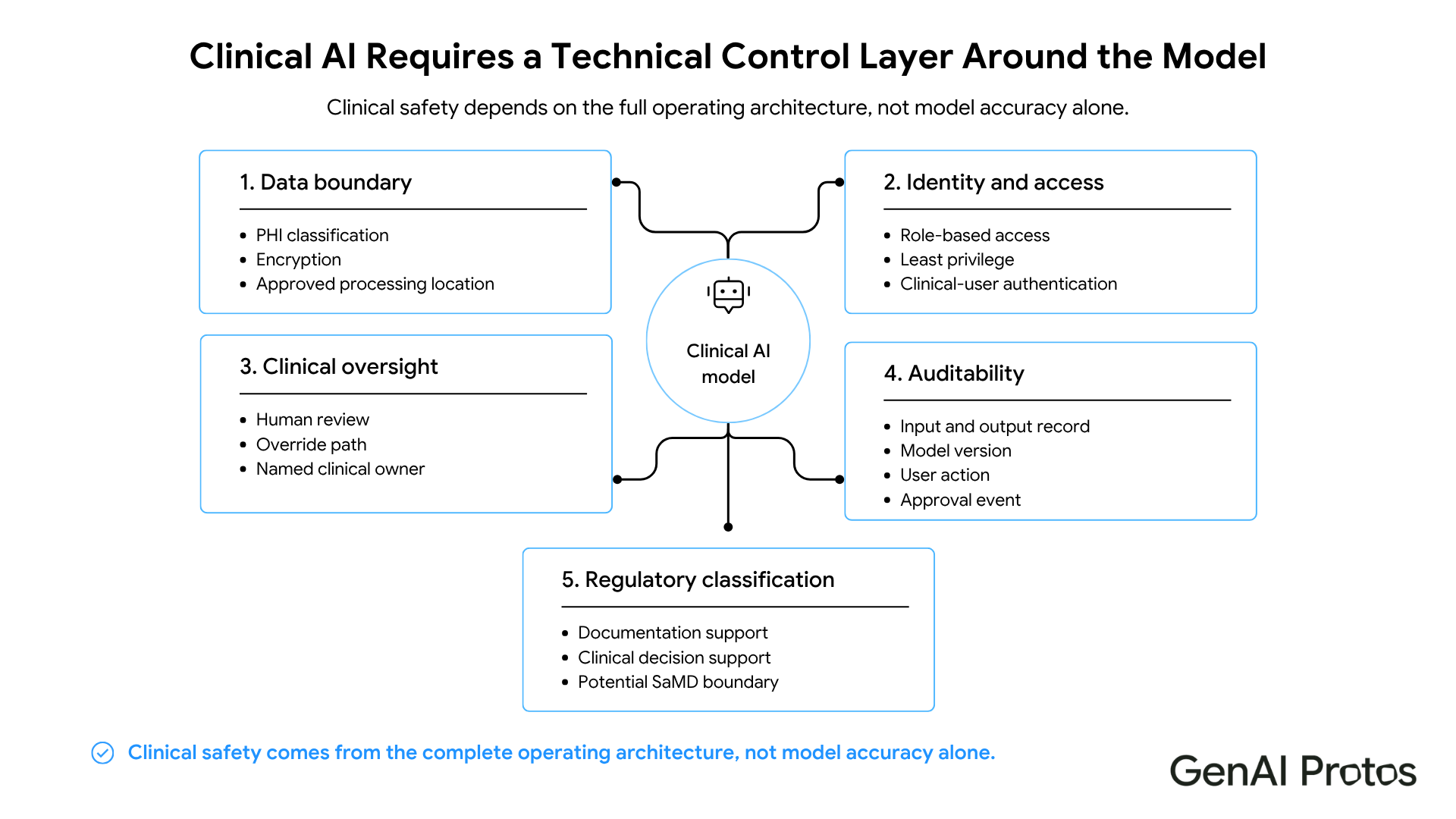
The accuracy drops outside the training distribution. A model validated on chest X-rays from a US academic medical center may degrade on images from a different acquisition protocol, a different scanner model, or a patient population with different demographic characteristics. Conduct site-specific performance and workflow validation before any ai diagnostics deployment, especially where patient populations, equipment, protocols or intended use differ from the product's validation environment. Vendor validation studies are a starting point for understanding performance characteristics, not a deployment approval for your specific setting.
The Healthcare Image Analysis solution GenAI Protos deploys includes site-specific calibration as part of the implementation protocol, not as an optional step.
Clinical AI in Documentation and Trial Matching
The highest-volume healthcareai use cases are not diagnostic. They are documentation and data extraction.
Clinical documentation ai handles transcription, structured note generation, problem list updates, and referral letter drafting. These tools operate on physician-reviewed outputs. The risk profile is lower than diagnostic use cases because a clinician reviews and approves every AI-generated entry before it enters the medical record.
Clinical trial matching operates at the pre-screening stage, before any patient is contacted. The ai flags candidates for coordinator review. No patient receives a recommendation, an invitation, or a change to their care based on the AI output alone. The workflow keeps the human in the decision loop.
Both patterns have a common structure: the ai generates a candidate output, a trained human reviews it, and the human makes the final determination. This human-review architecture can reduce clinical and regulatory risk when roles, escalation rules and accountability are clearly defined.
The Compliance Layer: HIPAA, FDA and What Healthcare AI Actually Requires
HIPAA requires safeguards for protected health information (PHI). Any healthcareai ormedicalai system that processes, stores, or transmits PHI must implement technical, administrative, and physical safeguards as defined in the Security Rule. Required specifications include access controls, audit controls,authentication and transmission security, with documented risk management throughout. Encryption is an addressable safeguard that organisations generally implement for modern healthcare systems, but the regulation applies it through a risk-based framework rather than as an unconditional technology mandate. Business associate agreements are required with vendors that create, receive, maintain or transmit PHI on behalf of a covered entity or business associate.
FDA classification depends on the specific software function and intended use, not simply whether the system relates to clinical decision-making. FDA's Clinical Decision Support guidance distinguishes between software that may not be a device, device software subject to oversight, and lower-risk functions for which FDA may exercise enforcement discretion. Software that analyses medical images generally remains within device oversight. Some administrative and clinician-reviewable decision-support functions may be excluded or treated differently. Know your regulatory category and verify with regulatory counsel before you build, as FDA guidance continues to evolve.
HIPAA does not prohibit cloud processing of PHI. It requires appropriate safeguards. The specific safeguards depend on the contract, the data classification, and the vendor's BAA terms. "The cloud is not HIPAA-compliant" is a misreading of the regulation, not a legal constraint. Healthcare organizations with stricter data residency requirements should review why regulated industries need private AI before selecting a deployment model.
Healthcare AI Deployment Decision Framework
| Use case | AI role | Human role | Primary risk | Validation required |
|---|---|---|---|---|
| Imaging triage | Queue prioritisation | Interpret image | Missed or excessive flags | Clinical and workflow validation |
| Trial matching | Candidate pre-screening | Confirm eligibility | Incorrect inclusion or exclusion | Criterion-level review |
| Clinical documentation | Draft note generation | Review and sign | Hallucinated or omitted details | Note-quality audit |
| Coding and administration | Suggested codes or documents | Coder or staff approval | Incorrect billing or documentation | Coding accuracy and compliance review |
Every row represents a workflow where the AI generates a candidate output and a trained human makes the final determination. The AI role, risk profile and validation approach differ materially across use cases. Do not apply one set of controls to all four.
Explore our industry approach: GenAI Protos designs Healthcare AI around workflow validation, data safeguards and accountable human oversight.
What Teams Get Wrong With Medical AI Deployment
Optimizing on the wrong metric. Sensitivity and specificity are ai diagnostics model metrics. Workflow impact is the clinical metric. A 97% sensitivity model that generates enough false positives to slow radiologist review is worse than an 89% sensitivity model that integrates cleanly into the existing workflow. Measure both.
Skipping site-specific validation. Vendor validation datasets are not your patient population, your scanner hardware, or your documentation style. Conduct site-specific performance and workflow validation before clinical deployment, particularly where populations, equipment or protocols differ from the product's validation environment.
Treating compliance as a pre-launch gate rather than an ongoing practice. HIPAA compliance is not a checkbox completed at deployment. Access controls must be reviewed as staff turnover, data usage must be logged and audited, and vendor BAAs must be reviewed when vendors update their terms.
Deploying without clinical champion ownership. Healthcareai deployments that succeed have a named clinical champion who owns the workflow change, trains the staff, and owns the escalation process when the AI is wrong. A named clinical champion materially improves workflow ownership, staff adoption,training and escalation management. GenAI Protos covers the full healthcare AI implementation journey, from compliance architecture to clinical champion enablement.
Key Takeaways
- Healthcare AI shows meaningful production adoption in four categories: imaging triage, trial matching, clinical documentation, and administrative coding. Readiness depends on specific product, intended use, local validation and workflow controls.
- AI diagnostics and medicalai accuracy figures from vendor studies reflect controlled conditions. Run site-specific validation before deployment.
- HIPAA does not prohibit cloud AI. It requires documented safeguards, BAAs with vendors, and ongoing audit practices.
- FDA classification depends on specific software function and intended use, not simply on whether the system relates to clinical decisions. Know your regulatory category before you build.
- Successful clinicalai deployment requires a named clinical champion, site-specific validation, and workflow measurement beyond model accuracy.
Conclusion
Healthcare AI creates value when model performance is translated into safer and more efficient clinical workflows. GenAI Protos combines healthcare data engineering, validation design and clinician-reviewed implementation patterns to help organisations move from promising pilots to controlled production use.


