
Introduction
Regulated organizations are under pressure from both sides. Business teams want AI assistants to reduce manual work. Risk, legal, and compliance teams need proof that the assistant can be reviewed, controlled, and audited. When the architecture does not answer those questions, the project stalls.
The fix is not to make compliance review faster. The fix is to build a system that compliance can evaluate.
A compliance AI assistant should have clear data boundaries, controlled retrieval, explainable outputs, reviewer routing, and complete logging. These are not features to bolt on after a demo. They are core system requirements.
GenAI Protos’ Private AI expertise is a strong internal link because it focuses on private, on-prem, and sovereign AI solutions where data control and governance are central.
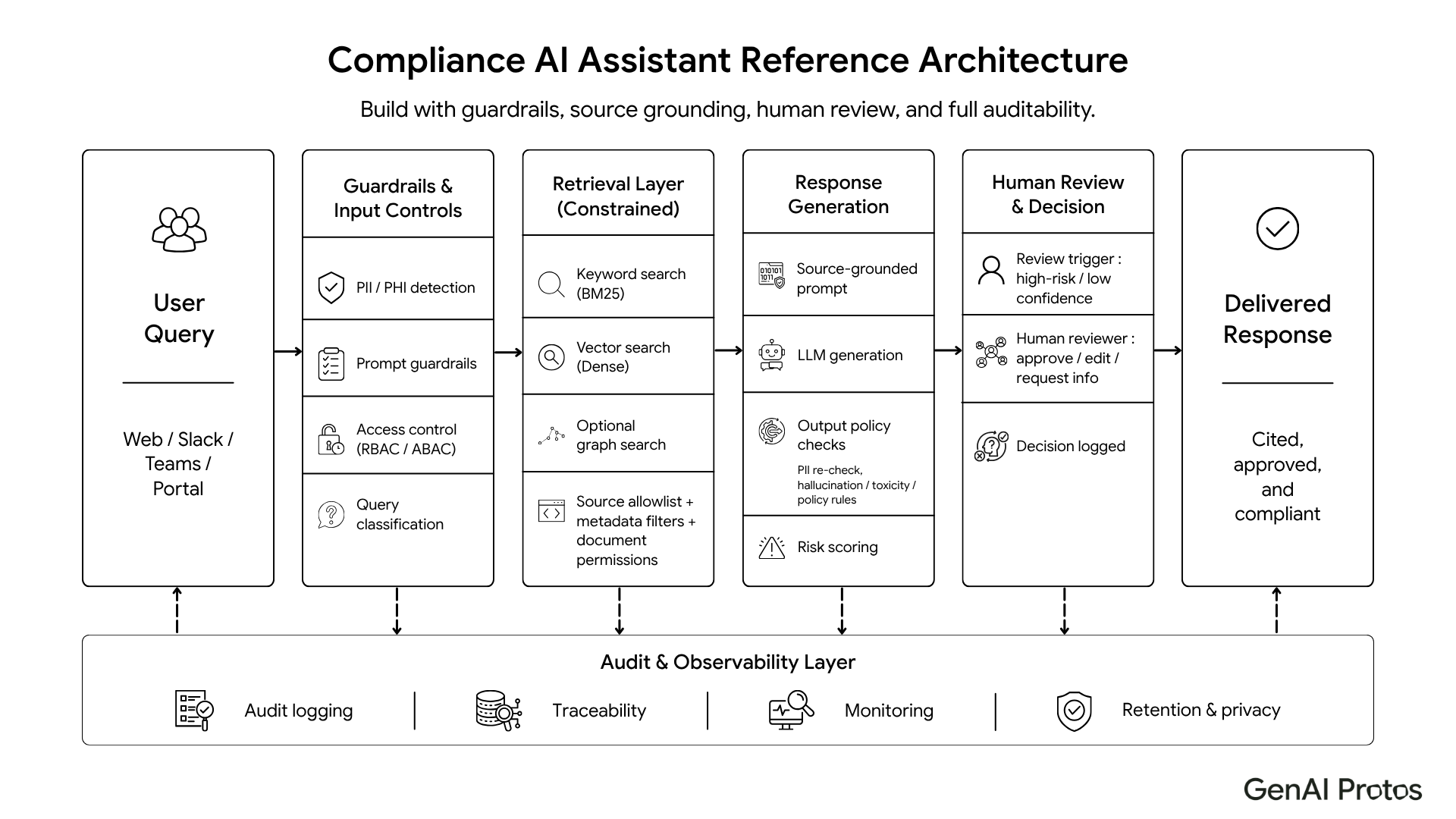
Business impact: Compliance delay is not only a legal issue; it is an operating cost. Every blocked assistant keeps manual review, repetitive policy lookup, and compliance triage inside human queues. Designing audit logs, source grounding, and reviewer routing upfront gives risk teams something concrete to approve and reduces the chance of expensive post-build redesign.
What Compliance-Grade Actually Means
A compliance-grade AI assistant must satisfy four expectations.
1. Controlled data handling
The assistant must detect sensitive data, limit unnecessary data exposure, respect user permissions, and avoid sending regulated content into uncontrolled processing paths.
2. Source-grounded answers
The assistant should answer from approved policies, documents, records, or knowledge bases. If it cannot cite or trace the source, it should not produce a high-confidence answer in a regulated workflow.
3. Human oversight
Some outputs should not go directly to users or systems of record. A clinical, financial, legal, HR, or compliance-sensitive response may require a reviewer before delivery.
4. Complete auditability
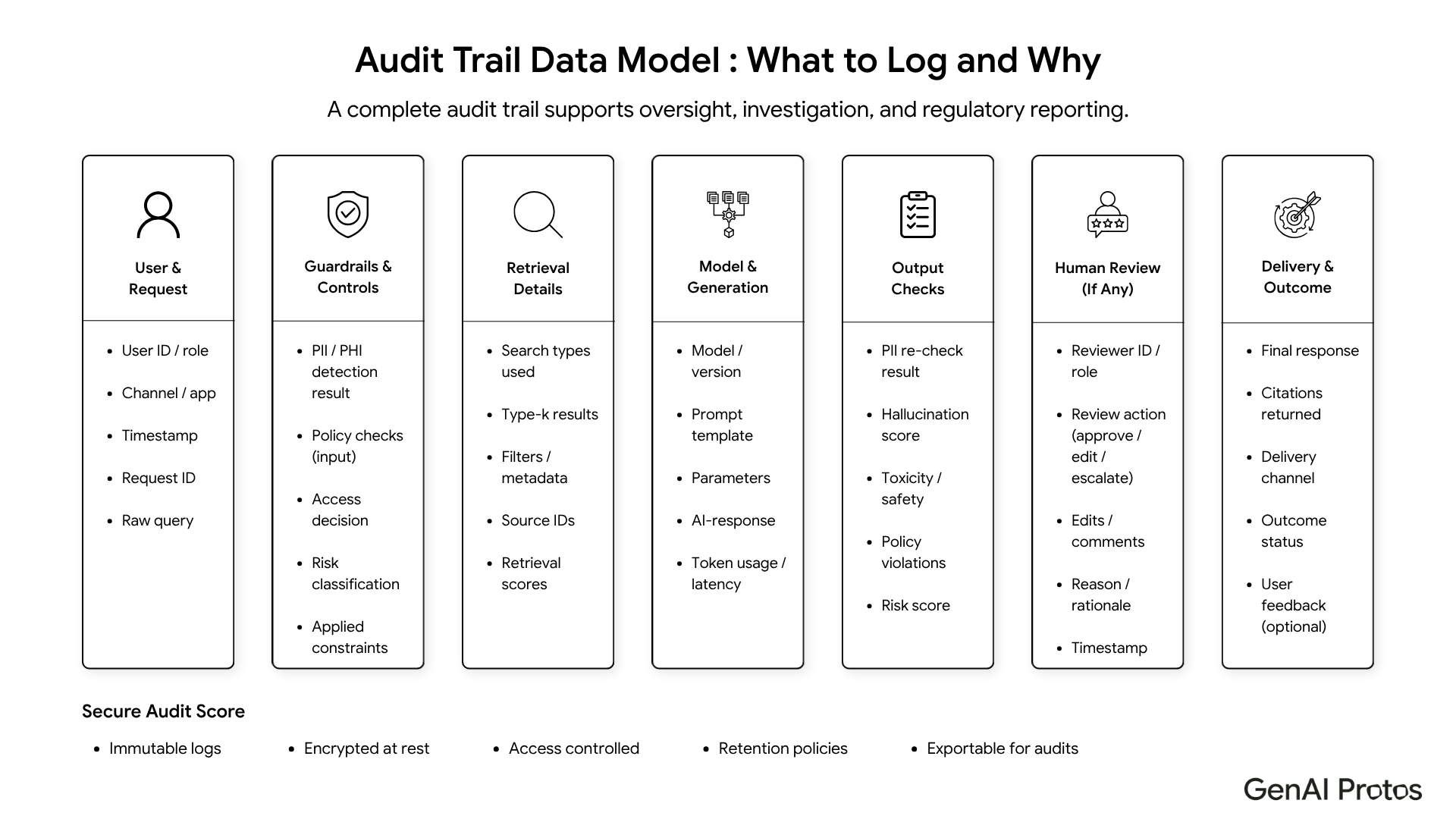
The system must preserve enough information to reconstruct what happened: input, retrieval context, model or workflow version, output, policy checks, reviewer actions, and final delivery state.
The simplest definition: a compliance AI assistant is an AI workflow that can explain, restrict, route, and prove its own behavior.
The Five Architecture Layers
| Layer | What it does | Why it matters |
|---|---|---|
| Input guardrails | Detects PII, PHI, confidential data, and restricted prompts | Prevents unsafe ingestion |
| Retrieval constraints | Limits answers to approved and permissioned sources | Reduces hallucination and policy drift |
| Output policy checks | Screens responses before delivery | Stops advice, disclosure, or compliance violations |
| Human review routing | Sends high-risk outputs to named reviewers | Keeps oversight inside the workflow |
| Audit logging | Records full interaction and decision history | Supports review, investigation, and governance |
Layer 1: Input guardrails
The system should classify incoming content before it reaches the model or retrieval layer. Sensitive content may be redacted, blocked, routed, or logged differently depending on risk.
Layer 2: Retrieval constraints
The assistant should not answer from uncontrolled sources when operating in regulated workflows. Source libraries, permissions, and freshness rules must be explicit.
Layer 3: Output policy checks
The model output should pass through a policy layer before delivery. The policy layer can flag restricted advice, missing citations, unsupported claims, or sensitive data leakage.
Layer 4: Human review routing
Review should not depend on user judgment alone. The workflow should define trigger rules, such as “external-facing legal language,” “patient-specific clinical interpretation,” or “investment recommendation.”
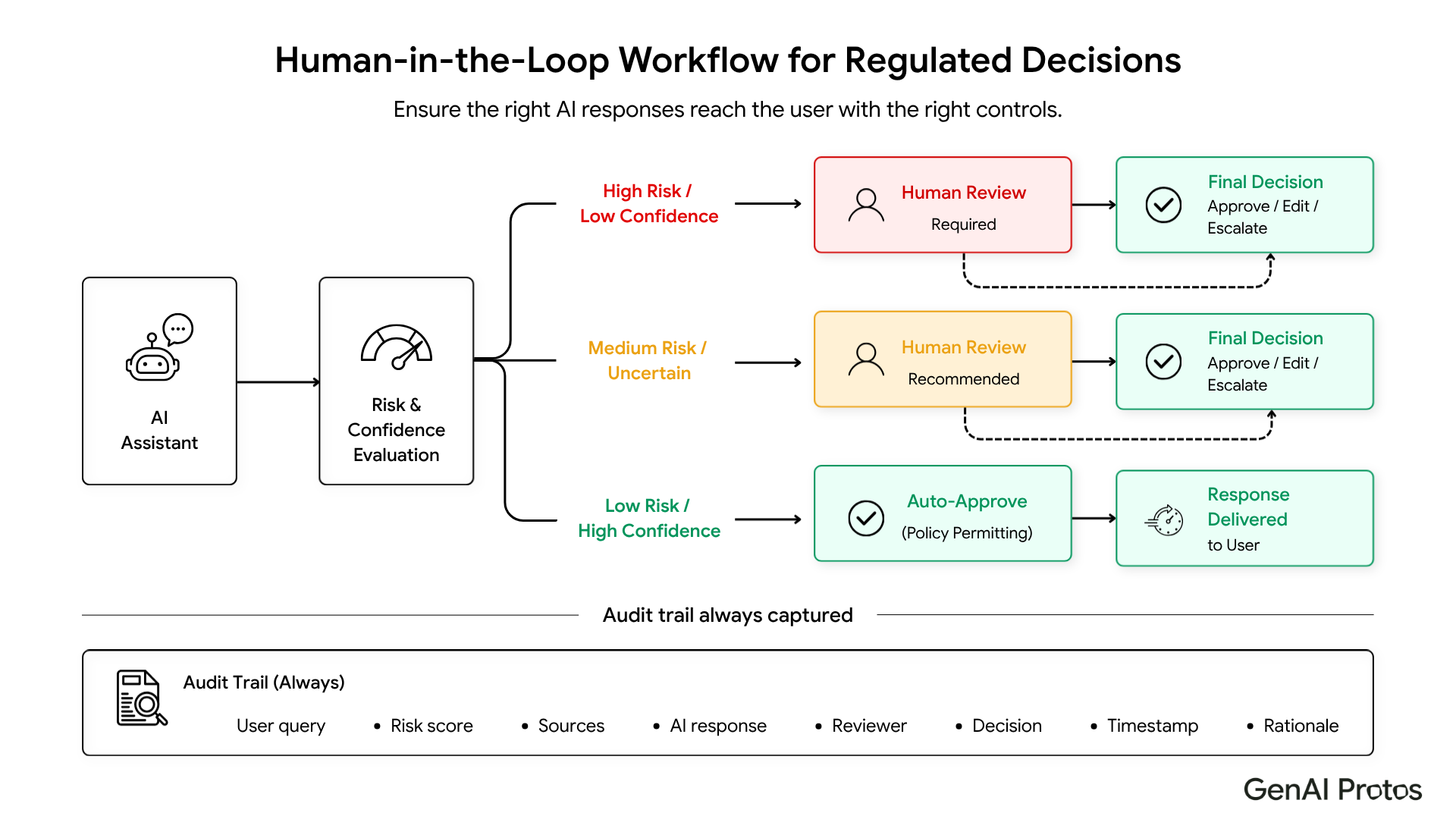
Layer 5: Audit logging
Audit logs must be useful to compliance, not only engineering. Capturing latency and errors is not enough. The log should show why the system delivered, blocked, or escalated a response.
How Regulations Shape Design
Regulatory frameworks do not all ask for the same controls, but they push the architecture in the same direction: stronger data governance, traceability, oversight, and documentation.
| Framework | Design implication |
|---|---|
| HIPAA | PHI handling, access controls, encryption, business associate requirements, and review for clinical impact |
| GDPR | lawful processing, data minimization, access rights, retention controls, and protection of personal data |
| EU AI Act | risk classification, technical documentation, logging, transparency, and human oversight for high-risk systems |
| SR 11-7 | model governance, validation, monitoring, documentation, and decision reconstruction |
| MiFID II | recordkeeping, rationale tracking, and controls around advisory or trading-related outputs |
The key is to assess the regulatory design implications before scoping the build. If classification or auditability is discovered late, teams often have to redesign the workflow.
For readers evaluating regulated AI patterns, GenAI Protos’ page on Private AI gives the right internal context around private, on-prem, and sovereign deployment models.
What It Looks Like in Practice
Healthcare documentation support
The assistant helps summarize or draft documentation, but patient-specific output routes through clinician review. It only retrieves from approved clinical sources and logs source context.
Financial compliance workflow
The assistant helps analysts review policies, transactions, or regulatory text, but it does not deliver final advisory language without review. The audit trail captures inputs, sources, output, and reviewer decision.
Legal operations knowledge assistant
The assistant answers internal policy and document questions from access-controlled knowledge bases. Responses involving client-sensitive matters or external-facing language are routed to a reviewer.
GenAI Protos’ Employee Assist Agent and Confluence AI Agent for legal services are relevant internal examples because they show controlled internal knowledge workflows where retrieval scope and source access matter.
Why Projects Stall
Audit logging is defined too late
Engineering logs cannot answer compliance questions if they do not capture source context, workflow state, and decision history.
Guardrails block too much
Overly broad filters reduce adoption. Guardrails need tuning against real workflow examples.
No clear reviewer routing
“Human in the loop” must specify who reviews, when, and what action they can take.
Unclear source authority
If the assistant answers from outdated or unofficial sources, risk review becomes difficult.
Compliance owns approval but not requirements
The compliance team should shape the architecture before the build, not only review it after completion.
GenAI Protos’ De-Risk Your AI Investment is a useful supporting link for teams that need to identify risk and governance gaps before committing to a build.
Key Takeaways
Compliance AI assistants need guardrails, retrieval constraints, output policy checks, review routing, and audit logs.
Regulated AI should be designed for review, not retrofitted for approval.
Source grounding is the safest pattern for high-stakes workflows.
Human review must be part of the workflow logic.
Compliance stakeholders should be involved before integration work begins.
Conclusion
The fastest way to pass compliance review is not to hide complexity. It is to make the architecture concrete. Risk teams need to see how the assistant handles sensitive data, where it gets information, how outputs are checked, when humans review, and what evidence exists after the fact.
A compliance AI assistant built this way can support regulated teams without creating uncontrolled risk. It becomes a governed workflow, not an experimental chatbot.
Deploy a Compliance AI Assistant That Passes Risk Review
GenAI Protos designs compliance-grade AI assistants with guardrails, retrieval constraints, audit logging, and human review built in from day one.
Start the conversation


