
Your AI agent in SDLC pipeline ran perfectly in the sandbox. Four agents collaborated, pulled context, wrote code, ran tests, and flagged the security issue your QA team missed. You promoted three engineers and scheduled the production migration for Monday morning.
Production AI agents should be managed with the same operational discipline used for critical distributed services. Teams that survive the pilot treat autonomous agents with the same rigor as microservices: they define resource envelopes, enforce circuit breakers, isolate runtimes, and validate state persistence before a single agent touches a production branch.
This guide gives you the production sizing rules, authorization model, and compute boundaries your AI agent in SDLC pipeline requires from the Four-Agent Cohort Model to circuit breakers that prevent runaway execution and state corruption in enterprise deployments.
Why Agent Infrastructure Requires Its Own Sizing Model
A single agent conversation loop is a stateful, long-running process. It holds an expanding context window, makes repeated LLM API calls, potentially executes shell commands, and writes intermediate state. That is not structurally different from any other service with memory growth and external I/O dependencies.
The difference is non-determinism. A standard service call returns in predictable time. An agent reasoning loop can iterate five times or fifty, depending on task complexity and the quality of the stop condition. That non-determinism is what makes production agent sizing non-trivial.
Practical rule: size your agent infrastructure on worst-case execution paths, not average-case. Define a maximum iteration count per agent loop before deployment. Without that constraint, you do not have a production system. You have a billing event waiting to happen.
The Four-Agent Cohort Model for Enterprise SDLC
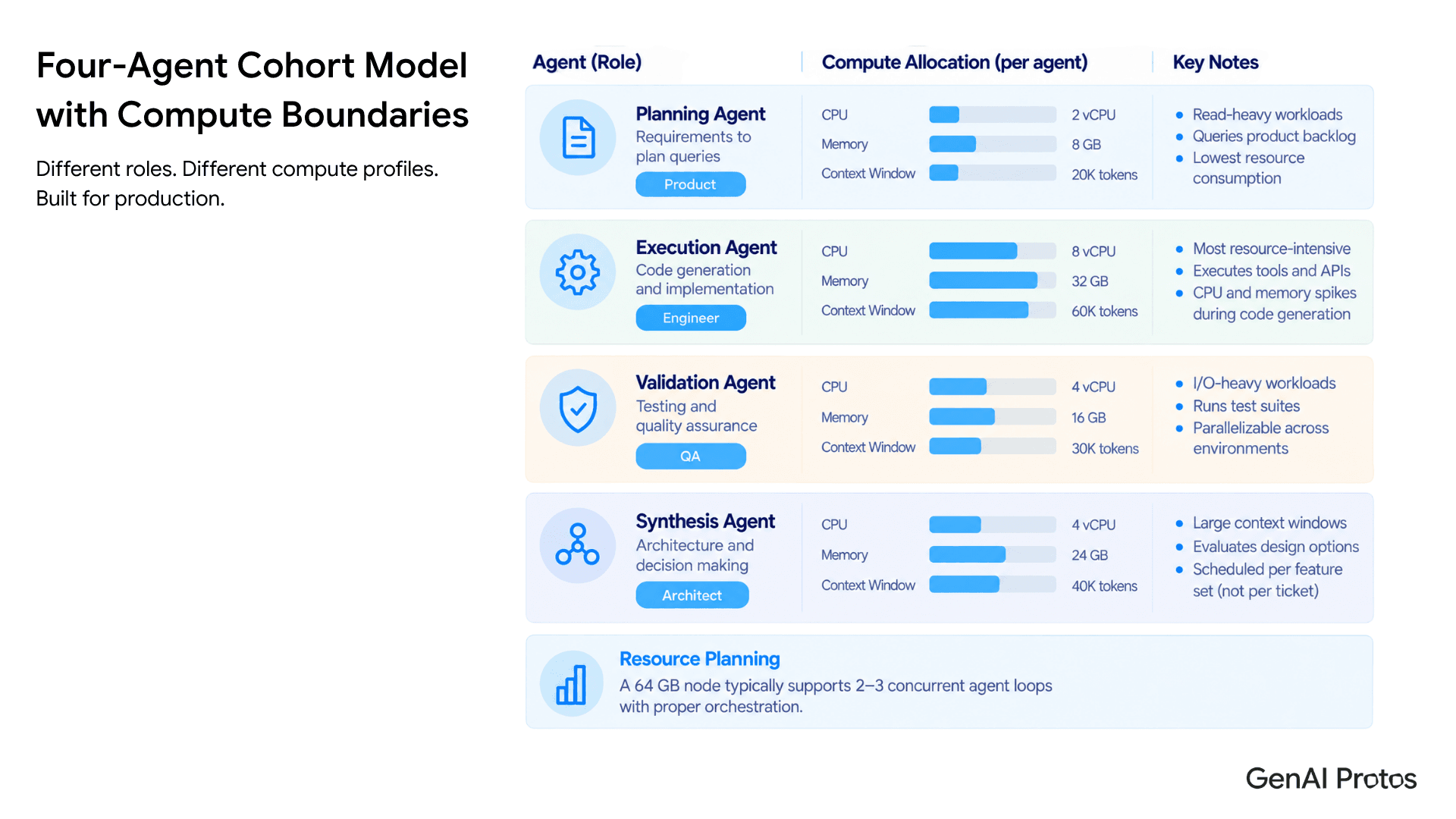
When teams ask how many concurrent agents a Kubernetes node can support, the honest answer depends on which agents. The 2026 AI Agent Development Lifecycle introduced the cohort concept. Here is the production sizing view.
Four functional agent roles emerge in a standard enterprise SDLC, each with a distinct compute profile:
Product Agent:
Reads requirements, generates user stories, queries the product backlog. Read-heavy with moderate context windows. Lowest resource consumption of the four roles.
Architect Agent:
Evaluates system design options, queries codebases, generates architecture decision records. Context windows grow large. Memory-intensive. Schedule one per major feature, not one per ticket.
Engineer Agent:
Writes, modifies, and refactors code. Executes shell commands, calls version control APIs, manages file I/O. CPU and memory spike during code generation runs. Your most resource-intensive role.
QA Agent:
Generates test cases, runs test suites, evaluates coverage reports. Parallelizable but I/O-heavy. Dependent on the Engineer Agent completing its state hand-off cleanly.
On a production node, a conservative baseline supports two to three concurrent Engineer Agent loops, with Product and QA agents in lighter containers alongside. Architect Agents run sequentially per feature set.
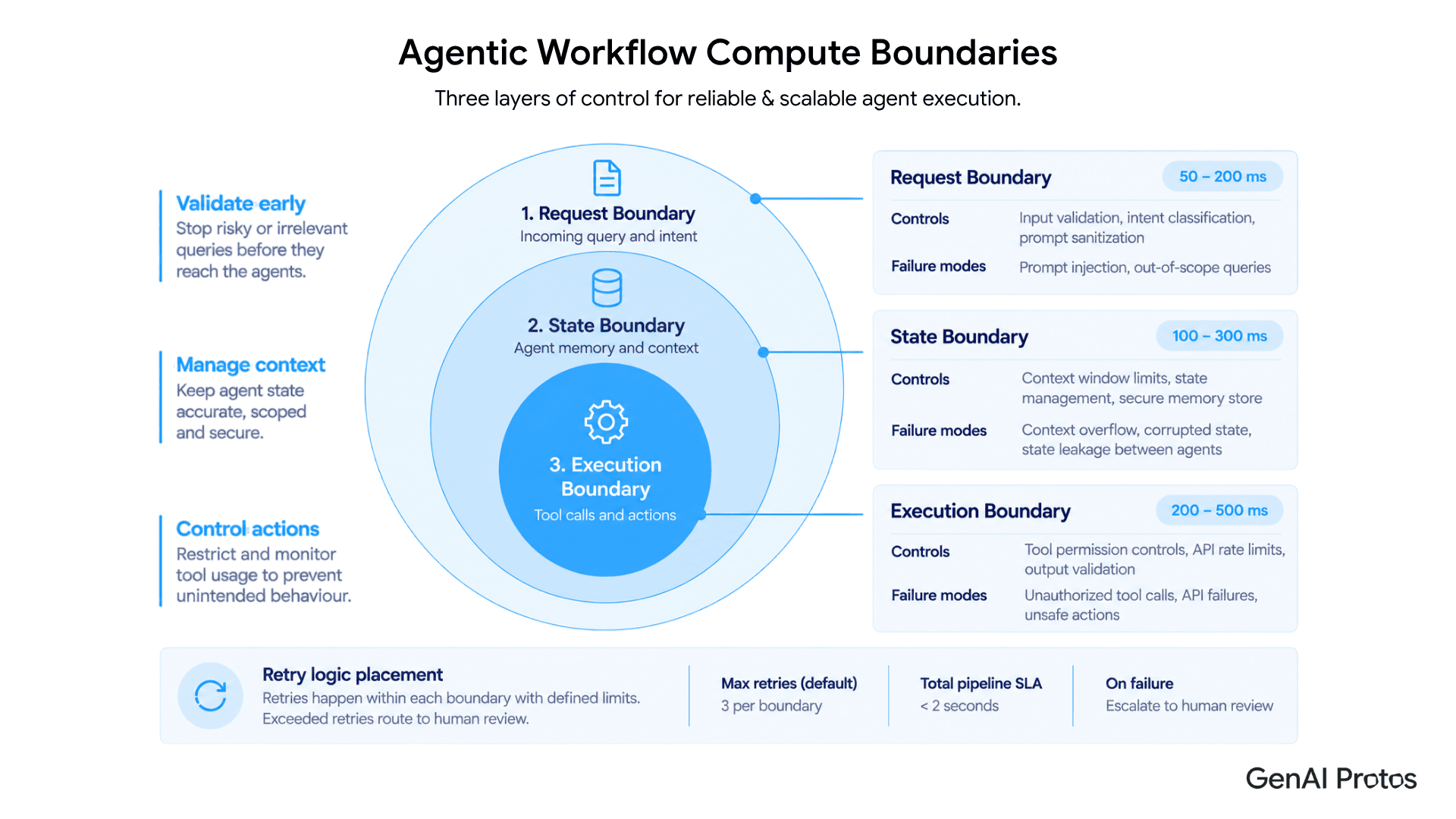
Agentic Workflow Compute: The Three Boundaries That Matter
Scaling ai agents is not about adding nodes until errors stop. Multi-agent systems for enterprise workflows outlined the workflow architecture. Production sizing adds the enforcement layer.
Context window accumulation.
Each agent loop grows its context with every step. Unbounded growth increases per-call token cost and degrades response quality. Set a context window ceiling per role and implement a compression step before the agent hits that ceiling.
Concurrent API call limits.
Multiple Engineer Agents making simultaneous LLM calls compete for rate limits. Without a request queue in front of your LLM gateway, agents degrade each other. Use a shared token-bucket rate limiter at the gateway layer.
State hand-off integrity.
If the Engineer Agent writes partial state before a failure, the QA Agent reads corrupt input. Treat every state hand-off as a transactional commit, not a file write.
A Production Sizing Example
To make these boundaries concrete, consider a four-agent SDLC pipeline processing a single feature request per run. A reasonable production configuration looks like this:
Maximum concurrent workflow runs: 3, to stay within the memory envelope of a 64 GB Kubernetes node at peak load.
Maximum steps per Engineer Agent: 25 iterations before circuit breaker fires, regardless of task completion status.
Context window limit per role: Engineer Agent capped at 60K tokens; QA Agent at 30K; Product and Architect agents at 20K.
Queue timeout: 120 seconds. If a task has not been claimed by an available agent within two minutes, it returns to the queue with an incremented retry counter. After three retries, it escalates to a human review queue.
Circuit breaker trigger: Any of: iteration ceiling reached, token budget exhausted, or wall-clock time exceeded (default 15 minutes per loop). On trigger, the loop commits current state and fails closed.
Cost alert threshold: Per-workflow token spend above a defined limit triggers an async alert to the platform team before the workflow completes. Avoids bill shock without blocking execution.
Dependency failure handling: If the Engineer Agent fails to deliver a state hand-off, the QA Agent does not start. The orchestrator logs the failed hand-off, increments the failure counter for that workflow, and notifies the monitoring channel.
These are starting values, not universal constants. Validate them against sustained load testing at your target concurrency before they become your production configuration.
Get a Production Readiness Review for Your Agent Pipeline
Before you deploy multi-agent systems in your SDLC, get an architecture review from GenAI Protos covering compute boundaries, circuit breaker design, and state hand-off integrity. Learn about GenAI Protos Full-Stack AI Engineering
Circuit Breakers Prevent Runaway Agent Execution
The Microsoft AutoGen research paper (see AutoGen: Enabling Next-Gen LLM Applications via Multi-Agent Conversation) introduced multi-agent conversation patterns enterprise teams now deploy in production. What it does not cover is what happens when those conversations do not terminate.
A circuit breaker for agent loops operates on three triggers: maximum iteration count reached, token budget consumed, or wall-clock time exceeded. When any trigger fires, the loop fails closed: it writes current state, emits a structured error to the orchestrator, and releases its resource allocation.
Without circuit breakers, a stalled agent can exhaust node memory over hours. The failure is silent because the process is still running. It looks healthy until it is not.
Implement circuit breakers at the orchestrator level, not inside individual agent code. Agent code should not manage its own runaway behavior. That is an architectural control, not an agent concern.
Authorization Boundaries Protect Production Code
Agent pipelines that can write code and call APIs need explicit authorization models. An Engineer Agent should never have permission to merge to a protected branch. It generates a pull request and stops. A QA Agent runs tests against an isolated environment, never against production data.
Understanding AI agents in the SDLC covers the integration points. Apply least-privilege as you would for a service account: scope tokens to specific repos and branches, time-limit credentials per session, and audit all agent-initiated actions through your existing access logs.
For teams using GitHub Copilot Enterprise alongside autonomous agents, the GitHub Copilot Enterprise documentation covers branch protection and policy controls that apply equally to AI-initiated pull requests.
Build Guardrails for Your Autonomous Agent Pipeline
Need an authorization model that prevents AI agents from committing untested code to production? GenAI Protos designs deterministic guardrails for enterprise agentic systems. Explore GenAI Protos Agentic AI Expertise
Common Sizing Mistakes
Most teams size for the average case.
They test five concurrent agents in staging, see acceptable memory usage, and deploy with ten. Then two agents hit complex tasks simultaneously, context windows balloon, and the node runs out of memory. Size for the worst-case concurrent load, not the average.
The second mistake is treating agent state as ephemeral.
If state lives only in process memory, every infrastructure event is a data loss event. Persist intermediate agent state to a durable store after every reasoning step. Recovery becomes a checkpoint restore, not a full task restart.
Third:
Teams disable circuit breakers in staging because they trigger too aggressively, then ship to production with them off. Tune the thresholds. Never remove the controls.
Key Takeaways
- Manage production AI agents with the same operational discipline applied to critical distributed services.
- Use the Four-Agent Cohort Model to size by role, with Engineer Agents as the most resource-intensive.
- Implement circuit breakers at the orchestrator level on three triggers: iteration count, token budget, wall-clock time.
- Persist intermediate agent state durably; process memory is not a persistence layer.
- Apply least-privilege authorization: agents generate pull requests, they do not merge to protected branches.
Conclusion
Production agent sizing is an infrastructure problem, not a prompt problem. Start with one concrete step: define a maximum iteration count and token budget for every agent role in your pipeline before you write orchestration code. That single constraint forces every other architectural decision into place. Teams that skip it learn the lesson on their cloud bill.


