
Your AI agent just wrote a SQL query against the production warehouse. It joined three tables incorrectly, skipped the semantic-layer access filter, and returned revenue numbers that contradict what the finance team sees in their dashboard. No error was thrown. The agent was confident. The numbers were wrong.
That is one of the risks when AI agents query complex enterprise data without governed business definitions and controlled query paths. The semantic layer is not a nice-to-have for enterprise AI. It is the governance contract between your agents and your data.
What this covers: What a semantic layer is, how it differs from raw data modeling, why AI agents need it, and what teams consistently get wrong when they skip it. Architecture patterns draw from production vendor documentation reviewed in July 2026 and GenAI Protos engineering experience.
What Is a Semantic Layer?
A semantic layer is the governed translation layer between your raw data and the systems that query it - whether those systems are BI tools, applications, or AI agents. It centralises metric definitions, entities, joins and access rules in one place, so every consumer of that data works from the same definitions.
Without a semantic data model, a metric like monthly recurring revenue means something different in every query. One analyst joins on order_date. Another joins on invoice_date. The finance team has a third definition in their BI tool. When an AI agent writes ad-hoc SQL, it picks one interpretation - usually without knowing which is correct.
The semantic layer fixes this. It centralises metric definitions upstream of every consumer. Revenue is revenue everywhere: in the BI dashboard, in the embedded analytics product, and in the response your AI agent returns to a user.
How AI Agents Query Data Through a Semantic Layer
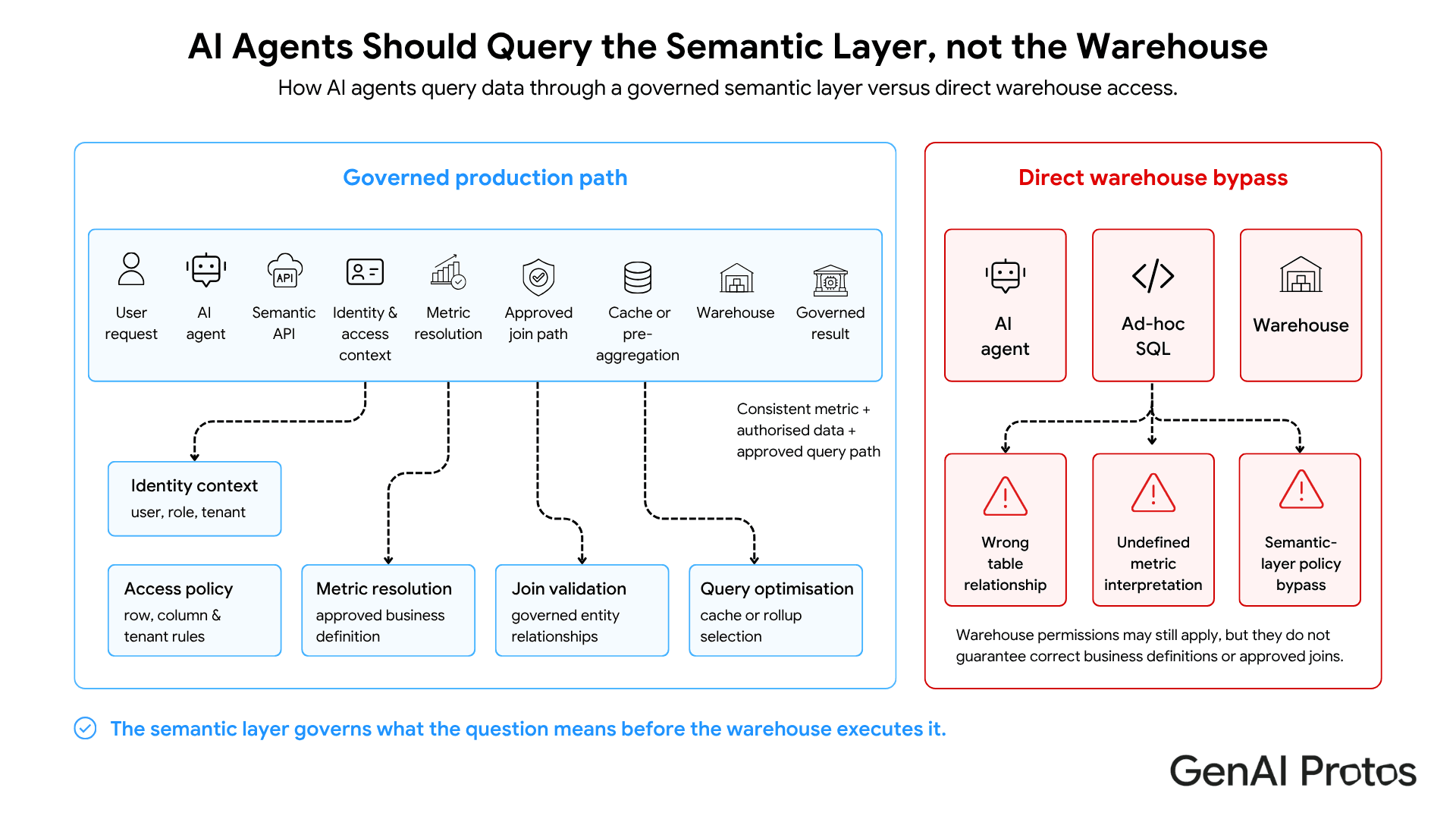
AI agents that query warehouse tables directly bypass the metric definitions, approved join paths and policies enforced only in the semantic layer. Database- and warehouse-level controls may still apply - identity controls, database permissions, row-level security and audit logging can all exist at the warehouse layer - but they do not ensure the agent uses the correct business definition or follows the approved query paths your data team defined.
A semantic layer addresses this by giving AI agents a governed query interface rather than a direct warehouse connection. The agent asks a business question. The governed data layer translates it into a validated, access-controlled query against the correct tables, applying the correct filters for the requesting user. The agent receives a governed answer, not a raw query result.
This architecture - AI agents querying through the semantic layer rather than around it - is the difference between an AI assistant that produces trustworthy outputs and one that occasionally returns plausible-looking wrong numbers.
For production agentic AI architectures that include the semantic layer, see the GenAI Protos Agentic AI Stack overview.
What an Enterprise Semantic Layer Must Provide
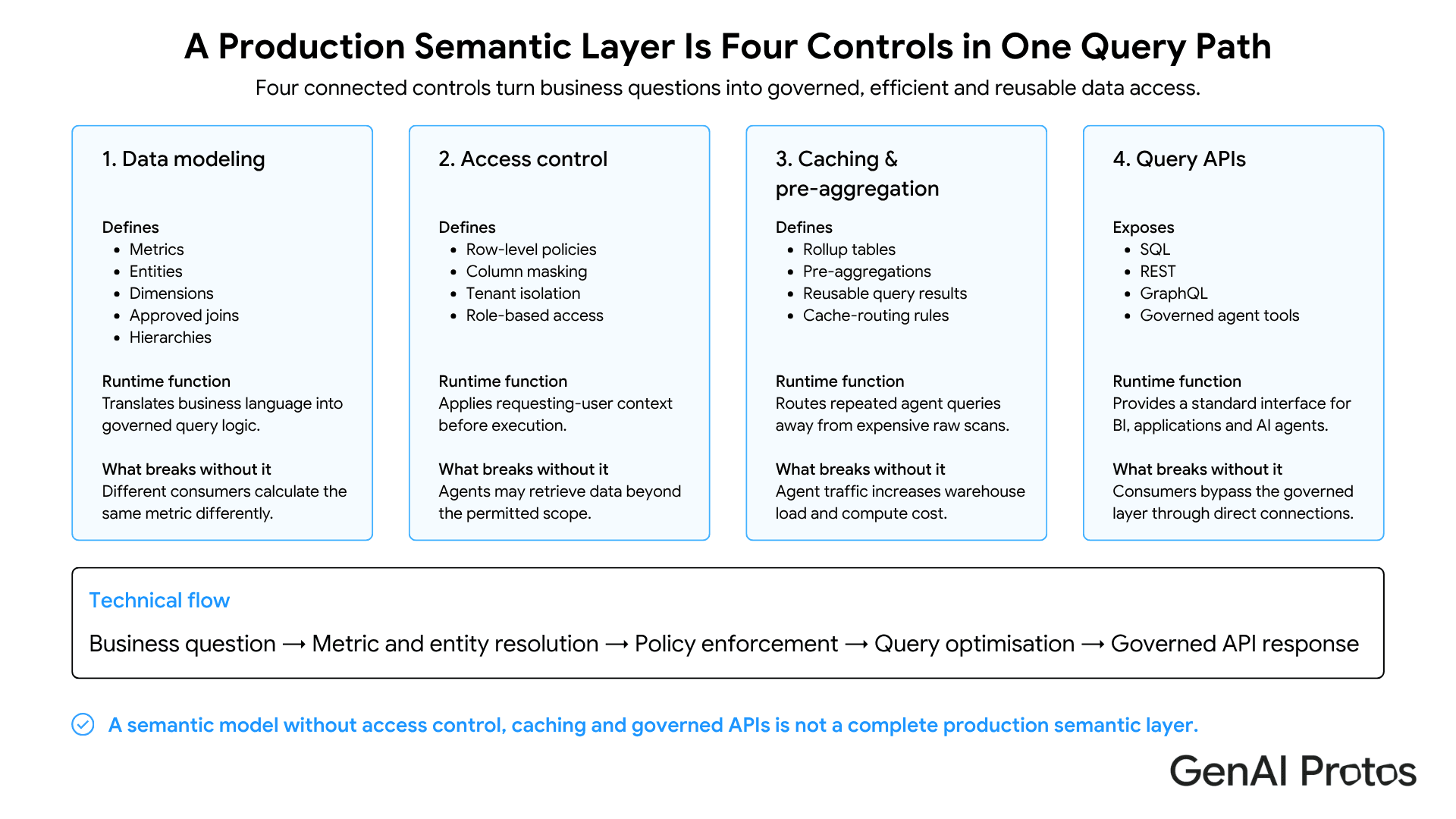
The four capabilities below form a practical evaluation framework. Platforms such as Cube present them explicitly as architecture pillars. Other implementations - including dbt Semantic Layer and Looker - cover the same capabilities but package them differently. Evaluate any platform against all four.
| Capability | What It Does | What Breaks Without It |
|---|---|---|
| Data modeling | Defines metrics, entities, joins as version-controlled code | Inconsistent metric definitions across consumers |
| Access control | Enforces row, column and tenant rules for every governed query | AI agents access data beyond their permission scope |
| Caching | Pre-aggregations route queries to rollup tables | Repeated agent queries increase warehouse load and may raise compute costs |
| Query APIs | SQL, REST, GraphQL interfaces for every consumer | Consumers bypass the governed layer via direct connections |
In code-first implementations such as Cube, dbt and Looker (LookML), data models and access policies can be version-controlled, reviewed and deployed through standard CI/CD workflows. AI tools can suggest model changes, but human review and automated validation must remain mandatory before any change reaches production. This discipline is not inherent to every semantic layer - it is a property of code-first products that choose to implement it.
Architecture reference: Cube Semantic Layer documentation covers this four-capability model in production detail.
For enterprises with strict data residency requirements, see GenAI Protos Private AI for deployment patterns that keep semantic layer infrastructure on your network.
Why Data Governance Must Live at the Semantic Layer
Data governance in most enterprises means a policy document and a quarterly review. In an agentic AI system, governance must be technical, automated and applied at the point of query. The semantic layer is where that enforcement can live.
Access policies can be defined once and applied consistently to every consumer that routes through the governed data layer. Row-level security, column masking and tenant-aware access rules run at the semantic layer before any query reaches the warehouse. Preventing direct warehouse bypass - by restricting direct-access credentials and enforcing the semantic interface for all consumers - is an identity, network and credential-management responsibility that sits alongside the semantic layer.
For regulated workloads, a semantic layer can serve as an effective central enforcement point for business definitions and data-access policies. It does not by itself establish GDPR, HIPAA or SOC 2 compliance. The wider architecture must also address identity management, encryption at rest and in transit, audit logging, data retention, infrastructure controls and operating procedures. The semantic layer is one component of a compliant architecture, not the whole of it.
Reference: dbt Semantic Layer documentation covers how centralised metric definitions and governed access apply across downstream consumers.
The Semantic Model as a Business Knowledge Map for AI
A semantic model can act as a business knowledge map for AI. It defines entities, relationships, metrics and hierarchies explicitly, giving agents a governed path through enterprise data. When an AI agent asks about top customers by lifetime value, the semantic model provides not just the metric but the full path to compute it - joining the correct tables through the correct business-defined relationships.
Some platforms use graph-like representations internally to express these entity relationships. However, a semantic layer is not necessarily a formal knowledge graph, and the two terms should not be used interchangeably. dbt expresses relationships through dimensional modeling and metric definitions. Looker uses LookML to define dimensions, calculations and joins. Neither requires a graph database or graph query engine.
What all of them share is an explicit, traversable map of your business's data relationships. That map is what separates an AI agent that produces governed answers from one that guesses at SQL joins.
For teams combining a semantic layer with retrieval-augmented generation, see GenAI Protos RAG Applications for architecture patterns.
Reference: Google LookML: What is LookML? covers how LookML defines dimensions, calculations and data relationships as a semantic model.
What Teams Get Wrong: Semantic Layer Edition
Treating the Semantic Layer as a BI Tool
The governed data layer is infrastructure, not an analytics product. It serves BI tools, embedded applications and AI agents from the same governed layer. Teams that deploy it only for dashboards leave their most important consumer - AI agents - querying around it with ungoverned SQL and undefined metrics.
Putting Access Control at the Application Layer
If access rules live only in the application sitting on top of your data, any consumer that connects to the warehouse directly will bypass them. Access control must be defined at the semantic layer, upstream of all consumers. This requires actively restricting direct-access credentials alongside deploying the semantic model - not just configuring rules in the platform.
Skipping Data Modeling and Going Straight to Agents
An AI agent that queries an ungoverned warehouse is a prototype, not a production system. It will fail when it encounters data inconsistency, joins the wrong table, or returns a metric no business team agrees on. Build the semantic data model first. The agents follow from that, not the reverse.
For multi-agent systems that route queries through governed data layers, see GenAI Protos Multi-Agent AI expertise.
Key Takeaways
- A semantic layer is the governed translation layer between raw data and AI agents - infrastructure, not an analytics tool.
- Without governed business definitions, AI agents bypass metric logic, approved joins and access policies, returning inconsistent or unauthorised results.
- Four capabilities to evaluate in any platform: data modeling, access control, caching and query APIs. Different vendors package them differently.
- Access policies defined at the semantic model apply to every consumer that routes through it. Preventing direct bypass is a separate identity and credential-management step.
- The semantic data model is the business knowledge map your agents use to understand your data. Build it before you build the agents.
- A governed data layer supports GDPR, HIPAA and SOC 2 compliance as one enforcement point. It does not replace identity, encryption, audit and retention controls.
Conclusion: Build the Governed Data Layer Before You Build the Agents
An AI agent is only as trustworthy as the data layer it queries. The semantic layer is what converts a powerful but ungoverned agent into a reliable enterprise tool. It defines the metrics, enforces the access rules, and gives every consumer a consistent view of the business. Build the semantic data model first. The right agents follow from that.


