
Your model ranks third on the MMLU leaderboard. In your internal customer service pilot, it hallucinates answers on 40% of product questions. The leaderboard was accurate. It just never tested product questions.
AI benchmarking for enterprise is not a leaderboard exercise. It is an engineering problem: how do you measure whether a model will work for your specific use case before you deploy it to production users? Most teams skip this step. They pick a model from an LLM leaderboard based on its highest LLM benchmark scores, run a demo, and ship. The production failure surfaces 90 days later in support tickets. This post covers three ai benchmarking patterns that enterprise teams use to catch failures before launch, the AI evaluation stack that replaces guesswork with measurement, and the model evaluation cadence that keeps your system honest as models update.
What LLM Benchmarks Actually Measure
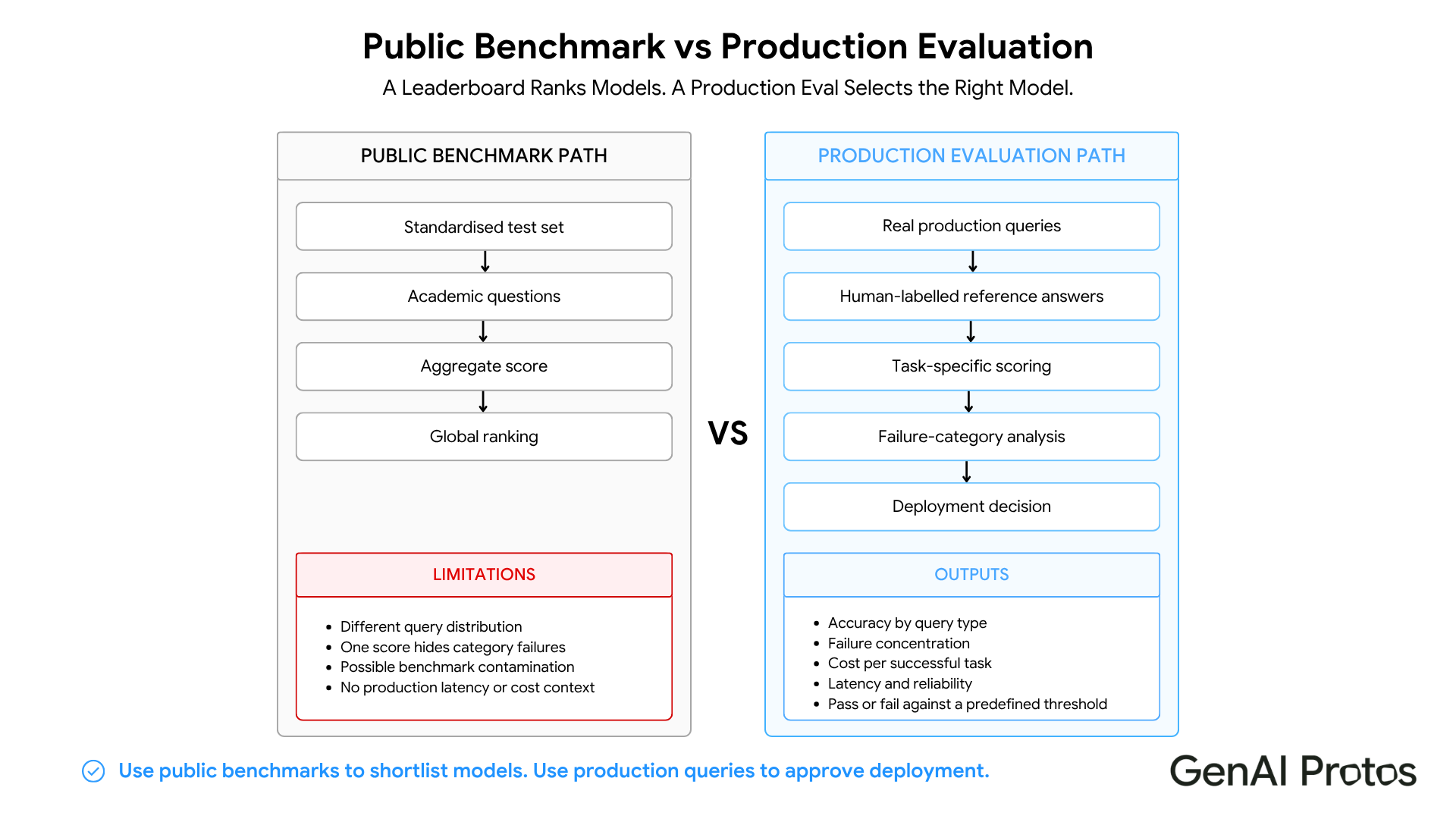
Each public LLM benchmark measures specific, narrow capabilities. MMLU tests 57 academic subjects including mathematics, law, and medicine. HellaSwag tests commonsense reasoning about physical events. HumanEval measures code generation on competitive programming problems. These are valid tests for what they measure. They are not valid proxies for your production use case.
The problem with using an LLM leaderboard as your primary evaluation tool is selection bias. Models score well by performing across all benchmarks. A model that ranks first does so by averaging well across all tasks, including tasks irrelevant to your deployment. The model that ranks fifth on the leaderboard might outperform the leader on your contract review task by 30 percentage points. You will not know unless you test it.
LLM benchmark contamination makes this worse. Several studies have documented that frontier models show elevated performance on benchmarks that were publicly available before their training cutoff. If the model has seen the test data, LLM benchmark scores inflate. The practical consequence: never use a vendor-published leaderboard score as your deployment decision. Use each LLM benchmark result for initial model shortlisting, then validate against your own data.
The LLM Leaderboard Problem in Production
Three factors break the relationship between leaderboard ranking and production performance.
Distribution shift
Your production queries come from real users with real intent and real informal language. Academic test sets come from researchers with carefully controlled phrasing. The vocabulary gap alone causes measurable performance drops. A model fine-tuned to excel on academic text often degrades on customer support tickets, internal Slack messages, or handwritten clinical notes.
Metric collapse
Leaderboards compress complex performance into a single aggregate score. You lose information about which query types fail, how variance behaves across runs, and where latency and cost trade-offs land. A model with average accuracy of 88% that fails consistently on one query category is worse than a model with 84% average accuracy that fails randomly.
Update invisibility
Frontier model providers update their models frequently and silently. GPT-4o, Claude, and Gemini all have versioned releases that change performance. A model evaluation you ran at deployment may no longer reflect model behavior 60 days later.
Three AI Evaluation Patterns That Work
Evaluation Pattern 1: The Golden Set. Build a dataset of 50 to 200 real production queries with correct, human-labeled answers. Run every candidate model against this golden set before deployment. Run it again on every model update. A golden set may begin with 50 to 200 carefully selected cases, but the required size depends on failure-category coverage, expected performance differences, risk level and the statistical confidence needed for the deployment decision. This is the foundation of any ai benchmarking practice for enterprise deployment. GenAI Protos uses this pattern across every LLM fine-tuning engagement.
Evaluation Pattern 2: LLM-as-Judge. Use a separately selected and validated judge model to score outputs of the model under test against a reference answer. LLM-as-judge scales model evaluation to thousands of queries without requiring human labeling of each output. Calibrate it first: run the judge against 50 human-labelled examples and measure agreement rate. Teams that skip calibration get a judge that scores writing quality rather than factual accuracy. Additional practices for reliable LLM-as-judge evaluation: use an explicit rubric for each evaluation dimension; randomise output order in pairwise comparisons; blind model identities; run repeated judging for high-impact decisions; measure agreement with qualified human reviewers; route judge-human disagreements for adjudication; and track the judge model version separately from the tested model. For RAG systems specifically, the GenAI Protos RAG evaluation harness guide covers retrieval-specific precision, recall, and context relevance scoring.
Evaluation Pattern 3: Behavioral Testing. Write test cases that target known failure modes in your domain. For a contract review agent: test for hallucinated clauses, missing jurisdiction carve-outs, and incorrectly flagged standard language. For a customer service agent: test for off-topic responses and brand voice violations. Behavioral tests cover the long tail that golden sets miss. Run them in the same CI/CD pipeline as your code tests.
GenAI Protos service: Use On-Demand AI Labs & Experimentation to compare models on controlled enterprise workloads before committing to a production architecture.
Building the AI Evaluation Stack
A production model evaluation stack has four components.
The golden set runs before every deployment and is the cornerstone of any ai benchmarking practice. Define your pass threshold before you see results. Teams that define thresholds after seeing results are not running an ai evaluation: they are rationalising a decision already made. Define task-specific acceptance thresholds before running the evaluation. High-risk categories may require substantially higher thresholds or zero tolerance for particular failures.
The LLM-as-judge layer runs on a sample of live production queries. Sampling rate should reflect production volume, risk tolerance and the sensitivity of the deployment. It catches regressions introduced by silent model updates without requiring human review of every output.
The regression baseline stores the last three production evaluation runs. Any new deployment should match or exceed baseline performance on the golden set.
The human review layer samples flagged outputs at a cadence matched to deployment risk and failure-pattern emergence rate. This layer calibrates the automated layers and catches failure patterns the automated systems miss.
Track these dimensions across every evaluation run: accuracy by use-case category, critical failure rate, safety and policy compliance, retrieval accuracy for RAG deployments, tool-call success rate for agents, latency, cost per successful task, response consistency, human escalation rate, and confidence intervals across all metrics. A single aggregate pass rate can hide an unacceptable failure cluster in a high-risk category. A system achieving 95% overall accuracy may still fail 40% of queries in one regulated product category.
Model Evaluation Cadence
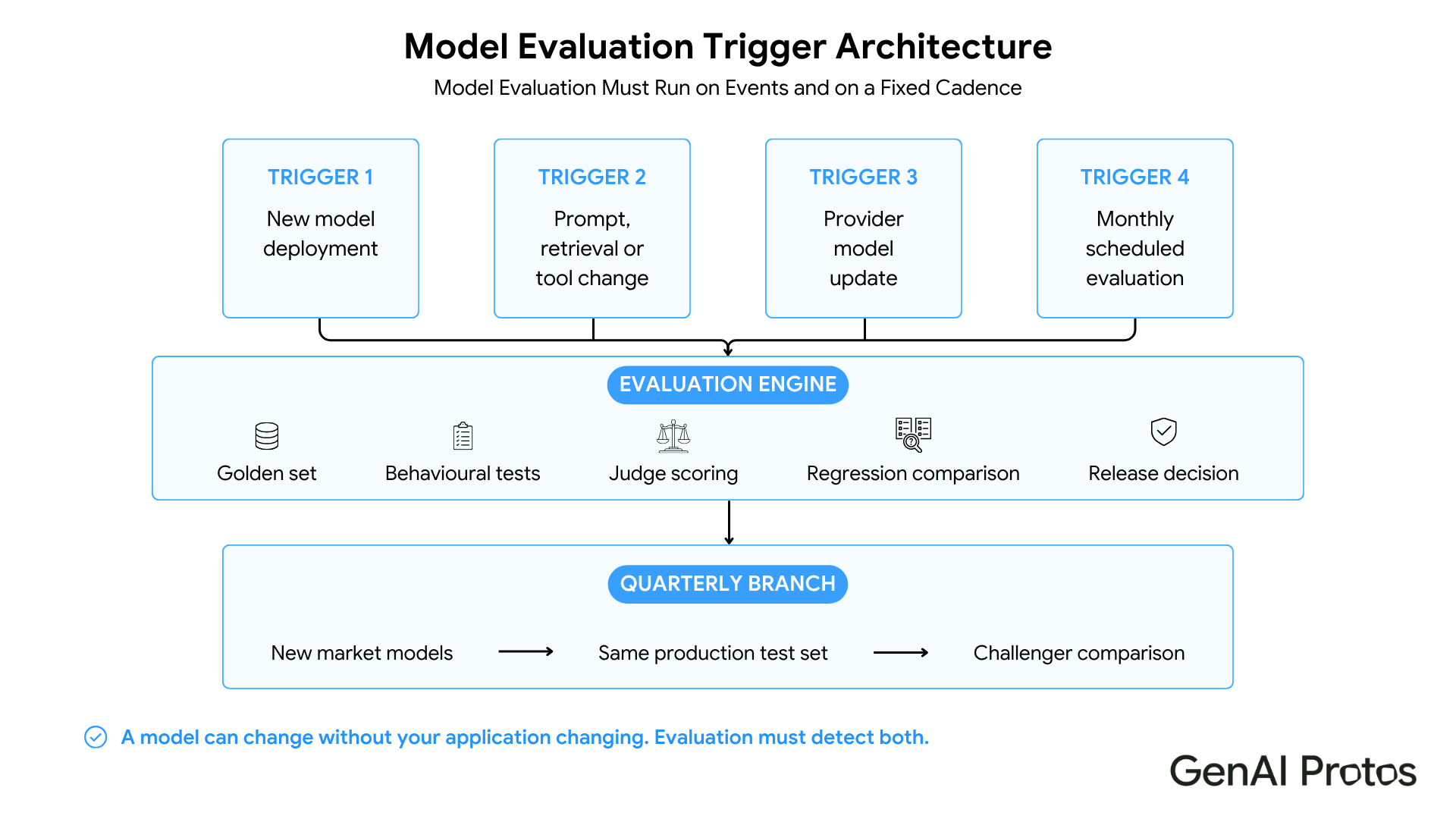
Run your golden set evaluation on four triggers: before initial deployment, before any model upgrade, when the provider announces a model update, and on a recurring schedule whose frequency reflects your deployment's risk level and rate of change.
Evaluation staleness is the main risk. Your evaluation results can become outdated when a provider updates a moving model alias, when you adopt a new model snapshot, or when the surrounding prompt, retrieval, tooling or policy configuration changes. Evaluation cadence should be determined by production volume, failure severity and the frequency of model or system changes - not a single universal interval.
For comparing new market entrants against your current deployment, run a structured comparison whenever a model change is under consideration, balancing evaluation cost against the potential performance gain. The GenAI Protos enterprise AI model deployment guide covers how model versioning fits into a complete production AI strategy.
Relevant evaluation guide: Explore the RAG Evaluation Harness for retrieval relevance, faithfulness and regression checks that support production evaluation.
What Teams Get Wrong With AI Benchmarking
The most common mistake: running evaluation only once at launch. Performance degrades as models update, user queries evolve, and data distribution shifts. One-time ai benchmarking is not a practice. It is a launch gate that stops working on day two.
The second mistake: using vendor-published benchmark scores as your ai benchmarking substitute. These scores are real but they measure academic distributions. No single LLM benchmark score substitutes for a golden set built from your actual production queries.
The third mistake: setting thresholds after seeing results. Set the pass rate minimum before you run the eval. An 87% result against a retroactively set 85% bar tells you nothing about model quality. It tells you about your willingness to rationalize.
Key Takeaways
- Public LLM benchmarks measure academic capabilities, not your production use case.
- Golden set size should be determined by workload risk, query diversity, failure severity and the statistical confidence required for your deployment decision.
- LLM-as-judge scales evaluation to thousands of queries. Calibrate it against human-labeled examples before trusting it - the number required depends on the task and required confidence level.
- Run evaluation on four triggers: deployment, upgrade, provider update, and a recurring cadence whose frequency reflects the deployment's risk level and rate of change.
- Define pass rate thresholds before you see results.
- Behavioral testing covers failure modes that golden sets miss.
Conclusion
Enterprise AI benchmarking creates value when it reflects real workloads and remains active after deployment. GenAI Protos helps teams connect model evaluation, release gates, cost and risk controls in one measurable operating framework.


