
The demo query is: "What were our top 10 customers by revenue last quarter?" The text tosql system generates perfect SQL. The stakeholders are impressed. You move to production. The first real analyst query is: "How does our net revenue retention compare to last year for customers who upgraded their plan but still have an outstanding support ticket?" The query fails. The generated SQL joins the wrong tables and double-counts revenue.
Natural language to SQL translation is one of the highest-value AI applications for enterprise data teams. It is also one of the most brittle when the gap between demo schema and production schema is 50 tables wide. This post is a diagnosis of where NL2SQL systems fail in production, a technical breakdown of the SQL AI architecture choices that determine failure rate, and an honest assessment of what "natural language SQL" can and cannot handle on real enterprise databases.
Why the Demo Works and Production Breaks
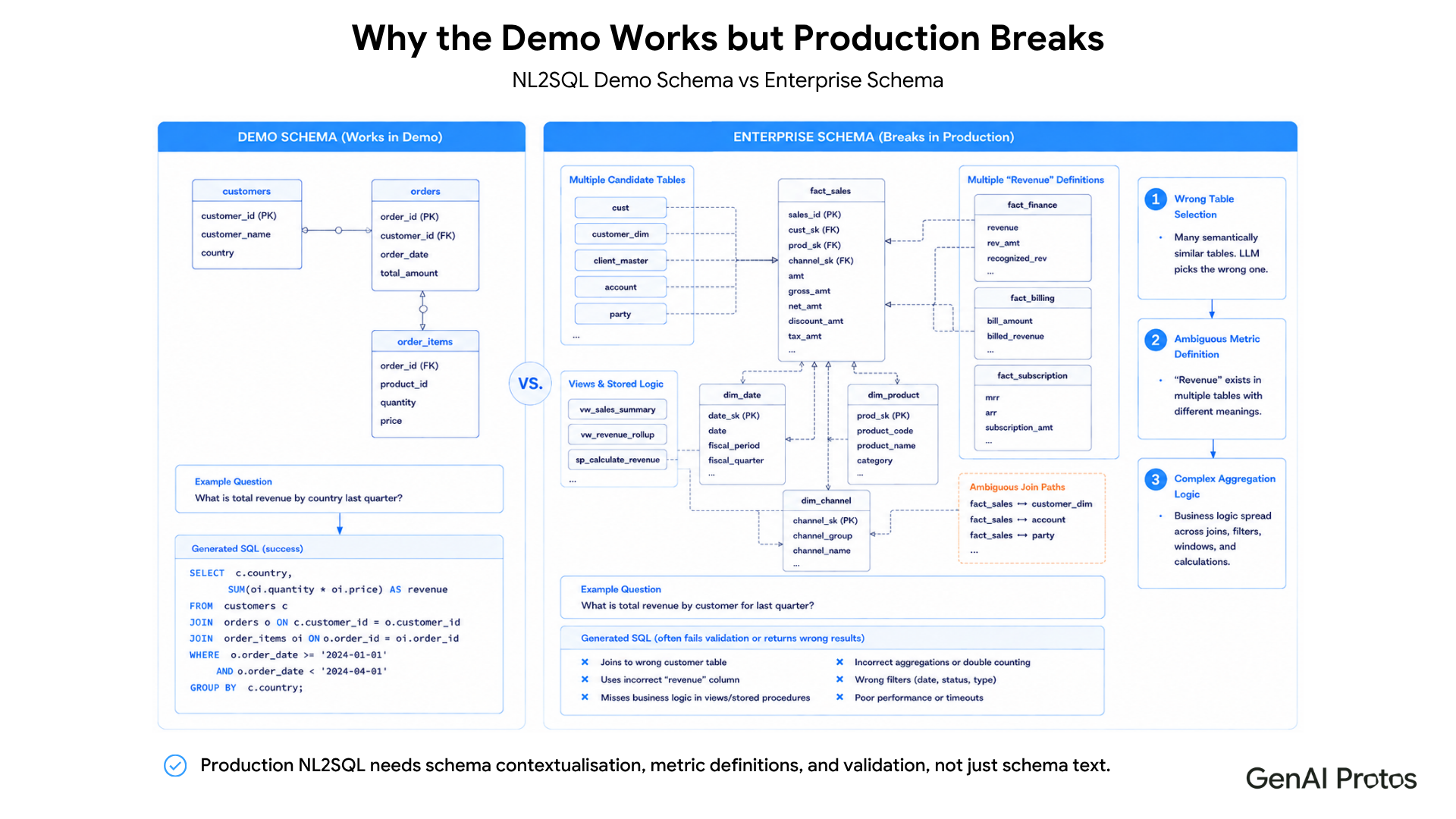
Text tosql demos use schemas with 3 to 10 tables, clean column names, no naming ambiguities, and queries that join at most two or three tables. The language model generates correct SQL because the schema is small enough to fit in the context window, column names are semantically obvious (customer_name, order_date, total_revenue), and the query maps cleanly to one or two joins.
Production enterprise schemas are different on every dimension. A mid-sized enterprise ERP has 200 to 800 tables. Column names are abbreviated legacy codes (CUST_NO, REV_AMT_QTR, TXN_DT_EFF). Business logic is encoded in views, stored procedures, and data warehouse transformations that the raw schema does not expose. "Revenue" might mean different things in four different tables depending on whether it is booked revenue, recognized revenue, net of returns, or gross of discounts. The GenAI Protos guide to GenAI on existing data platforms examines why this semantic ambiguity affects every AI data application, not just NL2SQL.
Three failure modes consistently dominate natural language SQL production deployments.
Failure Mode 1: Wrong table selection. When the schema has 200 tables and the user asks about "orders," the model must choose between orders, order_header, order_line, order_summary, order_facts, and order_staging. On the correct schema, the right answer is context-dependent: order_facts is the reporting table, order_staging should never be queried for business analysis. The model has no way to know this from schema metadata alone.
Failure Mode 2: Ambiguous metric definitions. "Revenue" has 4 definitions. "Active customers" has 3. "Last quarter" is unclear when the fiscal year is non-standard. The model picks one definition based on column name proximity. Without business metadata context, it picks the wrong one for a significant proportion of queries involving these ambiguous metrics.
Failure Mode 3: Complex aggregation logic. Queries involving net revenue retention, cohort analysis, time-series comparisons, or multi-step filters with different conditions at each step require SQL patterns (CTEs, window functions, subqueries) that the model generates incorrectly at significantly higher rates than simple aggregations. The Spider benchmark shows state-of-the-art models achieving 85%+ on simple queries and dropping to 60 to 70% on complex multi-hop queries.
Explore our data engineering service: AI Data Engineering Services helps teams curate schema metadata, semantic definitions and secure query pipelines for enterprise NL2SQL.
The NL2SQL Architecture Stack That Reduces Production Failure Rate
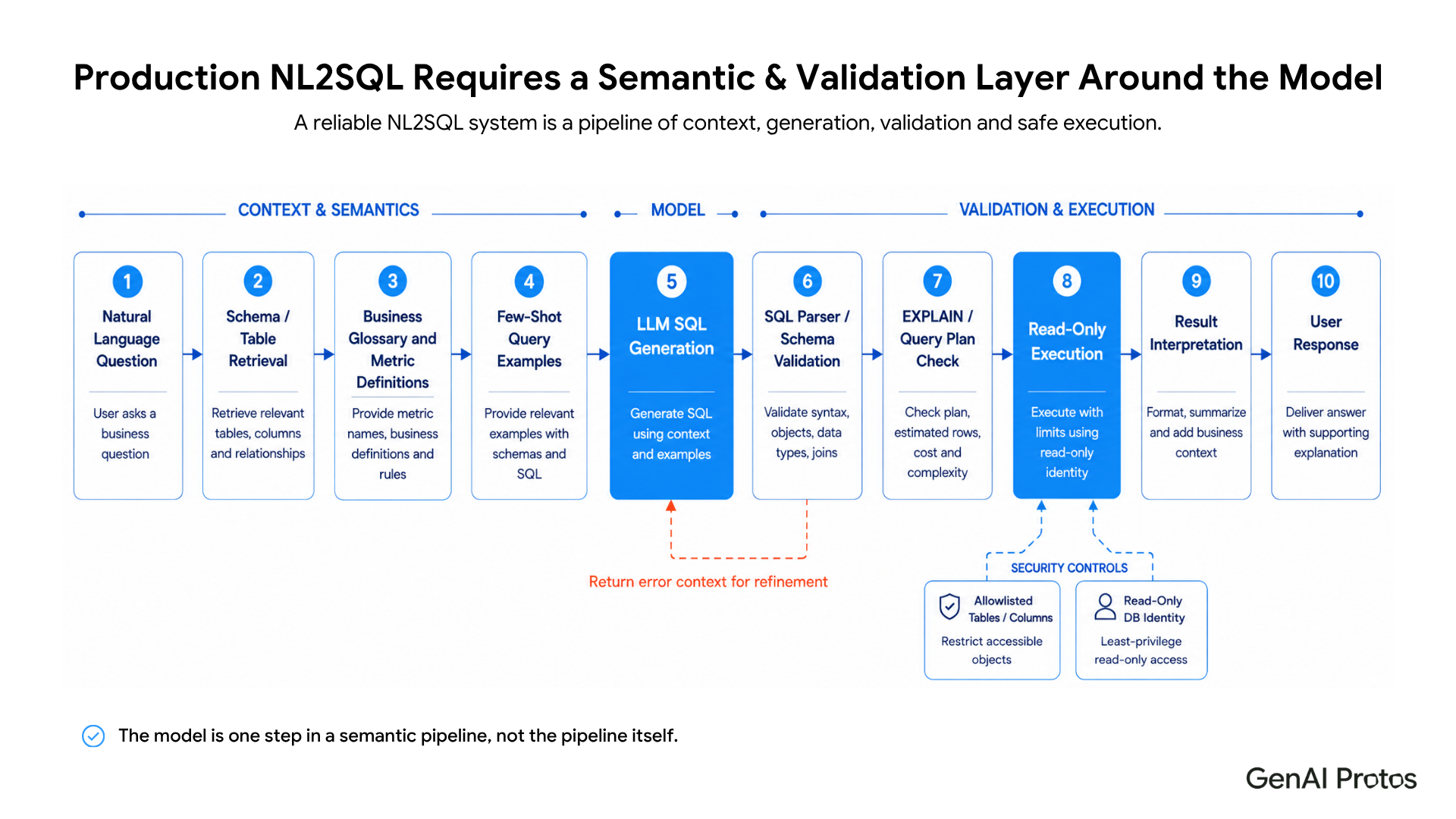
Component 1: Schema contextualization with business metadata.
The model cannot generate correct SQL from raw schema alone. It needs business context: which tables are used for what, what metrics mean, which joins are correct, which tables to avoid. This context is provided through a schema representation layer that combines table names and column names with business metadata annotations.
The implementation: a curated schema metadata layer that stores for each table -- purpose, primary use cases, which tables it joins to, and any metric definitions relevant to that table. This metadata is injected into the model's context alongside the schema before the user's query is processed.
The Chat with SQL solution GenAI Protos deploys includes a schema metadata layer that is populated collaboratively with the data team during onboarding. Setup time depends on schema size, documentation availability and how well-defined business metrics already are. Without it, production accuracy on enterprise schemas is substantially lower than demo performance. With it, accuracy improves significantly. In GenAI Protos deployments, the metadata layer has moved accuracy from the 40-55% range to the 70-85% range for standard business queries; results vary by schema complexity and query type. These figures reflect execution accuracy on standard business queries evaluated against human-validated reference answers; they are not benchmark numbers and should not be extrapolated to schemas with different complexity, data models or query distributions. Methodology: mid-complexity enterprise schemas, query sets of standard business report types, model versions current at evaluation date, execution accuracy (query runs and returns results) and business-answer accuracy (result matches expected output) measured separately.
Component 2: Query verification before execution.
Generated SQL should not execute immediately on user query. Insert a verification step: parse the generated SQL for syntax errors, validate that the referenced tables and columns exist in the schema, check that the query plan does not scan tables with more than N rows without a limiting clause. These checks catch a meaningful proportion of invalid queries before they hit the database.
For production systems, add a dry-run step before returning results: validate that the query executes without error using a database-appropriate technique - `EXPLAIN` or query plan analysis for most databases, warehouse-specific dry-run APIs for cloud data warehouses such as BigQuery's dry run mode, cost and row estimate controls, or a test execution with result-set limiting. Simple result limiting alone is insufficient for some query types and may not catch scan or permission errors. A query that errors on the dry-run triggers a retry with additional error context injected. Enterprise SQL AI implementations should also enforce a read-only database identity for the query execution service (the NL2SQL layer should never have write or DDL privileges), an allowlist of tables and columns the query layer is permitted to access, and an audit log of all generated and executed queries for traceability. The AI Data Engineering Services team at GenAI Protos handles schema metadata curation, security controls, and pipeline setup for enterprise NL2SQL implementations.
Component 3: Iterative SQL refinement.
When the initial query fails verification or execution, feed the error back to the model with the original query and the error message, and request a corrected query. This iterative refinement loop handles cases where the first generation has a correctable syntax error or uses the wrong column name. Two to three refinement iterations recover a significant portion of initially failed queries in practice.
Component 4: Natural language SQL result interpretation.
The output of a natural language SQL system should not be a raw SQL result set. It should be a structured natural language interpretation of the result: what the numbers mean, any caveats about the data, and whether the result looks anomalous. A result that returns 0 rows might mean the query is correct and there is no matching data, or it might mean the wrong table was queried. The interpretation layer surfaces these distinctions.
What "AI SQL Query" Can Handle Reliably in 2026
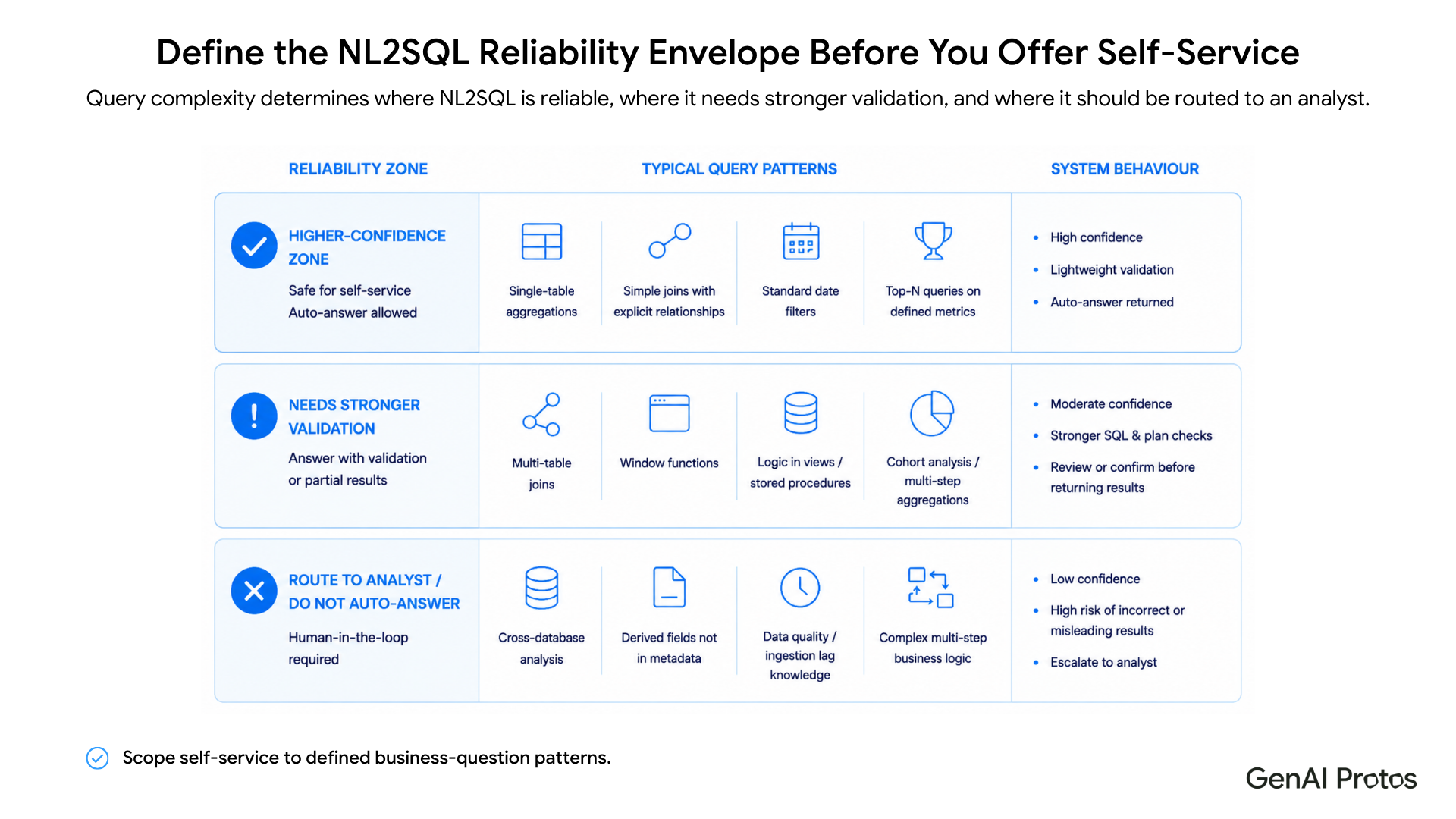
The practical reliability ceiling for any AI SQL query system depends on schema complexity and metadata quality. Reliably (> 80% accuracy on production schemas with metadata layer)
- Single-table aggregations with clear metric definitions
- Simple two-table joins with explicit foreign key relationships
- Date-range filtering with standard fiscal calendar definitions
- Top-N rankings on defined metrics
With higher failure rate (60 to 75%):
- Three or more table joins
- Window functions for running totals and period comparisons
- Queries requiring business logic encoded in views or stored procedures
- Cohort analysis and multi-step filtered aggregations
Not reliable (< 60%):
- Queries that require understanding of derived or calculated fields not in the raw schema
- Multi-step analytical queries with different filter conditions at each step
- Cross-database queries
- Queries requiring knowledge of data quality issues or ingestion lag
Relevant solution: Chat with SQL shows how GenAI Protos combines natural-language querying with schema context, verification and controlled database access.
WhatsApp SQL: Conversational Interface for Non-Technical Users
The WhatsApp SQL solution extends natural language SQL access to non-technical business users through a messaging interface. The architecture is identical to Chat with SQL but the interface is a WhatsApp chatbot. A sales manager asks "how many deals did we close in Q2 by rep?" and receives an answer with the numbers, without needing to know SQL or access the BI tool.
This use case works because the query distribution from non-technical users is narrower: they ask about metrics they already track, in terms they already use. The schema metadata layer is built around the most common business queries for that team's actual use patterns - typically a manageable set of priority metrics that cover the majority of day-to-day analytical needs. Within that distribution, the text tosql accuracy is high enough for production use.
The WhatsApp interface also enables the multi-turn conversational pattern that catches a significant class of errors: when the AI produces an unexpected result, the user naturally asks a follow-up question ("that doesn't look right, can you show me by month?"). The follow-up query often produces a corrected analysis.
Key Takeaways
- SQL AI demos use small, clean schemas. Production schemas have 200+ tables, ambiguous column names, and business logic not in the schema.
- Three failure modes dominate production failures: wrong table selection, ambiguous metric definitions, and complex aggregation logic.
- Schema contextualization with business metadata is the highest-impact component. In GenAI Protos deployments it has moved accuracy from the 40-55% range to the 70-85% range; results vary by schema complexity.
- Query verification before execution catches a meaningful proportion of invalid queries before they hit the database.
- Iterative SQL refinement recovers a significant portion of initially failed queries through error feedback loops.
Conclusion
NL2SQL succeeds when the model receives business semantics, validated schema context and safe execution controls. GenAI Protos combines data engineering and AI orchestration to make natural-language querying useful on real enterprise schemas rather than only on curated demos.


