
Your legal team signed off on the AI assistant. Three months after launch, a compliance analyst forwarded a screenshot: the system cited a regulation that does not exist. The confidence in the AI-generated response was indistinguishable from the accurate answers. You need an AI fact checker in the pipeline before the next audit, not after it.
LLM hallucination in enterprise deployments is a systems engineering problem, not a prompt engineering problem. Better prompts reduce hallucination frequency. They do not eliminate it. A grounded, production-grade enterprise AI system needs a verification layer that checks LLM output against source evidence before delivery.
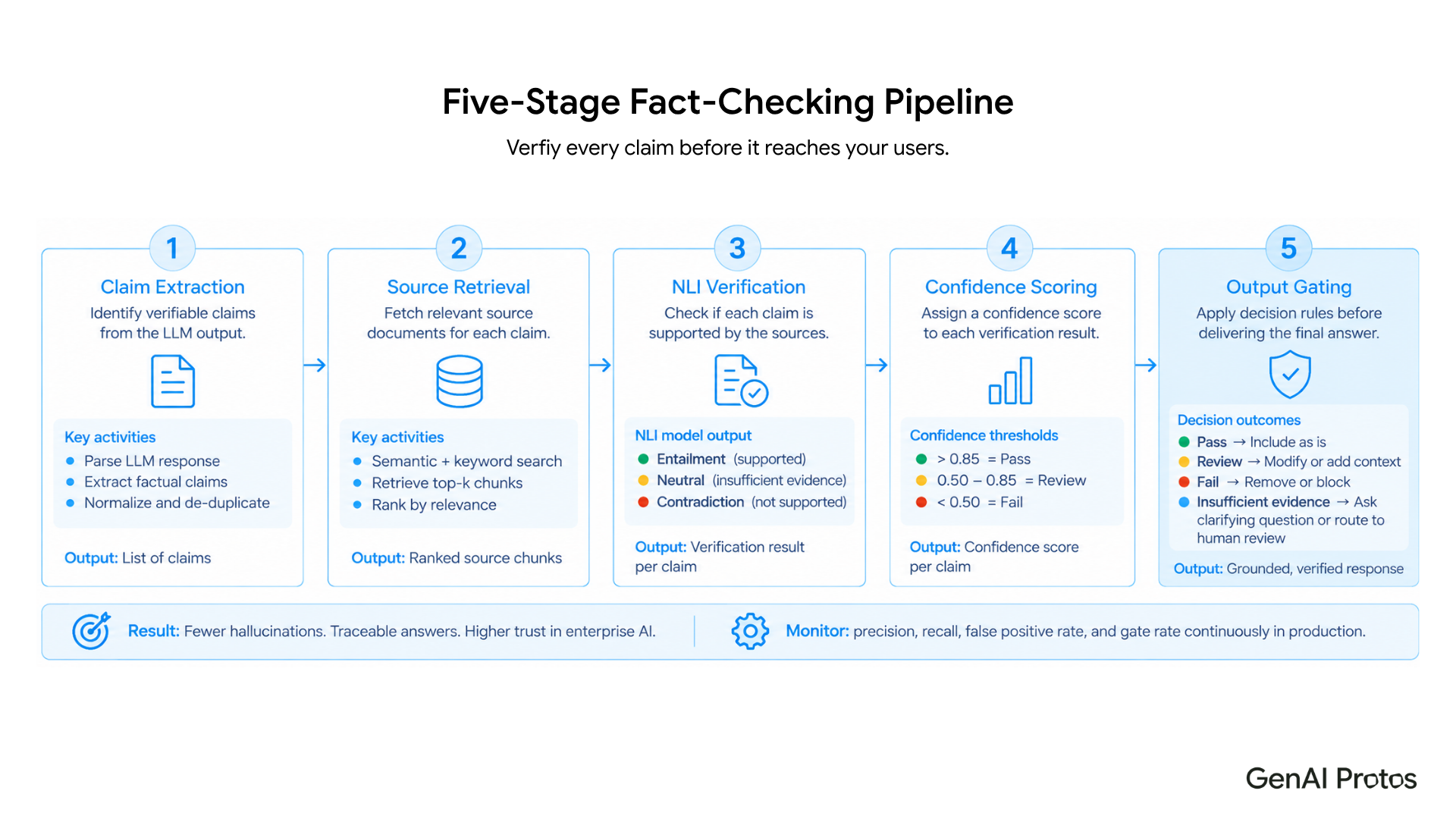
This guide introduces the five-stage Natural Language Inference pipeline for AI fact checking: Claim Extraction, Source Retrieval, NLI Verification, Confidence Scoring, and Output Gating. Each stage is defined with its model architecture requirements, failure modes, and production integration points.
Why Prompt Engineering Alone Does Not Solve Hallucination
Prompt-level guardrails reduce hallucination frequency by instructing the model to acknowledge uncertainty and limit its responses to the provided context. They do not provide a mechanism for verifying whether a specific claim in the generated output is supported by source evidence. The model still generates; it just generates with instructions to be more cautious.
For use cases where a fabricated regulatory citation, an incorrect financial figure, or an invented policy reference carries legal or compliance risk, caution in generation is not sufficient. The system needs a post-generation stage that extracts specific claims, retrieves relevant source evidence, and verifies each claim against that evidence before the output reaches the user.
Stage 1: Claim Extraction
The fact-checking pipeline begins after the LLM generates its response. A claim extraction model parses the generated text and identifies factual assertions: specific entities, dates, regulatory references, numerical figures, and causal relationships. Each identified claim is extracted as a discrete unit for independent verification.
Claim extraction models are typically fine-tuned on domain-specific labeled datasets. A financial services deployment fine-tunes on financial regulatory text. A healthcare deployment fine-tunes on clinical and regulatory documentation. Generic claim extraction performs below domain-specific models on specialized enterprise content.
Stage 2: Source Retrieval
For each extracted claim, the pipeline retrieves the most relevant source documents or passages from the knowledge base. Retrieval uses the claim text as the query, applying the same retrieval system used by the LLM in generation. The critical requirement is that the source set for verification is determined by the claim content, not by the original user query.
Stage 3: NLI Verification
A cross-encoder NLI model evaluates each claim-source pair. The model takes the retrieved source passage as the premise and the extracted claim as the hypothesis, and predicts entailment, neutral, or contradiction. NVIDIA NeMo Guardrails for LLM application safety controls provides tooling for integrating verification controls into LLM inference pipelines.
Models fine-tuned on MultiNLI or FEVER datasets provide a starting baseline. For domain-specific enterprise deployments, fine-tune on labeled claim-source pairs from your own document corpus. Inference latency depends on model size and the number of claim-source pairs evaluated per response.
Stanford HELM: Holistic Evaluation of Language Models benchmark suite provides evaluation methodology for measuring NLI model performance across domain-specific tasks.
Stage 4: Confidence Scoring
The confidence scorer aggregates the NLI model outputs across all claim-source pairs for a given response. Each claim receives a verification status: supported, unsupported, or contradicted. The aggregate confidence score reflects the overall level of source grounding across the full response.
There is no universal confidence threshold. The appropriate cutoff depends on the consequences of delivering an unverified claim in your specific use case. Calibrate against a labeled evaluation set that includes both verified and fabricated claims from your domain. Bias toward higher thresholds for high-stakes outputs even if it increases the rate of blocked responses.
Stage 5: Output Gating
The Output Gating stage makes the delivery decision: pass the response to the user, flag it for review, modify it by removing unverified claims, or block it. The decision logic is rule-based, configured at deployment based on the use case risk profile.
Grounded AI agents with verifiable output for enterprise covers the broader architecture for grounded enterprise AI systems where output verification is a first-class requirement.
Build a Production AI Fact Checker with GenAI Protos
GenAI Protos engineers NLI-based hallucination reduction pipelines and grounded AI systems for enterprise deployments where output accuracy is non-negotiable.
Contact UsWhat the Pipeline Should Do When Verification Fails
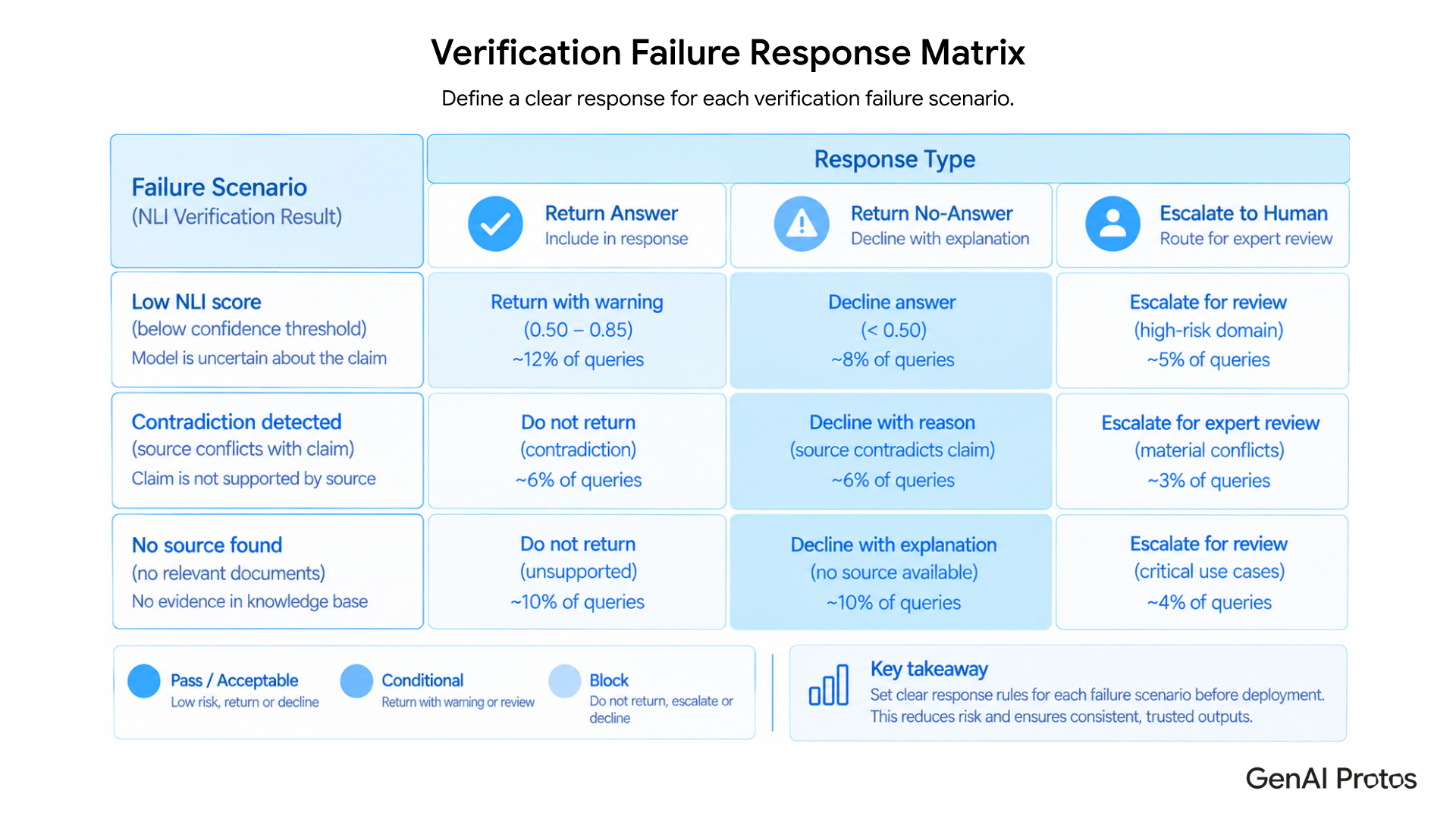
Verification failure is not a binary event. The pipeline needs a defined set of approved outcomes for different failure modes, matched to the risk profile of the use case:
Show a grounded partial answer with citations:
For responses where some claims are supported and others are not, the pipeline can deliver the verified claims with explicit source citations and omit or flag the unsupported claims. This is appropriate for informational use cases where partial answers are more useful than no answer.
Ask a clarifying question:
When retrieved source evidence is insufficient to verify claims because the query was ambiguous or too broad, the pipeline can return a clarifying question to the user before attempting synthesis again with narrower scope.
Return a safe "insufficient evidence" response:
When the verified source set cannot support any answer to the query, return an explicit "insufficient evidence" response that directs the user to human review or additional sources. This is preferable to a blocked response with no explanation.
Route for human review:
For high-value queries where an unverified answer carries significant business risk, route the response to a subject-matter reviewer before delivery. The pipeline delivers the generated answer and the verification report to the reviewer, not directly to the end user.
Block the response for high-risk use cases:
In regulated deployments where an unverified output carries legal or compliance liability, the appropriate action is to block the response entirely when the confidence score falls below the threshold. Log the blocked query and the verification failure for audit.
Define the approved outcomes for your use case at deployment. Do not make verification failure handling an ad hoc decision after the first failure reaches a user.
Production Deployment Considerations
LLM observability: monitoring beyond CPU and memory metrics covers the monitoring layer. For the fact-checking pipeline, track four production metrics: precision (what fraction of blocked claims were actually unsupported), recall (what fraction of unsupported claims were correctly blocked), false positive rate (what fraction of supported claims were incorrectly blocked), and gate rate (what fraction of total responses required at least one claim modification or block).
NLI verification adds latency proportional to the number of extracted claims and the size of the source chunk set. For real-time applications with strict latency budgets, run claim extraction and NLI verification in parallel across claims, use a smaller distilled NLI model, or apply verification only to high-risk claim categories rather than all extracted claims.
What Teams Get Wrong
The most common mistake is treating hallucination reduction as a solved problem after deploying the pipeline. Hallucination rates change as the LLM model updates, as the document corpus changes, and as query patterns evolve. Monitor verification metrics continuously and recalibrate confidence thresholds when precision or recall degrades.
The second mistake is calibrating the confidence threshold against a generic benchmark dataset rather than against domain-specific claim-source pairs from your production environment. Benchmarks do not represent your actual document corpus or the specific failure modes in your deployment.
Key Takeaways
- LLM hallucination is a systems engineering problem. The five-stage NLI pipeline addresses it at the output verification layer, not at the prompt layer.
- The pipeline: Claim Extraction, Source Retrieval, NLI Verification, Confidence Scoring, Output Gating.
- Define approved failure outcomes (partial answer, clarify, insufficient evidence, human review, block) before deployment.
- Calibrate confidence thresholds against domain-specific claim-source pairs, not generic benchmarks.
- Monitor precision, recall, false positive rate, and gate rate continuously in production.
Conclusion
The goal of an AI fact-checking pipeline is not to eliminate hallucination entirely. It is to reduce the risk that an unverified claim reaches a user in a context where it carries compliance, legal, or business consequences. Define the acceptable verification threshold for your use case, implement the pipeline against that threshold, and monitor the metrics that tell you whether it is holding. That is the production standard for grounded enterprise AI output.


