
Traditional software testing assumes deterministic behavior. Input A produces output B, always. LLMs produce probabilistic outputs. The same prompt on two consecutive calls can produce two different answers, both syntactically valid, one factually wrong. Softwaretestingai requires a different mental model, different tooling, and a different relationship with the concept of "passing" a test. This post covers the three reasons conventional QA fails on LLMs, the llm testing stack that addresses each failure, and the ai quality assurance cadence that keeps deployed systems from degrading silently.
Reason 1: QA Fails Because Output Correctness Is Not Binary
A unit test for a sort function checks whether the output is sorted. The output either is or is not sorted. There is no partial credit. LLM output correctness exists on a spectrum: factually accurate but poorly formatted, correctly formatted but missing a critical clause, on-topic but confidently wrong on one detail.
Traditional ai testing approaches try to force LLM outputs into pass/fail by matching exact strings or checking for keyword presence. These tests either over-constrain (failing on valid paraphrases) or under-constrain (passing outputs that contain the right words in the wrong context). The result is a test suite that produces false positives and false negatives at rates that make it useless for production quality gates.
The fix: grade LLM outputs on a rubric, not a binary condition. Define what a correct output looks like across multiple dimensions: factual accuracy, format compliance, completeness, tone, length. Score each dimension separately. Set pass thresholds per dimension. A contract summary that scores 100% on factual accuracy and 40% on format compliance is a different problem than one that scores 40% on factual accuracy and 100% on format.
Reason 2: QA Fails Because Test Coverage Assumptions Do Not Transfer
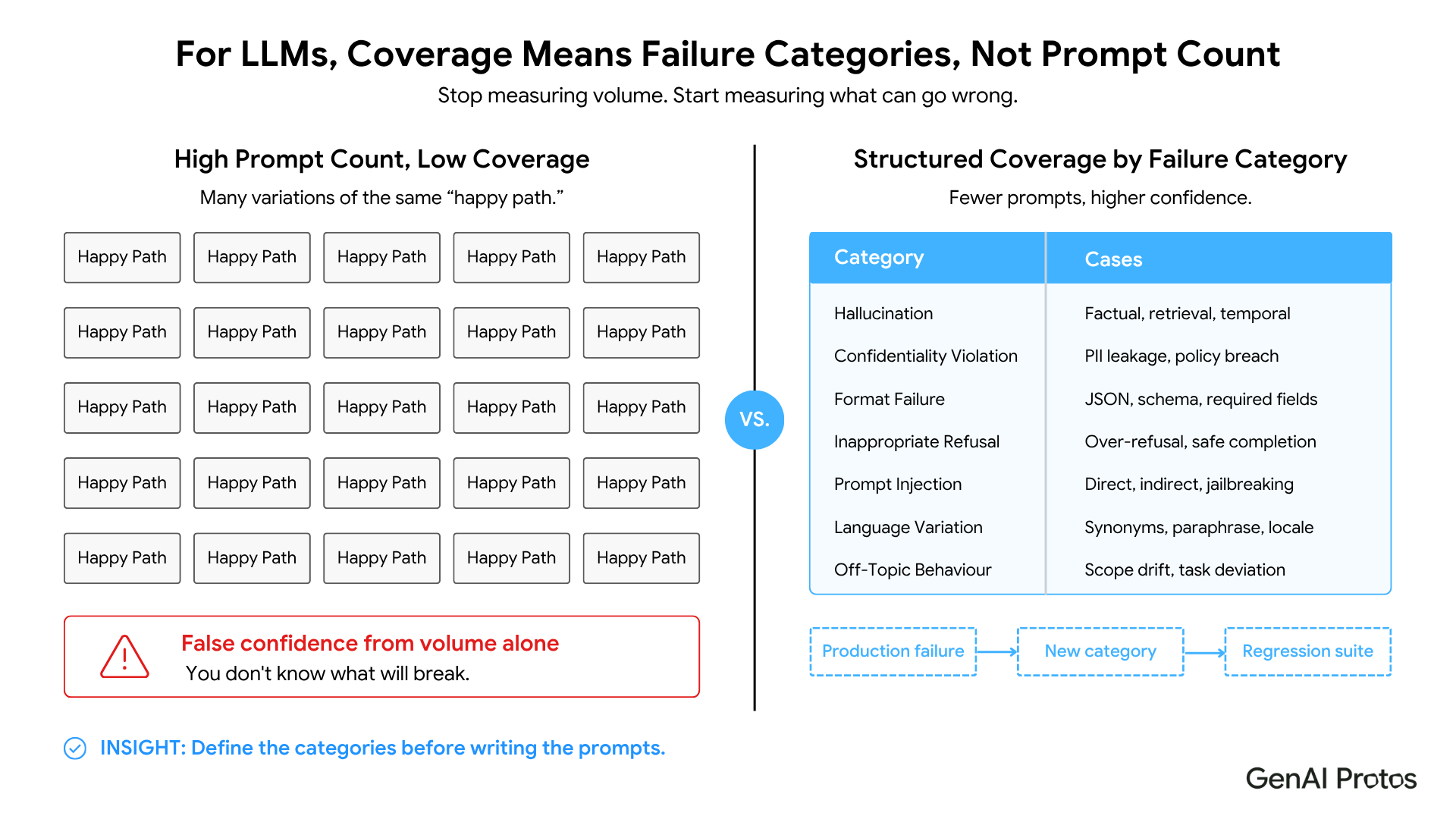
In softwaretestingai , 80% code coverage is a meaningful signal. In llm testing, "80% coverage" has no equivalent. There is no finite set of inputs. The input space is all possible natural language prompts, which is unbounded.
Teams apply software testing intuitions and write 50 example prompts. These 50 examples cover the happy path scenarios the team can think of. Production surfaces the edge cases they did not think of: adversarial inputs, dialect-specific phrasing, out-of-domain queries, compound questions that mix two task types, inputs with intentional typos, inputs in a language other than English.
The fix: cover failure categories, not input examples. Instead of writing 50 example prompts, define a set of failure categories relevant to your deployment, then write multiple test cases per category. For a customer service LLM: hallucinated pricing, confidentiality violations, off-brand tone, refusal on valid requests, false certainty on unknown facts, competitor mentions, language switching. This structure gives you a targeted test set that covers the failure modes that matter, rather than a set weighted toward the inputs that were easiest to think of.
Reason 3: QA Fails Because LLMs Have No Stable Behavior Over Time
Software functions behave identically until a developer changes the code. That change is tracked in version control. LLMs from hosted providers update silently and frequently. The model you evaluated at deployment may not be the model running in production 60 days later.
Most ai quality assurance practices test at deployment and assume stable behavior until the next deployment. This assumption is false for hosted LLM providers. GPT-4o, Claude, and Gemini all have continuous update cycles. A monthly silent update can change output format, verbosity, refusal thresholds, or factual recall without any action from your team.
The fix: run your test suite on a schedule, not just on deployment. How frequently depends on how often the model or surrounding system changes, the risk level of the deployment, and the cost of letting a regression go undetected. Alert on any metric that drops significantly between runs without a corresponding deployment event - the threshold should reflect the acceptable level of quality variance for your use case.
Explore our experimentation service: On-Demand AI Labs & Experimentation helps teams test models, prompts and workflows against defined quality gates before scale-up.
The LLM Testing Stack: What to Actually Build
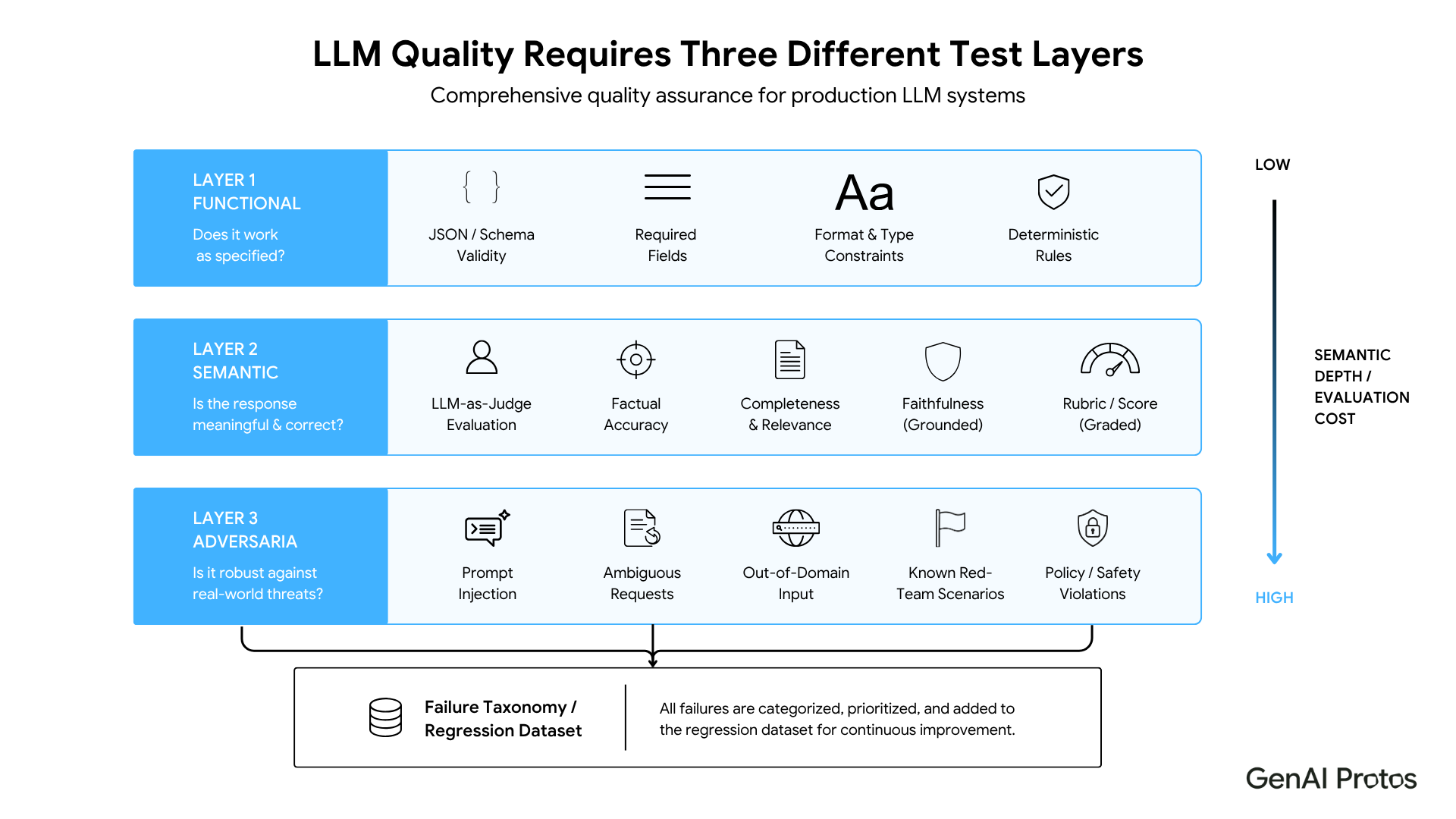
Layer 1: Functional tests with rubric scoring
These are deterministic checks on LLM output structure and content. Does the response include the required fields? Does the JSON parse? Is the response under the maximum character limit? Is the mandatory disclaimer present? These tests are easy to write and catch a high proportion of production failures. Use pytest for the test runner and write assertions against parsed output, not raw strings.
Layer 2: LLM-as-judge semantic evaluation.
Use a capable model to assess outputs against a reference rubric. Each test case has a prompt, expected behavior criteria, and an LLM judge that scores the actual output against those criteria. This layer catches semantic failures that Layer 1 misses: correct structure but wrong content, present disclaimer but wrong disclaimer, valid format but hallucinated fact.
Tools in this space include DeepEval, which provides ready-made test metrics for hallucination, answer relevance, faithfulness, and contextual recall. Build custom judges for domain-specific criteria the general metrics miss. For RAG systems specifically, the GenAI Protos RAG evaluation harness guide covers retrieval-specific metrics tailored to RAG architectures.
Layer 3: Adversarial and red-team tests
These are tests designed to find the failure modes you do not expect. Prompt injection attempts. Out-of-domain queries. Requests that combine two tasks in a way the prompt does not handle. Intentionally ambiguous instructions. Run these at deployment and on a recurring basis whose frequency reflects the risk level and rate of change of the system. The failure modes they surface become the next batch of Layer 1 and Layer 2 tests.
Test Automation AI: Integrating Into the Development Pipeline
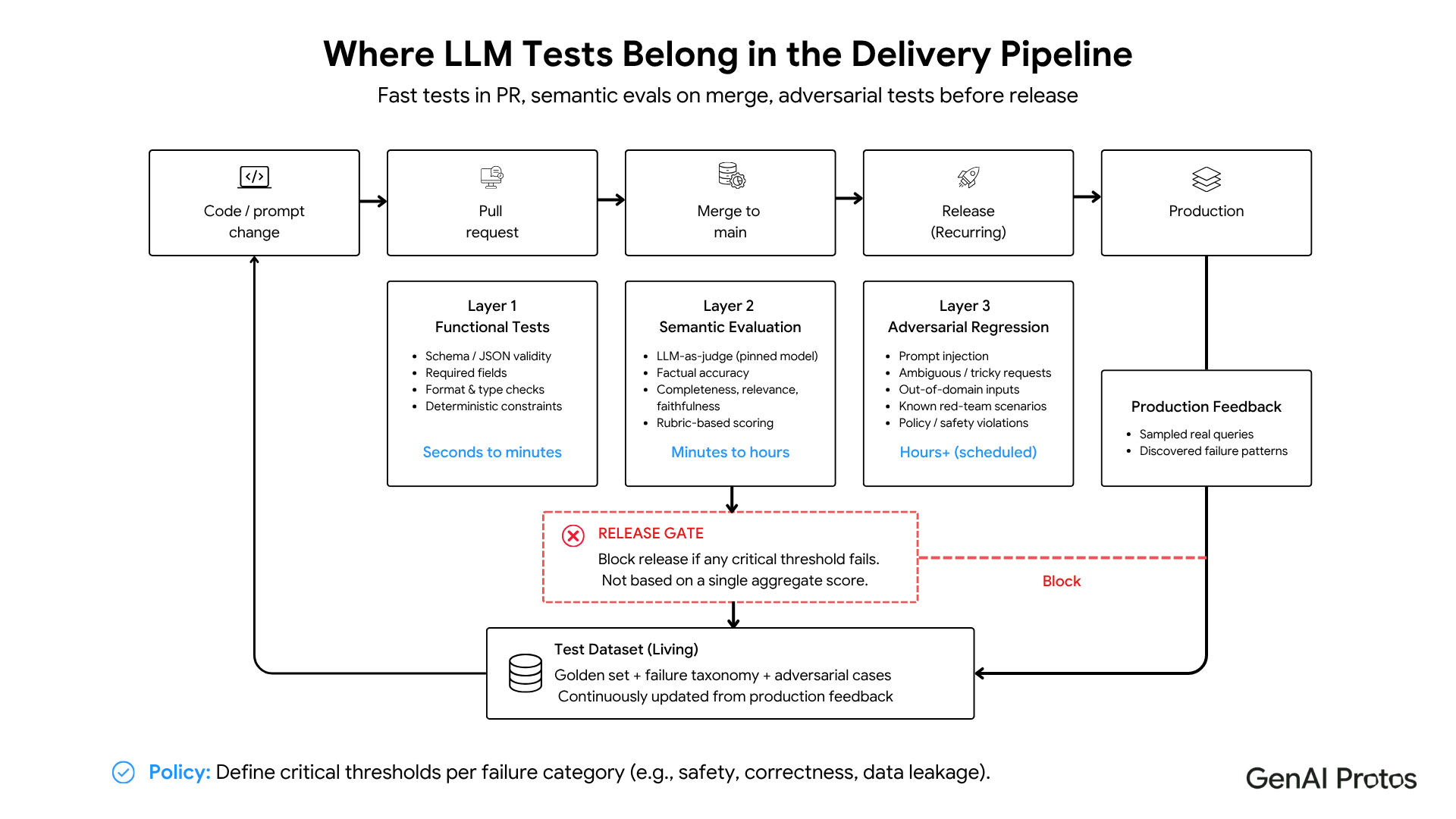
Test automation AI for LLMs belongs in the same CI/CD pipeline as code tests with one modification: separate fast tests from slow tests. Functional Layer 1 tests run in seconds. LLM-as-judge Layer 2 tests call an external API and add meaningful latency per test case. Do not block every pull request on a slow LLM eval suite.
A common structure: Layer 1 runs on every pull request, Layer 2 runs on merge to main, and Layer 3 runs on a scheduled interval tuned to the deployment's risk level. Adjust the structure based on how quickly you can detect and respond to a regression, and the cost of running each layer.
Use a fixed model for the LLM judge layer and pin the model version string. If the judge model updates silently, your eval scores become incomparable across runs. Pin the judge. Update it deliberately with documented rationale, not automatically. This versioning discipline is part of the broader enterprise AI model deployment practices that keep production LLM systems stable as models evolve.
Relevant evaluation guide: The RAG Evaluation Harness measures retrieval quality, answer faithfulness and regression risk for production RAG systems.
What Teams Get Wrong With AI Quality Assurance
Skipping the test designbefore the test writing. Insoftware testing AI, the failure taxonomy drives the test plan. The same applies to AI testing: define failure categories before writing examples. Most teams open a test file and start writing examples. The failure categories come later, derived from what was easy to think of. Start with failure mode analysis, then write tests that target each failure mode.
Using LLM-as-judge without calibration. An uncalibrated judge scores whatever the judge finds interesting, which may not be what you care about. Calibrate every judge against a representative set of human-labeled examples before using it as a quality gate. Review the agreement rate between judge and human labeler and adjust the rubric until agreement is sufficient for your use case.
Testing the demo, not the deployment. Demos use curated inputs and optimal prompts. Testing with demo inputs builds confidence in demo behavior, not production behavior. Use real production query logs for test case selection once the system is live.
Key Takeaways
- Traditional QA fails on LLMs because outputs are probabilistic, not deterministic.
- Cover failure categories, not just example inputs. Define a meaningful set of failure categories for your deployment and write multiple test cases per category.
- Run your test suite on a schedule, not just at deployment. LLM providers update silently.
- A three-layer stack works: functional tests, LLM-as-judge semantic evaluation, and adversarial red-team tests.
- Separate fast tests (pull request gate) from slow tests (merge gate) in the CI pipeline. Test automation AI frameworks handle this layered structure at production scale.
- Software testing AI adds probabilistic thinking to traditional QA: coverage by failure category replaces coverage by input volume.
Conclusion
LLM testing requires rubric-based evaluation, failure-category coverage and continuous regression checks rather than deterministic pass or fail assumptions. GenAI Protos builds testing stacks that connect model behaviour to CI pipelines, release decisions and production monitoring.


