
Building an agentic rag architecture means designing a system of coordinating agents not configuring a single retrieval step. Each agent requires its own input validation, output logging, and failure handling before the pipeline handles production queries. This blueprint covers the implementation decisions for each layer of the Four-Agent Retrieval Pipeline: Query Planning, Retrieval Routing, Validation, and Synthesis.
Teams that build the pipeline top-down wiring agents together before configuring each one produce systems that fail on the exact production queries they were built to answer. Per-agent configuration, instrumentation, and testing must happen before end-to-end integration.
This guide is for teams that have already decided to implement agentic RAG and need the implementation decisions at each agent layer not an explanation of what agentic RAG is or when to choose it.
The Four-Agent Retrieval Pipeline: Your Implementation Baseline
The Query Planning Agent is the pipeline entry point. It receives every incoming query, classifies retrieval intent, and decomposes complex queries into sub-queries. Configuration: intent classifier choice (lightweight vs. prompt-based), maximum sub-queries per request (recommended: 5), and fallback behavior when classification confidence is below threshold.
The Retrieval Routing Agent receives sub-queries from the Query Planner and dispatches each one to the appropriate index or data source. Configuration decisions: source selection logic (rules-based routing by intent label vs. embedding-based routing), the index registry that maps intent labels to retrieval targets, and the logging schema for chain-of-custody records. Every routing decision must be logged with the sub-query, the selected source, and the retrieval timestamp.
Single-pass retrieval on multi-hop queries produces partial context: chunks that are semantically similar to the surface question but do not contain the intermediate answers needed to resolve it. Agentic RAG architecture patterns for enterprise covers how the four-agent model addresses this structurally.
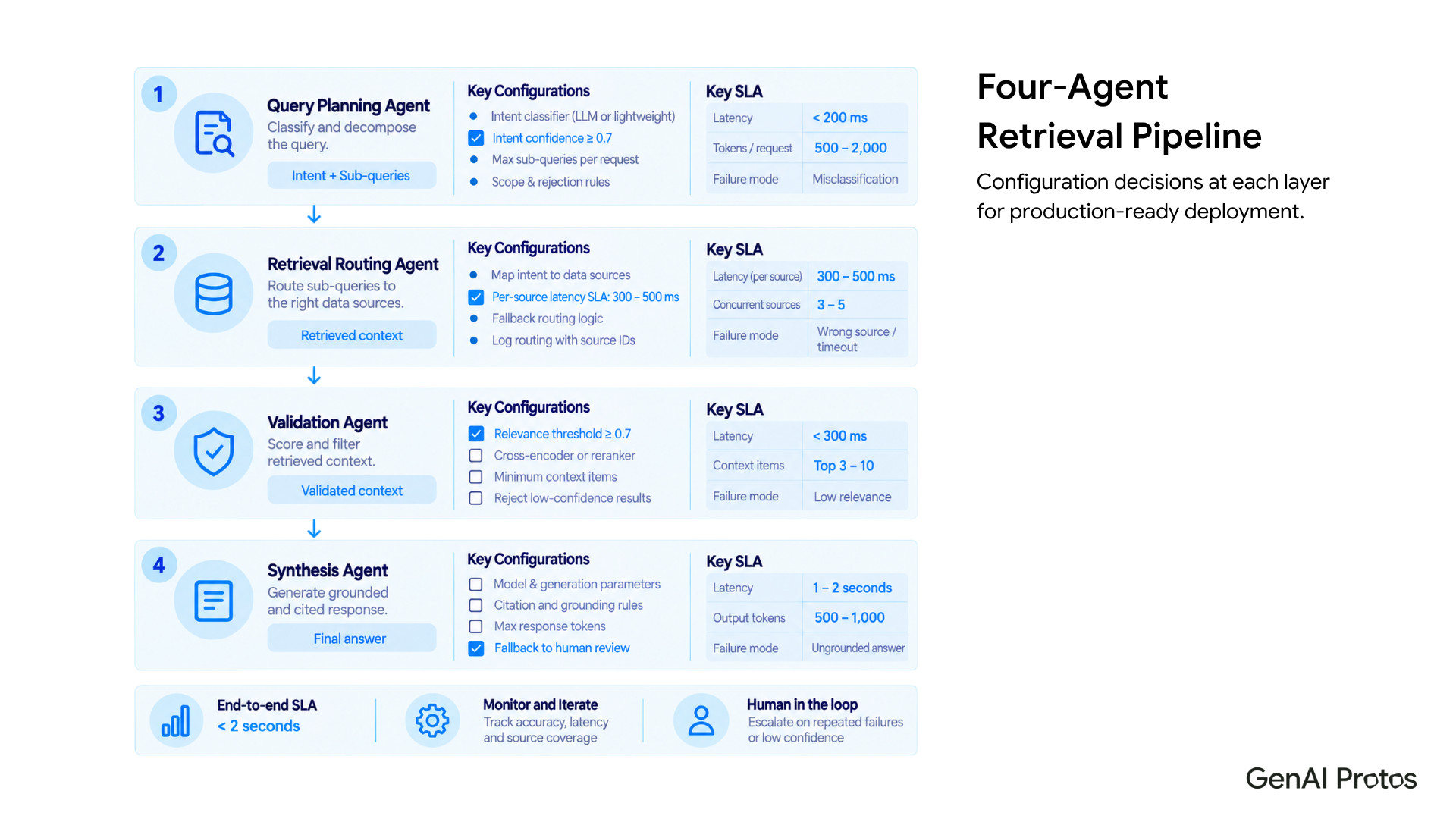
Query Planning and Retrieval Routing: Configuration Checklist
The Corrective RAG research (see Corrective RAG paper by Shi et al. 2024) established that a validation layer between retrieval and synthesis significantly reduces hallucination from low-confidence retrieval. The four-agent model extends this with a full retrieval orchestration pipeline.
Query Planning checklist: Set intent classifier to output structured labels. Define scope boundaries which query types the pipeline handles and which it rejects at entry. Log every decomposition with original query, sub-queries, and rejection decisions.
Retrieval Routing checklist: Map each intent label to a specific source in the registry. Define per-sub-query latency SLA before fallback triggers. Log source selected, retrieval latency, and source document identifiers.
The Validation Agent receives retrieved chunks and scores each one for relevance before any chunk enters the Synthesis Agent context window. Configuration decisions: the confidence threshold (start at 0.7, calibrate against your query-to-source ground truth before launch), the fallback strategy when no chunk clears the threshold (return a no-answer response, trigger a web search fallback, or escalate to a human review queue), and the scoring model (cross-encoder is more accurate than bi-encoder for this task).
The Synthesis Agent receives only the validated chunk set. Its output must map every claim to the specific source chunk that supports it. Implementation requirement: the Synthesis Agent prompt must include source attribution instructions, and the output schema must include a citations field. A Synthesis Agent that generates claims without source citations breaks the chain of custody the entire pipeline was built to create.
Each agent handoff must be logged as a discrete event: agent name, input received, decision made, output passed downstream, timestamp, and a session identifier that links all four events to the originating query. This log is the audit record for every query the pipeline processes.
Build Your Agentic RAG Pipeline with GenAI Protos
GenAI Protos has built NVIDIA-powered agentic RAG systems and enterprise knowledge agents in production. Book a technical design session to blueprint your multi-agent retrieval architecture. Book a RAG Design Session
Contact UsValidation Agent and Synthesis Agent: Configuration Checklist
Multi-agent retrieval adds orchestration overhead that single-pass RAG does not have. Advanced RAG design for enterprise retrieval applications covers the full retrieval design space. These are the production constraints that matter in each layer.
Validation checklist:
Document confidence threshold as explicit configuration. Calibrate against labeled known-relevant and known-irrelevant chunks. Log every chunk score and threshold decision.
Synthesis checklist:
Require source attribution in output schema. Include faithfulness check to measure whether each claim is grounded in a retrieved chunk. Log the validated chunk set and faithfulness score.
Instrumentation across all agents:
Each agent emits structured log events to a centralized, append-only store with: session ID, agent name, input/output hash, decision type, confidence score, and timestamp. Log asynchronously do not block query processing.
Performance budget:
Set a per-agent latency SLA before launch. Query Planning: under 200ms for most classifier configurations. Retrieval Routing: budget 300-500ms per source queried. Validation: under 300ms for corpus sizes under 10,000 chunks with a cross-encoder. Synthesis: model-dependent measure against your specific LLM. If the full pipeline exceeds your end-to-end SLA, profile each agent independently before tuning globally.
Multi-agent RAG architecture patterns for enterprise retrieval covers evaluation methodology for each pipeline layer.
Production Readiness: What to Test Before the First Live Query
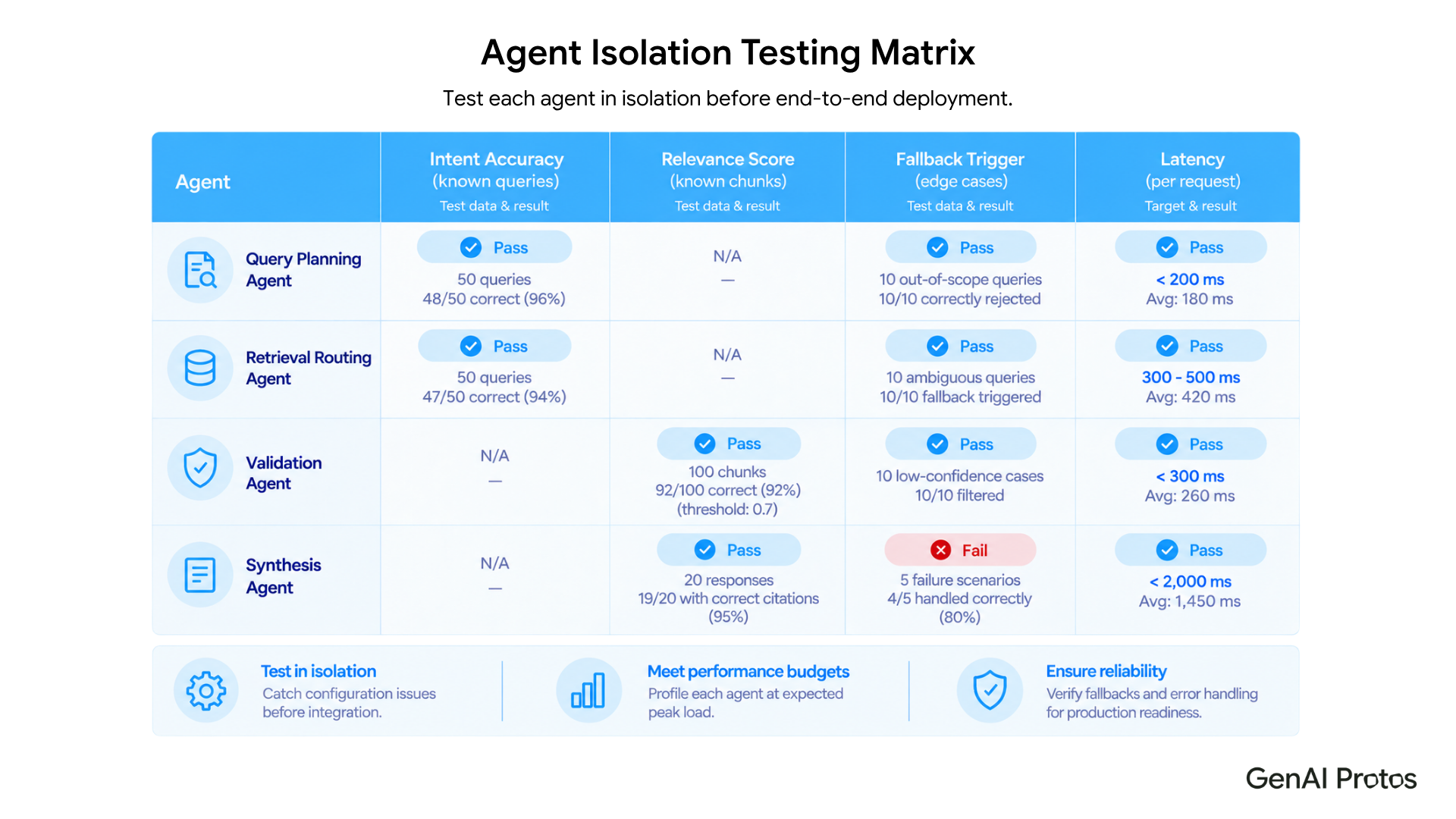
Test each agent in isolation before running the full pipeline. End-to-end integration tests catch wiring errors not configuration errors. Isolated agent tests catch configuration errors before they compound across handoffs.
Query Planning isolation test:
Feed the agent a set of 20 known complex queries. Verify sub-query decomposition produces the expected sub-queries and intent labels. Verify rejection logic blocks out-of-scope queries before they reach routing.
Retrieval Routing isolation test:
For each intent label in the registry, verify the correct source is selected. Submit a query with an ambiguous intent and verify the fallback behavior matches your specification.
Validation isolation test:
Run the scoring model against 50 known-relevant and 50 known-irrelevant chunks. Confirm the threshold separates the two sets correctly. Identify the threshold value that minimizes false negatives (correct chunks rejected) before accepting a threshold that minimizes false positives.
Synthesis isolation test:
Verify the output schema includes a citations field. Submit a query with a known validated chunk set and verify every output claim is traceable to a specific chunk in the citations. Run a faithfulness check on a sample of 20 outputs before launch.
Audit log completeness test:
For a sample of 50 end-to-end queries, trace each one from Query Planning input through Synthesis output. Verify the log contains every required field for every agent event. A missing log field discovered in a post-launch compliance review is a production incident.
Latency test under expected peak load:
Profile each agent at your expected peak query volume. Identify the bottleneck agent before adding horizontal scale. Scaling the wrong agent does not resolve the bottleneck.
Once all isolated agent tests pass and the end-to-end pipeline is verified under load, the agentic rag architecture is production-ready. Teams that skip isolated agent testing discover their configuration errors through user-reported failures not controlled testing.
Where Agentic RAG Implementations Break Down in Production
The most common failure is skipping per-agent logging. Teams build the pipeline and move to production without instrumentation. The first compliance review reveals the chain of custody does not exist.
The second failure is a static Validation Agent threshold. Calibrated once, the threshold becomes too permissive or too restrictive as the corpus grows. Treat it as a managed parameter with scheduled review cadence.
Third: co-locating all four agents on shared compute without profiling individual resource requirements. When the Validation Agent cross-encoder inference consumes 70% of the shared compute budget under peak load, the entire pipeline slows. Profile each agent resource consumption independently and allocate compute accordingly before launch.
Key Takeaways
- The Four-Agent Retrieval Pipeline Query Planning, Retrieval Routing, Validation, Synthesis gives each implementation decision a specific owner and a specific logging requirement.
- Configure each agent in isolation before testing the full pipeline. Isolated agent tests catch configuration errors before they compound across agent handoffs.
- The Validation Agent confidence threshold is a configuration parameter, not a constant. Calibrate it before launch against your actual corpus, and review it when the corpus changes by more than 20%.
- Per-agent logging is not optional. The audit record is the log. A pipeline without complete per-agent event logging cannot answer post-hoc questions about what the system did and why.
- Profile each agent resource consumption independently before launch. The bottleneck agent is rarely the one teams expect before they measure.
Conclusion
An agentic rag architecture delivers auditable retrieval when each of its four agents is correctly configured, instrumented, and tested. The configuration checklists and isolation tests in this guide are the decisions that must be verified before the first production query. Teams that work through them before launch avoid the most common agentic RAG production failures.


