
Your model is underperforming on a specific document type. You have 200 examples of it in your training set. You need 2,000. Collecting and annotating 1,800 more examples can take months and significant budget. Generating them synthetically can take weeks at a fraction of the cost. That is the synthetic data case that works.
Here is the one that does not work: your fraud detection model is underperforming because it has never seen certain fraud patterns. You generate synthetic examples of those patterns. The synthetic examples are realistic by statistical measures. The model trains on them, and its performance on real fraud detection decreases because the synthetic distribution differs from the real distribution in ways the generation model could not capture. The real-world distribution shift was not in the features you measured.
Synthetic data generation is a powerful tool for specific, well-defined training data problems. It is not a universal solution for data scarcity. This post is a decision guide: when the technique solves real problems, when it compounds them, and how to validate your dataset before it corrupts your model.
When Synthetic Data Generation Solves Real Training Data Problems
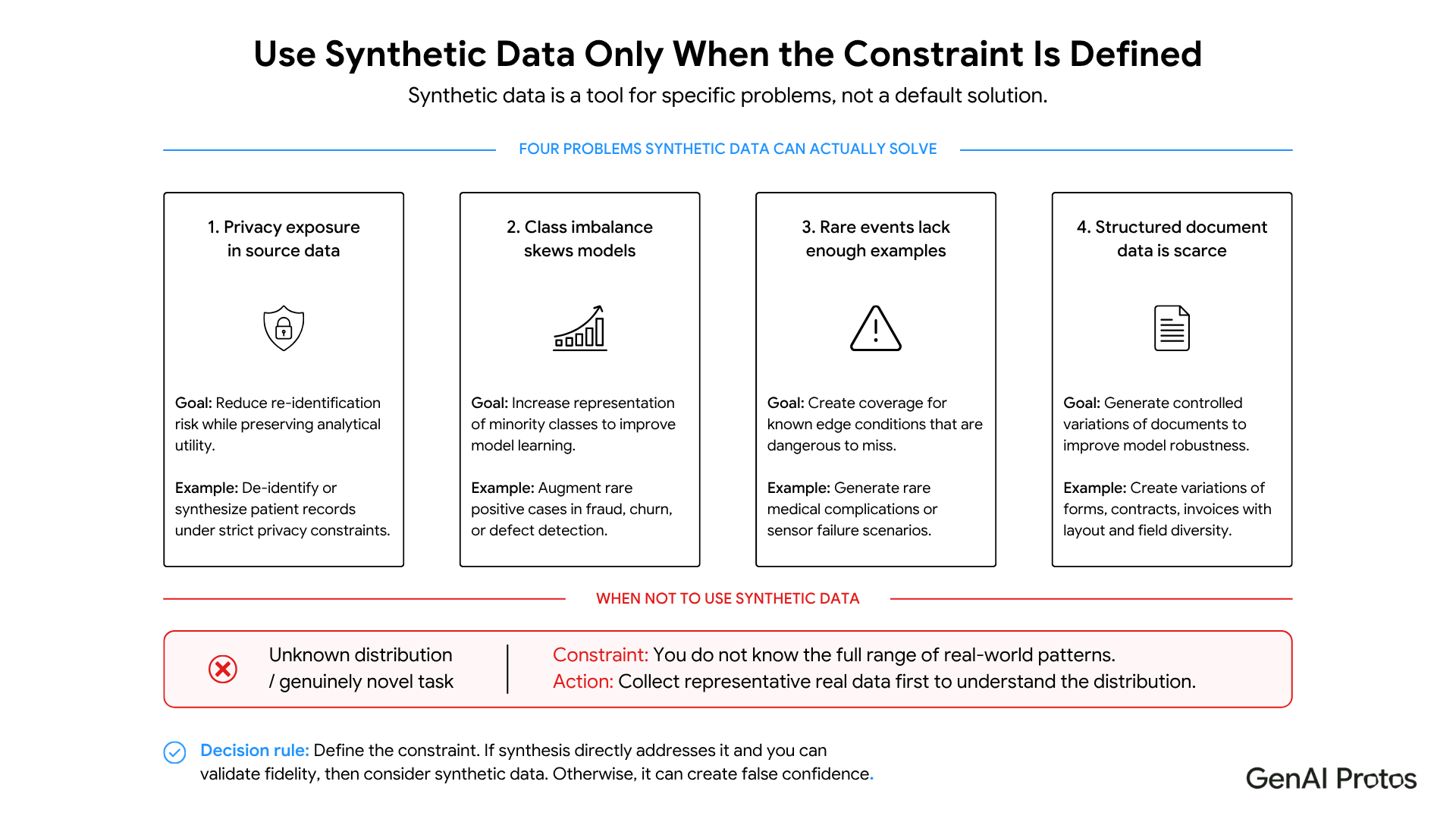
Use case 1: Privacy-risk-reducing dataset creation.
Your real training data contains personal health records, financial transactions, or PII that cannot be shared outside a secure environment. Synthetic data generation produces a dataset with substantially reduced exposure to real individuals' data. This is the highest-confidence use case because the goal is statistical similarity, not capturing unknown real-world patterns. Note: synthetic data generation reduces privacy risk but does not automatically provide formal privacy guarantees (NIST's guidance on this topic notes this distinction explicitly). A well-generated synthetic health dataset with proper privacy accounting significantly reduces compliance exposure for many purposes, but each dataset and use case must be evaluated against applicable regulatory requirements.
Use case 2: Class imbalance correction.
Your fraud dataset has 100,000 legitimate transactions and 500 fraud cases. The fraud class is underrepresented by 200:1. Generating 5,000 additional synthetic fraud examples with varied attack patterns corrects the class imbalance without requiring additional real fraud data. This works because you understand the fraud distribution well enough to generate realistic variants. Data augmentation of underrepresented classes with known structure is one of the most reliable applications of this technique.
Use case 3: Edge case and rare event coverage.
Certain failure modes, weather events, equipment states, or document types appear rarely in real data but matter critically for model performance. Generating synthetic examples of these rare cases expands training coverage into distribution regions your real data cannot reach. Autonomous vehicle datasets use this pattern extensively: synthetic rare events (pedestrian at night in rain, debris on road) are generated in simulation to cover scenarios that rarely appear in driving footage.
Use case 4: Data augmentation for structured documents.
Your contract review model underperforms on non-disclosure agreements with jurisdiction-specific clauses. You have 50 NDA examples but need 500. Generating 450 synthetic NDAs with varied clause structures, jurisdiction references, and formatting using an LLM covers the structural variation you need. This works because NDAs follow known legal conventions. The generation process captures the document structure well.
The generation strategy GenAI Protos implements handles all four use cases: privacy-preserving dataset synthesis, class imbalance correction, rare event generation, and document augmentation.
Explore our data engineering service: AI Data Engineering Services helps teams prepare, govern and validate pipelines for synthetic-data programmes.
When This Approach Makes Training Problems Worse
It fails when the underlying distribution is unknown.
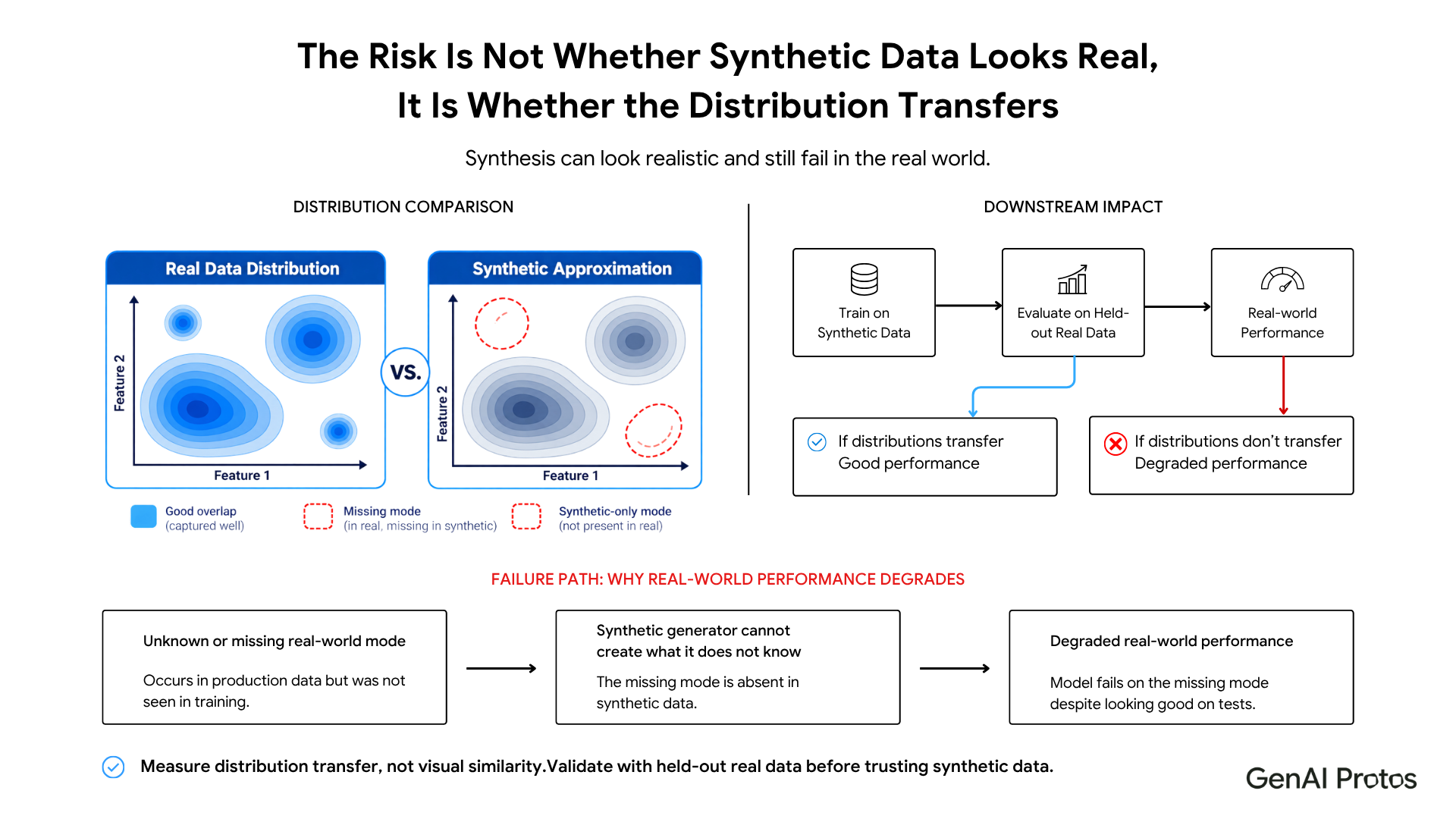
If you do not know what real examples of a class look like at a statistical level, you cannot generate realistic synthetic examples. The generated data reflects your generator's assumptions, not reality. Models trained on this data learn to recognize your assumptions, not the real pattern. Fraud pattern generation fails this way when new fraud techniques emerge that differ structurally from historical patterns.
It fails when the synthetic-real distribution gap is large.
The generation models used (GANs, VAEs, LLM-based generators) approximate the real distribution. If the real distribution is complex, multimodal, or depends on features the generator cannot access, the approximation is poor. Data synthesized from a poor approximation teaches the model the wrong distribution. This is worse than having less data: it actively degrades model performance on real inputs.
It fails when used as a substitute for data collection on novel problems.
Generated data can augment existing real data. It cannot bootstrap a model with no real examples of a genuinely novel task. A model fine-tuned entirely on generated examples for a task where no real data exists is a model trained on your assumptions about the task, not the task itself. Validate against representative real examples before relying on a synthetically fine-tuned model - the number needed depends on the task's complexity and risk level.
It fails when privacy synthetic datasets are not validated for re-identification risk.
A synthetic dataset generated with a simple approach (replacing names with random names, for example) provides insufficient privacy protection. Re-identification attacks that combine synthetic records with public information can link synthetic records back to real individuals. Meaningful privacy risk reduction requires formal privacy accounting such as differential privacy guarantees, not surface-level anonymization.
The Validation Framework
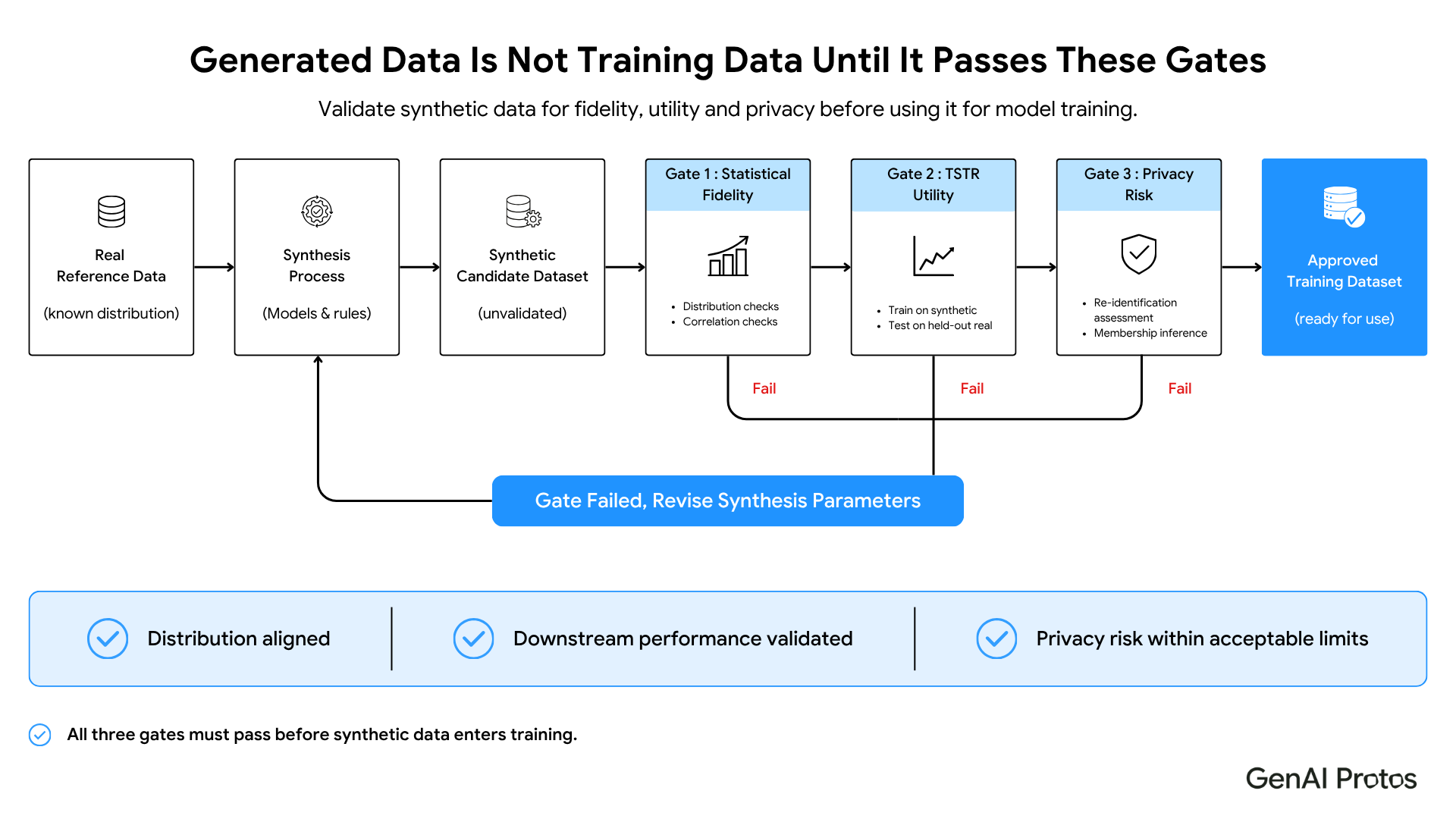
Before generated training data enters your model pipeline, it must pass three validation checks.
Check 1: Statistical fidelity.
Measure whether the synthetic dataset preserves the statistical properties of the real dataset. Column-level: distributions of continuous features, cardinality of categorical features, null rates. Joint-level: correlations between feature pairs. Check fidelity with Kolmogorov-Smirnov tests on continuous features and chi-squared tests on categorical features. KS statistics provide a useful starting indicator; appropriate acceptance thresholds depend on the data complexity, the downstream model's sensitivity, and the intended use of the synthetic dataset.
Check 2: Train-on-synthetic, test-on-real (TSTR).
Train a classifier on the synthetic dataset. Test it on real data. Compare performance to a model trained on real data of equivalent size. If the TSTR model performs within an acceptable margin of the real-data baseline, the generated dataset preserves enough information to be useful for training. What constitutes an acceptable margin depends on the task stakes: a 10% performance gap may be acceptable for low-risk augmentation and unacceptable for safety-critical models. If performance degrades materially, the synthetic distribution is likely too far from real to be useful.
Check 3: Re-identification risk (for privacy use cases).
Run a membership inference attack on the generated dataset: can a model trained on the synthetic data predict whether a given real record was in the original training set? If the attack success rate is meaningfully above random chance, the synthetic dataset may provide insufficient privacy protection for sensitive use cases. The appropriate threshold depends on the specific privacy risk model, the sensitivity of the data and the applicable regulatory context. GenAI Protos' AI Data Engineering Services team implements these validation checks as part of every enterprise AI data validation pipeline.
Relevant solution: The Synthetic Data Generation Strategy shows how GenAI Protos balances utility, coverage and privacy-risk testing.
Data Augmentation vs Full Generation
These are different tools for different problems. Data augmentation applies transformations to existing real data to produce more training examples: image rotation and cropping, text paraphrasing, noise injection into time series. Augmentation preserves the real distribution's core structure and adds variation within known bounds. It is lower risk and should be tried before full synthetic generation. The GenAI Protos guide to structured vs unstructured data in AI explains how each data type affects which augmentation strategy is appropriate.
Full generation produces entirely new records without starting from real examples. It is appropriate when real data is unavailable due to privacy constraints or genuine scarcity. It carries higher risk of distribution mismatch and requires the validation framework above.
LLM fine-tuning on generated data follows the same validation logic: the synthetic instruction-response pairs must be validated against real user queries before they replace or augment real fine-tuning data.
Key Takeaways
- Works for: privacy-risk-reducing dataset creation, class imbalance correction, rare event coverage, and structured document augmentation.
- The technique fails when the underlying distribution is unknown, when the synthetic-real gap is large, or when used as a full substitute for real data on novel tasks.
- A synthetic dataset should be evaluated for statistical fidelity, downstream utility, subgroup behaviour and privacy leakage using thresholds defined for the specific deployment.
- Data augmentation of real data is lower risk than full synthetic generation. Try augmentation first.
- TSTR performance close to the real-data baseline is the quality signal. What is acceptable depends on the task stakes and risk tolerance.
Conclusion
Synthetic data is effective only when it addresses a defined scarcity, imbalance or privacy constraint and passes utility and leakage testing. GenAI Protos combines data engineering, generation methods and validation controls to build synthetic datasets that remain useful for the intended model task.

